Showing posts with label matrix. Show all posts

Monday, August 14, 2017

Materiality: from meaningless to differentiating

Pretty much anything that's important these days is material. High material, medium material, low material... material for the business, material for stakeholders.. materiality assessments, materiality analyses, materiality matrices. We can't get enough of materiality. In fact, materiality has become so commonplace that it's almost materially meaningless. Since the coming-of-age of materiality via G4 in 2013, and the subsequent move to GRI Standards published in 2016, you are not on the map if your map is not material. While companies publish a list of material issues, at whatever level of granularity they (arbitrarily) choose, by and large, in many, many cases, the list does not really influence sustainability strategy, stakeholder relationships or sustainability reporting. It's often a list of broad-brush, carefully-massaged any-company issues that can be universally relevant. So what's the point of conducting a materiality assessment, if all you are going to come up with is what everybody already knows?

We love it when we have a nice matrix. If it's on a matrix, it must be right, right? The matrix surely indicates that companies have embraced materiality and that give us great comfort. The matrix must be a result of something, the company must have done the work, they must have truly understood what's important in terms of their impacts on society. Yes, materiality matrices inspire the warm fuzzies about a company and its reporting. If there's a matrix, all is well with the world.

So who are we kidding? I am reminded of Woodie Allen's well-known observation that "80% of success is showing up", and this certainly appears to be the driving motivator for many materiality matrices. The remaining 20% is the differentiator. A materiality matrix without this 20% is like an iPhone without IOS.

80% of the outcome of any materiality process is a known given before the process even starts. This is why:
  • There are topics that are universally relevant - climate change, energy consumption, employee rights, anti-corruption - this is just a selection of issues that are relevant for any company anywhere. 
  • There are topics that are business or sector-relevant - if you have an extended supply chain with tons of outsourced suppliers, ethical supply chain will always be material for you. 
  • The markets speak to you - a company, in the natural course of business maintains interactions with the market that make it clear what the markets wants and where the market is dis/pleased with performance. Just ask Abercrombie and Fitch.
  • The watchdogs woof at you - Check out Oxfam and its Behind the Brands ranking, or Know the Chain's food company rankings, or any of the ranking and rating analyst companies - they woof their message and any company on their radar cannot fail to hear.    

So, 80% of the issues are predictably material and do not need extensive analysis paralysis to determine. Engaging stakeholders then becomes an exercise that helps determine the remaining 20%, or fine-tune the prioritization. That is, of course, if you actually engage... and if you engage with stakeholders that are relevant. Not all stakeholders are created equal and not all should be represented with equal voice. Sending out a survey may sound like fun, and 500 responses may sound robust, but if the 500 voices are a random mix, and if the survey is the only tool you use, then it's quite possible that your outcome will not reflect a differentiating set of issues for your company.


GRI Standards, the most widely used sustainability reporting framework, has in part been responsible for creating this  double-edged sword. On the one hand, the notion that companies should focus on what's most important/impactful (material) makes absolute sense. On the other hand,  what's the point in going through a whole process to articulate the obvious? Maya Angelou is quoted as saying: "Ask for what you want and be prepared to get it." (This works well for me at the ice cream store). GRI asked for a list of material priorities - and that's exactly what GRI is getting in GRI Standards-based reports (and G4 reports before them). But is that really what GRI wanted? A generic list of material topics that are relevant to any company? While GRI Standards also ask for disclosures about stakeholders engaged and topics raised by them, responses by companies to this disclosure are often template-ish and not necessarily correlating to the final list of material topics presented.

Let's recap - my assertion is this:
  • Materiality is the crux of sustainability strategy and relevant reporting.
  • Material sustainability issues are 80% predetermined and 20% differential
  • The material differentiators are business or sector specific.
  • Most companies take a blanket approach to materiality - everything goes in the mix and every stakeholder has equal voice. What comes out the other end is a blanket list of material topics that could apply to most companies.
  • The process of determining material impacts lacks specificity and robust structure. 
So this is what I am thinking:

There should be a harmonized standard baseline of disclosures that are relevant to all companies -  some will be more critical than others for different companies - but they are relevant - and material - for all. I call this Operational Materiality.

Then we should have materiality that is precise enough to differentiate - focusing on the specific aspects of a company's impacts that are a directly relevant to its business, the locations it operates in and the influence it has on society.  Let's call that Precision Materiality.

I recently came across a framework which shows how this Operational Materiality part might work. It was via an interesting interview on Forbes by Christopher P Skroupa of Evan Harvey, the Global Head of Sustainability for Nasdaq. Evan Harvey explains: "Nasdaq published an ESG Reporting Guide for our European markets in March, 2017. The Guide is meant to provide an overview of the “business case” for sustainability strategy, management and performance disclosure. We identify 33 different metrics across the ESG space — the common denominators in global reporting frameworks, the most revealing and insightful measurements of company vitality — and make the justification for each. Reaction has been almost uniformly positive, and many investors have thanked us for helping to declutter a crowded data landscape." I looked at this guide, which I hadn't seen before.

The guide is primarily written to help companies traded on Nasdaq provide the information that investor markets need. The guide presents a set of 33 "Operational Materiality" metrics that all companies should report.

 For each metric, there is an explanation, following the format;
  • What does it measure? 
  • How is it measured? 
  • Why should it be reported? 
  • How does this metric correlate with other major sustainability frameworks? 
  • Research Notes


Now, the great thing about this guide is that is does not replicate the detail provided by other leading frameworks. It leaves the detailed metrics definition to the expert standards developers such as GRI and leaves the choice of which framework to use to the reporting companies. BUT, it elevates the most universally relevant metrics for all publicly-traded companies (and why would this not apply also to privately owned companies?) into a clear, well-worded and well-explained document that any corporate exec can understand, not just the ones with a post-doctorate in sustainable development. No jargon. Just plain, clear, straightforward language. This is a good start-point for what I call Operational Materiality.

(The Singapore Stock Exchange (SGX) also hints at this approach. While it does not strictly prescribe reporting topics, but rather adherence to a known framework, it does include guidance as follows: "In broad terms, environmental factors would include materials, energy, water, emissions, effluents and waste as well as environmental complaint mechanisms. Social factors would include health and safety, employment practices and labour rights such as collective bargaining, as well as product responsibility, anti-corruption and supplier assessments. The framework chosen is likely to have additional factors that the issuer would report on." 

If we accept that the Nasdaq selected indicators together form a sensible "common denominator", then companies are freed up to focus their materiality discussions on their "precision" topics. Precision topics go beyond the common denominator baseline to the real difference the company makes in our society. Such a process would be efficient. By doing precision, engagement becomes targeted on a smaller number of issues at a deeper level. An example might be a pharma company referencing access to medicine, or a casino company referencing responsible gaming or a food company referencing nutrition or an Indian bank discussing local access to finance. Instead of debating whether water is more of a priority than energy or otherwise,  you get to spend your time reviewing topics that have a differentiating impact, and you target stakeholders to engage with specifically on these topics, such as subject-matter experts, local communities, watchdogs etc. What we need is a process for determining Precision Materiality. 

Let's do the litmus test. I randomly picked a few reports that use GRI Standards (selected using the GRI Sustainability Disclosure Database).  


CapitaLand 2016 Global Sustainability Report: The "critical" material topics could easily be part of a common denominator of Operational Materiality. "Stakeholder engagement" has not been defined by GRI as an impact - it is a principle and process - but there's no rule to say that it couldn't be material, if the process of engaging stakeholders actually delivers an impact in society as well as being necessary to understand stakeholder perspectives. This could be precision. In the moderate and emerging section, building materials and construction waste are hints of business specific areas and could be precisionally material.


Fauji Fertilizer Company Corporate Sustainability Report 2016: Top-right quadrant topics listed are all Operational Materiality with the exception of Farmer Advisory which is definitely business-specific for agri companies. The other quadrants of the matrix are also fairly Operational. I might have expected to see something related to sustainable agriculture or groundwater contamination as material for a company in the fertilizer industry.


Hershey 2016 Corporate Responsibility Report: Wow. So many issues plotted in such detail. How long did THAT take? The red blobs indicate the most material priorities. "Product Ingredients and Transparency" is a clear precision topic for the food business, as are "Consumer Wellness", and "Food Safety". "Global competitiveness" is matched by Hershey to GRI Standard Anti-Competitive Behavior and is therefore operational not precision. "Supply Chain Sourcing" is also highly relevant to a food company - which includes, according to Hershey, "topics related to supplier management, supply chain transparency, sustainable and ethical sourcing, and practices to ensure supply chain continuity. This issue also includes our agricultural sourcing practices and support for farmers."  So, in a precision matrix, where all the operational priorities are removed, Supply Chain Sourcing could probably become two or even three precision issues - Sustainable Raw Materials, Agricultural Practices and Supplier Management. Hershey's report covers these topics in detail.

Target 2016 Corporate Responsibility Report:  Operational topics in the main, though "Better Products" and "Better Services and Experiences" are precision topics expressed in a not-very precise way. What does "better" mean? And does this refer to all products? All services? All experiences? "Resilient and Vibrant Communities" could also be precision, if it's more specific than general community contribution and employee volunteering. "Forest" is an interesting one - Target has a new Forest Products Policy - this could well be precisionally material as well. So, if you strip off the Operational Materiality from this list, you are left with a much shorter, focused, precise list that differentiates Target and its business. Together with  operational disclosures, that would make for a clearer focus and strong presentation of materiality and reporting. 

Wacker 2015/2016 Sustainability Report: There are 32 dots on this matrix (3 fewer than the Hershey matrix). Compliance, Product Safety and Plant Safety stand out as being the most significant topics. Compliance doesn't feature in the Nasdaq 33 metrics explicitly, and probably that's an omission. Every company must be compliant, that's a basic prerequisite for all sustainability initiatives and performance. However, stakeholders can benefit from understanding processes the company uses to ensure compliance, train its people and the outcomes of compliance (or non-compliance). I would call this Operational Materiality and include it as metric number 34. Plant Safety is operational. Product Safety is precision -  in this case, it relates to chemical products where safety may be critical. As for the rest, there is not much that's not operational.

So, in this very brief review, we can see that just a fraction of the material issues are truly material in a very specific sense. Most of the issues labeled "material" are direct impact accountability as defined by 33 metrics - or a few more if required. Why spend so much time debating things that we all know to be a given? How many more hours will we waste moving dots around on a matrix? Yes, I hear you saying that some companies may not have as big an impact on energy, water, waste or other areas and therefore these issues are not universally material. I disagree. I think every company of a certain size must have accountability for its resource consumption, for its people management and for its governance practices and should report performance. Where companies have a greater impact in these areas, their disclosure can be more extensive.

I think there is an opportunity to simplify and harmonize sustainability disclosures in this way and use a standard set of fundamental, universally relevant operational disclosures to form the basis of sustainability reporting. The Nasdaq guide is based on recommendations from the World Federation of Exchanges (WFE) so we know this would resonate with an investor audience and be a good core for inclusion in integrated reporting. Beyond this, Precision Materiality would enable us to understand the company specific impacts, the area where added value is generated and/or where specific risks are managed.

In considering the next evolution of GRI Standards, in particular the Core / Comprehensive options, which are not terribly helpful, GRI might consider encouraging reporters to report all Operational Material Metrics (with policies, goals and targets etc in line with current GRI standards) as the GRI Standards Baseline Material Reporting Option. Each company would report on all of these metrics, using the relevant individual GRI Standards and the General Disclosures (GRI 102) to frame their reporting as now. In addition, companies would select additional business/company/sector specific topics using input from internal and external expert stakeholders, to disclose on precision material issues as the GRI Standards Advanced Material Reporting Option. In this way, companies won't be able to hide behind a materiality matrix filled with things that are relevant to everybody, but will need to elevate their focus to the things that are relevant to them and their specific stakeholders.

Phew. That turned out to be rather a long ramble that I hadn't intended. I haven't mentioned things like impact assessments and outcomes reporting - or even all those capitals that it's so sexy to talk about these days -  more on these on another sunny day - it's all relevant to materiality. But in the meantime, this could be a way of demystifying of black-box materiality to satisfy multiple stakeholders. Wondering if anyone thinks it's too much and I need a vacation? (preferably one where there is lots of ice cream)


elaine cohen, CSR Consultant, Sustainability Reporter, former HR Professional, Trust Across America 2017 Lifetime Achievement Award honoree, Ice Cream Addict, Author of Understanding G4: the Concise Guide to Next Generation Sustainability Reporting  AND  Sustainability Reporting for SMEs: Competitive Advantage Through Transparency AND CSR for HR: A necessary partnership for advancing responsible business practices . Contact me via Twitter (@elainecohen)  or via my business website www.b-yond.biz  (Beyond Business Ltd, an inspired CSR consulting and Sustainability Reporting firm).  Need help writing your first / next Sustainability Report? Contact elaine: info@b-yond.biz 


Sunday, December 28, 2014

Why the materiality matrix is useless

2015 is a new year - Happy New Year to everyone! And as we close out 2014, I thought it would be a good time to shake things up a little and get just a touch provocative. (Totally out of character, haha). See, I have begun to be really irritated by useless materiality matrices.  I am looking forward to a year in 2015 where materiality drives strategy and reporting in a profound way, and where we stop playing around with dots on a matrix just because that's what seems to be the de rigeur of sustainability reporting.

One of the things that is going to have to get a whole lot better if companies are really going to gain best value from a strategic sustainability approach is the way materiality is considered, analyzed, developed and communicated, as well as, more importantly, used as a basis to drive action. In many cases, it's near impossible to relate what are stated as material issues to the way the company approaches its sustainability activities. The more G4 reports I read, the more materiality matrices I look at,  the more I come to the conclusion that, by and large, many companies are just missing the point

This is probably not entirely intentional. Maybe many companies actually think they are doing a good job of defining materiality. Spending time plotting little dots on a matrix and moving them up or down a millimeter may actually be someone's idea of meaningful strategic planning. Maybe people think that's how it's supposed to be done. Maybe companies look at their materiality matrices and give themselves a big slap on the back. 

But actually, it's not being done well. It's not hitting the right spots. It's not generating the leverage that is needed. Materiality, so far, as a concept, is not proving itself. It's a nice buzz word, makes everyone feel good, sound intelligent and provides creative license to draw pleasant graphs, charts and multicolor, even interactive, visuals, but it's not doing what it intended to do. This is clear from the disconnect we are still finding in sustainability reports between what's supposedly material (because the matrix says so) and what companies are actually doing (based on what's reported). 

The basis for my comments is my personal review of many of the 500+ GRI G4-based sustainability reports that have been published to date. I am referring to G4, because G4 places material impacts squarely at the center of the reporting approach. Not because it's right for reporting. Because it's right for business. This is how GRI G4 defines materiality: 


In G4 reporting, companies are required to list material aspects and provide disclosures that show how  an organization "identifies, analyzes, and responds to its actual and potential material economic, environmental and social impacts". Performance indicators supporting  material aspects are designed to reflect how a company measures its performance in relation to those stated material impacts. While I know that the G4 framework is not always 100% logical, and there is, in many cases, a rather unfathomable connection between certain material Aspects in the framework and the Performance Indicators that are designed to reflect those Aspects, the underlying issue is whether companies are approaching materiality in a meaningful way. (Perhaps someone might even be able to explain to me why G4 chose the very odd word Aspects and did not use the very clear word Impacts when making materiality the G4 engine driver). The metrics, or indicators, can be adapted or developed to meet the need. The material impacts should first drive what a company does or should do, and therefore measures, and therefore reports. Creating a materiality matrix after you have done everything else is not exactly going about things in the right way.

Let's think about what materiality really means in a sustainability context. It means the material impacts IMPACTS IMPACTS on stakeholders. 

These are things that material impacts are NOT (or not only):
  • what's going to help us make more profit
  • what our stakeholders mention in passing
  • how we perform
  • what we think is politically correct
  • what everybody else is saying
  • what's easiest to report
  • what shows us up best
  • what's in fashion
  • what the  lawyers tell us to say
  • what we've always said
  • what the assurers can count
  • things we have data for
  • an afterthought
  • an easy option
  • a buzz word
  • a box to tick
  • lip-service
  • a way to appear as though we wrote a G4 Sustainability Report

Material impacts are: 
  • the way our business activities affect the lives of our stakeholders and our long-term business viability
  • the basis for creating a sustainable business strategy with relevant targets
  • defined as the result of an analytical process that engages internal and external stakeholders about what affects them and how
  • the basis for creating sustainability communications including reporting
  • specific to a business, a sector, a geography, an issue
  • a catalyst for planning and action
  • connected to a business's core social mission
A few examples? Sure. Wizness recently published a free download benchmark of 50 materiality matrices across 5 industry sectors. Almost all of them have loads of little dots carefully plotted on creatively designed squares, blocks and circles. Some of them have so many dots you begin to wonder how on earth the company even recognizes the dots, let alone creates a strategy to manage them. Whoever is selling dots is making a killing. And the relativity between the dots is often just incomprehensible. Here are some examples from the ones presented by Wizness:

You may be able to see, just about, that this company has loads and loads of dots, with the top 16 prioritized as the most material issues/impacts, supported by a detailed stakeholder matrix of what affects whom. The top 9 issues all have the same degree of importance to stakeholders, yet they are all at different coordinates on the matrix. Compliance with laws and regulations is only mediumly important to the business and to stakeholders while compliance with laws concerning products and services hits the top right box in the matrix. I wonder how these nine issues were plotted. What makes anti-corruption so much more important than anti-competitive behavior? The report gives no clue to how these issues were placed in the matrix. Their placement suggests that they are not equally most material and that some are more most material than others. What does this differentiation actually mean? To me, it suggests that there is a focus on moving dots around a matrix and not on the underlying drivers of sustainability performance. Notwithstanding the fact that the very act of defining a set of material priorities is an important part of the process and should be encouraged.  

Here is another example:

Pan American Silver Sustainability Report 2013


Wow. The entire 46 G4 material Aspects and Sector Disclosure Aspects all carefully ticked or unticked and slotted into place on a matrix that it took me half an hour to work out what's where. I wonder how long the plotting exercise took and how the little letters on the matrix were locked into position. The color coding of the different categories makes it almost impossible to tell without detailed study what is actually most material for this company. It looks to me like the top three - turquoise "a" is "local communities" as the top issue,  purple "c" is "occupational health and safety" one of the two runners-up and blue "d" looks like child labor as the second runner up. Why are these issues more important, than, say, anti-corruption, which appears much lower on the list, or labor relations which is not material at all?

In Pan Silver's report, there is a large section devoted to the most material Aspect, local communities. It's about how Pan Silver, while doing its core business, is engaged with local community projects to support economic and social development. A really fine array of projects that I am sure are highly commendable and make a genuine difference to local quality of life. But why is engaging with local community development projects the most material impact of this company? What about the impacts generated through the company's core business? What about materials use and ecological limits? Pan Silver produced 26 million ounces of silver and 150 thousand ounces of gold in 2013. What about water use in the mining sector? Total water withdrawn for Pan Silver in 2013 was more than 42 million cubic meters, that's about 15,000 Olympic swimming pools. Not to mention water discharge with potential toxic chemicals. Pan Silver has addressed these issues in the report, but what makes them less important local community projects? Does the materiality matrix indicate priority in allocation of the company's resources required to address material impacts, suggesting that a higher priority received more attention, more resources, more commitment? What I would really like to know from Pan Silver is its most significant impacts on stakeholders. The top 5 or 10. I don't really care where they are on a matrix. I don't really care about the tenth of a millimeter of space between the little letters. Does anyone? I don't even believe it is possible to differentiate between the most important material impacts at this level of detail. I am sure the process of thinking about what is most important should have been beneficial. I suspect that the part where the dots on the matrix slotted into place is simply a total waste of time.  

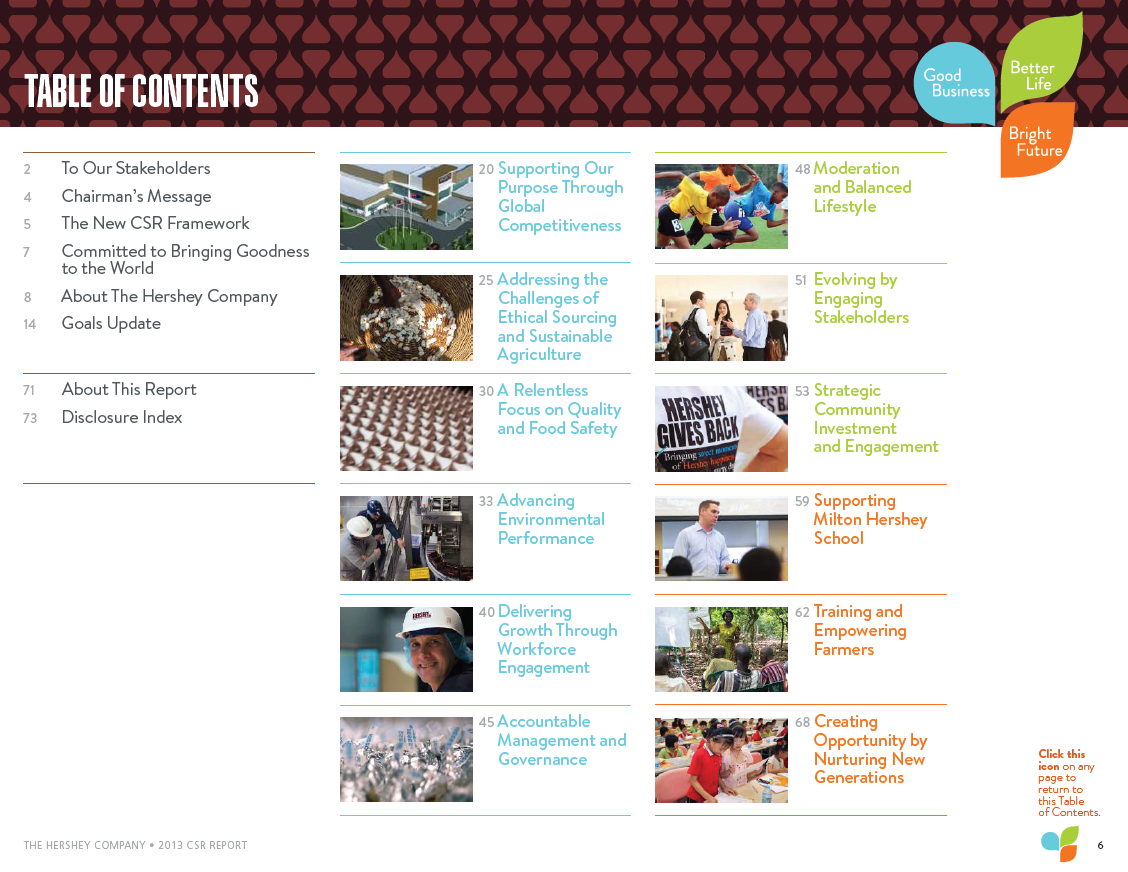
And here is another example from The Hershey Company 2013 CSR Report.


Hershey's has defined the priority issues and they are all dealt with well in the company's CSR report. It's great that out of a total of 25 issues, Hershey has selected ten that represent the most important impacts. However, what makes food safety so much less important than ethical sourcing? Why is child labor so much more important than GHG emissions? Why is ethics more important than governance? And if philanthropy is so low on the matrix, both for stakeholders and for the company, then what's it even doing on the matrix? Isn't that just a waste of energy, deciding where to put the philanthropy dot? And if the currency is dots, is philanthropy the only dot that is loooooooow priority? I could think of a whole load of additional issues that might have come up in a materiality discussion that are not on this matrix. The point is, selection of the top ten prioirities is great. Using these materiality priorities to define strategy is fantastic, and structuring your reporting around these material priorities is brilliant. Hershey does this fairly well.


But taking that to the point of plotting dots on a useless matrix is what I don't understand. Especially if no-one explains why these dots are where they are.

The GRI G4 guidelines does not require the presentation of material Aspects in a matrix. The reporting disclosure is:
The G4 guidance for determining what is material makes reference to defining thresholds for materiality and defining and documenting how the thresholds have been defined. The guidance also offers a matrix for presentation of material issues. But this is guidance... it's not a G4 requirement. In general, the companies that present materiality matrices define why issues are material but they do not make reference to the relative material priority of each dot on the matrix. So why bother with a matrix. Why not simply do what is asked: give a list.

Materiality and its importance were recently addressed by think-tank advisory firm SustainAbility


SustainAbility published an excellent paper on transparency and its use as a driver for improved performance. SustainAbility says: "Most companies are not gaining the value commensurate with the resources spent on reporting." This is a proposition that I wholly agree with, for many reasons. (Haha - you can see that from my red text). SustainAbility's response to this is to use materiality to drive the rest. 


The SustainAbility paper provides two examples of materiality presented in reports: PG&E and Fibria. 

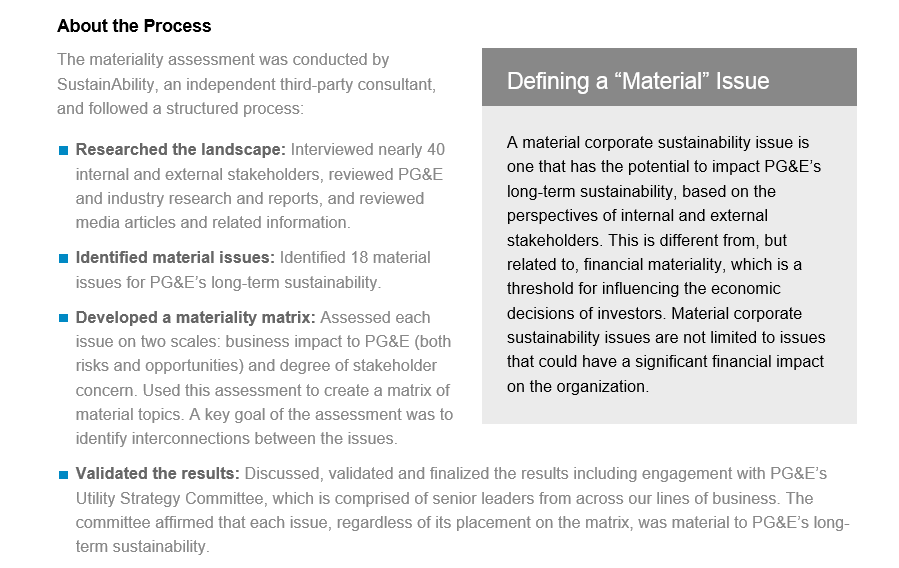
The PG&E Sustainability Report for 2013 presents a materiality matrix in a pretty familiar way - using dots. (SustainAbility helped PG&E create this matrix.) It has an element not usually found in materiality matrices: the addition of arrows showing the interrelation of issues. The online presentation of the matrix is interactive - when you click on an issue, it turns blue and a number of little orange dots show up connecting things to the blue dot, as in the version shown below. No connection between Public Safety and Employee Engagement, for example. Seems rather odd to me. However, SustainAbility writes in their report that highlighting interconnectivity between issues "provided insight into how PG&E might approach issues in a more integrated way." Intuitively, that sounds sensible to me. Although, if I were to be truly provocative, I would say that pretty much everything is connected to pretty much everything.   


In the PG&E matrix, however, we again we have a nicely arranged set of dots. It is not clear, based on the description of the process, what criteria were used to actually decide where each dot should be carefully placed. On what basis do you assess the scale of business impact? Is this an opinion based assessment or a fact-based analysis? Interestingly, PG&E states that: "PG&E’s materiality assessment identified 18 issues. Every issue is material to PG&E’s long-term sustainability, regardless of its placement on the matrix." Sounds to me that there is no need for a matrix. The real value of the process was the engagement benefit. See this quote from the Corporate Sustainability Director.


The Fibria 2013 Sustainability Report, on the other hand, uses the list method. Isn't this super-clear? Ten key issues, all equally important, all top priority. Businesses are complex things. It's OK to have more than one top priority. 


For those of you who like a little more detail and to know where things fit, Fibria provides an infographic: 

However, the plain, no-dots list of material issues, and its use in defining strategy and reporting is.... for me.. the way to go. I like the list. I don't like the meaningless matrix.

In addition to the list of top priorities, for completeness, companies may also select to indicate other topics that are on the radar, but not considered to be most material. This could be another (not too long) list. All attempts at creating flurries of dots is simply a waste of energy.

So here's to a great 2015 and clear, focused, material reporting.
Down with the matrix.
Up with the list. 


elaine cohen, CSR consultant, Sustainability Reporter, HR Professional, Ice Cream Addict. Author of Understanding G4: the Concise guide to Next Generation Sustainability Reporting  AND  Sustainability Reporting for SMEs: Competitive Advantage Through Transparency AND CSR for HR: A necessary partnership for advancing responsible business practices . Contact me via Twitter (@elainecohen)  or via my business website www.b-yond.biz   (Beyond Business Ltd, an inspired CSR consulting and Sustainability Reporting firm).  Need help writing YOUR Top Ten Report in 2015? Contact Elaine: info@b-yond.biz   

Tuesday, September 9, 2014

Dr. Sustainability is BACK!

Dr. Sustainability is back in town, and as always, she is delighted to answer CSR Reporting Blog reader questions.

Dear Dr. Sustainability: How can you tell if a materiality analysis is genuine or if it was written on the back of an envelope over a beer in the pub?
Dear Alcoholic: If it was written on the back of an envelope over a beer in the pub, it's probably more genuine than most of the ones that weren't.

Dear Dr. Sustainability: What sustainability conferences have you attended recently and what conferences do you recommend?
Dear Curious: I have almost been attending loads of fantastic conferences. A couple of months ago, I was at the Climate Change Deniers Annual Conference. I denied that you can deny climate change and they kicked me out. Then I was at the We Love Reporting Annual Conference. The attendees were all wackos and weirdos so I left early. I mean, you have to be a wacko or a weirdo to love reporting. Last month I was at the Sustainability is an Imperative or We Will Perish Annual Conference. That was so depressing I am still taking valium. The best conference I almost attended was the Sustainable Ice Cream Conference in Vermont, where I was hoping that Ben and Jerry's would be distributing free fair-trade organic ice cream. When I realized that ice cream was not on the menu, I decided to stay home.

Dear Dr. Sustainability: A funny thing happened to me last month. I was finishing up our sustainability report and just as I was about to complete the GRI Content Index, I got an incredible pain that started in my head and traveled all the way down to my feet. Do you think there is any connection between the pain and the GRI Index?
Dear Painful: Yes, I have recommended for years now that GRI Reporting should come with a health-warning. You are apparently one of the lucky ones. Many of my friends and colleagues are now gazing mournfully out of a sanatorium window, unable to recognize their mothers and throwing objects at passing nurses. When you say hello to them, all they can respond is "DMA.... DMA... DMA... page... DMA... G4-21... Page...." and they carry on like that for hours. I think it has gotten a little worse with G4. Now they are mumbling "material Aspects ...... material Aspects ...... material Aspects ...... material Aspects...... material Aspects...."

Dear Dr. Sustainability: I have been reporting for years and now my company has decided to do G4 and wants a materiality matrix. Where on earth can I get a matrix?
Dear Experienced Reporter: The best matrix I have found is The Matrix. You can get it on iTunes. Called "The Most Eye-Popping and Imaginative Movie of the Year", the Matrix will be much more fun than the boring squares and arches of most of the materiality matrices you find in regular reports.

Dear Dr. Sustainability: Can you please advise how I should deal with our chief legal officer who insists on reading our Sustainability Report before it is published. That's never happened before. What should I do?
Dear Backache: The fact that your chief legal officer wants to read the report before it is published is a real disaster. Typically, legal folks see a court case in anything. They can't read a sustainability report without a big pair of scissors and an extra-extra-large delete button. After your chief legal officer has done his thing, you will be left with a cover page, a back-cover, a few nice photos and about two pages of narrative describing improvements in your environmental performance and increases in community donations. Hmmm. I guess that will make your report look quite consistent with most of the reports that have been published in the last ten years. Maybe it's not such a disaster after all.   

Dear Dr. Sustainability: We have heard that stakeholder engagement is all the rage these days and at our company we have decided to get some, although we don't really want to. What's the best way to engage hundreds of stakeholders at lowest cost without them really having an influence on what we do? We want to be able to say we have engaged without really engaging.
Dear Engagement: That's such an easy question. I have the perfect solution. SurveyMonkey. Just send out your questionnaire to thousands of anonymous people (you can call them stakeholders if you like, most people don't know the difference). Even better, you can send out your survey to loads of consultants and ask them for their professional opinion for free. If you really want people to engage, promise them that you will donate $0.05 to a charity of their choice for every completed questionnaire. While the quality of feedback you will receive from 437 completed questionnaires will be totally irrelevant to your sustainability strategy and will not be useful in defining material issues, you will be able to tick the stakeholder engagement box with a REALLY BIG TICK. 

Dear Dr. Sustainability: I have been reading loads of G4 reports and before I go totally cross-eyed, I was wondering if i am missing something. They all look like G3 reports.
Dear Puzzled: I can recommend you start with Elaine Cohen's G4 Game Changer Series. In this series, expert GRI report-writer and commentator, Elaine Cohen, analyses the differences between G3 and G4 reports of different companies. This cutting-edge analysis will lead you to the same conclusion. G4 reports, so far, are looking pretty much the same as G3 reports. Now you don't need to go totally cross-eyed. Unless you want to.

Dear Dr. Sustainability: How can I make more people read our Sustainability Report?
Dear PeoplePerson: Give your report a new title. Call it: The ALS Ice Bucket Challenge.

Dear Dr. Sustainability: We are having a real problem with gender balance in our company. As much as we try to recruit and promote women, it never works.They all have children that get sick, and they can never work overtime. They decorate their offices with pretty pictures of their kids and family pets, instead of our company values posters, and they are so OTT about multi-tasking that everything gets done without anyone noticing. Our CEO wants to show at least 30% women in management in our Sustainability Report (currently the actual is 0.43%). What can we do? 
Dear GenderBender: Look, there appears to be no hope in your company. There are two options. Kick out all the women and make it a male-only company. While this is illegal and immoral, your company will soon go down the tubes before you have a chance to face the court cases and pay the fines. The second option is to make your workplace more women-friendly. Offer all males over the age of 27 free sex-change operations and fire those who don't take up the offer.  

Dear Dr. Sustainability: I hear that there is a new trend in sustainability reporting called unsustainability unreporting. What do you think about that?
Dear PeoplePerson:   I have always been in favor of telling it like it is.


elaine cohen, CSR consultant, Sustainability Reporter, HR Professional, Ice Cream Addict. Author of Understanding G4: the Concise guide to Next Generation Sustainability Reporting  AND  Sustainability Reporting for SMEs: Competitive Advantage Through Transparency AND CSR for HR: A necessary partnership for advancing responsible business practices . Contact me via www.twitter.com/elainecohen   or via my business website www.b-yond.biz   (Beyond Business Ltd, an inspired CSR consulting and Sustainability Reporting firm)

Wednesday, October 12, 2011

31 ways of looking at materiality

If everything is material, it's not material. Everything cannot be top priority. Everything cannot be most important. The complexity of sustainability, especially for large, global businesses, is vast. A list of potential material issues can run in to hundreds of issues. Ford, for example, started out with a list of over 500 issues and whittled those down to a mere 57 issues which the company considers material. Identifying and prioritizing material issues is one of the most difficult tasks of companies on the sustainability journey. Most ignore it. In Sustainability Reporting, most skip over the materiality piece, presenting instead what I call a shopping list of activities which includes just about anything which can be crammed into the heading of CSR. However, some do it better. The best reporters include a Materiality Matrix, which, arguably, is the most important part of any Sustainability Report, and certainly the thing I look for as soon as I have finished reading the CEO statement.

That's why the new report, Materiality Futures, from the recently formed consulting firm, Fronesys is a fascinating look at how companies report materiality. Chris Tuppen, formerly BT CSO, together with Jyoti Banerjee, a business application software professional, partnered up to found Fronesys and start making a material impact.

For those of you who can't remember what a Materiality Matrix looks like, here is the basic format that is included in the GRI Reporting Framework:
Issues appearing in the top-right part of the matrix are the most important ones which both impact the business results and are important to the organization's stakeholders.

Materiality Futures analyses the Materiality Matrices of 31 sustainability-reporting companies for reports published before August 2011, presenting a refreshing and innovative look at how materiality gets reported. Overall, Fronesys discerned 140 separate issues listed somewhere on these 31 matrices, quite a low number when you think that the companies analyzed listed between 8 and 65 issues with the overall average being 27 issues per company. The analysis whittles this down to 50 core issues which were listed by at least 5 companies, and are not industry sector specific, and mapped these issues in what Fronesys calls the Matrix of Matrices.

The top 10 issues which emerge as important both for businesses and stakeholders in terms of number of times mentioned and relative importance to business and stakeholders are:

1 Sustainable Products
2 Product Carbon Footprint/Energy Efficiency
3 Economic Development/Emerging Markets
4 Customer Relationships/Satisfaction
5 Economic Stability/Recession
6 Climate Change (policy/strategy)
7 Energy Use/Own Greenhouse Gas Emissions
8 Employee Retention and Attraction
9 Legal Compliance
10 Product Safety

It is interesting that Sustainable Products takes top place. Perhaps this is an indication that companies are hoping to make some money out of sustainability. The fact that Legal Compliance appears in the top ten is perhaps an indication of the efforts companies need to make simply to keep up with changing legislation in the area of sustainability. Although compliance is often thought of as a precondition for voluntary sustainability efforts, the fact is that compliance is by no means something to be taken for granted.

Issue number 50, right down at the bottom of the materiality ranking list, is Senior Executive Remuneration, something which is starting to affect more companies as shareholders, not only stakeholders, are taking a stronger stand and demanding more proof of performance and bang for the executive buck.

The two issues which were mentioned somewhere on the matrix by most companies (irrespective of their positioning) were Health and Safety (25 times) and Climate Change (24 times). This is what the overall matrix of companies looks like for climate change - you can see that most companies have it right up there with the leading issues.

Fronesys also offers two additional ways of looking at materiality:

Issue Coherence Level: This is the degree to which companies (and their stakeholders) agree that an issue is material. In any given set of companies, each will note specific material issues in at different points on the Materiality Matrix. The degree to which all companies are synchronized regarding the relative importance of the issue as noted on their matrix, is the Issue Coherence Level (ICL). Across the 31 companies analyzed, the highest coherence is achieved for Economic Stability / Recession, Stakeholder Engagement, Employee Retention and Attraction, Customer Relationships/Satisfaction. Sustainable Products, however, has a much lower level of coherence, demonstrating that, although many companies include this on their matrix, not all agree about how important it is. The lowest level of coherence is biodiversity. This is indeed an issue which is either high on the radar or or very low, depending on sector, I think, so it doesn't surprise me to see companies placing this in different corners of the matrix.

Materiality Convergence: This is another metric invented by Fronesys which shows the degree to which a company and its stakeholders agree or disagree on the relative importance of a particular issue. For example, a company might rate customer satisfaction, as Cisco does in their 2010 materiality matrix , as very important to the business but not so important to society.


Fronesys says that total convergence of issues between a company and its stakeholders would be "odd" where as "a total lack of convergence would suggest the company is out of touch."

So far, this is all very interesting, but ...err... what's the point? Why is comparing materiality of different companies important? Well, first, Fronesys says, this represents a benchmark for all companies battling with materiality prioritization. If each company in your sector (and its stakeholders) confirms that renewable energy is one of its most material issues, but it's nowhere on your radar, perhaps you should be asking why not.

However, there is another important motivator for this analysis - the run-up to integrated reporting. Fronesys maintains that the integrated thinking which necessarily precedes integrated reporting will require good materiality work.

"It is hoped that the IIRC framework will not only lead to a consolidation of the reporting of a companyʼs most material issues, but also lead to more forward looking reports that illustrate a more strategic alignment between sustainability and conventional business objectives. For any company adopting the IIRC framework, the process of materiality determination will need to be at the core of their thinking."

I am not so sure. Right now, the materiality matrices contained in sustainability reports are based on sustainability issues and do really address core (financially material) business issues. There is some overlap, but broadly, sustainability matrices do not truly serve Integrated Reporting in their current form because they mainly address sustainability as separate from the business. For Integrated Reporting, a business materiality matrix containing financial and sustainability issues will need to be created. As mentioned in a previous post, I hope that when all the issues are put together,  the issues which are primarily sustainability driven won't drop off the bottom of the matrix. However, maybe the development of Materiality Matrix Muscles will help and I concur that companies need to get better at "the process of materiality determination".

The issue that the Materiality Futures Report does not cover is whether, having developed the Materiality Matrix, a company adequately discloses on the material issues in the Sustainability Report. I often find that a Matrix is stuck somewhere in the report but the actual issues are not addressed in any depth. The whole point of identifying material issues is to understand them, make decisions about them and report on them to stakeholders. If you see a Materiality Matrix in a Sustainability Report, look for disclosure on the highly material issues.

There is another whole debate (which Materiality Futures references) and that is the process for determining material issues, stakeholder inclusion, diversity of stakeholder voices and how issue are prioritized. The fact that a Materiality Matrix exists is not necessarily an indication of good process, which Fronesys highlights as another area where disclosure should be improved. Sustainability is as much about the "how" as it is the "what". If you see a Materiality Matrix in a Sustainability Report, look for disclosure on how the Matrix was developed.

If I were to do a materiality matrix of issues in my life, I would probably find that 24/7 Ice Cream Supply probably comes out as the top issue, but don't ask me about process or the convergence score or the coherence level. 
 
elaine cohen, CSR consultant, Sustainability Reporter, HR Professional, Ice Cream Addict. Author of CSR for HR: A necessary partnership for advancing responsible business practices   Contact me via www.twitter.com/elainecohen  on Twitter or via my business website www.b-yond.biz/en  (BeyondBusiness, an inspired CSR consulting and Sustainability Reporting firm)

Wednesday, June 29, 2011

57 issues and still counting: Ford's materiality

This is the third in the Reporting Materiality series. Number One was about Delhaize. Number Two was about Vodafone. This is Number Three and it's about FORD. You may have heard of Ford. It's a little automobile manufacturer making around 2 million vehicles per year worth around $130 billion in sales and employing over 164,000 people at 73 plants, 41 distribution centers and warehouses, 57 engineering research & development facilities and 106 sales offices worldwide. Small, right? But with BIG impacts.

The Ford Motor Company Sustainability Report 2010/2011 is long and detailed. It is presented online and offers a print-page download of 486 pages. I opted for the online version!

Ford's Materiality Matrix is clickingly spectacular. 

When you click on each box, you get a drop-down list of all the issues categorized in one of the nine sections. In total, 57 material issues were identified, of which 34 are of high-impact or high-concern or both.  Sounds like Ford's Director of Sustainable Business Initiatives is gonna need a LOT of ice cream!  But actually, he should feel relieved that there are only 57 issues as Ford started out with a list of more than 500. The description of how Ford developed their materiality analysis, both in terms of identifying the issues and prioritizing them is detailed and demonstrates good process and included feedback from a Ceres-convened stakeholder group review.

The 14 top issues in the very purple top-right box include:
  • Four issues relating to climate change
  • One issue relating to public policy
  • One issue relating to water
  • Two issues relating to Ford financial health
  • One issue relating Ford future competitiveness
  • One issue relating to vehicle safety
  • Four issues relating to supply chain sustainability
While this might seem like a very through deep dive into material issues, presented interactively, the downside is that you cannot discern the relative importance of issues within a given box in the matrix. Are these 14 high impact, high concern issues all of exactly equal importance to Ford and to Ford stakeholders?

As Ford didn't volunteer this information, I picked three issues of my own to focus on.  I skipped over supply chain issues which, though important, are don't strike me as materially groundbreaking (though addressing carbon and water issues in supply chain relationships is a new high-level issue this year which is a good thing) and while water is an ultrasonic issue of growing importance, I didn't feel it's where Ford is likely to gain materiality traction. The key take-out for Gina Marie Cheeseman in her post on Triple Pundit was Ford's focus on climate change and vehicle emissions reduction.

Anyway, I picked Ford Future Competitiveness : sustainable mobility, defined as "Ford’s approach to increasing challenges of urban mobility, congestion, urbanization and mega-cities, as well as rural mobility and economic opportunity"  which is connected to electrification strategy and developing more and better electric vehicles. Ford says this is simply an issue of adding up the numbers. Here are some of those numbers: 
  • There are now more than 6.9 billion people in the world. By 2050, there will be 9 billion, 75 percent of whom will live in urban areas.
  • By 2015, it is projected that at least 35 mega-cities will have a population of more than 10 million.
  • The number of automobiles globally is expected to grow from about 800 million today to between 2 and 4 billion by 2050.
  • During 2010 alone, the car market in China expanded by 30 percent, while the market in India grew by more than 35 percent
Guess that's a nice market any self-respecting car maker wouldn't want to miss out on. The competitive edge for Ford will be to compete in a way which satisfies global demand for more vehicles and more environmentally efficient options. I would think this has to be the top issue for Ford over the next 15-20 years and an opportunity to create Sustainable Shared Value. (But that's just my opinion)

I also think the Public Policy question of  "Regulation of vehicle emissions globally, state-by-state regulation in U.S.; increasing stringency and inconsistency of regulation; challenges left by lack of U.S. federal climate legislation" is crucial for Ford sustainability. Ford lays out the climate change policy landscape quite thoroughly and it is clear that this could have major effects on their operations  (and costs) and change the way Ford can serve consumers and appease regulators.

Finally, I select vehicle safety. Despite the fact that someone said "there are no safe vehicles, only safe drivers", I liked Ford's definition " Active and passive safety; pedestrian safety; customer interest in and demand for safe vehicles; increasing regulation generally with focus on active safety; challenge of evolving in-vehicle technology". This goes beyond making motor cars and looks at the whole scope of impacts of people driving cars in our communities. Road accidents are responsible for over 1.2 million deaths per year and up to 50 million injuries. The economic, business, social and environmental burden of road accidents is tremendous and the causes varied. It is in Ford's interest to do what they can to make driving a safer experience as this reflects positively on Ford in terms of reputation, protects communities and environmental damage and also make economic sense. Ford's driver-assisted technologies could be important in helping Ford gain competitive ground while managing the business, social and environmental risks associated with road safety. Again, Ford shares relevant contextual data and discuss in detail issues such as distracted driving with a very interesting case study. 

While Ford's materiality matrix does not quite meet the need in terms of understanding the relative importance of a high number of material issues (many companies identify less than 14 issues in total, while Ford have 14 issues in their top box alone), I don't think we can fault Ford in providing a comprehensive level of narrative which both educates and enlightens about the issues of the day. The only problem is that, to read all the narrative covering 57 issues would take far longer than it would to do anything about it.

This was post Number Three on Materiality. But watch this space. We're not done yet! Any guesses on who's up next?

PS: In writing this series I was reminded by Dave Meyer of a great series of posts the he wrote on his blog Valuestreaming about Materiality in the Supply Chain. This is a great series located here.


elaine cohen, CSR consultant, Sustainability Reporter, HR Professional, Ice Cream Addict. Author of CSR for HR: A necessary partnership for advancing responsible business practices Contact me via www.twitter.com/elainecohen  on Twitter or via my business website www.b-yond.biz/en  (BeyondBusiness, an inspired CSR consulting and Sustainability Reporting firm)

Sunday, June 19, 2011

From good to great: reporting materiality

So many Sustainability Reports published in this period... it's like being in an ice-cream parlor... haha.... very hard to know what to choose. You want to read all of them but you clearly cannot otherwise you would explode (yep, that's what happens when I go into an ice-cream parlor.).

One thing that distinguishes a great sustainability report from a good sustainability report, for me, is the way the reporting company handles materiality. I think we have seen many reporters mature in the last couple of years. The better reports are tending to be less shopping-list style with long lists of activities and more issues-based. In the best cases, the issues that companies focus on are plotted on a materiality matrix.

The GRI defines materiality as:

Topics and indicators that: reflect the organization’s significant economic, environmental, and social impacts or that would substantively influence the assessments and decisions of stakeholders.


Materiality matrixes (matrices?) come in many shapes and sizes. Some are rather creative. Some are minimalistic. Some are interactive. Some are so vague that they make you wonder if they have anything to do with materiality. But simply posting your materiality matrix is not enough. Good reporters ensure that the content of their reports actually address the material issues in some depth, providing both reasonable context and strategic relevance. This is the first in a series of materiality posts which examines how companies represent materiality and report on key issues. 

This is the fourth report of this Belgian-based retailer, operating 2,800 stores in six countries with 138,000 people. This report is Application Level C of the GRI. Retailing has many sustainability issues and Delhaize has navigated these skillfully and present their materiality matrix in which healthy eating and food safety are the number one issues.


Safety is clear to all, but why would a supermarket select healthy eating as its most material issue both for its own business and for its stakeholders?

Delhaize's "healthy eating" goals include improving the nutritional quality of private brand products, improving health and wellness communications and applying Guideline Daily Amount labels to private brand products. Aha! Private label brands are a clear competitive arena for retailers and for the first time in Europe, private labels reached 40% in five countries with as much as 57% in Sweden in some categories. In the U.S., private label is said to account for 17% of retal grocery sales.  At the same time, private label brands are both more profitable for the retailer and significantly lower in price for the consumer. Surveys show that consumer perception of private label brands is strong. These days, retail brands are all about health and nutrition. There is no self-respecting food manufacturer around who is not reducing salt, sugar, artificial colorings, trans-fats and other undesirables and making loud noises about the fact that they are doing so. Much of the pressure to improve health parameters is coming from consumers who are concerned about the long-term health effect of manufactured foods as well as more and more regulation in this area, including product labeling regulation.

It makes great sense for a retailer such as Delhaize to focus on both improving the health qualities of private label products so as to compete more effectively in this arena and also support the ongoing education of consumers in the healthy options available to them and why. Delhaize claims that private label brands account for over 50% of their revenue in Europe and 26% of revenue in the U.S. and provide a consumer price benefit of up to 20%. This is surely a compelling business case for sustainability. In 2010, Delhaize reviewed formulations of almost 2,000 private label products.

Other materiality "musts" for Delhaize that appear in their Materiality Matrix are Employee (associate) development, health and wellbeing, social compliance and climate change.  These are all covered well in the narrative of Delhaize's report. Middle-ranking materiality issues for Delhaize include waste, packaging, organics, fair-trade, local sourcing and community, while low-ranking issues include biodiversity, water, animal welfare and more.

Delhaize's Corporate Responsibility Report addresses materiality well, in my view. There is a clear link between the high-focus issues and corporate strategy and stakeholder interests. The only thing lacking is a more comprehensive discussion of how the materiality prioritization was developed and what kind of feedback significantly prompted the selection of issues and their ranking by Delhaize. For example, Delhaize does not report on commercial relationships with food manufacturers and food pricing policies, post-purchase food waste prevention (via consumer education), overall contribution to food security and access to food beyond specific community outreach programs. Downstream impacts on packaging and packaging waste is discussed briefly but there is no explanation for the marginal reduction of only 2% of non-reusable carrier bags issue to customers which has barely changed since 2008. I wonder if and to what extent these issues arose in the stakeholder feedback and materiality methodology.

Overall, the Delhaize report gets the message through. The design is bold, clean and clear. Goals and progress against targets are presented in an orderly way and in general, reflect improving performance. The structure for managing CR is transparent and includes people with names and faces.   The online report is nicely navigable and includes case studies, stakeholder voices and the opportunity to provide feedback by email or engage in dialog via the Delhaize CSR blog, and a glossary. (Though some elements, such as the important "About this Report" section, including the GRI Index, are only in the PDF download and not accessible from the website, which means you cannot rely entirely on the online report).  The CEO message is delivered via video. As is now becoming popular practice with online reports, you can  "like" each page of the report and share your sentiments on the Delhaize Facebook page. No iPad app, yet, though!

The Delhaize report is partially (a small number of specific indicators)  externally and internally assured and includes a statement from Forum for the Future. Internally assured? Delhaize includes a statement from the Group's Internal Auditors alongside the statement from external auditors. While there is a clear conflict of interest regarding internal auditing, it does demonstrate a level of internal rigor in the reporting process and I like it. I don't recall having seen an internal audit statement before in CSR reports.

Anyway, rounding off this Materiality Post One, Delhaize seems to be moving in the right direction. Next time I am in Delhaize territory, I will be sure to visit! Hope they sell ice-cream......

  
elaine cohen, CSR consultant, Sustainabilty Reporter, HR Professional, Ice Cream Addict. Author of CSR for HR: A necessary partnership for advancing responsible business practices  Contact me via www.twitter.com/elainecohen  on Twitter or via my business website www.b-yond.biz/en  (BeyondBusiness, an inspired CSR consulting and Sustainability Reporting firm)
Related Posts with Thumbnails