Showing posts with label reporting. Show all posts

Tuesday, August 1, 2017

Empowering connected with Liberty Global

Can you recall what life was like without technology? Or more specifically, connectivity? Just a few short years ago, connecting with people was a very limited thing. You lived with people, you met people in person through frameworks such as school, university, and work, you travelled to meet people in different places, you used a landline telephone and you wrote letters (on paper with pens) and sent postcards. C'est tout. The amount of people you could connect to using those methods was limited and the frequency was constrained by cost, time and logistics. Today, there are simply no limits on how we connect both to people we know and also to people we don't know, in so many ways, across so many channels. I could cite oodles of examples, but I am sure you have your own thoughts about how connectivity has changed your life and enabled you to expand your reach, interactions, influence and even capabilities. 

The thing is, connectivity is more than just hooking up to a computer screen or gluing a pair of iPhone 7+ bluetooth earpods to your ears. It's more than drilling a trench to lay fiber-optic cables and it's more than surfing the web. What matters about connectivity is what you do when you connect, it's the empowerment and inspiration you derive, it's the things you can achieve with people you connect with that you could never achieve alone. It's what you can create. It's how you can change the world. Connectivity is the platform; connecting is the opportunity. 

The CEO of Liberty Global, Mike Fries, opens up Liberty Global's 2016 CR Report this year with this promise about connecting:

"We live in connected times. Never before have we had the possibilities that we have today to connect people, ideas and places that were otherwise out of reach. The power of technology is transforming the lives of people around the world. At Liberty Global, we intend to use our collective imagination to help create an even more promising future for all."


This sets the tone for Liberty Global's 2016 CR Report. Compact and focused as usual, the full breadth and scale of the largest international TV and broadband company's contribution to connecting and empowering millions of people around the world is hard to capture. No-one wants a 3,247 page CR Report these days, right? And it would take at least 3,247 pages to reflect everything that Liberty Global is doing to connect, empower and inspire people in its various markets. That's ok though, because Liberty Global's subsidiary companies (Telenet, UPC, Virgin Media, and VTR in Chile) all publish their own market-tailored reports each year, adding local detail to the global overview that the parent group delivers.  

In this year's report, Liberty Global reminds us of its CR strategy Connected Purpose, a framework for "Empowering Positive Change through Technology" (which also serves as the report's title). This brings together the contribution of the Group to enabling and accelerating beneficial technology and managing business in a responsible manner. With 50 million services provided, more than 10 million mobile customers and 41,000 employees, Liberty Global isn't sitting quietly in a corner waiting for sustainability mumblings to pass. Proactively, consistently and with perseverance and determination, the Group keeps pushing forward in all areas of the Connected Purpose it has established for itself. 


Connected Purpose links well to six of the Sustainable Development Goals and specifically to the targets that underpin the goals. 


But, back to connectivity and connecting. Liberty Global has been very selective about the stories in this report, in order to keep the narrative short and the message uncluttered. This enables connectivity to shine through - starting with the CEO promise through to giving voice to the Digital Imagination that frames the way Liberty Global delivers 

The story in this report that captures this entire spirit and program, as well as our hearts, is that of 14-year old Aoife Kearins, a young winner of Liberty Global's Future Makers Awards. Aoife connected in a youth coding club CoderDojo in Sligo, Ireland and using her skills, created the Eye Opener app that prevents drowsy driving accidents. The wearable device measures changes in a driver’s core body temperature and warns them when they are at risk of falling asleep behind the wheel. Now, if this is what Aoife can come up with at age 14, just think of how much amazing potential she has to change the world through technology as she advances in her teens and adult years. Multiply that by all the young people who learn coding and are inspired to change the world. Nurturing this potential, recognizing it, fuelling it and giving it space to grow is exactly what Liberty Global's Future Makers focus within the Digital Imagination strategy is designed to do. Liberty Global has a long-standing partnership with youth coding club, CoderDojo, and supports 90 CoderDojo clubs across Europe. Who knows how much of our future will start in the imagination of these incredible youngsters? This is Connected Purpose (and Corporate Responsibility) at its best.


In other areas, too, under the Responsible Connectivity part of the Connected Purpose strategy, Liberty Global has made strong progress with renewable energy, and a new 2,400 panel solar array in Puerto Rico, reducing energy costs as well as GHG emissions.  At the same time, in Liberty Global's operations around the world, strong improvements in energy and carbon efficiency have been achieved. 

With a separately downloadable GRI Content Index, adhering to GRI Standards, core option, professional readers can get the data they need, including detailed disclosures of stakeholder dialogue and engagement throughout the year by stakeholder group. 

I often hold up Liberty Global's reporting as an example for others to learn from. The annual, compact narrative-based report packs a punch and provides just enough information and evidence of strong performance to paint a credible picture of how Liberty Global empowers positive change through technology and acts responsibly in business. The GRI Content Index gives additional detail for those who need it. Other disclosures, such as CDP and a well-populated corporate responsibility website add further transparency. 

As usual, my disclosure: Liberty Global is a client and I worked on this report, as I have on all previous reports. There is nothing more satisfying that working with clients who have a clear vision, take bold action and are scrupulous and meticulous in their reporting. I believe Liberty Global is making a positive contribution to our future. I count myself as very fortunate to be able to contribute to the contribution :)

And, as usual as usual, take a look. Give feedback.


elaine cohen, CSR Consultant, Sustainability Reporter, former HR Professional, Trust Across America 2017 Lifetime Achievement Award honoree, Ice Cream Addict, Author of Understanding G4: the Concise Guide to Next Generation Sustainability Reporting  AND  Sustainability Reporting for SMEs: Competitive Advantage Through Transparency AND CSR for HR: A necessary partnership for advancing responsible business practices . Contact me via Twitter (@elainecohen)  or via my business website www.b-yond.biz  (Beyond Business Ltd, an inspired CSR consulting and Sustainability Reporting firm).  Need help writing your first / next Sustainability Report? Contact elaine: info@b-yond.biz 

Saturday, July 8, 2017

Reportingmania in Singapore

There's definitely going to be a lot of talk about reporting in Singapore in September. This will be at an event I am totally looking forward to - except for the long-haul flights that I try to avoid - but in this case, it's worth it.

The Asia Sustainability Reporting Summit will bring together some of the leading experts in business, sustainability and reporting from the region as well as from the international scene. Take a look at the speaker page:


You'll notice I snuck in there at the end. I'll be moderating a few sessions over the couple of days, and also running a breakout session on Sustainability Reporting for Human Resources. 

It's not by chance that I will be taking part in this summit. Here's why I decided to help bring on the reportingmania in Singapore in 2017. 

  • Organizer Rajesh Chhabara of CSR Works is a veteran gentleman professional of the reporting  landscape and I admire tremendously his advancement in and of the field. When Rajesh says I have to be there, I am there. 
  • I heard there is great ice cream in Singapore.
  • I'll be humbled to share a stage with two super sustainability professionals (and clients): Gwen Migita, Vice President Sustainability and Corporate Citizenship with Caesars Entertainment, coming in all the way from Las Vegas, and Uday Gupta, Managing Director, Mahindra Sanyo Special Steel from Mumbai. These are leaders who are passionate, knowledgeable and forward-thinking in their approach to sustainability and reporting. I'll be honored to introduce them to you in Singapore.
  • Even a 10 hour flight has to come to an end sometime. I am prepared. I have a Power Bank.
  • The Summit is a "brand-extension" of the Asia Sustainability Reporting Awards (ASRA), now in their third year. (Submissions for ASRA2017 open until 24 November 2017). It is my pleasure and privilege to have been involved as a strategic partner and judge since the inception of the Awards and experience the amazing wealth and diversity of reporting in Asia. Each year so far, to be repeated again this year, I read and review ALL the sustainability reports entering the Awards, and contribute my scores and recommendations to the judging panel. For me, this is more than judging. It's a wonderful way to learn about current issues in the region, new approaches, and of course, experience some delightfully creative and innovative reports. During the summit, I expect to meet many of the reporters from different countries in Asia who have enlightened and educated me over the past couple of years. You can read about some of them in the brochure (I was the writer) Learn from Asia's Best which was published after the inaugural awards of 2015 to showcase how the winners won and what it takes to make the grade.
  • We are super-fortunate in being able to welcome not one but two leaders of the reporting movement from the Global Reporting Initiative. Chair of GRI, an experienced business leader, Christy Wood, will give an opening address on The Future of Sustainability Reporting and GRI's South Asia Director, the accomplished Aditi Haldar, will talk to the potential of Asia's leadership in reporting. GRI's voice in the reporting landscape remains the most prominent and the most influential, and this is a great opportunity to hear perspectives from two top women in the organization.
  • I heard there is great ice cream in Singapore.
  • As always, there are many dilemmas and choices in any reporting journey. The main sessions of the event will focus on what's new across a range of topics that drive the way companies report - from global and regional influences, to investor expectations, regulatory drivers and of course, one of my absolute favorites, the quality of reporting. We'll have a chance to hear from leaders, engage with practitioners and learn from each other. I expect this to be an empowering event for all who attend. 
  • I am looking forward to hearing from many other speakers and panelists over the two-day event. While I have called out just a few in this post, I will be writing more as the event approaches. It will be the first time that such summit focusing on reporting has been held in this region  - but, I expect, not the last.
  • I heard there is great ice cream in Singapore. 
If you have any chance of joining us all in Singapore in September, please do. I'd love to see you there! You can register here.

Include promotional code BLOG17 at registration to enter a prize draw to join me and my guests at a special private event during the conference (details to be revealed to the lucky two winners). 😉


elaine cohen, CSR Consultant, Sustainability Reporter, former HR Professional, Trust Across America 2017 Lifetime Achievement Award honoree, Ice Cream Addict, Author of Understanding G4: the Concise Guide to Next Generation Sustainability Reporting  AND  Sustainability Reporting for SMEs: Competitive Advantage Through Transparency AND CSR for HR: A necessary partnership for advancing responsible business practices . Contact me via Twitter (@elainecohen)  or via my business website www.b-yond.biz   (Beyond Business Ltd, an inspired CSR consulting and Sustainability Reporting firm).  Need help writing your first / next Sustainability Report? Contact elaine: info@b-yond.biz 

Wednesday, October 26, 2016

Trump versus Clinton or SASB versus GRI

Topical as ever on the CSR Reporting Blog, although usually not party-political, I was struck by some of the similarities in the current U.S. Presidential Election and the sustainability standards reporting landscape. In fact, we might liken the Trump-Clinton adversarial position to the SASB-GRI position, where the stakes have just been raised with the official publication of the GRI Standards.  

GRI was created as the voice of the people in 1999 to support the inevitable need of wide groups of stakeholders for increasing transparency about business practices and corporate accountability. Over the years, GRI has remained steadfastly true to its multi-stakeholder process (sometimes, sadly, at the expense of speed and flexibility) and continues to deliver the only broad set of globally applicable standards for sustainability reporting available today. With the vast majority of reporting companies using GRI guidelines, and, I expect, an equally vast majority planning to transition to the GRI Standards in the next reporting cycle, GRI's voice has been a dominant one on the sustainability landscape for many years. Unfazed by the absence of a CEO in this current period, the mission goes beyond individual interests, and the Standards promise to elevate GRI's position in the global debate - especially in the political arena where governments make decisions and regulators earn their bread. The voice of GRI is the voice of how business affects us. Often, the actions of business affect our bank accounts, but for most of us, they affect the quality of our environment, the values we hold dear and the way we live happy, productive lives. (Cue: violins).

SASB was created in 2011 with a different purpose. Distilled into one sentence, that purpose (as I interpret it) is to help people who have more money make more money with sustainability in mind. SASB states its vision and mission as: "The Sustainability Accounting Standards Board sets industry-specific standards for corporate sustainability disclosure, with a view towards ensuring that disclosure is material, comparable, and decision-useful for investors." This is how it's portrayed in a video screenshot on the SASB website:


Helping investors make more money in itself is nothing to be ashamed of. SASB's approach has been to split the business of corporations into different sectors, and develop a comprehensive range of standards, focusing on the mostly sector-specific sustainability-related issues that affect the financial valuations of companies for investors. SASB has had an amazing crazy-busy time, consulting with corporations and investors and pulling together sustainability accounting standards across 79 industries in 10 sectors. The full set was published in March 2016. It's been a mammoth job and the outputs are very clear.

At the center of SASB's raison d'être has always been that existing sustainability reporting is rubbish for investors. Sure, I don't recall SASB ever using the word rubbish, but that's how I understand it. For example, in a letter from SASB to the United States Securities and Exchange Commission in July 2016, SASB refers to Sustainability Reports as "glossy, attractive publications, often developed in consultation with a company’s marketing department or a public relations firm that describe a company’s achievements with respect to environmental, social, governance, and related matters" and "sustainability reports generally include information that is immaterial for purposes of investment decision-making. These reports tended to make the reporting company look as good as possible to stakeholders other than investors" and "Standalone sustainability reports are often prepared by corporate communications departments or public relations firms. They tend to be positively biased and do not provide investors with a true and fair representation of performance on material risks....This practice of producing a glowing sustainability report is known as “greenwashing”." No doubt then, that investors don't think much of sustainability reporting, according to SASB.

SASB goes further in its public comments to GRI during the Exposure Draft Period of the GRI Standards, submitting a 4-page letter, which includes the paragraph:


"Perhaps GRI is better placed in providing a forum for stakeholders to voice their concerns and ideas"? Seriously? After 17 years of driving the sustainability conversation by creating reporting frameworks that have been adopted and recognized as best practice by thousands of organizations globally, the suggestion is that GRI backs off and runs a chat-club while SASB's largely untried and untested Standards become the SEC endorsed/mandated reporting tool for a small pool of U.S. public corporations? That’s a bit off in my book. It made me think of the adversarial positions we are currently witnessing in the U.S. Presidential Election. In politics, for you to win, someone has to lose.

Portraying GRI as a virtually useless initiative that's encouraging companies to greenwash, and the thousands of sustainability reporters around the world as creators of imbalanced marketing blurb to make them look good is a distortion. SASB wants to be the recognized standard that the U.S. SEC endorses.  The above-mentioned letter to the SEC concludes: "Because of SASB’s approach, with its emphasis on due process and adherence to U.S. securities law, we believe it would be appropriate for the SEC to acknowledge SASB standards, once they become final, as an acceptable framework for companies to use in their mandatory filings to comply with Regulation S-K in a cost-effective and decision-useful manner." Now that GRI is a formal Standard, and not just a framework, SASB has real competition. 

Even before the GRI Standards were published, the GRI reporting guidelines (specifically G4) were used widely in both non-financial AND financial reporting. For example, using CaspianTM powered by DatamaranTM , eRevalue's brilliant corporate disclosure research tool, covering more than 44,000 corporate reports, it took me just a split second to discover that GRI was referenced 733 times in 2016 in financial reports and SEC filings, whereas, in this same period SASB was referenced just 18 times. That's in addition to the >800 non-financial (sustainability) reports that reference GRI, versus 51 non-financial reports that reference SASB. (Interestingly, SASB may be becoming a tool that's used more in non-financial reporting than for financial reporting. Oops!)  Of the 18 financial reports published in 2016 that reference SASB, only one actually reports against the sector indicators according to the relevant SASB Standard. All the others mention SASB once - in reference to the frameworks and guidance used in the preparation of a materiality matrix. Of these 18 financial reports, 14 include a full GRI G4 report with a Content Index, or refer to a standalone G4 report in addition to the financial report. The remaining four companies mention GRI as a guidance framework for the materiality assessment.  

Now, let's be clear. SASB has a very legitimate and useful agenda. Make sustainability disclosure more relevant and useful for the U.S. financial markets. Address the very specific information needs of investors. Help the financial markets enhance value creation. Efficiency. Comparability. Clarity. Focus. Sector-specific. It's all good. But as good as SASB is, SASB is not better by telling GRI to go and sulk in a corner because GRI has a different definition of materiality or because proper use of the GRI framework is evolving rather than perfect.

Sure, GRI-based reporting is fraught with issues of quality, good news rather than balanced news, and omissions. I have been a constant voice of the reporting quality mantra. It's true that some Sustainability Reports are glossy brochures. That's not to say the framework doesn't add value. GRI has been used tens of thousands of times over tens of years in hundreds of countries. How many times have the SASB standards been used in practice? How is the quality of adherence to the SASB Standards assessed? How many investors used SASB based disclosures and found them to be relevant to their investment decisions? What's the prognosis about how investors will actually use the information reported according to SASB Standards, if they are ever used by more than a couple of corporations?


In my work of more than 10 years as a sustainability reporting consultant, I know first-hand the tough deliberations that go into sustainability reporting and the processes companies go through to make quality and meaningful disclosure. I witness a genuine intent to present good and relevant information for stakeholders. I believe the reports of today are much more balanced than those of some years ago. But there is obviously still some way to go.

Marjella Alma, CEO and co-Founder of eRevalue, developer of a groundbreaking analytics platform for emerging ESG, regulatory and reputational risk assessment, is very much at home in this space. Marjella says: "The collective push for disclosure on sustainability issues is impressive. Irrespective of the specific framework, there is growing evidence that companies are including non-financial issues into all kinds of reports, including 10-K’s and Annual Reports. If you look at the issues, rather than the frameworks, you can see companies embracing the thought leadership and this push to more meaningful disclosure. GRI's work of the past 20 years is incredible; the global uptake including emerging markets, not just large multinationals, has made a big difference. The sector-specificity of SASB is a helpful addition. Ultimately, it's about helping companies understand 1. what issues are out there 2. manage them properly and 3. use the right metrics that reflect their business model. At eRevalue, we are making it much easier and much more efficient for companies to know what’s on the radar and do something about it."


What alarms me about the sustainability reporting landscape is this lack of respect and collaborative spirit. It may be that investors have different needs than non-financial stakeholders. It may be that materiality in sustainability reporting is used differently than materiality in a U.S. regulatory framework. But that doesn't mean that respectful, collaborative, constructive coexistence of these two approaches for maximum benefit would not be advantageous for financial markets. Both GRI and SASB organizations together are spending around $15 million per year to advance this - our - agenda. Perhaps that money could be used more efficiently with a greater degree of synergy. Instead of telling GRI to back off, maybe there should be a serious discussion about how to jointly provide guidance that meets the needs of SEC regulatory filings, investors and other stakeholders. I am sure this is possible. SASB has done amazing work in articulating sustainability priorities by sector. This is GRI's Achilles Heel. GRI has done amazing work in creating a strong framework that has put disclosure on the map around the world. There is surely something SASB can learn from that. Do we, as stakeholders, need to live with either/or? Can't we have both, in good spirit?

Which brings me back to the election. Only one candidate will win. One wins, one loses. It doesn’t have to be that way in sustainability. But then, I never was a politician but will always be an optimist.


elaine cohen, CSR consultant, Sustainability Reporter, HR Professional, Ice Cream Addict. Author of Understanding G4: the Concise Guide to Next Generation Sustainability Reporting  AND  Sustainability Reporting for SMEs: Competitive Advantage Through Transparency AND CSR for HR: A necessary partnership for advancing responsible business practices . Contact me via Twitter (@elainecohen)  or via my business website www.b-yond.biz   (Beyond Business Ltd, an inspired CSR consulting and Sustainability Reporting firm).  Need help writing your first / next Sustainability Report? Contact elaine: info@b-yond.biz 

Thursday, September 1, 2016

Connecting for #Citizenship at Caesars

The publication of Caesars Entertainment's seventh annual 2015-2016 Citizenship Report is a testimony to the value of connecting all year round, and not just during reporting season. Caesars Entertainment is one of the best companies I know that connects on several social media platforms across a range of topics with regularity, creativity and consistency. That's why, in this Citizenship Report, the theme of connecting is highlighted and illustrated with Tweets and hand-held Message Boards. 


Caesars Entertainment Corporation is the world’s most diversified casino-entertainment provider and the most geographically diverse U.S. casino-entertainment company. A regular feature of the report is the Footprint, updated each year, showing the size and scale of the company.


Connecting is something Caesars does well. Perhaps this is what you might expect of a hospitality company. However, it's not to be taken for granted. Connecting at many levels with stakeholders is a cornerstone of sustainability and citizenship practice, and becomes a regular feed of interactions, sharing, learning and supporting that builds familiarity and trust. And add a little fun into the mix. The new Citizenship Report reflects this, from the senior management team right through the organization. 

Jan Jones Blackhurst - Executive Vice President of Government Relations and Corporate Responsibility

 
Alex Dixon, Assistant General Manager, Horseshoe Baltimore

Brooks Robinson, Regional Senior Vice President & General Manager, Harrah’s Cherokee

Jessica Rosman, VP, Procurement
Tweets in the report are dispersed throughout, supporting the narrative. This of course was only possible because Caesars maintains strong Twitter streams throughout the year from a variety of Twitter handles. The main one is the Citizenship stream (@CitizenCaesars). Then there is  Caesars diversity and supplier-diversity stream (@CZRDiversity) and Caesars charitable Foundation (@CaesarsFdn) and the corporate stream that includes many citizenship-related updates (@CaesarsEnt) and the Caesars "We Mean Business" Responsible Meetings stream (@CaesarsMeetings). And that's just to start with. Most of the 50+ properties at Caesars have their own Twitter streams where they amplify many of the citizenship messages to followers. There are few companies around that maintain such a pace on social media. It's a testimony to Caesars' respect for its stakeholders and openness to engage. 

For example, on a page where Caesars talks about advancing diverse suppliers, two Tweets are integrated into the story.


On a page where Caesars talks about creating memorable experiences for guests, with the new Jennifer Lopez sell-out residency, Tweets illustrate guests' excitement with the show of shows.


For every story in the report, and there are lots of stories, there's a Tweet, or several Tweets. As a channel of communication and engagement, Caesars gets the message real-time to where its followers are and listens to what they say back. It's modern, it's fun, it's transparent, it's citizenship. Of course, the publication of the report had to be followed up with a Twitter Chat. You can read the summary of the chat, hosted by Triple Pundit, here

But Caesars' report is more than Tweets and Message Boards. It's 110 pages of GRI G4 compliant reporting of advances in citizenship performance during the past year. It's also a first alignment with 8 of the 17 the Sustainable Development Goals, integrated with Caesars citizenship and sustainability strategy.


Overall, Caesars makes a strong contribution to economic development, with $9 billion in economic value created for stakeholders in 2015, bringing the total close to $40 billion in the past five years. Relatively speaking, Caesars contributes to communities more than three times the equivalent average value contributed by U.S. corporations.

This is not just about money. It's about the many different ways of being part of local communities, engaging and collaborating to support economic development and improvement in the quality of life. For example, 55% of Caesars employees are involved and invested in voluntary community activities in some way. Caesars' leadership in the development of responsible meetings defines specific sustainability standards for the thousands of meetings, conventions and conferences that Caesars hosts at its properties each year. The standards that Caesars requires of its suppliers through its Responsible Suppler Statement and the advancement of supplier diversity, engaging with diverse supplier communities and offering mentoring programs, are part of the social and economic value that Caesars creates. Also, Caesars takes a public stand against social inequalities and in favor of human rights, for example, as a founding partner of the Businesses Ending Slavery and Trafficking (BEST) Employers Alliance formed in September 2015. BEST is the first public-private partnership in the U.S. to work across industries to prevent sex trafficking and sex buying. 


Caesars reports strong progress (again) in environmental efficiencies through Caesars' CodeGreen strategy, both in 2015 and since the start of the initiative in 2007.


And guess what, as they get older, Caesars employees are getting healthier. With an award-winning Employee Wellness Program that demonstrates incredible levels of participation and outcomes, employees can enjoy a healthier and happier... and hopefully longer life.


It would be remiss of me not to mention Responsible Gaming when talking about Caesars. But there's no news here. Caesars was the industry leader in Responsible Gaming programs as the first commercial company to address the issue of problem gambling in 1989, and Caesars remains the industry leader today.  Caesars continues to invest in training, communications and providing practical tools, such as self-exclusion, to ensure that people who come to gamble do so because they want to have fun. With 796 trained Responsible Gaming Ambassadors throughout properties in the U.S, and tens of thousands of employees trained each year, this for Caesars is par for the course. No news, but good news.

Caesars 2015-2016 Citizenship Report covers all of this, and more, in a clearly structured GRI G4 (core) report that is supported by a year of Tweets from multiple Twitter streams. This makes the report fun to read (maybe one of YOUR Tweets got into the report?) and also validates the content by demonstrating that citizenship, at Caesars, is day-by-day and not report-by-report.

As always, take a look. Give feedback!

Disclosure: You probably guessed that I worked on this report (as well as on Caesars prior three reports).  It's always a pleasure and honor to work with Caesars. Maybe one day, I might even get to meet Jennifer Lopez. If I do, I'll Tweet about it.


elaine cohen, CSR consultant, Sustainability Reporter, HR Professional, Ice Cream Addict. Author of Understanding G4: the Concise Guide to Next Generation Sustainability Reporting  AND  Sustainability Reporting for SMEs: Competitive Advantage Through Transparency AND CSR for HR: A necessary partnership for advancing responsible business practices . Contact me via Twitter (@elainecohen)  or via my business website www.b-yond.biz   (Beyond Business Ltd, an inspired CSR consulting and Sustainability Reporting firm).  Need help writing your first / next Sustainability Report? Contact elaine: info@b-yond.biz 

Thursday, August 18, 2016

Beyond Reports - 11 insights

The GRI Conference has come and gone, and I have been so busy working on so many client reports that I have barely come up for air, let alone come up to post on the blog. More about some of the reports I have been working on in recent and upcoming posts.

Lots of water under the bridge since the GRI Conference in May 2016... including the not-so-surprising-to-many-of-us departure of Michael Meehan, the GRI CEO since 2014. A new era of collaboration and innovation will now be replaced with a new era of searching for a new CEO. The hunt is on... though, as is often the case, organizations look further than they need to.

Someone  I believe is eminently qualified to lead GRI into a new era of better and more impactful reporting is GRI's current Deputy Executive, Teresa Fogelberg. Teresa has been a reporting advocate for longer than most of us have been reporting, and has advanced the positioning of reporting around the world through her work with governments and advocacy organizations more than anyone else on the landscape. As a veteran GRIer, she's well positioned to put GRI back on course. Continuity at GRI is critical in this period to avoid onging over-commercialization of the GRI services and focus on advancing the true value of reporting as a process, an output and an impact on the way business gets done and the way economies are run. Just as we might hope for the USA in the forthcoming elections,  a woman (the right woman) at the helm of GRI will be a new era of not only collaboration and innovation, but also, getting things done.

But I digress.

This post is about podcasts. You may or may not have noticed, but GRI has been putting out a series of short podcast called Beyond Reports for some time now. In fact, there are 6 in the series to date. The podcasts include a brief update of reporting news over the past month, and an interview with a reporting personality from the GRI network.


It was fun for me to be one of the six podcasters so far. At the GRI Conference, GRI's charming Media Relations Manager Davion Ford asked me lots of questions about my favorite subject: reporting. and this was the result:


Five insights:
"A challenge that is significant for companies is about reporting impacts and outcomes rather than a whole shopping list of everything they have ever done. A report is not an activity agenda - it should be a focused material account of how companies are making a difference in our lives. Companies find it difficult to report how they are making a difference rather than simply what they did."

"The biggest thing that companies have a challenge with is: bad news. No-on wants to put bad news in a Sustainability Report. I always advise my clients to include good-bad news, which means that you should disclose a challenge or particular difficulty, but you can position that in a good way by describing what to have done to address that challenge or prevent recurrence of a problem."

"Legislation is always a great motivator but often it motivates to the minimum common denominator.....two drivers that will change the motivation of companies to report are large companies and CEOs. Large companies - the biggest multinationals - are more or less getting it. If they are able to drive reporting through their supply chain, that's a real motivator for their suppliers. The second thing is, if you want to motivate a business, convince the CEO. If the CEO is convinced that reporting adds value to the business, she will make it happen!"

"Your first sustainability report is not the absolute best report you could ever produce. It will take several years of perfecting your process in order to get a better quality report."

"A limitation of reporting today is that there tends to be bits of information presented in a fragmented way, which doesn't necessarily reflect a consistency of approach year on year. If I am reviewing the report of a company, for example, I always look at one or more prior reports. You can't take a single report in isolation. Our expectation is that we can read a report, and that's it. The big challenge is for companies is to develop consistency over time in reporting."


The first podcast in the series was with Nikki McKean Wood who heads up Corporate and Stakeholder Relations at GRI. Nikki talked about the new GRI GOLD community.

Three insights:
"The GOLD community members are really our core supporters so we strive to put them at the heart of GRIs network, shaping the future of sustainability reporting."

"We hope to achieve an active, engaged and diverse [GOLD] community."

"This is a new era of sustainability... we see business taking action towards a more sustainable world, but there's a lot to do and a transformational effort is required by all to unlock the real value of sustainability data."     

The most recent podcast in the series is an interview with Christina Burmeister of Deutsche Bank:


Three insights:
"The reporting process is relevant as much for management decisions as it is for investors."

"The Financial Services Sector has experienced a major shift in the last decade.. sustainability is becoming more and more of a strategic imperative."

"One can always improve the quality of reporting and the fact that a defined set of information will be mandatory [from the EU CSR Directive]  in the near future onwards will help that case.. there are sill some challenges ahead of us and we will take this opportunity to strengthen our internal process and get the adequate information."


I encourage you to have a listen to the Beyond Reports Podcast series of GRI  and pick up loads more insights from people who live and breath Sustainability Reporting every day. Of course, listening to podcasts with ice cream helps our brain understand all those wonderful insights.


elaine cohen, CSR consultant, Sustainability Reporter, HR Professional, Ice Cream Addict. Author of Understanding G4: the Concise Guide to Next Generation Sustainability Reporting AND Sustainability Reporting for SMEs: Competitive Advantage Through Transparency AND CSR for HR: A necessary partnership for advancing responsible business practices . Contact me via Twitter (@elainecohen) or via my business website www.b-yond.biz (Beyond Business Ltd, an inspired CSR consulting and Sustainability Reporting firm). Need help writing your first / next Sustainability Report? Contact elaine: info@b-yond.biz

Tuesday, October 20, 2015

I published a review of PepsiCo's report - guess what happened next ....

Over the years I have written many reviews of Sustainability Reports for different publications, in addition to the comments and observations I make here on my blog. My most recent report review was published in the October edition of Ethical Corporation Magazine and it was all about food and bev giant PepsiCo's 2014 Performance with Purpose Report. As Ethical Corp. is a subscription-based publication, I won't share the entire review here. However, I will share two interesting things, one insight that particularly impressed me in the Performance with Purpose Report, and one after the review was published. 

The insight

I'll reproduce a short section from the published review:

"A very positive feature of PepsiCo’s reporting is the linkage between sustainability performance to business growth and profitability. Most companies keep financial and non-financial messaging conveniently separate and it is rare to find an economic expression of sustainability benefits in standalone sustainability reports. PepsiCo’s press release leads with a highlight of financial benefits: “Environmental sustainability programs, including efforts to use less packaging and energy, have saved the company more than $375m since 2010.” 

Throughout the report, these references are specific: in 2014, PepsiCo recycled and reused 90% of waste with estimated savings of $3.5m compared with 2009; decreased absolute water use by one billion liters, generating $17m in cost savings; removed over 89m pounds of packaging materials resulting in $48m of cost savings and improved energy efficiency delivering energy cost savings of more than $83m. This is good for the financial community who use sustainability reports, and for PepsiCo stakeholders who are interested in impacts on society, and it also serves as an encouragement to other companies, demonstrating that sustainable practice can also be profitable practice. 

In other areas, PepsiCo incudes outcome-type statements that show the impacts of performance which are less easily quantifiable in money terms. For example, in 2014, PepsiCo India supported water-saving programmes that benefited more than 50,000 people."

I think you get the picture. Sustainability helps a business make a positive contribution to society AND do business. While it's great to declare how we are doing on energy savings and other sustainability-type metrics because we value our future on the planet, positive economic value realized from sustainability activities is nothing to be ashamed of. The opportunity to link sustainability impacts in the business to the sustainability impacts of the business is still not considered deeply by most companies. Just because a report is a Sustainability Report doesn't mean it cannot mention money. In fact, it should. Only a handful of companies get this. Marks and Spencer has for years demonstrated the economic contribution of Plan A in a clever way.


BT also makes an explicit link between business and economic benefits of sustainble practice. In BT's Better Future Report for 2015, the company confirms that global portfolio revenue from products and services contributing towards BT's goal to help customers reduce carbon emissions by three times more than the carbon impact of BT's business was GBP 3.4 billion in 2014-5 FY.  And there is of course the Kering Environmental Profit and Loss model that turns everything into money to the point where just reading the report may well generate economic impact. UPS also makes an impressive connection between environmental and economic efficiencies in UPS's 2014 Sustainability Report.

The more we accept that it's OK - in fact, it's imperative - that sustainability benefits equal business benefits as well as social and environmental benefits, the more we will see these sort of linkages in Sustainability Reports and also in Annual Reports. I have often said that you should write a Sustainability Report with a financial hat on and you should write an Annual Report with a sustainability hat on. That's assuming you wear a hat when you're writing. PepsiCo, in the 2014 report, has made great progress in making this connection.

What happened next 

No less interesting than the linkage of integrated sustainability to business performance is what happened after my review was published in Ethical Corporation. I received an email from Camille Aylmer, Sustainability Communications Director at PepsiCo, who wrote: "......we really appreciate the careful attention you gave to reading through our materials....There was some great feedback in the article that has created a lively discussion internally. I’d love to grab 15 minutes with you by phone to discuss some of these items....." 

Now, while my review included praise for PepsiCo's best practice in creating aforementioned linkage, it also included a few criticisms and recommendations. (So you all know me by now, it's rare that I don't have something challenging to say)  (even though my intentions are positive!). Yesterday, I chatted with Camille and was impressed by her questions. She wanted to know about my approach in reviewing the report, whether I had looked at prior reports, what stood out for me as I reviewed the report, why I had highlighted certain aspects. I genuinely felt she wanted to learn about what was important to me, and that this might help PepsiCo in developing strategy and reporting going forward.

I am one of mbillions of PepsiCo stakeholders and my teeny weeny voice is hardly the loudest, coherentest, intelligentest or importantest among all the experts that I imagine PepsiCo engages with on sustainability matters. But the fact that Camille took the time to track me down (ok, that's not hard), and have a really positive conversation with me (that's harder) earns her and PepsiCo top marks (and ice cream) from me.

I was happy to respond to Camille and share my thinking. I was delighted to know that someone actually reads my report reviews (apart from the Ethical Corporation editor) and that maybe they do a little good. Kudos to PepsiCo for reporting and for not being too big to take note.

Oh, and while you're here, take a look at PepsiCo's 2014 Report. Give feedback. They listen. 


elaine cohen, CSR consultant, Sustainability Reporter, HR Professional, Ice Cream Addict. Author of Understanding G4: the Concise Guide to Next Generation Sustainability Reporting  AND  Sustainability Reporting for SMEs: Competitive Advantage Through Transparency AND CSR for HR: A necessary partnership for advancing responsible business practices . Contact me via Twitter (@elainecohen)  or via my business website www.b-yond.biz   (Beyond Business Ltd, an inspired CSR consulting and Sustainability Reporting firm).  Need help writing your first / next Sustainability Report? Contact elaine: info@b-yond.biz  

Friday, December 26, 2014

The TOP TEN Sustainability Reports of 2014

Another year-end, another excruciating task picking out my Top Ten Sustainability Reports for 2014. It's excruciating because narrowing my selection down to ten is probably the hardest thing I do on the CSR Reporting Blog each year. I am always tempted to go to 15, or 20, or 25... but then I think that tradition has its advantages and I have been picking Top Tens now for several years... 2010, 2011, 2012 and 2013. These are always the most popular posts of the year and get thousands and thousands of views. So why change a winning formula? Nevertheless, this year was particularly tough. There really are some great reports out there. 

My selection is always based on reports that cross my radar throughout the year, not a scientific or strict methodical evaluation of the report quality. Some of them have already featured in different blog posts. I try to select a cross-section of companies, sectors and countries, rather than selecting the big names in reporting that generally pick up reporting awards around the world. However, as I have done for the past few years, I use the AIM MODEL as I consider the reports that I find worthy of mention. Each report adds value in its own way, and each report is evidence of progress. Therefore, in mentioning a mere ten reports of the thousands that were published in 2014, I continue to do reporting somewhat of an injustice. On the other hand, highlighting these ten reports and their unique elements may provide insights and inspiration for new reporters, or potentially better reporters. In any event, this is always a post I find both challenging and fun all at the same time. 

Here is a quick reminder of my AIM MODEL

Authenticity: I look for whether the company has reported in an honest way, using stakeholder voices to supplement performance data. Authenticity for me includes balance, accuracy and completeness. I look for targets and progress against stated targets.  
Materiality: I look for whether the company has clearly defined the most important issues for the company and its stakeholders and described the way in which those issues have been identified and prioritized. Reporting materiality should also include a certain amount of contextual information which can assist us in understanding the issues and why they are material.  
Impacts: I look for whether the company identified impacts rather than just presenting a shopping list of activities. This means discussing the outcomes of what was achieved. The outcomes are the achievements (impacts), not the activities. This is by far the most difficult thing for companies to address and very few do it well.

And, in alpha order by company name, my Top Ten pick for 2014 includes larger and smaller companies, companies reporting for the first time, companies using the GRI framework at G3 or G4, and companies not using any framework, from all corners of the world and from a range of business sectors.  


And now for the detail: 

GRI G3.1, Application Level B+, 7th report


There's something about the consistency and intelligence of ArcelorMittal's reporting that makes it a reporting winner for me this year. ArcelorMittal's global sustainability report is no design extravaganza and you won't find any spectacular graphic elements or sweet photos of kids holding up the world on steel girders. But you will find a carefully crafted, well-written and balanced account of the company's impacts across its value chain, supported by clearly presented performance against targets and future plans, with considered material focus. A selection of short case studies supplement the narrative.


One of the things that has always impressed me about this company is its commitment, not only to global reporting, but also to local engagement. This year, the company published 15 local reports in different markets, each a report in its own right and not a copy-paste translation of the global report (although there is a shared overall strategy framework).


In fact, ArcelorMittal is deepening its local stakeholder engagement efforts, with a plan for engagement at "each and every" ArcelorMittal site. There is a compact stakeholder overview in the global report. 


The global report follows a familiar structure framed around ArcelorMittal's strategy covering: investing in people, making steel more sustainable, enriching communities and transparent governance. In each section, progress is noted and relevant context is provided in each area. This aligns with the material focus of ArcelorMittal.


The material issues were developed in a process involving internal and external stakeholders. The top six issues are all direct impacts of ArcelorMittal's operations.


I wonder if the broader issues relating to the contribution of steel to society and the way steel consumption over time is changing may be equally important. This is addressed by ArcelorMittal in its reporting - I wonder if the materiality process employed was broad enough to include the full value chain impacts of steel-making as well as a focus on the operational impacts of the company. Something for ArcelorMittal to consider in future. However, this does not detract from the fact that this report is well done and fits the aspirational AIM model very well. 

For web-users, ArcelorMittal offers an online interactive infographic this year which is fun to explore.


Not GRI, 44 pages, 1st report


This is DS Smith's first report and it is swimming against the tide a little (in a way that I find encouraging!). The company says: "We have previously included a section on corporate responsibility within our Annual Report, which was aimed primarily at the financial community, but as our company continues to grow, we now want to broaden our reporting and reach a wider audience." Well, now, it's broadened. I have never noticed any of DS Smith's annual reports but I have noticed this Sustainability Report, and now, you have too!

DS Smith employs more than 21,500 people worldwide, in over 250 facilities across four continents, supplying four main products and services: packaging solutions, containerboard papers for the packaging industry, recycling operations and supply of flexible packaging and dispensing products.

There are several things I like about DH Smith's first report:

First, although it is not a GRI-base report, DH Smith has followed a materiality assessment process, defined material issues and clearly linked the report content to what's material.

The company explains its targets in different sustainability performance areas and links them to corporate values in an innovative presentation.


DS Smith's report includes case studies demonstrating performance and a statement of outcome. This is unlike many case studies in most of the reports that I read that simply describe a nice activity without telling us what kind of a difference it made.


DH Smith's report also includes external stakeholder voices and insights throughout the report, demonstrating a level of engagement in practice and an outward focus on stakeholders.


All in all, a very readable, interesting and AIM-worthy first report.


GRI G4 core, 49 pages, 3rd report


Reports from Latin America are generally quite colorful and this one from Globant in Argentina is characterized by bright design that makes reading this report fun. Sustainability is serious but it's also optimistic, energizing, aspirational and more. So many Sustainability Reports are soooooooooooooo serious, sooooooooooooooo tedious and sooooooooooooooooooooo straight-laced that it's no surprise that people moan and groan about how boring they are. Fun reports reflect a fun state-of-mind and it's catching. Globant's report combines this with good transparency and narrative in this G4 core report. 


Globant's business is about developing innovative software solutions for global audiences, headquartered in Argentina with offices around the world, employing more than 3,200 peopple. WPP, the large communication service group, acquired 20% of Globant at the end of 2012. 

Globant's material issues, although appearing right at the end of the report, are clearly (and colorfully) stated. Globant reports on 16 material Aspects and 21 performance indicators, demonstrating considered selection and focus of disclosure.


Each report section follows a similar structure : approach, management and performance narrative, supported by performance indicators and case studies as relevant. Globant provides data for three years, which is good practice. 

Although this report does not contain any external stakeholder voices, much of the narrative is outward looking, referring to impacts on stakeholders and impacts in markets and communities, with stakeholder engagement key players and headlines of their input. In future, it might be nice to see some (colorful) commentary from Globant's stakeholders. In the meantime, a respectable, credible and fun AIM-type report from Buenos Aires. 


GRI G4 referenced, 68 pages, 7th report 


By now, if you are a regular CSR Reporting Blog follower, you are probably thinking that I take a commission or something from Impahla, as the Impahla report has featured in my top ten in all but one year, and that was probably only because in 2011, I decided not to pick the same companies as 2010. However, Impahla's reporting is so consistently outstanding that it's not right to discount them because they already reached the top. No, I don't get a commission, kickback or reward of any sort from Impahla. I just think the company is great, with inspiring leadership and totally triple-ice-cream-worthy reporting. Even before we look at the content of this report of this SME company with around 400 employees, just look at the way employees are honored in this report (there are three pages, I show just one of them below):


Of course, not every global company with hundreds of thousands of employees can included a thumbnail of every single employee .... but more than the pictures themselves, this tribute to employees is a rare demonstration of the true appreciation this privately-owned, forward-thinking award-winning sports apparel company has for every individual. Including all employees in Impahla's annual report has become something of a signature style for this company. That's part of the reason that Impahla is special. The other part is the founder-leader, William Hughes, a modest Kenyan-born businessman whose visionary insight and trust-based actions have shaped Impahla into a successful and sustainable business. William writes in his introduction to this 2014 report that it is written as much "for ourselves" as for external stakeholders, which I believe would be a good approach for many companies to adopt. 

The report is neatly put together, smacks of professionalism and attention to detail, and  is a true celebration of employees throughout the narrative. Material issues are described over a couple of pages, and page references guide you to the detailed disclosures.


Results are shared with no holes barred - both the good and the challenging. 

A case study here or there adds a little color.


If there is one suggestion I might make to Impahla for future reporting, it would be to give some external stakeholders a voice. Impahla is a business rooted in the local community, a dedicated supplier to the great PUMA, a significant local employer .... while Impahla tells its story extremely well, the affirmation of external voices would help amplify and reinforce the credibility of Impahla's reporting. However, in my view, Impahla's reporting has been consistently AIMful over several years and I believe, will continue to be so.  


GRI G4 core,  63 pages, 3rd report


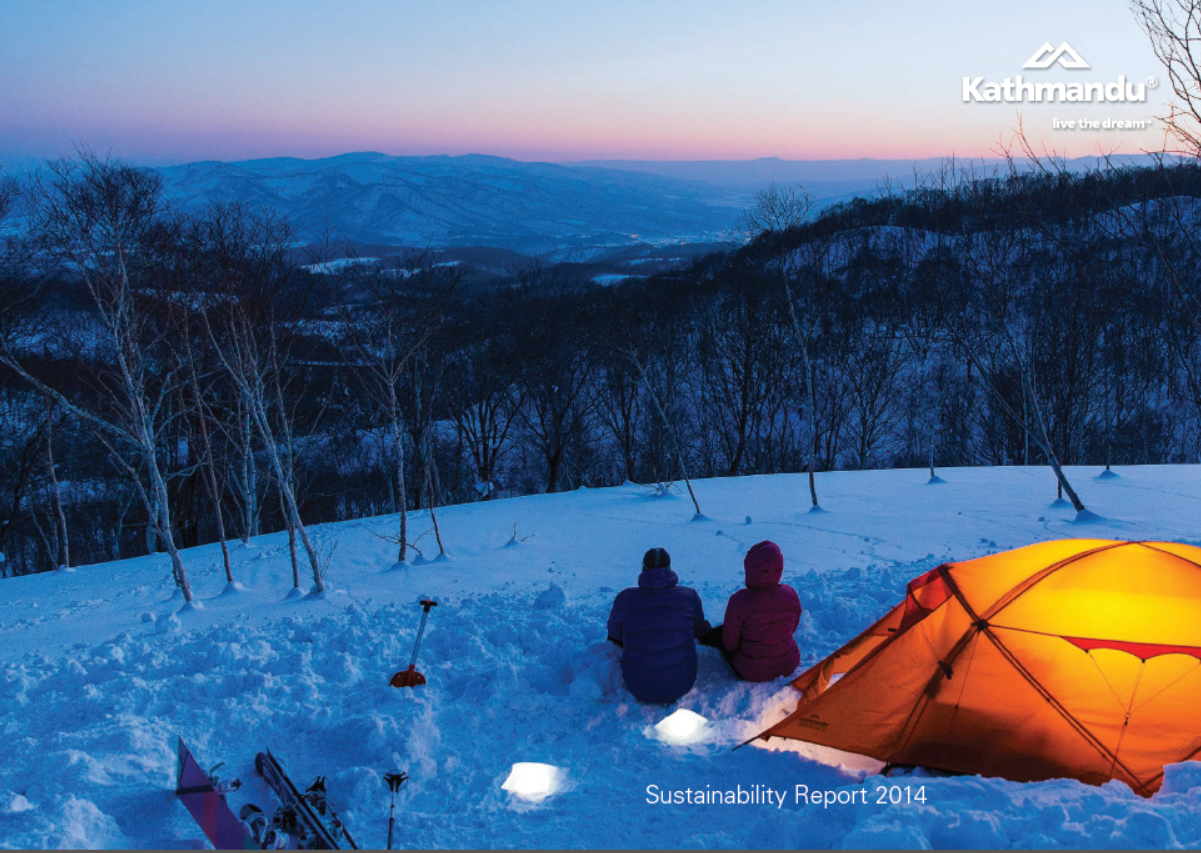
They say you should never judge a book by its cover. I say you should never judge a Sustainability Report by its photos. But some reports have photos that are just too great to pass over without comment. So it is with Kathmandu. Kathmandu is a leading retailer of outdoor clothing and equipment with 146 stores in Australia and New Zealand and 4 in the UK. The company employs just over 2,000 people. This is Kathmandu's third report. Here are some of the photos.


Although I would have like to have seen a slightly more direct link between material issues and performance indicators reported, Kathmandu works well with the GRI G4 framework in a focused 32 page report, covering its stated material issues.


An overarching issue for any apparel manufacturer is always supply chain management. Kathmandu deals with this well, with full description of the company's approach and strong relationship with a key supplier, while admitting that, at the other end of the spectrum,"we acknowledge that we have suppliers who are not achieving high standards and we are striving to increase awareness and assist them to build capacity." The challenges are by no means simple and Kathmandu transparently related an incidence of child labor in a new proposed factory as a young girl aged 15 had falsified her age and an older relative had provided verification. Kathmandu details its approach to instances of this nature - things, I suspect, that plague every manufacture using outsourced operations. Kathmandu's report also provides short case studies and outcomes of environmental activities in a way that is easy for us to understand.


As short, focused, materially relevant reports go, Kathmandu is definitely on the AIM scale. 


GRI G3.1, Application Level C, 58 pages, 7th report


Olam International is a leading agri-business operating from seed to shelf in 65 countries, supplying food and industrial raw materials to over 13,800 customers worldwide with a team of 23,000 employees. Key raw materials supplied include cocoa, coffee, cashew, rice and cotton. Olam apparently means "transcending boundaries" - though I am not sure in which language - and this theme comes through in Olam's reporting. Taking a landscape view of the overall value chain is a good place to start. 


Olam's 2014 report is a simple GRI G3 Application Level C affair. Or so it seems. In reality, it's an exceptionally cleverly written and designed, compact account of how Olam is making a difference in 7 key sustainability focus areas, presented as case studies in the report and exemplifying Olam's holistic sustainability approach.  


In each section, we are provoded with relevant context, Olam's actions, connections to other parts of the value chain and outcomes.


The narrative is short but the message gets through. Definitely Olam has AIMed for an impressive report, demonstrating equally impressive performance.


GRI G4 core, 55 pages, 1st report

Simple Green is the brand of Sunshine Makers, a privately-owned family company founded over 39 ago by the father of Bruce FaBrizio who runs the company today. The company developed a biodegradable, not-toxic, non-flammable, non-abrasive cleaning formula and now sells environmentally friendly cleaning products in 41 countries, manufactured in 11 facilities worldwide. Sunshine Makers employs 59 people directly and works with a network of partners for distribution. Sunshine Makers also founded EGBAR (“Everything’s Gonna Be All Right”), a non-profit foundation for environmental education and community improvement projects. I reviewed Simple Green's inaugural 2014 report on my recent post about U.S. first-time G4 reporters.

Simple Green does a nice job of reporting for the first time and using the G4 framework, two achievements rolled into one. As the name of the brand, so the report. It's simple, and it's green. The report takes a value chain approach and uses material issues to drive the reporting content.


The company covers its key sustainability risks in a transparent way over several pages of the report.


External stakeholder voices are represented also throughout the report. 


A very greenly AIMified report.


GRI G4 comprehensive,  92 pages, 12th report

Telekom Austria is the largest telecommunications company in Austria serving many countries in central and eastern Europe with products and services including voice telephony, broadband internet, multimedia services, data and IT solutions. The total group has more than 16,000 employees serving around 23 million customers. I reviewed Telekom Austria's Sustainability Report earlier this year in a post on the CSR Reporting Blog. As I mentioned in that post, Telekom Austria has a history of consistently fascinating and creative reports that reflect an authentic consideration of sustainability issues that are embedded in the way the company does business. As a G4 comprehensive report, this 2013 edition covers a lot of ground in its 92 pages. Materiality drives this report: 


An interesting thing about Telekom Austrian's report, as I wrote earlier this year, is the use of external insights to raise critical reporting questions and perspectives. This is a report that you read to help you think about issues, not just learn about the performance of a specific company. 


Telekom Austria also presents performance in a clear way, showing both continuity and intent.


Overall, AIMworthy performance and reporting from Telekom Austria. 

GRI G4 core, 55 pages, 4th report


I blogged about Tiffany and Co's 2012 Report during 2014, and this one is even more sparkling than the last. Not only because of all the spectacular diamonds.


Tiffany's report is as elegant in narrative style as it is in design. The story of diamonds is well told, with responsible mining, as you might have guessed, being the number one issue that is addressed comprehensively in this report. Tiffany has adopted a leadership approach in its own operations and in the sector over many years. 


What I like about Tiffany's reporting is the detail provided regarding sourcing of different raw materials, many of which have been controversial at some point and/or remain so today. Tiffany explains its sourcing, auditing and traceability processes, and its corporate position for each. 


A full set of focus areas is included in the report - following a materiality assessment - although it is not clear to what extent specific engagement with stakeholders shaped this approach, or whether it was the result of internal analysis of trends, issues and analysis.

Tiffany's 2013 report is, I believe, an AIM-driven report.


Not GRI (GRI referenced), 6th report, online with 106 page download


Wipro Limited is a global leader in providing IT Services, Outsourced R&D, Infrastructure Services, Business Process Services and Business Consulting. Wipro has a workforce of over 140,000 employees and serves over 950 clients across 57 countries. 

Wipro's 2012-2013 Sustainability Report is not just a report, it's an entire education. Telling the story of the migration patterns of butterflies on journeys which includes Wipro's biodiversity-friendly designed campus in Bangalore, Wipro likens the path of sustainability to their butterfllies' journey - transformation, tenacity and endurance. "The sustainability journey is similar and progress happens in small and often invisible steps. We think that every such step, every movement forward is important . Eventually the actions and thoughts of the many will add up to a critical gestalt, a point of significant inflection. The butterfly’s journey symbolizes a spirit of commitment to its future generations in the face of severe odds. It is to this spirit that our sustainability report this year is dedicated." That's probably the most inspiring sustainability report opener that I have seen this year, or even ever. It's a fabulous story, not plucked only out of Wipro's imagination, but an example of a sort of miraclulous and uplifting event that touched the hearts of the Wipro folks. It's really nice. You should read the butterflies' story. 

But that's not all. Wipro's sustainability report is also a reading list. It seeks not only to inform but to educate, commemorate and inspire.


With excerpts from classics that represent the landmarks of the sustainability movement, beautifully designed, this report is an entire Environmental Sustainability Education Program.


But don't get distracted by Wipro's creativity and respect for the great sustainability thinkers of our time. Wipro apparently has some sustainability thinkers of its own. The report is well constructed, referencing, not conforming, to GRI, but nonetheless, applying a material core. Not one, but two. Wipro splits its materiality analysis into two - actually, this is an interesting approach - and present smaterial issues for both econo-environmental and social aspects.

Wipro's report contains an overview of business and sustainability megaforces that provides important context and perspective. This is under the theme of the Sustainability Mobius.


I am not sure if I should be embarrassed to admit that I had no idea what a mobius is. How many people know that?  Anyway, now I know that it's something that usually looks like this:


And I also know why it's relevant: "..... complex, interrelated issues and our fragmented and siloed societal structures have largely been incapable of responding to these with a greater sense of urgency. The lines are blurring between all the stakeholders, their interests and business – with no clear start and end points much like the mobius strip."

Wipro presents achievements in the reporting year and objectives for the future - mainly qualitative but some quantitative targets. It's all very clear and very orderly and very meticulously done. If there were to be one suggestion I would make to Wipro for future reporting, it would be to raise the bar a little beyond operational activities in favor of greater emphasis on external impacts and contribution through core business accounting for the transformational change the company drives in society at different levels. Even so, this report has AIMed for much more than a report, and it's an absolutely deserving member of the 2014 Top Ten club.  

***************

I hope you enjoyed this overview and that you have met some reports that you hadn't seen before. I hope these reports bring inspiration for other reporters. Using these reporting ideas is never quite as simple as copy-pasting, because every company has a unique message, style and tone. However, some of the Top Ten reports may help you look at things in a different way as you undertake your first, or next, reporting cycle in 2015. Good luck!

NB: As usual, to be fair, I did not include reports that I have worked on or from other clients or affiliate or parent companies. If I were to do that, I wouldn't have room for any other reports ha-ha. But it also shows you how magnanimous we are on the CSR Reporting Blog :)) Gotta give 'n take a little in life, right? For reports I have worked on in 2014, see the Beyond Business (new improved) website.


Happy Reporting in 2015, everyone! 
Here's to the next Top Ten.


elaine cohen, CSR consultant, Sustainability Reporter, HR Professional, Ice Cream Addict. Author of Understanding G4: the Concise guide to Next Generation Sustainability Reporting  AND  Sustainability Reporting for SMEs: Competitive Advantage Through Transparency AND CSR for HR: A necessary partnership for advancing responsible business practices . Contact me via Twitter (@elainecohen)  or via my business website www.b-yond.biz   (Beyond Business Ltd, an inspired CSR consulting and Sustainability Reporting firm). Need help writing YOUR Top Ten Report in 2015? Contact Elaine: info@b-yond.biz   
Related Posts with Thumbnails