Showing posts with label global compact. Show all posts

Saturday, June 15, 2013

23 FSRs (Fabulous Sustainabilty Resources)

As sustainability reporters, we are always in learning mode. The fast-paced evolution of the sustainability field and the dynamic changes that happen all around us make it a challenge just to keep up with the latest thinking, recent research, new findings, leading insights etc. Stuff spins on and off our computer screens before we have time to know it's there and then, whoops, it's gone, and despite a mental note to take a look at it later, we never do. Familiar? Sure. The only thing you really have time to read is, of course, the CSR Reporting Blog. And as a big thank you, here is our new offering. FREE summaries and commentaries on 10 recent fabulous publications (some more fabulous than others) which will make you even better sustainability professionals, and provide you with interesting facts to tell at dinner parties. This is a one-time thing, so don't get your expectations up that we will be doing this on a regular basis. We are too busy trying to keep up with what's really going on out there.

A study by Ernst & Young LLP and the Boston College Center for Corporate Citizenship
 
This is the report of a survey of 579 respondents from U.S. based companies of which more than half also have operations outside the U.S. 391 of the respondents work for organizations which publish a Sustainability Report, the rest don't. It's not clear whether respondents were executive, management or non-management level. The report provides a rather glossy picture of the state of reporting, and all of its wonderful benefits. It's a little short on new insight, and a little OTT on the total wonderfulness of reporting, but it's an interesting and up-beat round-up of the reasons to report, just in case your Board or CEO is not yet convinced.  The emphasis on the value of assurance can't be missed - in several places - in my opinion. See this:

Mainstream analysts and investors are paying attention to sustainability reporting? Really? Perhaps I missed the few that do when I blinked.

An interesting table in this survey is what motivates organizations to report.

Ahead of any other reason, the noble objective of being transparent with stakeholders is cited as the key motivation to report in all the sectors represented in the survey. Brand reputation  is hardly cited as a motivator (but then, the sectors involved are largely not consumer-facing brand organizations) and even stakeholder pressure scores very low. I wonder what this means? Apparently, CEO's just want to be transparent. Tell that to yours. 
 
 
Measuring socio-economic impact – A WBCSD guide for business
This is a fabulous document from the World Business council for Sustainability Development (WBCSD) which explains the  ins and outs of measuring social impact. Know the difference between impacts, outcomes and outputs? This guide will see you straight. Know what the key tools that are available today to help you calculate socio-economic impact? This guide will both define them and tell you what they are good for. The details include ten key tools:


This guide is of specific importance, now that G4 is moving in the direction of value chain impacts. In assessing material impacts, G4 requires you to consider whether these happen internally or externally. In addition, G4 asks for performance measures relating to these impacts. In general, this is one of the hardest things to measure and most companies manage to measure inputs (infrastructure investments, cash donated, volunteer hours, pro-bono services etc.) but few manage to measure outputs, outcomes or impacts. Which is quite a paradox. Billions of $$$ and time (which is $$$) invested into communities without anyone ever asking whether they made a difference and what that difference was, or whether the funds have been used where they can do the most good. Everyone wants a big return on their $, even if this return is calculated in currencies other than monetary, such as in social benefit of different kinds. This guide may not make you an expert but it certainly gives you resources you need in order to work your way up the sustainability professionals capability chain.  (Did you notice how everything is a chain these days - value chain, supply chain, food chain, ball and chain....?)
 
An Ernst & Young survey in cooperation with GreenBiz Group

The report analyzes the results from 282 respondents who represented 17 sectors and are employed by companies with annual revenue greater than US$1 billion. Approximately 85% of these respondents are based in the United States.
 
And the six trends are: 1: The “tone from the top” is key to heightened awareness and preparedness for sustainability risks. 2: Governments and multilateral institutions aren’t playing a key role in corporate sustainability agendas. 3: Sustainability concerns now include increased risk and proximity of natural resource shortages. 4: Corporate risk response is not well paired to the scale of sustainability challenges. 5: Integrated reporting is slow to take hold. 6: Inquiries from investors and shareholders are on the rise.

Any surprises? Nah.

The Future of Corporate Giving
The Charities Trust and Corporate Citizenship

This is the first in a series of publications based on ongoing research into the way corporate philanthropy is changing. Research, comprised of a literature search, interviews with opinion leaders and an online survey of professionals, indicates that four key trends are changing the face of corporate giving:

Commercialization:
"The relationship between a company’s community involvement and its commercial activities has been growing for a number of years. In the future, this trend will accelerate. The boundary will blur further as companies seek more measurable coherence and long-term profits from their corporate giving. Softer benefits such as staff loyalty and enhanced reputation will no longer be enough to ‘claim’ – community initiatives will need to measurably contribute to driving company profitability. Social value and commercial value cannot be neatly separated. But all the interviewees we spoke to and 85% of survey respondents felt that there would be a greater focus on delivery of the business strategy through corporate community involvement in the future. Of all the trends we tested, practitioners rated this as the most significant."

This is a very important insight. Does it signal the end of philanthropy and mark the beginning of community investment as a business driver and not a values-based activity? The report says that finding the synergy between company and community will be the key skills for corporate community managers and community players and not-for-profit partners. 56% of respondents in the survey conducted said that corporate giving would no longer exist as a separate activity, but would be "driven as part of core business strategy". Emerging innovations in this area cited by the report include: Vodafone's M-PESA, Nestlé's Creating Shared Value Model, Hindustan Lever's Shakti model of women's entrepreneurship - none of which are particularly new, but the fact that we always come back to these when talking about new corporate philanthropy may mean that other examples are few and far between, so far.

The other three trends identified, which are currently being researched and which will, presumably, result in further publications are : Innovation Unleashed, Collaborative Coalitions and Cause-related Movements. All sound familiar. The implications of these trends for business are discussed:

"One thing that all four trends have in common is a blurring of boundaries. Distinctions are dissolving between motivations (commercial or societal?), responsibilities (government, not-for-profit or business?), and drivers (companies, suppliers, corporate customers or consumers?). Managers of the future will need to navigate this uncertainty, build coalitions, manage multiple partners and articulate the change they have created convincingly."

Interestingly, this report does not highlight impact measurement as a trend, or as an important factor in advancing community investment. Perhaps when charity becomes business strategy, adapted business models of return on investment may start to apply.
 
And here are four new reports from the Global Reporting Initiative, timed to coincide with the May 2013 Amsterdam GRI Conference:

Carrots and Sticks 2013
Global Reporting Initiative
 
This is the third publication in the Carrots and Sticks series of the GRI, and three other partners, and was launched ceremoniously at the Amsterdam conference by dynamo Teresa Fogelberg and a group of others. Carrots and Sticks is a look at the public policies and regulatory frameworks that are rapidly changing around the world. It's a self-proclaimed "global inventory of sustainability reporting policies and guidance" and includes: 1. Governmental or market regulatory requirements and voluntary initiatives for the public disclosure of sustainability information. 2. CSR initiatives requiring or providing guidance for sustainability reporting or other forms of public disclosure. 3. Requirements or recommendations covering a single topic (e.g., greenhouse gas emissions) or sector (e.g., mining), provided the disclosure has to be public. 4. Standards on sustainability assurance.

You will probably not be surprised to know that the trend is growing. See the table below for the number of initiatives over the past 6 years. More initiatives are becoming embedded in the laws of national governments.
Green represents initiatives for voluntary reporting
Orange are initiatives for mandatory reporting
The report notes that mandatory and voluntary approaches create "mutual traction" - one tends to advance the other. Mandatory disclosure is also increasing affecting state-owned enterprises. Carrots and Sticks provides a detailed update of the status of public policy and regulation on reporting in several countries and regions: Australia, Brazil, China, Colombia, Denmark, EU, France, India, Norway, South Africa and the USA. Which probably means that there is not too much to say about all the rest. Yet. Watch out for Carrots and Sticks 2020. I am sure that will present an entirely different picture. In the meantime, if you want a detailed look at sustainability reporting's regulatory status around the world, this is the best review out there.

Sustainability Topics for Sectors
Global Reporting Initiative

This 156 page report is the outcome of research among sustainability reporters and stakeholders, who submitted suggestions for sustainability topics by sector that could serve as a useful reference for identifying and prioritizing material issues in the sustainability management and reporting processes.  "In total, 194 organizations related to the different stakeholder groups either contributed directly or were researched as part of this effort. This research generated 2,812 topics which were related to 52 business activity groups. Over 600 documents support the 1,612 unique topics that have been identified through this process." The 1,612 topics are described in some detail and offer contextual information, aligned with GRI Material Aspects, so that in preparing your spanking new G4 report, you won't have to start from a blank page. The topics presented by 52 industry sectors. The sectors with the highest number of topics are:
 
Oil and Gas - 96 topics
Mining - 91 topics
Food and Beverage Processing - 78 topics
Electric Utilities - 71 topics
Construction and Home Building - 68 topics
Textile and Apparel - 59 topics
 
 
The tobacco sector has only 7 topics (!) - none of which relates to the degree to which their products kill people.
 
Sustainability Topics for the Tobacco Sector, page 64
 
In each sector, the high-level topic list is supported by detailed supplements which can be downloaded separately from the GRI's resource library. This is the link to the tobacco sector document, for example. Some sectors are more extensively covered than others.
 
This report is a very interesting collection of issues and certainly helpful. It is not exhaustive and in some cases, the list of issues is rather random. However, as input to any process which thinks about material issues, it's worth using. It would be good to see GRI continue this work. In fact, it's somewhat of a shame that more has not been done already. As G4 kicks in, this kind of thinking become more critical.  
 

The Sustainability Content of Integrated Reports - a survey  of pioneers
Global Reporting Initiative

The GRI sure was busy in the run-up to the Amsterdam conference, and this was one of the May 2013 suite of publications. This one, as the title suggests, is all about integrated. It looks at the integrated reports in the GRI database, aiming "to review the different ways in which self-declared ‘integrated reports’ are taking shape around the world", based on the feedback of 18 companies and contributions from a range of experts in this area. An interesting and not surprising conclusion: "The majority of companies find GRI reporting processes useful to their development of an integrated report, either because GRI helps them defining content at the start of their process, or informs their review of the report at the end of its development." In other words, sustainability first, integrated second.

Having said that, the report frankly states the issues with the concept of integrated reporting, and the fact that "at the time of writing, no globally accepted standards or practices exist with regard to what an integrated report should cover and how it should be constructed to meet the needs of its users. Neither is there clarity on who exactly integrated reports’ users are, or how such reports should ultimately be appraised for quality and substance." Spot on. Integrated reporting, despite the recent IIRC Exposure Draft, remains an enigma to most. But it sounds sexy, so I guess we'll see more of it. The survey of pioneers report (what are they pioneering exactly?) covers research (from the GRI database) on integrated reports broken down by type of companies,  sectors, countries and what these reports are called (annual reports, integrated reports, annual and sustainability reports etc.). Also the length. The average length of an integrated report is ....well, that number isn't provided.. but they are getting longer.

In 2010, 22% of reports were 200+ pages in length, while in 2012, 24% were that loooooooooooooooooooong. 40% of integrated reports in 2012 were more than 150 pages. Did anyone check the length of standalone sustainability reports? The report zooms in on South Africa and Australia in terms of integrated reporting practices, and most interesting is the perspectives of the practitioners themselves with interviews from people in reporting companies. This is an intriguing report and if integrated is on your radar, it's worth a look.
 
 
The External Assurance of Sustainability Reporting
Global Reporting Initiative

Another in the flurry of publications timed to coincide with the GRI Conference, this is a short look at the state of assurance from a GRI (and G4) perspective and based on a review of data in the GRI database. The report says: "In 2012, over 46% of reports listed on GRI’s Sustainability Disclosure Database indicated some form of external assurance. While notable differences exist between countries and sectors, the global trend is toward increased assurance of sustainability reports." Personally, I think this is misleading. Many of the assurance statements I read do far from assure sustainability reports, at best they sort-of assure some of the (typically carbon emission and energy consumption) data. At worst, they raise more questions than they resolve. I think assurance is a big mess (ooops, maybe that's not very PC) and needs hoisting out of the current paradigm. Yes, I have some ideas, and will post on this as soon as I can. In the meantime, this report summarizes current assurance frameworks and includes a checklist of what to look for when you are engaging an assurance provider. It's a good reference document, although, why the GRI should publish such a document when the GRI's approach to assurance has been lukewarm lip service at best is rather a puzzle.

Sustainia 100
Sustainia, Denmark


"Sustainia is an innovation platform where companies, NGOs, foundations and thought leaders come together to support and work with a tangible approach to sustainability. Sustainia100 is an annual guide to 100 innovative solutions from around the world that presents readily available projects, initiatives and technologies at the forefront of sustainable transformation." The Sustainia 100 guide is an interesting overview of different creative approaches to different issues, ranging from harnessing solar power in innovative ways connected to women's empowerment in Africa to community computing for the benefit of humanitarian research to smart irrigation and aerodynamic trucking. If you are lacking inspiration in your business, or simply want to see how the age of sustainabilitinnovation (there's a word that confounds blogger's spellcheck function) is still alive and kicking, take a look at this report. There are surely some ideas that are applicable to your business.
 
Accountability and United Nations Global Compact
(Thanks to CSRInternational's Research Digest for alerting me to this one)

The report presents the Sustainability Commitment Growth Curve (SCGC) which forms a roadmap for turning commitments into measurable value creation.


From adoption to implementation to advancement, this roadmap gives sound guidance on how to turn good intentions into good practice. Many of the concepts and approaches are familiar, but they are ordered here in a coherent and accessible way, with a host of interesting examples of practice from companies around the world. The roadmap is aligned with the UNGC principles, and shows how different companies have used the UNGC framework to align resources, structures and programs to deliver value-creating outcomes. This is a good source of inspiration and ideas for companies wanting do deepen their strategic approach to sustainable business.

But that's not all:

And as I was compiling this list above, I came across this other list:
 
13 HOT RESEARCH REPORTS by Sustainable Brands, compiled by Dimitar Vlahov.
 
This contains some more fabulous stuff, really interesting reports, and there is absolutely no overlap with my list, so, just by adding this link, the CSR Reporting Blog offers you a double-scoop of resources for absolutely no additional charge. Come on, admit it, how many other sustainability reporting blogs are this good to their readers?

Show your appreciation by tweeting, retweeting, mtweeting, facebooking, googleplussing and signing up for the CSR Reporting Blog directly to your email. Oh, and a scoop or two of Chunky Monkey next time we meet wouldn't go a miss either.


elaine cohen, CSR consultant, winning (CRRA'12) Sustainability Reporter, HR Professional, Ice Cream Addict. Author of Sustainability Reporting for SMEs: Competitive Advantage Through Transparency AND CSR for HR: A necessary partnership for advancing responsible business practices Contact me via www.twitter.com/elainecohen   or via my business website www.b-yond.biz (Beyond Business Ltd, an inspired CSR consulting and Sustainability Reporting firm)

Thursday, December 22, 2011

A COP can be a good thing

Some people think of the UN Global Compact Communication on Progress (COP) as a lightweight entry into the world of transparency. In some cases, they would be right. To submit an Active level COP, all you need to do is describe how you uphold the 10 Principles of the UNGC, describe the positive things your company is doing and sit back and wait for next year's deadline. However, in November 2011, 106 companies were delisted for not communicating, bringing the total delistings to 2,953 companies, so maybe it's a little more challenging.

Last year, the UNGC made a change to the COP structure, introducing what the UNGC calls the "Differentiation Programme". This gives companies two choices: Active Level and Advanced Level. Basically, "Active" means the old-style COP, in which companies do the Good News thing, saying how good they have been in advancing the 10 Principles. This could be compared to an Application Level C Report using the GRI Framework, though it doesn't quite require the same degree of rigor in terms of Management Disclosures. "Advanced" is another affair, requiring companies to report on how they meet 24 criteria of responsible and sustainable business practice, grouped in 5 broad categories:
  • strategy, governance and engagement
  • UN goals and issues
  • implementation of Global Compact principles
  • value chain implementation
  • verification and disclosure
Essentially, anyone aiming for an Advanced level COP is working at the level of a GRI Application Level A Report. But, as anyone who has ever written an A Level report knows, this is no small task. If you have the capability of producing an Advanced Level COP, in practice, you are capable of writing a Sustainability Report and posting it on the UNGC Website, thereby also fulfilling the UNGC COP requirements. The Sustainability Report will include a reconfirmation of the CEO commitment to the UNGC and a cross-reference index of UNGC principles to GRI Indicators.  In practice, this is what most companies who report at GRI B or A Level do.

For companies which are not quite ready to report at this advanced level, an Active COP could be a positive alternative. It provides an opportunity for transparency in a globally recognized context and allows some flexibility regarding what to disclose.  In some cases, companies invest quite a significant amount of effort to deliver an Active Level COP.

Take a look at this (Active Level) COP by (my client) , ECI Telecom.


ECI Telecom is a global provider of telecommunications networking solutions and this is the Company's second COP. Beyond confirming the Company's commitment to the 10 principles of the UNGC, ECI discloses how the company makes a Green Impact with ICT Technology. If you don't know your DSL from your VDSL, ADSL and HDSL, or the environmental significance of Vectoring, you can learn a lot from reading ECI's COP. ECI is a champion in low-power applications and E-band technologies. If this is all gibberish to you, don't worry. It was to me until I started to learn what it all means. It's actually surprisingly simple, once you get the letters in the right place, and confirms that ICT is one of the most significant opportunities for companies to provide services which improve their environmental footprint and those of consumers.


Additionally, ECI makes many environmental disclosures relating to  its own environmental impacts. With an E-TASC (Electronic Tool for Accountable Supply Chains) score of 96%, the company's best to date, ECI demonstrates a commitment to managing, measuring and reporting. The company achieved a 20% reduction in paper consumption in 2010, a 20% reduction in electricity consumption per employee, a 12% reduction in water consumption and a 9.75% reduction in waste. Great progress.

However, my favorite part of this COP is the description of the Green Camera project that ECI Telecom's CSR Manager, Eynat Rotfeld, organized in 2010. Employees were invited to submit their "green" photographs and the three winning photos were selected from around the ECI globe. The photos were breathtaking. Here are the winning photos:

My Green Life in Huangzhou by Tony Xu (China)
Tony Xu said about this photo: "Bicycle is a green, healthy and convenient choice for me. In Hangzhou, the government purchased a mass of bicycles and offer free use for residents in order to improve the condition of traffic and reduce the usage of cars. You can borrow near the home and return at your destination. It is very convenient, saves money and good for health for everyone. That is my reason for choosing this picture."


Harvesting the power of nature by Glenn Leis (ECI Philippines)
Glenn said about this photo: "I was amazed when I saw those windmills up-close and personal and wonder how the force of nature, which is the wind, drives those giants to produce electricity without any bi-products / pollutants. I’ve been to some power plants during my college day field trips and I have compared it to those diesel-fed engines that are very dependent in oil in which we do not have here (yet) in our country. The power of nature is everywhere, we just need to harvest it in a way we do not destroy it in the end because it's FREE...."

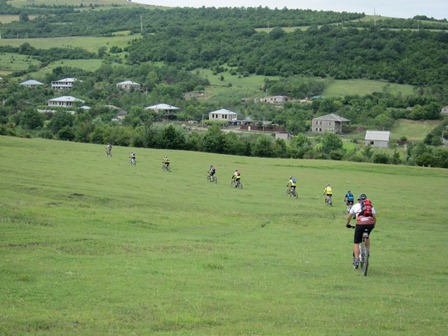
The ECI Biking Team in Georgia by Amit Singer (Israel)
Amit said about this photo: "This picture was taken during our "green" sporting activity, an ECI team bike ride, which doesn’t cause any form of pollution. The team also gets involved in a lot of volunteering activity, including making donations to hospitals, supporting underprivileged children and more. The photo itself represents the spirit of the group – riding in an atmosphere of calmness and blending with the green of nature."

ECI Telecom's 2011 COP is a comprehensive document of 65 pages covering a wide range of social and environmental disclosures, demonstrating year on year progress in advancing sustainable practices. Not a lightweight entry by any means.


elaine cohen, CSR consultant, Sustainability Reporter, HR Professional, Ice Cream Addict. Author of CSR for HR: A necessary partnership for advancing responsible business practices Contact me via www.twitter.com/elainecohen  on Twitter or via my business website www.b-yond.biz/en  (BeyondBusiness, an inspired CSR consulting and Sustainability Reporting firm)

Tuesday, September 7, 2010

Getting the CSR message through!

I am pleased to make you aware of a first Communication on Progress published by the great CSR news distribution company CSRwire, LLC - whom most of you probably know via the News Alert which promptly plops into your inbox every morning with the latest CSR news and interesting editorials (haha, disclosure, some of them are mine!) . Anyway, if this plop thing doesn't happen to you, I would strongly recommend you sign up and get the News Alert. Whilst you are doing so, check out the rest of the site and see how CSRwire can help you get greater exposure for your CSR news and get your CSR message through! 

Anyhow, I digress.

What I really wanted to do was congratulate CSRwire on the submission of a first COP to the UN Global Compact. (oops, time for another disclosure, I worked with CSRwire and helped develop this COP).  

As most of you may know, the UNGC is a voluntary policy framework established 10 years ago by the UN to help drive responsible business practices according to 10 core pinciples. Businesses who wish to participate willl send a signed commitment to the effect that they will uphold the principles, spread the word around and report annually on what they have been doing in this respect. Over 5,000 businesses accross the world have committed to support this framework. A Communication on Progress is usually a positive document which doesn't require full disclosure in the same way as a comprehensive Sustainability Reoprt type GRI does, but it can contain considerable information and is an excellent route to supporting accountability and developing a culture of  transparency.

Accountability and transparency is not new to CSRwire as they are a certified B Corporation, and have been practising responsible business practices since the very start of their operation in 1999. However, the  CSRwire COP is a very full document, the most transparent ever published by CSRwire, and describes their business mission, profile, history, responsible practices, targets for the future and most importantly, the most material element of the company's work, the way CSRwire delivers and distributes CSR news so that the CSR message gets through to an increasingly wider range of readers all over the globe including corporate practitioners, CSR professionals, non-profits, academics, students and opinion leaders. With over 5,600 members and 250,000 page views per month, and growing, this is a strong reach. 

Also important is the fact that CSRwire is an SME, a small business with 12 employees. Even a small business can do their stuff responsibly,  and actually, it is vitally important that small businesses do do their stuff responsibly. The UNGC route is a great framework for smaller businesses to start building their Sustainability Stamina and gain global recognition. SME's who read CSRwire's COP can gain inspiration and ideas for how they might follow suit. I hope many do. See it on the UNGC website here.

Anyway, rushing off now to a Chunky Monkey event. YEAH!

elaine cohen, CSR consultant, Sustainabilty Reporter, HR Professional, Ice Cream Addict. Contact me via www.twitter.com/elainecohen  on Twitter or via my business website www.b-yond.biz/en  (BeyondBusiness, an inspired CSR consulting and Sustainability Reporting firm)

Tuesday, December 29, 2009

Ethical Fashion - Who cares ?

Today I lectured to 4th and final year Design students at the Fashion Design faculty of the prestigious Shenkar Design College in Tel Aviv. My objective was to create awareness of the important impact of fashion designers on social responsibility and sustainability, and to encourage these young budding designers to exercise social and environmental responsibility as they start to practise their new profession. Some of these students will be individualists, creating and selling their own innovative designs. Many will go on to work as designers in Companies who retail their fashion in Israel and perhaps world-wide. Some may even become world famous designers to the celebs, attaining a position of influence far greater than a modest, well, sort of modest, consultant like myself can do.  This was the only exposure of students to sustainability thinking as part of their four year course, something I am hoping will change as the importance of fashion design with a sustainability mindset becomes more compelling. My presentation, entitled Ethical Fashion, Who cares? I regret, is only in Hebrew at present, so I will take you through a  brief summary of my key points here:  

The fashion industry is a multi-billion dollar industry, employing over a million people and touching the llives of each and everyone of us on the planet, at all stages and phases of our development. Who cares about sustainability, CSR and ethics in the fashion industry?  No-one declares that they want to destroy the planet's natural resources, wear sweatshop shirts at the expense of the most basic human rights of children in the Far East, or make the hole in the ozone layer bigger. No-one says they want to impoverish communities through exploitation or perpetuate a fast fashion consumer culture which results in tons of unwanted clothes sent to landfill each day. So maybe everyone cares. But caring is not enough. We  know that people care only when we see them take action in line with what they care about. In the fashion industry, we can start with three core groups who influence fashion, and ask ourselves what they really care about:
  • Designers - to what extent do ethical, social and environmental considerations form an early part of the design phase?
  • Retailers - to what extent do similar considerations dictate retail policies and practices ?
  • Consumers - to what extent do consumers vote with their feet, or more accurately, their purchasing choices?
There are many positive examples in all three categories of fashion industry stakeholders such as these, though, overall, the fashion industry is still a perpetuation of unsustainability, especially in Israel where 90% of fashion is imported and little is disclosed about supply chain processes by almost all the leading retailers.

The result of everything that designers and retailers do ends up somewhere as a consumer choice. So I then took the students through a brief review of the things that impact consumer choice, beyond the pure design elements of a specific garment. I focused on three broad areas: 
  • Materials - fabrics, yarns, adhesives, dyes, and all forms of accessories - what environmentally friendly and ethically favourable choices are available to the fashion designer ?
  • Production processess and supply chain - sourcing, outsourcing, transportation, sales, fair trade - what influence does the designer have on manufacturing complexity and waste levels, for example ?
  • Garment care - what the consumer does after purchasing a garment, which makes up a significant element of the garment's total life-cycle impact, often greater than the impact of producing the garment.
I then  I ran through a reasonably exhaustive list of issues for consideration by designers including  fabric traceability, organics, garment life-cycle, labelling,  issues related to body image, use of pesticides, models and modelling practices, technology developments which facilitate use of environmentally friendlier fabrics such as hemp, and more.

Finally I looked at the question of transparency and yes, you guessed it, my favourite subject, reporting, and talked about the leading reporters in the fashion industry, including the only private fashion house in Israel to have produced a CSR report, my client, comme il faut.  I mentioned the Global Compact, and our efforts to drive the Israeli fashion industry to accept and promote the UNGC Principles, though only the comme il faut Company has done so to date, and one more en route, whose first Communication on Progress we are currently working on.

To sum up,  I stitched it all together (don't you just love puns?) and suggested that if they care, they should take responsibility, as designers, and consider social and environmental issues at the start of the design process. Perhaps if I ever become a celeb, one of them might design an eco-celeb-outfit for me. Chunky Monkey colours, please.

I also referred those who are keen to learn more to my list of wonderful books, all of which I have read, enjoyed , learnt from and been inspired by, on the subject of ethical and sustainable fashion, textiles and apparel. Here's my list, in no particular order, they are all great!:


I waited as some rushed to copy down the titles. Good sign!

Later, as I pondered over  questions the students asked, and the real impact of their work, I tried to recall  to what extent designers are given air-time in CSR reports. I recalled the wonderful 2005-2006 report by Gap Inc where they state : In our business, everything begins with design.And later in the report, there is a quote from the Director of Textile Development:


Quick look at one more: Next plc, whose 2009 report I just came accross a day or so ago. It's an interesting report, doesn't really touch on the role of the designer, thoough there is evidence that designers are bound by social and environmental commitments such as the development of traceable sustainable cotton products and more.

I hope that this new generation of designers will be a generation of sustainable designers. And I hope that consumers will both demand and applaud this direction. That is, if anyone cares.

elaine cohen is the joint CEO of BeyondBusiness, a leading reporting and social-environmental consulting firm . Visit our website at: www.b-yond.biz/en 

Saturday, July 4, 2009

You dont have to be BIG to do CR

I often hear questions about whether CR is relevant to SME's.
I often hear criticsm that UNGC participation is not a powerful driver of action as it has no enforcement clout. My position of course is that CR is absolutely relevant to SME's and the UNGC is a very significant framework which is changing corporate behaviour. And i found a perfect example with a Communication on Progress (they actually call it a Social Responsibility Report) issued in the Republic of Moldova .

This Moldova COP is from the SME PTC BIOPROTECT . Read it here. It is a 12 pager Communication on Progress reporting on activities in alignment with the UN Global Compact Principles and a charming and wonderful example of leadership in a small country known as the poorest in Europe, independent since 1992, with 4 million inhabitants and a GDP of around $1200 per capita, average wage $250 per month, and 25% of the polulation living on below $2 a day . Landlocked and devoid of any significant natural assets, this country depends largely on agriculture for its economic prosperity, so perhaps it is no coincidence that CR should show up in the agricultural sector.

PTC Bioprotect is an importer-exporter of agricultural products founded in 1993 and employing 28 people. They joined the Global Compact in 2006 and have embraced the 10 principles wholeheartedly. Their report is about small-scale impact in their local business environment - worlds away from MNE scale and leverage - but equally important. The kind of impacts reported are :
  • support for 130 orphans in the town of Falesti with Easter gifts such as " sweets, sports equipment, towels, A4 format paper, bags and ribbons.".
  • support for 15 students to attend an International Conference on Chemistry, Chemical Technology and Environmental Protection
  • sponsoring a prize for entrants in National Contest of Business Plans for Young People, 2008
  • participation in the International Program on the Elimination of Child Labor (IPECL) of the (ILO) to combat child labor in the agricultural sector of the Republic of Moldova by financing the purchase of two digital cameras and two Micro SD cards that were sent to the Labor Inspection to be used in the documentation of child labor cases.
  • collaboration with other 12 Moldovan UNGC participating companies to expand the green sites to the leisure areas in the city – THE GREEN DAY – BECAUSE WE CARE - in the public garden from Botanica sector of Chisinau. In addition to personal volonteering, the Company provided 26 shovels, 42 rakes and 108 pairs of gloves for the execution of works of cleaning and digging around the trees.
  • focus on agricultural product offerings which are more environmentally friendly
  • support for the national campaign „You can stop corruption” organized by the Government of the Republic of Moldova
These impacts might seem small against a global backdrop, but they are BIG at a local level. I applaud PTC Bioprotect as an exemplary model of reponsible behaviour which supports the fact that CR is for SME's and UNCG is a route to developing a more comprehensive CR approach.

And if you haven't tasted Moldovan wine lately..... try a glass while you read their report ..... it goes well with Chunky Monkey ....

elaine cohen is the joint CEO of BeyondBusiness, a leading reporting and social-environmental consulting firm based in Israel, and an active supporter of the UNCG (though having less than 10 fulltime employees, regretfully, we cannot be signatories) . Visit our website at: www.b-yond.biz/en

Sunday, June 14, 2009

Buzz No 3: COP this !

We've gone Beyond, we've been through complicity … now it's time for … coffee… nope, not yet …it's time for COP. Lots of buzz about COP in Istanbul. Actually, there are two types of COP. There is COP, or even notable COP. And COP15. (Don't ask me about COP 2 – 14). So let's make a start with plain ole COP and then move upstage to 15.

COP = Communication On Progress
This is what participants do once they have confirmed their participation in the Global Compact of the United Nations. You all know the Global Compact, right? It's a framework of 10 principles relating to the responsibilities of business to uphold human rights and labor standards, and to work to improve environmental impacts and anti-corruption. The UNGC has over 5,000 participants from all over the world and is supported by a web of networks who advance active application of the principles. It was in this context that I joined the Human Rights Working Group meetings last week in Istanbul. A COP is a mandatory annual communication for participating companies to publish the ways in which they are advancing the UNGC principles. Guidance on how to write a COP can be found here. A "notable" COP is one which the UNGC team finds to be particularly comprehensive and clear, and a model for others, for example here. Finally, businesses which do not communicate get kicked out. Which is as it should be, right ? COP is a kind of voluntary corporate disclosure, i.e. a report, which means that COPs fit perfectly into this reporting blog. Might just do a little COP analysis over the next few weeks. Once i get past the buzz.

COP15 = Copenhagen 15
This is way the climate-connected refer to the meeting which will take place in Copenhagen (COPenhagen .. COP … get it ? ), the United Nations Climate Change Conference on December 7 to December 18, 2009. It's a kinda climate change annual hot spot (geez, that pun thing again). The Kyoto Protocol, which was adopted in 1997, sets binding targets for 37 industrialized countries and the European community for reducing greenhouse gas emissions at the rate of an average 5% against 1990 levels between 2008-2012. At the 13th conference in Bali it was decided to work towards an agreement for the subsequent years. This agreement is to be negotiated in Copenhagen in 2009. Stakes are pretty high, it seems, as the influences on emission reduction decisions are dominated by economic-geo-political decisions, especially relating to China and India. By now, if you follow my blog, you will realize that I am not terribly competent about things environmental, so I contented myself with a quick look at the conference guide. Connie Hedegaard, the Danish Minister for Climate and Energy says : “We must move the world from an era of talk to an era of change” In this spirit, it is important to know that attending Heads of State will be offered eco-friendly transportation, and other conference travel will be offset. Towels in hotels will be shared on a one-to-four-rooms basis, and specially constructed conference seating will enable participants to peddle in-situ to generate energy to power their laptops. (so what if I got a little carried away). Follow the conference on Twitter , Facebook ,
take the climate quiz (I got 7 out of 10, which proves that this quiz was designed with first graders in mind, and it helps if you are Danish). I can't help being impressed with the locations of all these climate change conferences: Berlin, Rio, Kyoto, Bali, Copenhagen, New Delhi, Poznan, Marrakesh, Milan, Nairobi, Montreal etc … how about next year in Darfur, Mogadishu, Gaza, Karachi, Teheran or Baghdad ? Anyway, you have until Dec 7 to place your bets on COP15 outcomes. Cop that?

What else was buzzing in Istanbul ? Stick around to find out. It was a really buzzful week.

elaine cohen is the joint CEO of BeyondBusiness, a leading reporting and social-environmental consulting firm based in Israel. Visit our website at: www.b-yond.biz/en

Saturday, June 13, 2009

Buzz No 2: Complicity aka the Ostrich Defense

Buzz number 2 from the Global Compact meetings in Istanbul : Complicity.
Websters definition: com·plic·i·ty
1 : association or participation in or as if in a wrongful act 2 : an instance of complicity


So here you will understand that complicity always has an association with something negative or wrong. Like, its bad, ok ? And in the context of sustainabilty, and human rights in particular, complicity is an important concept. And one which came up several times in the course of discussions on labor standards and human rights at the Global Compact Human Rights Working Group Meetings last week in Istanbul. This reminds me of a fashion show with the theme of sustainability that my client comme il faut staged last year. All the models in the fashion show walked the walk with their hands over their ears, eyes and mouth, denouncing corporate and even consumer attitudes. Hear not, speak not, see not. As though what we ignore doesn’t exist.

.

This has been pretty much the attitude of corporations over the years in relation to human rights in their operations and their supply chains, and the way the products they produce are used. The assumption was that if you outsourced it, it was no longer your responsibility. If you sold it, it was the buyer's responsibility. If you passed on the responsibility, then you were left with none. Well, the concept of complicity blows this notion right off the validity radar.

Let's take a first look at what is expected of corporations with respect to human rights. The mother document for human rights is of course the Universal Declaration of Human Rights of the United Nations. This was approved in 1948. Ever read it? Did you know that you had ALL THOSE rights, just be virtue of being you? I would be a little interested, if I were you. (I proposed that the UN add the right to a daily serving of Chunky Monkey, but the High Commissioner has yet to pronounce on that one). I had to smile at the recent Marks and Spencer plc CR Report 2009 which states on page 38: "Our employment policies meet the requirements of the United Nations Universal Declaration of Human Rights." Sorry, M&S. The UDHR is not an Employee Handbook. For a start, it doesn’t contain dates of all the office parties for the next 5 years. Wonder how many of the M&S Human Resources team actually read the UDHR . Still, full marks for good intentions, eh ? (oops, bad pun, get it ?)

What M&S should have referred to is the ILO Declaration on Fundamental Principles and Rights at Work. Adopted in 1998, this " is an expression of commitment by governments, employers' and workers' organizations to uphold basic human values - values that are vital to our social and economic lives." The ILO declaration is based on 8 conventions "that should be considered as fundamental because they protect basic workers rights".
These are:

  • Freedom of association and the effective recognition of the right to collective bargaining
  • The elimination of all forms of forced or compulsory labor
  • The effective abolition of child labor
  • The elimination of discrimination in respect of employment and occupation


The Labor Principles of the Global Compact ( principles 3 – 6) are the expression of these principles with regard to the responsibility of businesses. But then, you all knew that, right ?

So what does this mean for corporations and where does complicity come in to the picture?
Well, this post by Christine Arena, author of the High Purpose Company, one of the best books around and worth a read, makes reference to the $15.5million settlement by Royal Dutch Shell who was accused of complicity in the execution of Ken Saro-Wiwa and others in Nigeria. Shell didn’t actually order the executions nor is there any evidence to suggest they were directly involved. But there is plenty of evidence, including letters of thanks to those who made ole Ken's life a little difficult, to suggest that Shell not only knew what was going on but privately encouraged the oppression of the Ogoni tribe's opposition to Shell's activities in Ogoniland.

Another example: Nike's Indonesia Manager, then John Woodman, is quoted as saying back in 1994, when asked about problems at the company's subcontracted plants. "I don't know that I need to know," he explained. "It's not within our scope to investigate.". This was termed "The Ostrich Defense". Wonder why?! Nike's tune is a somewhat different now of course. And there are many more examples and many more quotes. But I gotta end this long post sometime before the end of this century, and I think I have made my point.

There are clear frameworks for upholding human and labor rights in all parts of a business's operations. Corporations must make it their business to know, and be responsible for, and account for, what goes on in their supply chains. And I have just skimmed the surface of this complex subject.

But back to complicity. This is a good piece by Amnesty International. If you are really keen. When you think that there are STILL 12.3 million people in forced labor, and STILL 218 million, yes, 218 million kids, in child labor, then you kinda get that complicity still plays a role in our supply chains around the world.

Next post. Chunky Monkey. Oops, sorry, not. Something else from Istanbul. Betcha can't wait to find out, right ?

elaine cohen is the joint CEO of BeyondBusiness, a leading reporting and social-environmental consulting firm based in Israel. Visit our website at: www.b-yond.biz/en

Friday, June 12, 2009

Beyond Global Compact

Beyond is the new buzz. Yep. It's here to stay. Beyond now. Beyond today. Beyond signifies that infinite space of possibilities that create our collective sustainable future. (geez, did I overdose on Cherry Garcia or something? Doesn’t that sound pathetic?) Well let me explain…
I just returned from 3 days attending an ILO workshop and the Human Rights working Group meetings of the United Nations Global Compact in Istanbul. I will be blogging about this in more detail over the next week or so, so stay tuned. But my first of many is about the Beyond buzz. This is the new word to describe everything positive, innovative and sustainable.

Go Beyond

Allow me introduce you to Mas Holdings and the MAS Go Beyond program. This is the brainchild of the most charming and accomplished man, Mr Ravi Fernando, whom I had the privilege of meeting this week in Istanbul after our cyber acquaintance. Ravi was until recently the Director Corporate Branding & Strategic Sustainability at MAS Holdings Ltd. MAS Holdings is one of Sri Lanka’s largest apparel manufacturers, employing more than 45,000 people in 28 factories in several countries and annual revenues of US$700 million. 5 years ago, Ravi started out on a path of empowering the women of MAS to "Go Beyond". 80% of MAS employees are women. MAS are leading bra manufacturers. (It turns out that bras are pretty complicated to make. A bra has between 20 and 48 parts, including the cups, lining, bands, straps and hooks. No wonder they are so darn uncomfortable! Perhaps we should have burned them after all….). Anyhow, the MAS program is based on supporting career advancement, strengthening work-life balance and rewarding excellence. It has changed the lives of many women and empowered them to go beyond to "transcend hardship and adverse social conditions to achieve great heights". The program has been an unrivalled success, the subject of two INSEAD case studies (link here for abstract) . Ravi presented me with a wonderful book published by MAS Holdings, containing very moving stories of 95 women who have suceeded with program. The book is sold and proceeds go to the Go Beyond program. Here are some quotes from the Go Beyond women:
  • "Pushpa's mother died from complications at childbirth, and her life has been a struggle almost from day one. Tragically at just 13, she became a child bride, given in marriage so that she would no longer be a burden on her family…." Pushpa has also survived cancer of the throat. She is now a Line Leader at Mas Active.
  • "It chills the soul to imagine the despair that could drive a mother to abandon her baby, and it is almost incomprehensible that anyone could have left an infant at the foot of a rubbish dump, where baby Dhamnika was discovered by a passing stranger …." Dhamnika is now a Line Leader at Mas Slimtex.
  • "With her mother away working in the Middle East, it was Suweeja and her brothers who built their house. The children made the bricks themselves, carrying buckets of water from the village well.. " Suweeja is now an operator at Mas Leisureline


It's hard to do justice to this program in a short blog post, but it is breathtakingly awesome. (Link here to a paper published by IFC )

Beyond Monitoring Working Group
This is a working group led by BSR and participating companies in the UNGC network to review monitoring procedures in the supply chain.which, by and large, have not created the improvements that heavy investments in monitoring should merit. The group has come up with proposals which are currently being reviewed and finalized so I won't share them here, but watch this space, as there are some exceptionally sharp insights and process improvements to drive a more effective way of creating sustainable supply chains.

Beyond Essential
The term used by BLIHR in a publication introducing the Human Rights Matrix which is a web-based self-assessment tool, to support companies understanding human rights and manage human rights programs and performance. Beyond essential (see this for the essentials) is essentially (oops!) beyond compliance, a term we're all used to by now, right ?

Beyond Business
No surprise that this term was very popular indeed. Every time I introduced myself in each of the different sessions, and to a whole host of impressive people I met over the three days, I said Hello, I am elaine from Beyond Business. Beyond Business is the name of my consulting firm. Hah! A plug!

So which Beyond came first ? We won't be so presumptuous as to think that Beyond Business was the inspiration for all the other beyonds, but we are certainly very happy to be up there in the buzz.

Any yes, you've guessed it, B&J's next flavor is most definitely going to be…..
Beyond Chunky Monkey!

Stick around for more from the Global Compact meetings……

elaine cohen is the joint CEO of BeyondBusiness, a leading reporting and social-environmental consulting firm based in Israel. Visit our website at: www.b-yond.biz/en

Related Posts with Thumbnails