And here it is. The new Sustainability Report 2011-2012 from Gap Inc. This report has been written with reference to the spanking new G4 guidelines, and contains a G4 Index, although no "In Accordance" Level has been declared. The In Accordance level is not so important in the final analysis. What is most important is the way the spirit of G4 is reflected in the structure of the report. As I have may have mentioned somewhere, material issues in a G4 report should jump out at you from the page or the touch-screen. In G4, material issues should be:
Yes, material issues in G4 should be all of the above.
Ok, so what if I had a little help from thesaurus.com.
The new Gap Inc. report merits our attention for two reasons:
First, it's Gap Inc. - I have admired both Gap Inc.'s performance and its reporting over the years.
Second, it includes a G4 Content Index. To me, that means it's aspiring to get into the next generation sustainability reporting arena. I think this may also be the first report published by a company anywhere that includes a G4 Content Index.
One of the nice things about Gap's reporting is the sense of authenticity it conveys. The report tells you what's going on, no frills, no politically correct, no hiding behind the label. From the CEO letter which describes the report as "a candid, open assessment of our progress as a company and as a collaborative partner to address the complex issues of operating a global business in a responsible, ethical way" to the complexities of the human rights operating context of outsourced production to the difficulties of achieving environmental efficiencies in 3,000 stores around the world, Gap Inc. tells it like it is.
accessible
clear
conspicuous
discernible
distinct
evident
glaring
indisputable
noticeable
overt
palpable
pronounced
recognizable
self-evident
straightforward
undeniable
unmistakable
visible
barefaced
bright
clear as a bell
conclusive
distinguishable
explicit
exposed
in evidence
lucid
manifest
observable
open
patent
perceivable
perceptible
plain
precise
prominent
public
self-explanatory
standing out
transparent
unconcealed
undisguised
unsubtle
Yes, material issues in G4 should be all of the above.
Ok, so what if I had a little help from thesaurus.com.
The new Gap Inc. report merits our attention for two reasons:
First, it's Gap Inc. - I have admired both Gap Inc.'s performance and its reporting over the years.
Second, it includes a G4 Content Index. To me, that means it's aspiring to get into the next generation sustainability reporting arena. I think this may also be the first report published by a company anywhere that includes a G4 Content Index.
One of the nice things about Gap's reporting is the sense of authenticity it conveys. The report tells you what's going on, no frills, no politically correct, no hiding behind the label. From the CEO letter which describes the report as "a candid, open assessment of our progress as a company and as a collaborative partner to address the complex issues of operating a global business in a responsible, ethical way" to the complexities of the human rights operating context of outsourced production to the difficulties of achieving environmental efficiencies in 3,000 stores around the world, Gap Inc. tells it like it is.
Gap's report takes us through 5 core sections:
- Company
- Human Rights
- Environment
- Employees
- Community
In each section, Gap Inc. works systematically through the key issues, providing a good deal of context and background to help us understand the issues, how they affect Gap Inc.'s business, and what Gap is doing about them. Want to know about fire safety in Bangladesh? Gap covers it. Want to know how many kids around the world are forced to work against their free will? Go look at the Gap Inc. 2012 report. Need a data-point on what percent of garment workers are women, globally? Gap Inc. provides. Interested in strikes in the Cambodian garment industry? Get the low-down from the Gap Inc. report. Seek a definition of human trafficking? It's there. In short, a lot of Gap's report is context, which is good and useful. Sometimes it's even more context than report, which is less useful.
Gap Inc.'s performance in key areas has been strong: employee volunteering and corporate community contributions have increased each year since 2008. Total carbon emissions have decreased each year for the past three years. So has U.S. energy consumption. The percentage of red-rated factories, that is, those which must put in place corrective action after Gap Inc.'s audits, has reduced each year for the past four years. Gap completed 1,148 audits in 2012. Gap has been driving environmental efficiencies through the supply chain through provision of Green Manufacturing Workshops for key vendors. Overall, Gap Inc.'s report attests to ongoing commitment and good performance. The name of Gap Inc. has become synonymous with championing of human rights in the supply chain and this report continues to testify to Gap Inc.'s leadership in this area.
As a report, and as a report which was apparently written in the spirit, if not the letter, of the G4 framework, however, Gap Inc.'s delivery is disappointing this time around. This is a two year report and while one might expect that much has changed, there is inconsistency between reports. For example, two years ago, there was an ECO focus on three core issue areas:

In the 2012 report, water conservation gets a page of narrative, but no data and water conservation is not listed as a material issue. In 2010, seven environmental goals were reported with targets for 2012-2015. In 2012, two of these are reported as completed, one has changed and four have slipped off the map. Instead, one updated and three new goals for 2015-2020 have been developed. Tracking Gap's performance against stated goals in the environmental area needs Rubik-cube like skills.
Similarly, I find a disconnect between goals and narrative and data. In the community goals, for example, Gap Inc. reported on progress of a previously stated goal: "Strive to increase the annual value of employee-driven contributions of time, money and talent to the community", noting this has been achieved. However, a chart shows that total contributions and volunteerism have decreased in the past two years. So, the striving was done and the target was ticked? Who cares about striving?
 This apparent disconnect in Gap's presentation of its strategy and performance over time erodes credibility. It would be more interesting to see the overall strategy, with clear multi-year goals, all in one place, for tracking and reporting in a consistent way each year. Even if the Sustainability Report is biennial, this should not be an excuse for things dropping off the edge in the interim year.
This dissonance continues through to the way in which Gap Inc. describes its materiality process. Transparently, Gap Inc describes the way it selected material issues and the criteria for doing so. Generously, Gap Inc. shows us an empty materiality matrix. For our general education and edification.
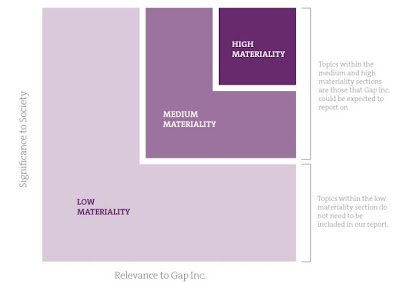
This would be fantastic if the issues that Gap Inc. had identified as material were shown in this three-band matrix. The issues are not separately listed, so the reader needs to do some detective work in order to understand what's material and what's not. Frankly, G4 or otherwise, I do wonder about the sense of including all the detail about materiality process and then not actually stating the issues and where they fit. I agree that prioritizing issues within the high, medium and low materiality bands is redundant, but if the work has been done to place issues in one of the three boxes, and deliberately not disclosed, we the readers become more interested in why not, than in what the issues actually are. It diverts our attention from the substantive to the technical aspects of reporting.
However, as I usually take a detective-type approach when reviewing reports (just call me Pink Panther) I understand that the Gap Inc. report content list serves as the material issues list, and the issues for which material Aspects are included in the G4 Content Index are the ones that fall into the high and/or medium materiality box. Well, that's how I understand it anyway. Crystal clear, right? Working on this premise, I see that Gap Inc. has identified 15 material Aspects (out of a possible 46) and reported on 21 indicators out of a possible 91 indicators.

The Material Aspects are:
Gap Inc.'s performance in key areas has been strong: employee volunteering and corporate community contributions have increased each year since 2008. Total carbon emissions have decreased each year for the past three years. So has U.S. energy consumption. The percentage of red-rated factories, that is, those which must put in place corrective action after Gap Inc.'s audits, has reduced each year for the past four years. Gap completed 1,148 audits in 2012. Gap has been driving environmental efficiencies through the supply chain through provision of Green Manufacturing Workshops for key vendors. Overall, Gap Inc.'s report attests to ongoing commitment and good performance. The name of Gap Inc. has become synonymous with championing of human rights in the supply chain and this report continues to testify to Gap Inc.'s leadership in this area.
As a report, and as a report which was apparently written in the spirit, if not the letter, of the G4 framework, however, Gap Inc.'s delivery is disappointing this time around. This is a two year report and while one might expect that much has changed, there is inconsistency between reports. For example, two years ago, there was an ECO focus on three core issue areas:

In the 2012 report, water conservation gets a page of narrative, but no data and water conservation is not listed as a material issue. In 2010, seven environmental goals were reported with targets for 2012-2015. In 2012, two of these are reported as completed, one has changed and four have slipped off the map. Instead, one updated and three new goals for 2015-2020 have been developed. Tracking Gap's performance against stated goals in the environmental area needs Rubik-cube like skills.
Similarly, I find a disconnect between goals and narrative and data. In the community goals, for example, Gap Inc. reported on progress of a previously stated goal: "Strive to increase the annual value of employee-driven contributions of time, money and talent to the community", noting this has been achieved. However, a chart shows that total contributions and volunteerism have decreased in the past two years. So, the striving was done and the target was ticked? Who cares about striving?

This dissonance continues through to the way in which Gap Inc. describes its materiality process. Transparently, Gap Inc describes the way it selected material issues and the criteria for doing so. Generously, Gap Inc. shows us an empty materiality matrix. For our general education and edification.

This would be fantastic if the issues that Gap Inc. had identified as material were shown in this three-band matrix. The issues are not separately listed, so the reader needs to do some detective work in order to understand what's material and what's not. Frankly, G4 or otherwise, I do wonder about the sense of including all the detail about materiality process and then not actually stating the issues and where they fit. I agree that prioritizing issues within the high, medium and low materiality bands is redundant, but if the work has been done to place issues in one of the three boxes, and deliberately not disclosed, we the readers become more interested in why not, than in what the issues actually are. It diverts our attention from the substantive to the technical aspects of reporting.
However, as I usually take a detective-type approach when reviewing reports (just call me Pink Panther) I understand that the Gap Inc. report content list serves as the material issues list, and the issues for which material Aspects are included in the G4 Content Index are the ones that fall into the high and/or medium materiality box. Well, that's how I understand it anyway. Crystal clear, right? Working on this premise, I see that Gap Inc. has identified 15 material Aspects (out of a possible 46) and reported on 21 indicators out of a possible 91 indicators.

The Material Aspects are:

Water conservation, as mentioned above, earns a place in the report content list and some narrative, but not identification as a highly material Aspect. Given the amount of water used in cotton-production, and what Gap Inc. refers to as freshwater risk in the report narrative, I find it surprising that water did not merit inclusion as one of the top material issues.
The G4 Content Index itself is online, and is nicely hyperlinked to different parts of the online report. However, the Index is not quite what it is supposed to be. For example, several disclosures refer to Gap Inc.'s annual reports for 2011 and 2012, or other documents, providing a general link to the webpages of these documents. This is not the GRI way.
G4 guidelines state quite specifically (Principles Manual, page 13) (my highlights):
"Information related to Standard Disclosures required by the ‘in accordance’ options may already be included in other reports prepared by the organization, such as its annual report to shareholders or other regulatory or voluntary reports. In these circumstances, the organization may elect to not repeat those disclosures in its sustainability report and instead add a reference to where the relevant information can be found. This presentation is acceptable as long as the reference is specific (for example, a general reference to the annual report to shareholders would not be acceptable, unless it includes the name of the section, table, etc.) and the information is publicly available and readily accessible. This is likely the case when the sustainability report is presented in electronic or web based format and links are provided to other electronic or web based reports."
There are some other examples of where the Content Index doesn't quite provide a route to an actual relevant disclosure as required by the corresponding reporting indicator.
Any report that proclaims any level of G4 adherence is bound to come under the microscope in the coming year. The G4 promise is focus, clarity, and materiality. It's next generation. It's leadership and reporting best practice. Clearly, the early adopters are going to be scrutinized. For better or for worse, Gap Inc. has put itself in that space and while this report does not claim to be "G4 In Accordance", it does include a G4 Content Index. It's the Index that hooked me.
The G4 Content Index itself is online, and is nicely hyperlinked to different parts of the online report. However, the Index is not quite what it is supposed to be. For example, several disclosures refer to Gap Inc.'s annual reports for 2011 and 2012, or other documents, providing a general link to the webpages of these documents. This is not the GRI way.
G4 guidelines state quite specifically (Principles Manual, page 13) (my highlights):
"Information related to Standard Disclosures required by the ‘in accordance’ options may already be included in other reports prepared by the organization, such as its annual report to shareholders or other regulatory or voluntary reports. In these circumstances, the organization may elect to not repeat those disclosures in its sustainability report and instead add a reference to where the relevant information can be found. This presentation is acceptable as long as the reference is specific (for example, a general reference to the annual report to shareholders would not be acceptable, unless it includes the name of the section, table, etc.) and the information is publicly available and readily accessible. This is likely the case when the sustainability report is presented in electronic or web based format and links are provided to other electronic or web based reports."
There are some other examples of where the Content Index doesn't quite provide a route to an actual relevant disclosure as required by the corresponding reporting indicator.
Any report that proclaims any level of G4 adherence is bound to come under the microscope in the coming year. The G4 promise is focus, clarity, and materiality. It's next generation. It's leadership and reporting best practice. Clearly, the early adopters are going to be scrutinized. For better or for worse, Gap Inc. has put itself in that space and while this report does not claim to be "G4 In Accordance", it does include a G4 Content Index. It's the Index that hooked me.
I believe that this report doesn't do full justice to the fabulous work Gap Inc. has done and continues to do in the garment industry. If you asked me who are the best apparel players for sustainability in this sector, Gap Inc. would certainly be one of the top companies I would cite. I think this representative of the reporting challenges we all face. How do we present our sustainability risks and opportunities, and more importantly, impacts, in a clear, complete and balanced way, telling our story so that it reflects our organization's achievements, and remains within the constraints presented by the GRI Reporting framework?
Clearly, it's not that simple. Daniel Fibiger is Senior Manager of Strategy and Performance in Gap Inc.’s Social and Environmental Responsibility Department, and he expresses the challenge well in a post he wrote to introduce Gap Inc.'s 2011-2012 report: "... as the author of the report, the task of trying to summarize or highlight certain aspects of it is an unenviable one. Part of this might have to do with my background. I’ve been with the company for just over two years, and previously worked for several human rights NGOs, where I partnered with major apparel companies to address human rights issues in their supply chains. So when I try to think about what’s important, my answer is: all of it.....I also believe this is a work in progress. My hope is that our next report has more focused goals, provides more comprehensive data-driven insights, and more effectively conveys the impact we are having. If we do those things well, we’ll also be able to make it shorter, which will hopefully lead more people to read it. The work starts now on delivering that."
Gap Inc.'s report may not fit the G4 structure perfectly just yet, but the great progress and authenticity, right up to admission of the challenges of reporting, is evident in Gap's culture, and maybe that counts for even more than an impeccable G4 Content Index.
Clearly, it's not that simple. Daniel Fibiger is Senior Manager of Strategy and Performance in Gap Inc.’s Social and Environmental Responsibility Department, and he expresses the challenge well in a post he wrote to introduce Gap Inc.'s 2011-2012 report: "... as the author of the report, the task of trying to summarize or highlight certain aspects of it is an unenviable one. Part of this might have to do with my background. I’ve been with the company for just over two years, and previously worked for several human rights NGOs, where I partnered with major apparel companies to address human rights issues in their supply chains. So when I try to think about what’s important, my answer is: all of it.....I also believe this is a work in progress. My hope is that our next report has more focused goals, provides more comprehensive data-driven insights, and more effectively conveys the impact we are having. If we do those things well, we’ll also be able to make it shorter, which will hopefully lead more people to read it. The work starts now on delivering that."
Gap Inc.'s report may not fit the G4 structure perfectly just yet, but the great progress and authenticity, right up to admission of the challenges of reporting, is evident in Gap's culture, and maybe that counts for even more than an impeccable G4 Content Index.
elaine cohen, CSR consultant, winning (CRRA'12) Sustainability Reporter, HR Professional, Ice Cream Addict. Author of Understanding G4: The Concise Guide to Next Generation Sustainability Reporting AND Sustainability Reporting for SMEs: Competitive Advantage Through Transparency AND CSR for HR: A necessary partnership for advancing responsible business practices Contact me via www.twitter.com/elainecohen or via my business website www.b-yond.biz (Beyond Business Ltd, an inspired CSR consulting and Sustainability Reporting firm)







 Posts
Posts

