Showing posts with label report. Show all posts

Monday, September 4, 2017

People Planet Play at Caesars

Over the past couple of weeks, I have been horrified (as I am sure we all have) by heartbreaking first-hand accounts of people fighting for their safety and facing the loss of their homes in Houston, Texas and the region in the wake of Hurricane Harvey. I am sure we cannot begin to understand the challenges each is facing, nor the length of time it will take for the people of the area to achieve some sort of return to normal life. Our hearts go out to all those affected.

In the corporate world, many are mobilizing to provide emergency assistance and relief to the people of the area. It is no surprise to me that Caesars Entertainment was one of the first to announce support. See this post on LinkedIn:


This doesn't surprise me because I know Caesars Entertainment to be a genuinely caring company that invests in communities without hesitation all year round and not just in times of crisis. But when a crisis hits, Caesars can be counted on. I have been working with Caesars Entertainment for several years now, supporting annual citizenship reporting and other initiatives. I have had the privilege to personally engage and interact with hundreds of team members at Caesars in the U.S. and other parts of the world, from the President and CEO and senior executives to a very wide range of individuals in diverse roles. 

Without exception, I am struck every single time by the genuine passion and deep engagement of those I talk to, and their appreciation for the caring, nurturing, inclusive culture that is easily recognizable throughout the organization. Whether it's the CEO, Mark Frissora, who places employee engagement on a par with customer satisfaction and financial performance as a fundamental tent of the company's success (check out his  welcome message in the Caesars 2016-2017 Corporate Citizenship Report), or Mary Thomas, Executive Vice President of Human Resources, who says: "Our employees want to feel that our company is contributing to a better world," or a Caesars HERO (community volunteer), or a Health Wellness Nurse, or a Responsible Gaming Ambassador, or, in fact, just anyone at all, the folks at Caesars care. So it was certainly no surprise to see that Caesars is one of the first corporations out there taking action to support fellow citizens through the trauma and devastation that Hurricane Harvey has wrought. 


Which brings me back to Caesars eighth annual 2016-2017 Corporate Citizenship Report, this time under the theme of 

People Planet Play


People Planet Play is the new way Caesars is talking about citizenship and sustainability - to employees, to guests and to all of us. It's a corporate strategic framework for planning, reporting and communicating, setting out clearly what Caesars stands for as it does business. Jan Jones Blackhurst, Caesars' Executive Vice President of Public Policy & Corporate Responsibility explains:


People Planet Play enables the organization of all citizenship themes and programs under one umbrella:


So, for example, highlights for 2016 are organized in this format.


In this report, key members of the Caesars Executive team explain how this People Planet Play framework works for them and how it aligns with the vision of Caesars business development and growth in coming years. The report is written in accordance with GRI Standards, core option. More compact than prior years, it covers all key areas of progress in the past year or so, including:

Development of science-based emissions targets: For the past ten years, Caesars has set ambitious environmental intensity targets and has steadily achieved them each year. In establishing science-based targets, Caesars joins industry leaders in respecting planetary limits with absolute emissions targets through 2050.

Continued achievements in employee wellness: The Wellness Rewards program helps employees get healthier as they get older and in 2016, another year of strong participation enabled Caesars 50,000+ employees in the U.S. to feel well, save money and enjoy life. 


Ongoing leadership in Responsible Gaming: This is a core element of citizenship at Caesars, and has been for more than 25 years when Caesars developed the first industry efforts to address problem gambling among guests. Caesars continues to demonstrate leadership wherever it operates so that people who choose to take part in gaming activities can have fun doing so and know that help is at hand if this is not the case. This report includes major strides to advance responsible gaming in the UK where Caesars operates several casinos, as well as ongoing activity in the U.S.


Economic and social contribution in communities: Caesars has established strong ties within all the communities that host its properties, and makes a significant economic contribution. In addition to the >400,000 hours of community service that Caesars volunteers invested in their communities last year, Caesars distributed more than $9 billion of economic value to its stakeholders. A third-party analysis shows that contributed value by Caesars (wages, taxes and corporate giving) was almost three times the estimated average of U.S. corporations. 

Taking a public stand: As usual, Caesars doesn't shy away from speaking up for justice.  Whether it's on policy relating to LGBTQ rights or taking a stand against human trafficking, Caesars voice is where it counts. Gwen Migita, Vice President, Sustainability & Corporate Citizenship puts it like this:


(By the way, if you are heading to Singapore in September by any chance, come and join us at the Asia 2017 Sustainability Reporting Summit where Gwen will be speaking on embedding a culture of citizenship and the People Planet Play framework.)

Finally, who said sustainability reporting is not fun? Caesars 2016-2017 Citizenship Report also gives you the opportunity of a chance to win two nights at Caesars Palace in Las Vegas. Just by completing a super fun crossword.


Check it out, follow the instructions and you could be waking up to breakfast in Nevada. But even if crosswords are not your thing, I recommend you taking a look at this report from a clear citizenship leader in the gaming-entertainment-hospitality industry. There's much more in there that I have been able to mention in this post. As usual, send your feedback!


Disclosure: As you probably realized, I worked on this report (as well as on Caesars' prior four reports).  It's always a pleasure and honor to work with Caesars. But shucks, that makes me not eligible to enter the draw for the crossword prize.


elaine cohen, CSR Consultant, Sustainability Reporter, former HR Professional, Trust Across America 2017 Lifetime Achievement Award honoree, Ice Cream Addict, Author of three totally groundbreaking books on sustainability (see About Me page). Contact me via Twitter (@elainecohen) or via my business website www.b-yond.biz (Beyond Business Ltd, an inspired CSR consulting and Sustainability Reporting firm). Need help writing your first / next Sustainability Report? Contact elaine: info@b-yond.biz 

Elaine will be chairing the Asia Sustainability Reporting Summit in Singapore on 19-20 September 2017 and the edie Conference on Smarter Sustainability Reporting  in London on 27th February 2018

Tuesday, July 28, 2015

Short reports, big messages

Some of the best reports are the shortest. Writing a short report doesn't mean you lose the big message. On the contrary, short reports focus the mind on the right information for the right stakeholders. So, when Liberty Global decided to prepare the Group's 2014 annual G4 core Corporate Responsibility Report at 32 pages (excluding covers), this immediately caused the adrenaline to flow and the brain-cells to gravitate to a different approach to reporting that is much more focused and strategic than the intuitive approach of "let's gather everything we can and report on that". Heaven forbid that a company should forget to include the $1,500 donation that operators in the packing plant collected for Oxfam, or the Christmas party held for local schoolkids, or the color of the plant manager's new socks. All of these things are great, but when you tune yourself in to reporting strategically on the most important things - what I call relevant transparency - then you end up with an immensely readable, compact and relevantly transparent report. 


That's not to say that Liberty Global doesn't pack a punch with this report. Partially, this is because this strategic approach is not new. Liberty Global adopted a clear CR framework in 2012 and has empowered this framework to guide the global corporate approach and activities, improving in focus and sharpness with each successive year.


Promoting a digital society is at the heart of the strategy and represents one of the group's most material impacts. Liberty Global is the largest international cable company with 27 million customers subscribing to 56 million television, broadband internet and telephony services, operating in 14 countries and employing more than 38,000 people. Consumer brands owned by Liberty Global that you might recognize include Virgin Media, Ziggo, Telenet and UPC. The Liberty Global report covers activity driven at corporate level and provides a framework and direction for the companies in the group, most of whom report separately in their own markets. The digital society is Liberty Global's core business and advancing access and skills to take advantage of the digital society is both a social good and a business benefit. Strategically, Liberty Global has aligned business, sustainability and materiality. This forms the basis for reporting and enables the possibility of an extremely focused report.

Keeping the report short is then a four pronged affair: First, get the strategic framework right. Check. Second, be completely selective about what to include and what to exclude. Adding in loads more case studies - and there are plenty in a company the size of Liberty Global - is not an advantage. Selecting specific stories that illustrate performance and are representative of material impacts is what you aim for. Exclude the non-critical stories. Check. Third, once you have selected the content and stories, keep the narrative compact, minimal, and avoid repetition. Check. Fourth, where you can, use visuals to tell the story and save on words while getting the message across. Check.

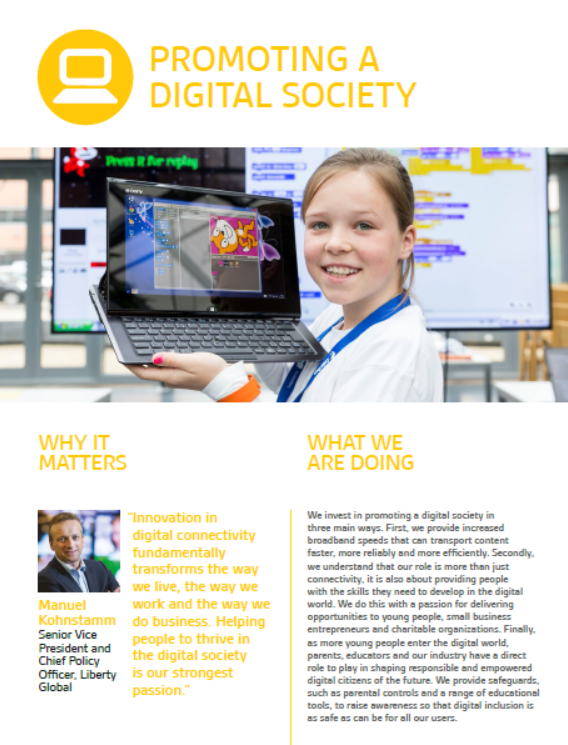
Example of a visual used to present a lot of information about Liberty Global's digital society initiatives.

One of the impressive features of Liberty Global's reporting is the consistency of alignment to a set of multi-year commitments. As with prior reports, in 2014, Liberty Global clearly updates us on progress made against these commitments and advises new ones. Commitments (or targets) are available for each material impact area -  a total of 14 targets in all. Just a couple didn't progress as planned, and these are communicated transparently.

Each of the report's main sections starts with an explanation of why it matters and what Liberty Global is doing.


Aside from the presentation, Liberty Global has made impressive headway in its Corporate Responsibility performance over the past few years, and in 2015, was named the RobecoSAM Industry Mover, achieving the largest proportional performance improvement among industry peers. Liberty Global has improved energy and carbon efficiency against 2020 targets, and has advanced a program of supply chain assessment of key suppliers based on self-assessments against 21 environmental and social indicators. And as for promoting a digital society, Liberty Global has been a consistent support and key player in the Digital Agenda for Europe , investing in programs such as YouRock’s employability platform and CoderDojo, a not-for-profit coding club across Europe with 60 sessions that reached 2,000 young people.


Here is the press release that gives some more highlights of the report.

For a short report, that is aligned with GRI G4 Guidelines, Liberty Global's 2014 Corporate Responsibility Report gets the message across. I recommend you take a look. And give feedback!


Disclosure: I assisted Liberty Global in preparing the 2014 Corporate Responsibility Report.


elaine cohen, CSR consultant, Sustainability Reporter, HR Professional, Ice Cream Addict. Author of Understanding G4: the Concise Guide to Next Generation Sustainability Reporting  AND  Sustainability Reporting for SMEs: Competitive Advantage Through Transparency AND CSR for HR: A necessary partnership for advancing responsible business practices . Contact me via Twitter (@elainecohen)  or via my business website www.b-yond.biz   (Beyond Business Ltd, an inspired CSR consulting and Sustainability Reporting firm).  Need help writing your Sustainability Report? Contact elaine: info@b-yond.biz   

Saturday, July 11, 2015

Getting Human Rights Right

Unilever gets a lot of the spotlight these days on the sustainability horizon. This will help you understand why. I felt compelled to shine a light on the new report that Unilever has published on human rights. This is by far one of the best corporate accounts of position, practice, performance and intention on this subject that I have seen over the years, and again, Unilever raises the bar for advancing sustainability practice and disclosure. With this report, Unilever turns human rights from an onerous obligation that's reported by most companies with zero bells and whistles and a dollop of misplaced righteousness into a fun, colorfully-presented, superbly constructed and actually interesting 64 pages. This has to be mandatory reading for anyone thinking about their company's position on human rights - both for the insights about what's important and why and what can be done, and also for the way it's presented. Just look at the cover. Doesn't look like boring old human rights again, does it?  


Paul Polman's introduction is credible. This is because Paul Polman has become more of a sustainable brand than Unilever itself. Paul Polman's personal brand promise is about the no-nonsense practicalities of making sustainable values work. All may not be perfect at Unilever but Paul Polman cuts through the noise as a leading sustainability advocate with a trusted voice that speaks honestly and with integrity. When Paul Polman says in this report that Unilever is approaching human rights with a mixture of conviction and humility, I believe him. When he says the process of developing the Unilever's inaugural human rights report has been inspiring and humbling, I believe him. When he says this is a new beginning, and a long-term commitment, I believe him. And believing him, I am believing the report. Partly also because this report is not touted as a look-how-great-we-are report, but as a sharing of learnings and a stage in the journey. It's also a public declaration of intent to go beyond "respecting human rights" to "actively promoting human rights". There is a sense that this report is as much for Unilever itself as it is for the world.  

It starts with reiterating the social need to protect human rights and goes on to highlight milestones along the path that Unilever has taken over the years to bring human rights into the corporate consciousness.


Marcela Manubens, Global VP for Social Impact at Unilever, reinforces the approach, making a call to "rethink" business. "At Unilever, our vision is to build a company that represents the new capitalism, in which business exists to serve – not take from – society, and is a critical enabler of inclusive economic growth and job creation.

There are many things we can learn from this report. I am tempted to quote so much of it, but that would make this post as long as the report itself. So I will limit myself to a few observations:

Unilever's approach is firmly rooted in policy, starting with external globally-accepted policy frameworks that most of us are familiar with, such as the Universal Declaration of Human Rights and ILO (International Labor Organization) policies. It is also the first report that is aligned with the UN Guiding Principles Reporting Framework that was launched in February 2014 following the work of John Ruggie. What's interesting here is the way Unilever has created a set of aligned policies (7 in all, including the original Unilever Code of Business Principles) and while there is some overlap, each targets a specific aspect of Human Rights and /or a specific audience (such as suppliers or business partners). This suite of policies forms the bedrock of Unilever's action across the range of human rights issues in the business. 

Unilever's governance of human rights issues is clearly laid out - from the creation of HR Ambassadors across the markets to external engagement with a range of stakeholders. Long-standing collaborations with NGOs Oxfam and Solidaridad, among others, have helped shape Unilever's perspectives and performance. 

The focus of Unilever's activities has been clearly articulated across 8 core human rights issues identified as "salient" for Unilever.  (Maybe "salient" is the new "material"?).  


Each issue is addressed in its own section, providing some context, Unilever's historical and current approach, and a few case studies. It's good reading. What's most appealing, and illuminating, is the discussion of the challenges a company like Unilever faces when reaching deep into the supply chain to uncover issues at the day-to-day level of diverse operations and Unilever's sharing of examples of problems that have arisen and actions taken to resolve. For example, a supplier was found conducting pat down searches to prevent workers from bringing their mobile devices to the production area, and at a salt pan operation in India, excessive working hours, poor health and safety practices, and lack of a proper process for the payment of wages were uncovered. An an independent assessment of Unilever's tea supply chain in Turkey revealed "significant and pressing" challenges. Equally, there is an open discussion of road safety risks with 48 road traffic-related fatalities involving Unilever employees on company business and members of the public, as well as more than 250 injuries and 5,000 accidents between 2007 and 2014. Land use is a fairly recent addition to the human rights agenda, and Unilever's work in this area is also at an early stage, but the intention to create a new Global Land Rights Policy and ongoing consultations with external experts and organizations will help Unilever establish leadership here too in coming years.

The next section of this report is dedicated to Unilever's framework: Prevent - Detect - Respond - both in Unilever's own operations and throughout the supply chain.  Due diligence, supplier audits, support and encouragement for suppliers as they try to improve, and detailed tracking analysis of compliance data are highlighted. There was a 60% decrease in conformance issues over the past couple of years, for suppliers who were re-audited, but, Unilever notes, "while these audits present us with a snapshot in time, they do not communicate the full story." Ongoing local engagement and constant vigilance are key to making sustainable change.

This inaugural Human Rights report ends with Unilever's directional objectives for the coming three years. These includes a intention to create a set of quantitative metrics, noting  "more attention needs to be given to measuring social profit and loss". Uh oh. I hope this doesn't mean that human rights impacts will be converted to $ or Euros or £ a la Kering EP&L - which could turn the focus from people and lives to endless number-crunching and bottom lines. But I certainly am in favor of a methodology that helps us understand the true measure of social impact - positive and negative - of corporations and it's possible that Unilever's dialogue-based approach may held create breakthrough in this area.

All in all, while this report, as a first report, demonstrates a maturity of approach, there are many areas where Unilever must reach even deeper and embed robust systematic sustainable change and find creative and meaningful ways to measure progress. In the meantime, hats off to Unilever for all that has been done so far and triple ice creams all round for everyone who worked on this report. It's a text book for advancing and promoting human rights and a fascinating read, presented in an optimistic way. As the report notes: "The work ahead is significant but not insurmountable."

Read this report. It's worth a half hour of your time.


elaine cohen, CSR consultant, Sustainability Reporter, HR Professional, Ice Cream Addict. Author of Understanding G4: the Concise Guide to Next Generation Sustainability Reporting  AND  Sustainability Reporting for SMEs: Competitive Advantage Through Transparency AND CSR for HR: A necessary partnership for advancing responsible business practices . Contact me via Twitter (@elainecohen)  or via my business website www.b-yond.biz   (Beyond Business Ltd, an inspired CSR consulting and Sustainability Reporting firm).  Need help writing your Sustainability Report? Contact elaine: info@b-yond.biz   

Sunday, November 9, 2014

Reporting is seriously undervalued

This past week, I was privileged to attend as a guest speaker the World Business Council for Sustainable Development (WBCSD) 2014 Annual Council Meeting in Atlanta. This will be the first of a few posts reporting from the field about the sessions where I was involved in Atlanta and highlighting the work of the WBCSD, which I found to be compelling, engaging and very leading-edge. For a quick look at what WBCSD is all about, check out the website or take a look at this post.

The first of the three sessions I took part in was the presentation of the 2014 (second annual) edition of Reporting Matters.  Reporting Matters is the bible of reporting effectiveness, using reports of WBCSD members as the basis for an analysis against 18 criteria (a "reliability" criterion was added in 2014). The new report showcases best practice examples selected from 162 sustainability and integrated reports analyzed across all criteria. This is a tremendous resource for any reporter. The Reporting Matters team from WBCSD and Radley Yeldar have done a great job in pulling this all together. What's more, overall, reports show an improvement over 2013 with 25% of reporting companies showing better materiality disclosure. 86% of reporters use GRI guidelines (up from 75% in 2013)  with 25% of reporters already having transitioned to G4. This year again, GRI reporters tended to score better than non-GRI users.

Reporting Matters 2014 was unveiled in Atlanta by the Redefining Value team. Redefining Value is one of the WBCSD's priority work areas to help deliver its Vision2050 which proposes that a "business should be measured by its ‘True Value’ and should use ‘True Costs’ and ‘True Profits’ in its internal and external reporting." This means including the costs and benefits of externalities and reporting in a way that links profit and loss, performance and value creation in the context of longer-term environmental and social impacts.

After presentation of the report and other insights from the Future Leaders development program (more about this in a future post), I was asked to share some insights about reporting. Below is the gist of what I said (including the bits I skipped over for lack of time)(I get carried away talking about reporting)(Did you notice?)

"

I have studied the new Reporting Matters report and find it very valuable for any company to learn and improve. Sustainability reports are meant to be used. To be used, they must be effective. Peter Bakker (WBCSD President and CEO) states in the introduction to Reporting Matters 2014 : "The end goal [of reporting] is concise corporate disclosure that brings together financial, environmental and social performance to reflect improved risk and performance management within companies, as well as to drive more accurate valuation of companies and improved allocation of capital market investments." Improving performance. Improving allocation of investments. That means change. Reporting both reflects and DRIVES change. 

Here is the key message I want to share with you today.

Reporting is seriously undervalued – the failure to capture the power of the reporting process to drive performance, engagement and empowerment is probably one of the biggest failures of business over the past 10 years. Let's face it. Whenever anyone talks about reporting, all you hear is groans and sighs. All people do is moan that their reports don't get read. Everyone talks about the cost and resources required for reporting but very few people actually refer to it as an investment. No-one smiles when they talk about reporting. Quite the opposite in fact. Mention sustainability report and people's jaws drop to the floor or they go into a deep coma. Hardly anyone actually says: "Wow, we derive real benefit from our sustainability reporting. It's a fantastic and fun activity. It's really worth our time and effort.

So, how did that happen? How did we turn sustainability reporting into everyone's biggest headache? How is it that companies who are expert at squeezing every cent out of a capital investment get barely a quarter of the value from their report? Let me tell you why. It's because reporting is, sadly, very misunderstood. And who misunderstands reporting the most? Yes, you guessed it. Pretty much everyone. CEOs. Investor Relations folks. Managers. And, don't fall off your seat… Chief Sustainability Officers. Yes. Quote me on that. Chief Sustainability Officers don't understand reporting. Haha. I'll probably never work in this industry again, but what the heck. I can prove it. Just go back home to your workplace and see how many managers and employees know about your sustainability report and have actually taken an interest in any part of it. Call up any of your key suppliers and ask them if they have noticed your report. Talk to a few customers. See what they say. Ask your Sustainability Officers how many conversations they have had about their latest report with just about anybody. I am prepared to guarantee that, for most of you, the responses won't be very encouraging. 

So let me present another perspective. Sustainability Reporting has business value, it engages internal and external stakeholders, it empowers people and it's fun. Notice that I talk about reporting, not just reports. Because the PROCESS is just as important as the OUTPUT. What you do with the output is also part of the process. A Sustainability Report is made up of three parts: the preparation process, the publication and the engagement process following publication. Most people undervalue the first part, minimize the second part and completely ignore the third part. 

Sustainability Reporting has business value, it engages internal and external stakeholders, it empowers people and it's fun. 

Business value: The minute you follow a reporting framework, you are forced to think about issues in a different way. If you take a framework such as the GRI G4 framework, you are asked to give deep consideration to material impacts and the focus of your sustainability activities. The minute you publicly declare what's material, your paradigm of what you are doing, measuring and reporting changes. And when it does, you start to create a different kind of business value and business commitment. But only if you do this as a serious activity. If you just go through the motions, all you get is motions.

Engagement: The reporting process is a fantastic platform to engage internal and external stakeholders on what's important to them and their expectations of you. You may think you know. Maybe you do. But asking the questions creates ownership, partnership, commitment, motivation. Talking in a different way to stakeholders will deliver you a different kind of stakeholder relationship. 

Empowerment: I say that everyone engaged in the reporting process is empowered by it. Sustainability reporting is a way to bring people out of their regular activities, allow them to tell their stories, shine a little. With so many online platforms for reporting, employees are now even becoming movie stars .. reporting videos featuring employees are becoming much more popular. Take a CEO. CEOs have almost no involvement, I might say, even no ownership, for the reporting process. Most of them probably hardly even read their own opening statements. Yet, look what happens to a CEO when she has a great sustainability report to share … suddenly the CEO can join a conversation about sustainability, can showcase her organization on world stages, is seen as progressive or at least, legitimate. It's highly empowering for a CEO to be able to demonstrate – through a Sustainability Report – that her company is behaving in a sustainable manner. 

Don't let the technobabbling frameworks misguide you. Part of the headache around sustainability reporting is that we all think it's so complicated. GRI, SASB, CDP, Integrated Reporting… finding your way through a labyrinth of conflicting and disconnected guidance documents written in language that you need to be a professor of law to understand doesn’t really help anyone. But it's not that tough. Don’t let all these technobabblers derail you. It really is quite simple. Work out what your unique contribution to the world is. Define how you are materially impacting stakeholders. Prioritize. Act. Measure. Report. Engage. Voila. Don't let the framework builders define what's important for you. You have to do that yourself. Don't let SASB tell you biodiversity is important. Let your stakeholders tell you. Don’t let the Integrated Reporting framework scrunch up your brain with so many different capitals if they don't have meaning for you. Since when was a person "HUMAN CAPITAL"? How weird is that? Sustainability reporting in its simplest essence about the way your company impacts the world, how it measures and accounts for doing so. Doing it well adds value to your business, it's engaging, empowering and fun. 

Put comparability back in its box. One of the big dilemmas of course is how to tell who is better than the rest. We are all obsessed with ranking and ratings, and yes, wait for it, the Holy Grail of Comparability. Companies are competitive and sustainability is a competitive differentiator. GRI was set up with a goal (among others) of establishing comparability. It never worked. Even CDP, where the focus is on a single set of KPIs, I suggest, does not achieve true comparability. So you know that Company X has lower GHG emissions than Company Y. That single data-point is connected to so many other data-points that it's just not enough as a basis for making an informed decision about investing, buying from or working for that company, or allowing it into your neighborhood. I say comparability is a diversion. What we should be looking for is good process that delivers intended results and consistency over time that enables us to see how a company does better than itself. 

Consistency is the differentiator. Some of the best companies in this space are most respected because they demonstrate consistency over time. A single report is a drop in the ocean. Sustainability credibility is a series of action and reporting cycles over several years, where progress can be demonstrated. M&S and Plan A, Kingfisher and Net Positive, Patagonia and the Footprint Chronicles, Pepsico and Performance with Purpose, Nestle and Creating Shared Value, Unilever and the Sustainable Living Plan, Skanska and Deep Green, H&M and Conscious Fashion. The value in this program branding is its consistency year after year of delivering sustainability results. All these companies set multi-year targets and follow through, coming clean about where they are not delivering. 

Don't force it (all). I am often asked about mandatory reporting. Should all companies of a certain size be FORCED to report and FORCED to report the same things? There is no doubt that voluntary reporting has not evolved as a universally accepted norm in a consistent way. There is also no doubt that legislation changes the way companies behave. The Denmark report or explain experience caused more companies to report and some to actually derive benefit from it. In an ideal world, companies would want to use reporting to derive the value it brings for their companies. However, there's something else. If we believe that reporting has value and is a catalyst for performance improvement, why would governments not be more interested in having companies do things that will help them create performance improvement? It's in the economic, social and environmental interest of governments to have more companies report, and use the output to drive allocation of resources and plan future infrastructure. I therefore believe that governments should mandate sustainability reporting of policy, process and a  set of core indicators that should be disclosed by all companies. Exactly what and how companies report this and more can be discretionary. Those companies who, as now, see it as valuable will invest more and derive more value from it. Those who want to tick the box will do the minimum and get the minimum in return. But as a minimum, governments are also accountable for corporate impacts and should legislate to know what they are dealing with. 

Reports are people. Legislation alone is not going to make the transformation here. Companies are. CEOs are. People are. Stakeholders are. Sustainability reporting is one of the tools that can help this transformation. Rounding off, my message is that Sustainability Reporting has business value, it engages internal and external stakeholders, it empowers people and it's fun. If you approach reporting with this mindset, you will be amazed at what reporting can do for your business and for your stakeholders. You might even find it raises a smile. Or two.

"


elaine cohen, CSR consultant, Sustainability Reporter, HR Professional, Ice Cream Addict. Author of Understanding G4: the Concise guide to Next Generation Sustainability Reporting  AND  Sustainability Reporting for SMEs: Competitive Advantage Through Transparency AND CSR for HR: A necessary partnership for advancing responsible business practices . Contact me via Twitter (@elainecohen)  or via my business website www.b-yond.biz   (Beyond Business Ltd, an inspired CSR consulting and Sustainability Reporting firm).  Check out our G4 Report Expert Analysis Service - for published G4 reports or pre-publication - write to Elaine at info@b-yond.biz to help make your G4 reporting  even better.   

Thursday, May 22, 2014

Three Big Ambitions at Tesco

I love retail. It's fascinating - so varied, so full of so many different ways of impacting and influencing our lives. So many different priorities and so many opportunities to drive change. The retail sector is highly visible and constantly in the public eye. Not surprisingly, as most of us interact daily with the retail sector for the products we consume, ranging from food, to personal care, clothes, home appliances, furniture and almost everything else. The choices that retailers make affect millions of lives each day.

The retail sector is no stranger to scrutiny and it's probably true that corporate responsibility and sustainability leaders at the large retailers have a job that is anything but boring. Such is the case with Josh Hardie, Group Corporate Responsibility Director at Tesco. Today is one of those totally non-boring days:

First, Tesco announced it is to remove sweets and chocolate from checkouts across the full range of its stores by the end of the year. Tesco found nearly two thirds (65%) of customers said removing confectionery from checkouts would help them make healthier choices. Just over two thirds of parents (67%) told Tesco that confectionery-free checkouts would help them make healthier choices for their children.

Second, Tesco released its annual corporate responsibility communication, the 2014 Tesco and Society Report. More about that later. First, I was pleased to have the opportunity on this non-boring day to chat to Josh and hear his insights about what made today not boring. Josh has been in his role for around 18 months, having managed Tesco UK Community activities for three years prior to that.

Me: Well done on getting rid of sweets at the checkouts.....
Josh: Yes, we believe we are the first in the industry to do this. It's an absolute fit with our approach to helping people manage their health, and their family's health, by not creating temptations that don't support a healthy lifestyle.

Me: And this on the day you publish your Tesco and Society Report...
Josh: We are working all the time to advance our objectives and make a positive impact. The news is not the publication of the report. It's about how we are fulfilling our role in society. This is a fundamental change. In the past, it was all about the report. Anything you wanted to know about CR at Tesco, you would have to go to the report. Now we are trying to make this much more of a continuous communication, updating our website, much more real-time. While the report is important, it should not be the only way we communicate.

Me: CSR at Tesco has been changing  ....
Josh: Essentially, around 18 months ago, we realized that the way we were approaching CSR wasn't really doing the job, and was rather fragmented. Apart from carbon management, where we had done some great work and achieved impressive results, our overall CSR activity was not having the measurable social and commercial impact that we aspired too. Therefore, we took a long, hard look and what was going on and tried to reframe how to move forward.

Me: And Tesco and Society was born....
Josh: Yes, we learnt from what we did in the carbon area. It had been entirely embedded in the business, and all parts of the business had a role to play. It was managed integrally, rather than just being a project lead by community managers. We decided to take a proper look and adopt a more issues based approach, focusing on the issues Tesco people care about. We had hundreds of conversations internally and externally, and came up with our three big ambitions around reducing food waste, improving health and creating opportunities. These issues truly resonate with Tesco employees and they also meet pressing social needs.

Me: But that's not all ....
Josh: Of course not. But the rest is completely non-negotiable. Trading responsibly, reducing our impact on the environment, being a great employer and supporting communities - these aspects of doing business are now so fundamental that they are just part of the way we work. We need to maintain and improve our performance in all these areas. However, the three big ambitions are the areas where we can take a leadership position, given the size, scale and impact of a business such as Tesco. This can lead to truly meaningful change.

Me: And a culture change......
Josh: Yes, this is the hardest part. You can't change culture in a day. It takes time in an organization like Tesco. Refocusing the way we think about these issues, and our role in advancing solutions, and truly embedding them so they become part of the work that people do all the time and not just a project here and there is a really major transformation for our business.

Me: Aligning with global directions in sustainability...
Josh: We have learnt from what other companies are doing in sustainability, especially the companies that have broken the mold such as Nike. Our approach aligns with the way materiality is driving big change, based on a more holistic view of our role in society. We have flipped the way we are thinking, and this is the start of our new journey.

Me: But I didn't notice any targets...
Josh: Work in progress. Changing the way we think and identifying the big issues we will address has been the focus of our energies so far. Also, setting targets in some of these areas is a real challenge. How do you measure the impact we have on customers' health? Do you look at the healthy content of shopping baskets, or calorie content, or something else? We are reviewing the way we can measure our impact across all our CR performance areas, especially our three big ambitions, and plan to have firmer targets developed by the time our next report is published. We have a new advisory panel that is helping us in this area as well.

Me: I also didn't notice G4 showing up...
Josh: We take guidance from the Global Reporting Initiative framework, but we have chosen not to apply the framework in full. We feel that it's a very useful guide and has challenged us to improve our materiality and disclosure, but prefer the flexibility to do this in a way that is specifically relevant to our strategy.

Me:  What else isn't in there?
Josh: All the answers. We have tried to reflect our approach and performance in a modest way, focusing on the issues, expressing the start of a journey and the challenges ahead in a more realistic way than just saying how wonderful we are. One of the most difficult things is going out to the public with a declaration that we plan to do something in the area of food waste, health or anything else, when we don't have all the answers. Whatever we communicate triggers a debate. With this report, we have had to have the confidence that we mean what we say and that we will work toward delivering our promises, even though we can't provide all the detail today.

Me: And the next report
Josh One thing we might do better in the next report is reflect the different pace of progress in our three ambitions. In this report, we have given all three fairly equal weighting when in practice, we are far more advanced in the area of food waste, we are starting to motor just now in the area of improving health, and in the area of creating opportunities, we have some way to go. In the next report, we should try to reflect this in a way that gives each issue a more appropriate weighting.

Me: Not going to be a boring year, then...
Josh: Anything but.

As Josh Hardie mentioned above, this report is designed around the Tesco and Society approach that was developed last year and introduced in the 2013 report. Despite this not being a G4 report (you all know how I love G4!), the report has a priority-issues-based structure that enables us to clearly navigate to what Tesco is doing in the areas that matter.


The three big ambitions take center stage, and are well explained. At this point, as it is still early days in the "scale for good" journey for Tesco, it's as much about intention as it is about performance, and time will show how Tesco progresses in future reports. This report is very appealing to a wide readership - clear narrative and infographics galore - it might even appeal to Tesco customers. Maybe Tesco should place copies of this report at the checkouts instead of sweets :) Haha. Just joking. I think.


For the more professional reader, the report is rather light on 2013 performance data in areas I would expect a large company sustainability report to cover, such as, for example, employee diversity (other than gender), health and safety, and water performance relative to prior years. Also, while the focus on the three big ambitions is valuable, other issues that we might expect to be discussed in a corporate responsibility report of a major grocery retailer didn't hit the radar - socio-economic impact of store location and placement, construction and green building, sustainable agriculture, supplier diversity, sell-by dates, product labeling and all the other businesses that Tesco is involved in from mobile phones to banking services to petrol filling stations and more. However, the Tesco website contains a wealth of additional information including a catchy business model animation and deeper dive reports into specific issues.  

In the meantime, Tesco is doing more than reporting. It's driving a culture change throughout its business, and that's infinitely more challenging. This, of course, is what will make a difference to the lives of the half a million employees of the company, and the many more millions that go to Tesco to shop in several countries. Reporting about it reinforces and leverages that culture change. I am cautiously optimistically looking forward to the next report already. 


elaine cohen, CSR consultant, award-winning Sustainability Reporter, HR Professional, Ice Cream Addict. Author of Understanding G4: the Concise guide to Next Generation Sustainability Reporting  AND  Sustainability Reporting for SMEs: Competitive Advantage Through Transparency AND CSR for HR: A necessary partnership for advancing responsible business practices . Contact me at www.twitter.com/elainecohen   or via my business website www.b-yond.biz   (Beyond Business Ltd, an inspired CSR consulting and Sustainability Reporting firm)

Thursday, July 11, 2013

Sustainability with Passion

The Novus International 2012 Sustainability Report, the fifth annual report of this billion $ privately-owned company was published recently online. 
 

Novus International, Inc. is a provider of health and nutrition solutions for livestock, poultry, pets and people, headquartered in St. Charles, Missouri, U.S.A., employing more than 800 people in over 50 countries and serving more than 3,000 customers worldwide in over 100 countries. Novus operates facilities including corporate offices, research and development laboratories and manufacturing operations, as well as smaller offices with field staff in most local markets. Working from a strong base of scientific understanding and technological innovation, Novus has brought more than 100 new products to market over the past decade, contributing consistently to sustainable animal agriculture production and global food security while growing revenues and global presence. The Novus pledge is a Triple S Bottom Line – Solutions, Service and Sustainability.
 
I am particularly happy to blog about Novus, because (here it comes... disclosure >>>) Novus has been my client for some years now and I have been involved in developing and writing the 2012 report, as well as prior reports for 2011 and 2010. In preparation for the report, I interviewed around 50 Novus executives (including the CEO who is directly involved and passionate about Novus's sustainability journey) and many staff all over the world, and some external stakeholders, and collected data from over 10 manufacturing, offices and research sites. The thing that always impresses me each year about working with Novus is the absolute clarity that all the people in the organization have about their company's mission and purpose, and the passion with which they talk about their role in advancing the mission. When I asked Thad Simons, the President and CEO of Novus, about his major achievements as CEO over the past few years, without hesitation, he talked about creating an organizational culture that supports the sustainability mission - "building Novus with a sense of purpose and passion and a service culture". A CEO who leads a sustainable culture is a CEO who creates a sustainable business. Novus has grown year on year and makes a significant contribution to advancing sustainable food and improving food security in many ways. This approach is paying off!
 
The highlights of the Novus 2012 Sustainability report are to be found in the approach to reporting as well as in the data and information presented. For the first time, Novus includes a description of the organization's value chain, which shows where and how Novus generates triple bottom line impacts. Also for the first time, each section of this report is presented personally by the managers and staff who lead the organization. In each section, a Novus person tells her or his story, in her or his own words. For example, the Human Resources VP and Director talk about how they are advancing this prized organizational culture, and different managers talk about their experience in nurturing partnerships to advance sustainable solutions, while EHS Managers talk about sustainable design of offices and working spaces (Novus has a LEED Platinum certified HQ which has won several awards). The insights shared by Novus people  - the narrative is what they actually said,  not professionally copy-written texts  - are what makes up the Novus story: information and data combined with the personal contribution, leadership and drive of all the individuals. Supplementing the written narrative are several short videos, prepared specially for the report, which give you, report-users and stakeholders, a chance to see the faces behind the names and experience the passion beyond the written word. 
 
At GRI B level, GRI-checked Sustainability Report, Novus is not short on transparency either, and this report includes evidence of good performance. For example, energy consumption in production operations reduced by 5.7% in 2012, and safety performance continues to be well above industry averages with an injury rate of 0.48 per 100 employees (compared to a rate of 3.8 in all sectors in the U.S.).

One of the highlights in helping prepare the report for me is the Novus employee wellness program - see insights from Judith Thelwell who manages the program. For years, Novus has been demonstrating leading practice with one of the most comprehensive and highly engaging employee wellness programs around, that offers practical benefits for employees, and financial benefits for both employees and the company. This is a vibrant program which enables employees to engage in health and fitness related activities and earn benefits for doing so, beyond the personal benefit to their own health. In my discussions, I chatted with Andy Critchell, who works in IT Systems at Novus, (read his insights, too, in the same section), and his story was very moving. Diagnosed with diabetes, Andy had to make some serious life changes. The accessibility of Novus wellness benefits helped Andy take control and actually terminate medication for his condition. Without me even having to ask, he confirmed that this actually makes him a more productive employee. This conversation brought home to me, once again, the massive impact companies have on the lives of individuals, and the force for good that companies can become.

Another inspiring part of this report is the section on Valuing Partnerships. Novus works in partnership in almost every area the company is involved in. In fact, partnership development is a core competency of Novus, whether this means global partnerships to effect major transformation - such as the collaboration with the International Egg Commission (IEC) to advance the consumption of eggs as a low-cost, highly accessible source of nutrition (read Joanne Ivy's insights - she's President of the IEC), or specific local partnerships, such as a multi-stakeholder public-private partnership in Chad, to help build a $50 million industrial poultry production facility which will provide around 30 percent of the country's poultry needs and contribute substantially to food security in that country. This partnership includes the Chad government as well as a Novus customer, Globoaves, and a financing partner, working together to provide affordable, wholesome food for the Chad population and improve the quality of their lives. Read insights from Luis Azevedo about how all this came about. Partnerships are at the heart of sustainability. Companies who know how to collaborate in the true spirit of partnership are the ones that will be around for many years to come.

Please take a look at the Novus report and as always, give feedback.


elaine cohen, CSR consultant, winning (CRRA'12) Sustainability Reporter, HR Professional, Ice Cream Addict. Author of Sustainability Reporting for SMEs: Competitive Advantage Through Transparency AND CSR for HR: A necessary partnership for advancing responsible business practices Contact me via www.twitter.com/elainecohen   or via my business website www.b-yond.biz   (Beyond Business Ltd, an inspired CSR consulting and Sustainability Reporting firm)

Saturday, June 15, 2013

23 FSRs (Fabulous Sustainabilty Resources)

As sustainability reporters, we are always in learning mode. The fast-paced evolution of the sustainability field and the dynamic changes that happen all around us make it a challenge just to keep up with the latest thinking, recent research, new findings, leading insights etc. Stuff spins on and off our computer screens before we have time to know it's there and then, whoops, it's gone, and despite a mental note to take a look at it later, we never do. Familiar? Sure. The only thing you really have time to read is, of course, the CSR Reporting Blog. And as a big thank you, here is our new offering. FREE summaries and commentaries on 10 recent fabulous publications (some more fabulous than others) which will make you even better sustainability professionals, and provide you with interesting facts to tell at dinner parties. This is a one-time thing, so don't get your expectations up that we will be doing this on a regular basis. We are too busy trying to keep up with what's really going on out there.

A study by Ernst & Young LLP and the Boston College Center for Corporate Citizenship
 
This is the report of a survey of 579 respondents from U.S. based companies of which more than half also have operations outside the U.S. 391 of the respondents work for organizations which publish a Sustainability Report, the rest don't. It's not clear whether respondents were executive, management or non-management level. The report provides a rather glossy picture of the state of reporting, and all of its wonderful benefits. It's a little short on new insight, and a little OTT on the total wonderfulness of reporting, but it's an interesting and up-beat round-up of the reasons to report, just in case your Board or CEO is not yet convinced.  The emphasis on the value of assurance can't be missed - in several places - in my opinion. See this:

Mainstream analysts and investors are paying attention to sustainability reporting? Really? Perhaps I missed the few that do when I blinked.

An interesting table in this survey is what motivates organizations to report.

Ahead of any other reason, the noble objective of being transparent with stakeholders is cited as the key motivation to report in all the sectors represented in the survey. Brand reputation  is hardly cited as a motivator (but then, the sectors involved are largely not consumer-facing brand organizations) and even stakeholder pressure scores very low. I wonder what this means? Apparently, CEO's just want to be transparent. Tell that to yours. 
 
 
Measuring socio-economic impact – A WBCSD guide for business
This is a fabulous document from the World Business council for Sustainability Development (WBCSD) which explains the  ins and outs of measuring social impact. Know the difference between impacts, outcomes and outputs? This guide will see you straight. Know what the key tools that are available today to help you calculate socio-economic impact? This guide will both define them and tell you what they are good for. The details include ten key tools:


This guide is of specific importance, now that G4 is moving in the direction of value chain impacts. In assessing material impacts, G4 requires you to consider whether these happen internally or externally. In addition, G4 asks for performance measures relating to these impacts. In general, this is one of the hardest things to measure and most companies manage to measure inputs (infrastructure investments, cash donated, volunteer hours, pro-bono services etc.) but few manage to measure outputs, outcomes or impacts. Which is quite a paradox. Billions of $$$ and time (which is $$$) invested into communities without anyone ever asking whether they made a difference and what that difference was, or whether the funds have been used where they can do the most good. Everyone wants a big return on their $, even if this return is calculated in currencies other than monetary, such as in social benefit of different kinds. This guide may not make you an expert but it certainly gives you resources you need in order to work your way up the sustainability professionals capability chain.  (Did you notice how everything is a chain these days - value chain, supply chain, food chain, ball and chain....?)
 
An Ernst & Young survey in cooperation with GreenBiz Group

The report analyzes the results from 282 respondents who represented 17 sectors and are employed by companies with annual revenue greater than US$1 billion. Approximately 85% of these respondents are based in the United States.
 
And the six trends are: 1: The “tone from the top” is key to heightened awareness and preparedness for sustainability risks. 2: Governments and multilateral institutions aren’t playing a key role in corporate sustainability agendas. 3: Sustainability concerns now include increased risk and proximity of natural resource shortages. 4: Corporate risk response is not well paired to the scale of sustainability challenges. 5: Integrated reporting is slow to take hold. 6: Inquiries from investors and shareholders are on the rise.

Any surprises? Nah.

The Future of Corporate Giving
The Charities Trust and Corporate Citizenship

This is the first in a series of publications based on ongoing research into the way corporate philanthropy is changing. Research, comprised of a literature search, interviews with opinion leaders and an online survey of professionals, indicates that four key trends are changing the face of corporate giving:

Commercialization:
"The relationship between a company’s community involvement and its commercial activities has been growing for a number of years. In the future, this trend will accelerate. The boundary will blur further as companies seek more measurable coherence and long-term profits from their corporate giving. Softer benefits such as staff loyalty and enhanced reputation will no longer be enough to ‘claim’ – community initiatives will need to measurably contribute to driving company profitability. Social value and commercial value cannot be neatly separated. But all the interviewees we spoke to and 85% of survey respondents felt that there would be a greater focus on delivery of the business strategy through corporate community involvement in the future. Of all the trends we tested, practitioners rated this as the most significant."

This is a very important insight. Does it signal the end of philanthropy and mark the beginning of community investment as a business driver and not a values-based activity? The report says that finding the synergy between company and community will be the key skills for corporate community managers and community players and not-for-profit partners. 56% of respondents in the survey conducted said that corporate giving would no longer exist as a separate activity, but would be "driven as part of core business strategy". Emerging innovations in this area cited by the report include: Vodafone's M-PESA, Nestlé's Creating Shared Value Model, Hindustan Lever's Shakti model of women's entrepreneurship - none of which are particularly new, but the fact that we always come back to these when talking about new corporate philanthropy may mean that other examples are few and far between, so far.

The other three trends identified, which are currently being researched and which will, presumably, result in further publications are : Innovation Unleashed, Collaborative Coalitions and Cause-related Movements. All sound familiar. The implications of these trends for business are discussed:

"One thing that all four trends have in common is a blurring of boundaries. Distinctions are dissolving between motivations (commercial or societal?), responsibilities (government, not-for-profit or business?), and drivers (companies, suppliers, corporate customers or consumers?). Managers of the future will need to navigate this uncertainty, build coalitions, manage multiple partners and articulate the change they have created convincingly."

Interestingly, this report does not highlight impact measurement as a trend, or as an important factor in advancing community investment. Perhaps when charity becomes business strategy, adapted business models of return on investment may start to apply.
 
And here are four new reports from the Global Reporting Initiative, timed to coincide with the May 2013 Amsterdam GRI Conference:

Carrots and Sticks 2013
Global Reporting Initiative
 
This is the third publication in the Carrots and Sticks series of the GRI, and three other partners, and was launched ceremoniously at the Amsterdam conference by dynamo Teresa Fogelberg and a group of others. Carrots and Sticks is a look at the public policies and regulatory frameworks that are rapidly changing around the world. It's a self-proclaimed "global inventory of sustainability reporting policies and guidance" and includes: 1. Governmental or market regulatory requirements and voluntary initiatives for the public disclosure of sustainability information. 2. CSR initiatives requiring or providing guidance for sustainability reporting or other forms of public disclosure. 3. Requirements or recommendations covering a single topic (e.g., greenhouse gas emissions) or sector (e.g., mining), provided the disclosure has to be public. 4. Standards on sustainability assurance.

You will probably not be surprised to know that the trend is growing. See the table below for the number of initiatives over the past 6 years. More initiatives are becoming embedded in the laws of national governments.
Green represents initiatives for voluntary reporting
Orange are initiatives for mandatory reporting
The report notes that mandatory and voluntary approaches create "mutual traction" - one tends to advance the other. Mandatory disclosure is also increasing affecting state-owned enterprises. Carrots and Sticks provides a detailed update of the status of public policy and regulation on reporting in several countries and regions: Australia, Brazil, China, Colombia, Denmark, EU, France, India, Norway, South Africa and the USA. Which probably means that there is not too much to say about all the rest. Yet. Watch out for Carrots and Sticks 2020. I am sure that will present an entirely different picture. In the meantime, if you want a detailed look at sustainability reporting's regulatory status around the world, this is the best review out there.

Sustainability Topics for Sectors
Global Reporting Initiative

This 156 page report is the outcome of research among sustainability reporters and stakeholders, who submitted suggestions for sustainability topics by sector that could serve as a useful reference for identifying and prioritizing material issues in the sustainability management and reporting processes.  "In total, 194 organizations related to the different stakeholder groups either contributed directly or were researched as part of this effort. This research generated 2,812 topics which were related to 52 business activity groups. Over 600 documents support the 1,612 unique topics that have been identified through this process." The 1,612 topics are described in some detail and offer contextual information, aligned with GRI Material Aspects, so that in preparing your spanking new G4 report, you won't have to start from a blank page. The topics presented by 52 industry sectors. The sectors with the highest number of topics are:
 
Oil and Gas - 96 topics
Mining - 91 topics
Food and Beverage Processing - 78 topics
Electric Utilities - 71 topics
Construction and Home Building - 68 topics
Textile and Apparel - 59 topics
 
 
The tobacco sector has only 7 topics (!) - none of which relates to the degree to which their products kill people.
 
Sustainability Topics for the Tobacco Sector, page 64
 
In each sector, the high-level topic list is supported by detailed supplements which can be downloaded separately from the GRI's resource library. This is the link to the tobacco sector document, for example. Some sectors are more extensively covered than others.
 
This report is a very interesting collection of issues and certainly helpful. It is not exhaustive and in some cases, the list of issues is rather random. However, as input to any process which thinks about material issues, it's worth using. It would be good to see GRI continue this work. In fact, it's somewhat of a shame that more has not been done already. As G4 kicks in, this kind of thinking become more critical.  
 

The Sustainability Content of Integrated Reports - a survey  of pioneers
Global Reporting Initiative

The GRI sure was busy in the run-up to the Amsterdam conference, and this was one of the May 2013 suite of publications. This one, as the title suggests, is all about integrated. It looks at the integrated reports in the GRI database, aiming "to review the different ways in which self-declared ‘integrated reports’ are taking shape around the world", based on the feedback of 18 companies and contributions from a range of experts in this area. An interesting and not surprising conclusion: "The majority of companies find GRI reporting processes useful to their development of an integrated report, either because GRI helps them defining content at the start of their process, or informs their review of the report at the end of its development." In other words, sustainability first, integrated second.

Having said that, the report frankly states the issues with the concept of integrated reporting, and the fact that "at the time of writing, no globally accepted standards or practices exist with regard to what an integrated report should cover and how it should be constructed to meet the needs of its users. Neither is there clarity on who exactly integrated reports’ users are, or how such reports should ultimately be appraised for quality and substance." Spot on. Integrated reporting, despite the recent IIRC Exposure Draft, remains an enigma to most. But it sounds sexy, so I guess we'll see more of it. The survey of pioneers report (what are they pioneering exactly?) covers research (from the GRI database) on integrated reports broken down by type of companies,  sectors, countries and what these reports are called (annual reports, integrated reports, annual and sustainability reports etc.). Also the length. The average length of an integrated report is ....well, that number isn't provided.. but they are getting longer.

In 2010, 22% of reports were 200+ pages in length, while in 2012, 24% were that loooooooooooooooooooong. 40% of integrated reports in 2012 were more than 150 pages. Did anyone check the length of standalone sustainability reports? The report zooms in on South Africa and Australia in terms of integrated reporting practices, and most interesting is the perspectives of the practitioners themselves with interviews from people in reporting companies. This is an intriguing report and if integrated is on your radar, it's worth a look.
 
 
The External Assurance of Sustainability Reporting
Global Reporting Initiative

Another in the flurry of publications timed to coincide with the GRI Conference, this is a short look at the state of assurance from a GRI (and G4) perspective and based on a review of data in the GRI database. The report says: "In 2012, over 46% of reports listed on GRI’s Sustainability Disclosure Database indicated some form of external assurance. While notable differences exist between countries and sectors, the global trend is toward increased assurance of sustainability reports." Personally, I think this is misleading. Many of the assurance statements I read do far from assure sustainability reports, at best they sort-of assure some of the (typically carbon emission and energy consumption) data. At worst, they raise more questions than they resolve. I think assurance is a big mess (ooops, maybe that's not very PC) and needs hoisting out of the current paradigm. Yes, I have some ideas, and will post on this as soon as I can. In the meantime, this report summarizes current assurance frameworks and includes a checklist of what to look for when you are engaging an assurance provider. It's a good reference document, although, why the GRI should publish such a document when the GRI's approach to assurance has been lukewarm lip service at best is rather a puzzle.

Sustainia 100
Sustainia, Denmark


"Sustainia is an innovation platform where companies, NGOs, foundations and thought leaders come together to support and work with a tangible approach to sustainability. Sustainia100 is an annual guide to 100 innovative solutions from around the world that presents readily available projects, initiatives and technologies at the forefront of sustainable transformation." The Sustainia 100 guide is an interesting overview of different creative approaches to different issues, ranging from harnessing solar power in innovative ways connected to women's empowerment in Africa to community computing for the benefit of humanitarian research to smart irrigation and aerodynamic trucking. If you are lacking inspiration in your business, or simply want to see how the age of sustainabilitinnovation (there's a word that confounds blogger's spellcheck function) is still alive and kicking, take a look at this report. There are surely some ideas that are applicable to your business.
 
Accountability and United Nations Global Compact
(Thanks to CSRInternational's Research Digest for alerting me to this one)

The report presents the Sustainability Commitment Growth Curve (SCGC) which forms a roadmap for turning commitments into measurable value creation.


From adoption to implementation to advancement, this roadmap gives sound guidance on how to turn good intentions into good practice. Many of the concepts and approaches are familiar, but they are ordered here in a coherent and accessible way, with a host of interesting examples of practice from companies around the world. The roadmap is aligned with the UNGC principles, and shows how different companies have used the UNGC framework to align resources, structures and programs to deliver value-creating outcomes. This is a good source of inspiration and ideas for companies wanting do deepen their strategic approach to sustainable business.

But that's not all:

And as I was compiling this list above, I came across this other list:
 
13 HOT RESEARCH REPORTS by Sustainable Brands, compiled by Dimitar Vlahov.
 
This contains some more fabulous stuff, really interesting reports, and there is absolutely no overlap with my list, so, just by adding this link, the CSR Reporting Blog offers you a double-scoop of resources for absolutely no additional charge. Come on, admit it, how many other sustainability reporting blogs are this good to their readers?

Show your appreciation by tweeting, retweeting, mtweeting, facebooking, googleplussing and signing up for the CSR Reporting Blog directly to your email. Oh, and a scoop or two of Chunky Monkey next time we meet wouldn't go a miss either.


elaine cohen, CSR consultant, winning (CRRA'12) Sustainability Reporter, HR Professional, Ice Cream Addict. Author of Sustainability Reporting for SMEs: Competitive Advantage Through Transparency AND CSR for HR: A necessary partnership for advancing responsible business practices Contact me via www.twitter.com/elainecohen   or via my business website www.b-yond.biz (Beyond Business Ltd, an inspired CSR consulting and Sustainability Reporting firm)
Related Posts with Thumbnails