Wednesday, November 12, 2014

Is EP&L a waste of time?

As promised (threatened?), another post about the work of the WBCSD and my involvement in the Council meetings in Atlanta last week.

I was greatly privileged to moderate a plenary panel session on the subject of "Redefining Value - costing externalities" with three incredible sustainability and business achievers.


Marie-Claire Daveu: Chief Sustainability Officer and Head of International Institutional Affairs of Kering and member of Kering Executive Committee.   

After embarking on a career as a senior civil servant in the field of agriculture and the environment, Marie-Claire Daveu served as Technical Adviser to the Cabinet of Prime minister Jean-Pierre Raffarin, the Principal Private Secretary to Serge Lepeltier, Minister of Ecology and Sustainable Development, before joining Sanofi-Aventis Group in 2005 as Head of Sustainable Development. From 2007 to 2012, Marie-Claire Daveu served as Principal Private Secretary to Nathalie Kosciusko-Morizet, first within the Ministry of Ecology, then in charge of forecasting and the digital economy, and lastly, within the Ministry of Ecology, Sustainable Development, Transport and Housing. Since 2012, Marie-Claire heads up sustainability at Kering. Kering is a Group of 22 Luxury and Sport & Lifestyle brands such as Gucci, Bottega Veneta, Saint Laurent, Alexander McQueen, Stella McCartney, PUMA and others.  


Roberto Salas: CEO of Masisa, Chile

Roberto Salas serves as President of Grupo Nueva and, since 2008, in addition, as CEO at Masisa, one of the Latin American leaders in production and marketing of wood fiber boards for furniture and interior decorations headquartered in Santiago, Chile. Roberto began his career in Grupo Nueva in 1989, Ecuador. Roberto is Co-Chair of the Development Area of World Business Council for Sustainable Development. He was a Professor at the Faculty of Economics, Universidad Católica de Guayaquil, for 17 years.


Roberto Pedote: Chief Financial and Investor Relations Officer, Natura, Brazil

Roberto Pedote is responsible for Natura's financial and legal matters, as well as investor relations and corporate affairs. Formerly, he spent 16 years with Unilever in Brazil, England and Latin America, and served as Finance Vice-President for the Food and Ice Cream Division in Brazil. Prior to this he served as  Finance and Control Director for Nokia of Brazil. Since 2010, Roberto has been a member of the International Integrated Reporting Council (IIRC), and in 2013 he was appointed member of the Advisory Board for BM&FBOVESPA Listing. Natura is a Brazilian manufacturer and marketer of beauty products, household, and personal care, skin care, solar filters, cosmetics, perfume and hair care products. 

This was a rare occasion to have a CEO, a CSO and a CFO of major corporations together on a stage and ready to share insights about a rather controversial aspect of sustainability accounting and disclosure. I opened up with a really easy question!

"When we talk about externalities, we refer to all those often invisible impacts on society of doing business – the indirect social and environmental effects of your activities on climate change, health and the quality of life. Does it make sense to suggest that companies should calculate and account for these costs? Or is this just a diversion designed to help companies avoid doing the hard work of changing how they business in a more sustainable way?"

All three panelists responded in different ways, referring to the value of the externality costing approach, particularly as a tool to help resource allocation, prioritization and decision-making withing the company. By bringing impacts to a common denominator language in money terms - monetizing impacts - organizations have a new tool to identify and quantify the ways their business activities show up throughout the entire value chain. By using a common language, impacts can be prioritized more easily. Not only this, the exercise forces debate. It presences aspects of business impacts that have previously never been considered. Just having a conversation about externalities in your organization is an interesting first step, and the process of evaluating them, even moreso. Through debates such as these, leading edge companies are now starting to change the game. In our favor. 

To remind you, Kering was, I believe, the first organization to publish in what was thought to be a very bold move, the Environmental Profit and Loss statement of one of its companies, PUMA, back in 2011. (See a great infographic about the value of the EP&L on the Kering website) Marie-Claire Daveu promised that the EP&L for the entire Kering Group would be published soon. The EP&L now can be used to compare and reprioritize impact and risk management across the entire Kering group of companies, using the same tool.

The EP&L created quite a  stir in its day with many hailing it as the new way forward for corporate disclosure. Although many were impressed, there were also many questions. Is it reliable? Does it make sense to put a price on the environment? Is it accurate? Does monetization devalue the true impacts of business? Like, can you put a price on caring? 

We have not seen too many companies follow suit and take the leap into externality costing and disclosing the results. Partly because it is rather a complex exercise. And if you think monetizing environmental externalities is tough, then social externalities and their far-reaching impacts are even tougher to assess. And disclosure is a risk. WBCSD maintains that we will only ever be able to know the true cost of business if we make progress in understanding, assessing and accounting for these external costs, and is encouraging its members to make bolder moves in this direction. That's the essence of "redefining value", one of the strategic priorities of WBCSD in the organization's Action2020 program. The sustainability leaders in our panel discussion believe the process of externality costing adds real value.

Masisa is a company with a strong passion for sustainability and a vision through to 2050.


Masisa publishes an Annual Integrated Report and in 2013, for the first time, published monetized impacts.


Roberto Salas described one approach to externality costing on the social side. He talked about the work Masisa does in communities, considering a range of community needs and managing social development over time. His view is that, by taking a small number of social indicators, and tracking development over a period of several years, social impact will be quantifiable and correlatable to corporate interventions and positive actions. Monetization is not a one-off thing. Externality costing must be viewed as a long-term activity.

Roberto Pedote of Natura shared an important insight. Natura has not yet published an EP&L but they are working internally to develop this. Roberto made the point that the EP&L, however, is not about precision. It's about the trend that the numbers show over time, and the ability to compare the size and scale of impacts as they occur throughout the value chain. This will never be a completely precise exercise, and although it's about numbers, it's not the numbers that are most important. It's the understanding of relative weightings of different material impacts, and deep internal discussions about the accountability of the company to mitigate or improve them. As such, externality costing can be an extermely useful internal engagement and decision-making tool.

I asked the panel if stakeholders are actually asking for EP&L's? Is anyone really all that interested? The response was that, while there are not many explicit demands for this specific calculation, stakeholders are showing more interest and demanding greater transparency from companies. The requests that stakeholders make for information are often those that can be met through the work that an EP&L reqires. Doing the work on some form of EP&L accounting enables companies to respond to broader stakeholder demands for transparency in a more considered and thorough way.

I have to confess to having been somewhat dismissive of EP&L accounting prior to the session and the research I did in preparation and pre-conversation with the panelists and their teams. I had always felt that we spend too much time in analysis-paralysis and not enough time taking bold action. But, now, after engaging with such clear-thinking, driven and enlightened leaders, I am more open to hearing the benefits. As Marie-Claire Daveu, the champion of EP&L pointed out: How can you act without a tool to help you evaluate priorities in a holistic way?

While EP&L may not be everybody's double-fudge ice cream, it's a tool that seems to be helping some of the world's leading companies move forward and it's bringing the discussion around sustainable development to another level. We should probably keep our eye on externality accounting. My guess is that we will be hearing a lot more about it in the coming years.


elaine cohen, CSR consultant, Sustainability Reporter, HR Professional, Ice Cream Addict. Author of Understanding G4: the Concise guide to Next Generation Sustainability Reporting  AND  Sustainability Reporting for SMEs: Competitive Advantage Through Transparency AND CSR for HR: A necessary partnership for advancing responsible business practices . Contact me via Twitter (@elainecohen)  or via my business website www.b-yond.biz   (Beyond Business Ltd, an inspired CSR consulting and Sustainability Reporting firm).  Check out our G4 Report Expert Analysis Service - for published G4 reports or pre-publication - write to Elaine at info@b-yond.biz to help make your G4 reporting  even better.  

Sunday, November 9, 2014

Reporting is seriously undervalued

This past week, I was privileged to attend as a guest speaker the World Business Council for Sustainable Development (WBCSD) 2014 Annual Council Meeting in Atlanta. This will be the first of a few posts reporting from the field about the sessions where I was involved in Atlanta and highlighting the work of the WBCSD, which I found to be compelling, engaging and very leading-edge. For a quick look at what WBCSD is all about, check out the website or take a look at this post.

The first of the three sessions I took part in was the presentation of the 2014 (second annual) edition of Reporting Matters.  Reporting Matters is the bible of reporting effectiveness, using reports of WBCSD members as the basis for an analysis against 18 criteria (a "reliability" criterion was added in 2014). The new report showcases best practice examples selected from 162 sustainability and integrated reports analyzed across all criteria. This is a tremendous resource for any reporter. The Reporting Matters team from WBCSD and Radley Yeldar have done a great job in pulling this all together. What's more, overall, reports show an improvement over 2013 with 25% of reporting companies showing better materiality disclosure. 86% of reporters use GRI guidelines (up from 75% in 2013)  with 25% of reporters already having transitioned to G4. This year again, GRI reporters tended to score better than non-GRI users.

Reporting Matters 2014 was unveiled in Atlanta by the Redefining Value team. Redefining Value is one of the WBCSD's priority work areas to help deliver its Vision2050 which proposes that a "business should be measured by its ‘True Value’ and should use ‘True Costs’ and ‘True Profits’ in its internal and external reporting." This means including the costs and benefits of externalities and reporting in a way that links profit and loss, performance and value creation in the context of longer-term environmental and social impacts.

After presentation of the report and other insights from the Future Leaders development program (more about this in a future post), I was asked to share some insights about reporting. Below is the gist of what I said (including the bits I skipped over for lack of time)(I get carried away talking about reporting)(Did you notice?)

"

I have studied the new Reporting Matters report and find it very valuable for any company to learn and improve. Sustainability reports are meant to be used. To be used, they must be effective. Peter Bakker (WBCSD President and CEO) states in the introduction to Reporting Matters 2014 : "The end goal [of reporting] is concise corporate disclosure that brings together financial, environmental and social performance to reflect improved risk and performance management within companies, as well as to drive more accurate valuation of companies and improved allocation of capital market investments." Improving performance. Improving allocation of investments. That means change. Reporting both reflects and DRIVES change. 

Here is the key message I want to share with you today.

Reporting is seriously undervalued – the failure to capture the power of the reporting process to drive performance, engagement and empowerment is probably one of the biggest failures of business over the past 10 years. Let's face it. Whenever anyone talks about reporting, all you hear is groans and sighs. All people do is moan that their reports don't get read. Everyone talks about the cost and resources required for reporting but very few people actually refer to it as an investment. No-one smiles when they talk about reporting. Quite the opposite in fact. Mention sustainability report and people's jaws drop to the floor or they go into a deep coma. Hardly anyone actually says: "Wow, we derive real benefit from our sustainability reporting. It's a fantastic and fun activity. It's really worth our time and effort.

So, how did that happen? How did we turn sustainability reporting into everyone's biggest headache? How is it that companies who are expert at squeezing every cent out of a capital investment get barely a quarter of the value from their report? Let me tell you why. It's because reporting is, sadly, very misunderstood. And who misunderstands reporting the most? Yes, you guessed it. Pretty much everyone. CEOs. Investor Relations folks. Managers. And, don't fall off your seat… Chief Sustainability Officers. Yes. Quote me on that. Chief Sustainability Officers don't understand reporting. Haha. I'll probably never work in this industry again, but what the heck. I can prove it. Just go back home to your workplace and see how many managers and employees know about your sustainability report and have actually taken an interest in any part of it. Call up any of your key suppliers and ask them if they have noticed your report. Talk to a few customers. See what they say. Ask your Sustainability Officers how many conversations they have had about their latest report with just about anybody. I am prepared to guarantee that, for most of you, the responses won't be very encouraging. 

So let me present another perspective. Sustainability Reporting has business value, it engages internal and external stakeholders, it empowers people and it's fun. Notice that I talk about reporting, not just reports. Because the PROCESS is just as important as the OUTPUT. What you do with the output is also part of the process. A Sustainability Report is made up of three parts: the preparation process, the publication and the engagement process following publication. Most people undervalue the first part, minimize the second part and completely ignore the third part. 

Sustainability Reporting has business value, it engages internal and external stakeholders, it empowers people and it's fun. 

Business value: The minute you follow a reporting framework, you are forced to think about issues in a different way. If you take a framework such as the GRI G4 framework, you are asked to give deep consideration to material impacts and the focus of your sustainability activities. The minute you publicly declare what's material, your paradigm of what you are doing, measuring and reporting changes. And when it does, you start to create a different kind of business value and business commitment. But only if you do this as a serious activity. If you just go through the motions, all you get is motions.

Engagement: The reporting process is a fantastic platform to engage internal and external stakeholders on what's important to them and their expectations of you. You may think you know. Maybe you do. But asking the questions creates ownership, partnership, commitment, motivation. Talking in a different way to stakeholders will deliver you a different kind of stakeholder relationship. 

Empowerment: I say that everyone engaged in the reporting process is empowered by it. Sustainability reporting is a way to bring people out of their regular activities, allow them to tell their stories, shine a little. With so many online platforms for reporting, employees are now even becoming movie stars .. reporting videos featuring employees are becoming much more popular. Take a CEO. CEOs have almost no involvement, I might say, even no ownership, for the reporting process. Most of them probably hardly even read their own opening statements. Yet, look what happens to a CEO when she has a great sustainability report to share … suddenly the CEO can join a conversation about sustainability, can showcase her organization on world stages, is seen as progressive or at least, legitimate. It's highly empowering for a CEO to be able to demonstrate – through a Sustainability Report – that her company is behaving in a sustainable manner. 

Don't let the technobabbling frameworks misguide you. Part of the headache around sustainability reporting is that we all think it's so complicated. GRI, SASB, CDP, Integrated Reporting… finding your way through a labyrinth of conflicting and disconnected guidance documents written in language that you need to be a professor of law to understand doesn’t really help anyone. But it's not that tough. Don’t let all these technobabblers derail you. It really is quite simple. Work out what your unique contribution to the world is. Define how you are materially impacting stakeholders. Prioritize. Act. Measure. Report. Engage. Voila. Don't let the framework builders define what's important for you. You have to do that yourself. Don't let SASB tell you biodiversity is important. Let your stakeholders tell you. Don’t let the Integrated Reporting framework scrunch up your brain with so many different capitals if they don't have meaning for you. Since when was a person "HUMAN CAPITAL"? How weird is that? Sustainability reporting in its simplest essence about the way your company impacts the world, how it measures and accounts for doing so. Doing it well adds value to your business, it's engaging, empowering and fun. 

Put comparability back in its box. One of the big dilemmas of course is how to tell who is better than the rest. We are all obsessed with ranking and ratings, and yes, wait for it, the Holy Grail of Comparability. Companies are competitive and sustainability is a competitive differentiator. GRI was set up with a goal (among others) of establishing comparability. It never worked. Even CDP, where the focus is on a single set of KPIs, I suggest, does not achieve true comparability. So you know that Company X has lower GHG emissions than Company Y. That single data-point is connected to so many other data-points that it's just not enough as a basis for making an informed decision about investing, buying from or working for that company, or allowing it into your neighborhood. I say comparability is a diversion. What we should be looking for is good process that delivers intended results and consistency over time that enables us to see how a company does better than itself. 

Consistency is the differentiator. Some of the best companies in this space are most respected because they demonstrate consistency over time. A single report is a drop in the ocean. Sustainability credibility is a series of action and reporting cycles over several years, where progress can be demonstrated. M&S and Plan A, Kingfisher and Net Positive, Patagonia and the Footprint Chronicles, Pepsico and Performance with Purpose, Nestle and Creating Shared Value, Unilever and the Sustainable Living Plan, Skanska and Deep Green, H&M and Conscious Fashion. The value in this program branding is its consistency year after year of delivering sustainability results. All these companies set multi-year targets and follow through, coming clean about where they are not delivering. 

Don't force it (all). I am often asked about mandatory reporting. Should all companies of a certain size be FORCED to report and FORCED to report the same things? There is no doubt that voluntary reporting has not evolved as a universally accepted norm in a consistent way. There is also no doubt that legislation changes the way companies behave. The Denmark report or explain experience caused more companies to report and some to actually derive benefit from it. In an ideal world, companies would want to use reporting to derive the value it brings for their companies. However, there's something else. If we believe that reporting has value and is a catalyst for performance improvement, why would governments not be more interested in having companies do things that will help them create performance improvement? It's in the economic, social and environmental interest of governments to have more companies report, and use the output to drive allocation of resources and plan future infrastructure. I therefore believe that governments should mandate sustainability reporting of policy, process and a  set of core indicators that should be disclosed by all companies. Exactly what and how companies report this and more can be discretionary. Those companies who, as now, see it as valuable will invest more and derive more value from it. Those who want to tick the box will do the minimum and get the minimum in return. But as a minimum, governments are also accountable for corporate impacts and should legislate to know what they are dealing with. 

Reports are people. Legislation alone is not going to make the transformation here. Companies are. CEOs are. People are. Stakeholders are. Sustainability reporting is one of the tools that can help this transformation. Rounding off, my message is that Sustainability Reporting has business value, it engages internal and external stakeholders, it empowers people and it's fun. If you approach reporting with this mindset, you will be amazed at what reporting can do for your business and for your stakeholders. You might even find it raises a smile. Or two.

"


elaine cohen, CSR consultant, Sustainability Reporter, HR Professional, Ice Cream Addict. Author of Understanding G4: the Concise guide to Next Generation Sustainability Reporting  AND  Sustainability Reporting for SMEs: Competitive Advantage Through Transparency AND CSR for HR: A necessary partnership for advancing responsible business practices . Contact me via Twitter (@elainecohen)  or via my business website www.b-yond.biz   (Beyond Business Ltd, an inspired CSR consulting and Sustainability Reporting firm).  Check out our G4 Report Expert Analysis Service - for published G4 reports or pre-publication - write to Elaine at info@b-yond.biz to help make your G4 reporting  even better.   

Friday, October 31, 2014

GSK, Riga, reporting and ice cream

We were delighted to work once again this year with GSK Latvia on the development of the company's second Corporate Responsibility Report for 2013. The report is the local story of this GSK subsidiary which is making a big impact in a small country with a modest team of just 46 people. The commitment to local transparency and engagement is fantastic. The look and feel of the report aligns with the global GSK report design and structure. GSK Latvia applies global policies and approaches of its parent company including GSK's strong stand on ethics, sales team incentives based on behaviors rather than sales volumes, cessation of payments to physicians for speaking engagements or conference attendance, transparent research practices, investment in employee development and positive environmental practices. However, alongside confirming the way these practices are implemented in Latvia, the content of GSK Latvia's report is finely tailored to the activities and expectations of local patients, healthcare system and team.


Many companies don't make the effort  to report at local level. A global report, covering headlines of global activity, is generally regarded by most of the major multinational corporations as being enough. Big tick. Done that. Report published. At local level, however, the report comes alive. It speaks to local stakeholders about the things that affect their local lives. A recent post from Revital Bitan at Intel (where I contributed some insights) speaks about the importance to Intel in Israel of local reporting and the value it brings. the post is entitled: In CSR Reporting - everything is local!   

Back to Latvia and a report which is full of local people and local flavor. Hear from many GSK Latvian staff and from many local GSK Latvia partners and stakeholders in a report which showcases the incredible energy and commitment of this compact team. For example:

Patient Advocacy: GSK Latvia supports a range of local organizations such as the Asthma and Allergy Society, the Pulmonary Hypertension Society, HIV groups, the Rheumatics society, and the Association of Disabled Women and more. Several leaders of these organizations report how GSK's engagement helps them advance their activities and support patients who need far more than the state healthcare system is able to offer. 

Leading sustainability in Latvia: GSK Latvia is the first and only pharma company to have been honored in Latvia's Sustainability Index for 2013. The Index recognizes advanced sustainability strategy, management and practice and sets the standard for companies in Latvia. 


Funding local causes and volunteering in the community: Even a company of less than 50 people can make an impact. And that's what GSK Latvia sets out to do with its local flagship programs - Mission Possible (an initiative that helps drive quality leadership in education through support for teachers and school principals) and the Small Grants Programme (which awards up to Eur 700 per project for locally relevant initiatives - 9 initiatives have been supported in the last two years) as well as participating in the GSK global volunteering effort under the umbrella of Orange Day. It amazes me how such a small and very busy team manages to do so much. 


Family friendly: On the inside, GSK Latvia has achieved Family Friendly status as recognized by the Ministry of Welfare in the Latvian Government. GSK Latvia is the first local pharma company to achieve this status. In a team where 50% of managers are women, including the General Manager, this is not a trivial matter. Family friendly means that both men and women can enjoy an inclusive culture and equal opportunity at work. 

Supporting healthcare policy: GSK's Latvia's involvement in local healthcare infrastructure and development is important to help patients in Latvia gain access to the best options and the best healthcare treatment. GSK Latvia supports The Foreign Investors Council in Latvia (FICIL) - an organization that brings together the largest companies from various countries and sectors that have made significant investments in Latvia. With a place on the Board of FICIL, GSK Latvia drives home the message that an investment in healthcare is an investment in the economy. Lack of access to healthcare limits economic growth. GSK Latvia has been instrumental in ensuring healthcare issues have a place on the FICIL agenda and are included in FICIL's annual report, a recent new addition.

Ice cream in Latvia: Ok, you're right, this is not part of the GSK Latvia report. But how can I talk about a report without mentioning ice cream? So if you are in Riga, then Skrīveri Home-made Ice Cream seems to me to be the place to go. 100% natural ice cream with all-natural flavors. First stop next trip.

In the meantime, read the report, give feedback! 


elaine cohen, CSR consultant, Sustainability Reporter, HR Professional, Ice Cream Addict. Author of Understanding G4: the Concise guide to Next Generation Sustainability Reporting  AND  Sustainability Reporting for SMEs: Competitive Advantage Through Transparency AND CSR for HR: A necessary partnership for advancing responsible business practices . Contact me via Twitter (@elainecohen)  or via my business website www.b-yond.biz   (Beyond Business Ltd, an inspired CSR consulting and Sustainability Reporting firm).  Check out our G4 Report Expert Analysis Service - for published G4 reports or pre-publication - write to Elaine at info@b-yond.biz to help make your G4 reporting  even better.   

Monday, October 27, 2014

Reporting Matters.. more

Last year, the WBCSD (World Council for Sustainable Business Development), headed by the fearless Peter Bakker, published a review of sustainability reporting called Reporting Matters. I didn't get to blog about it at the time (I wish I could do nothing but blog) but I have taken it up again in the run-up to the invitation-only WBCSD Council Meeting in a couple of weeks in Atlanta, where I will be speaking and moderating in some sessions. The Atlanta meeting is themed: "Business - Setting the Pace". At this meeting, with the belief that business is a driving force for delivering sustainable solutions to the world’s most pressing challenges, senior executives of WBCSD member companies come together to explore opportunities to advance WBCSD's Action2020 strategy. The Council Meeting draws CEOs, Council Members and thought leaders from across all sectors and geographies in a high-level game-changing outcome-oriented week of debates and decisions. 


For those not familiar with WBCSD, it is an organization with a powerful voice in our sustainability landscape and a leading authority on natural and social capital risk management, disclosure and valuation. I include a brief blurb from the WBCSD website. 


"The WBCSD is a CEO-led organization of forward-thinking companies that galvanizes the global business community to create a sustainable future for business, society and the environment. From its starting point in 1992 to the present day, the Council has created respected thought leadership on business and sustainability. The Council plays the leading advocacy role for business. Leveraging strong relationships with stakeholders, it helps drive debate and policy change in favor of sustainable development solutions. The Council provides a forum for its 200 member companies - who represent all business sectors, all continents and combined revenue of over $US 7 trillion - to share best practices on sustainable development issues and to develop innovative tools that change the status quo. The Council also benefits from a network of 60 national and regional business councils and partner organizations, a majority of which are based in developing countries. By thinking ahead, advocating for progress and delivering results, the WBCSD both increases the impact of our members’ individual actions and catalyzes collective action that can change the future of our society for the better." 

Now you know. Check out the website. It's a wealth of resources. 

Anyway, back to the matter in hand and that's Reporting Matters. (Matter, matters. Good, right ?)


WBCSD produced this report in partnership with communications consultancy Radley Yeldar as a tool to help improve the effectiveness of reporting. Member companies can use the WBCSD analysis of their reporting to help improve different aspects of their own disclosure. Reporting Matters 2013 the baseline report and the research is ongoing with reports planned to be published annually. In early November, in Atlanta, the new Reporting Matters 2014 will be presented to give an updated view of data and trends in reporting effectiveness.

Peter Bakker introduced the 2013 baseline report with the words (among others): "We believe that reporting practices need to change to ensure that businesses are truly valued on what is important, that stakeholders have timely information, and that reports are read and used by investors and other stakeholders."

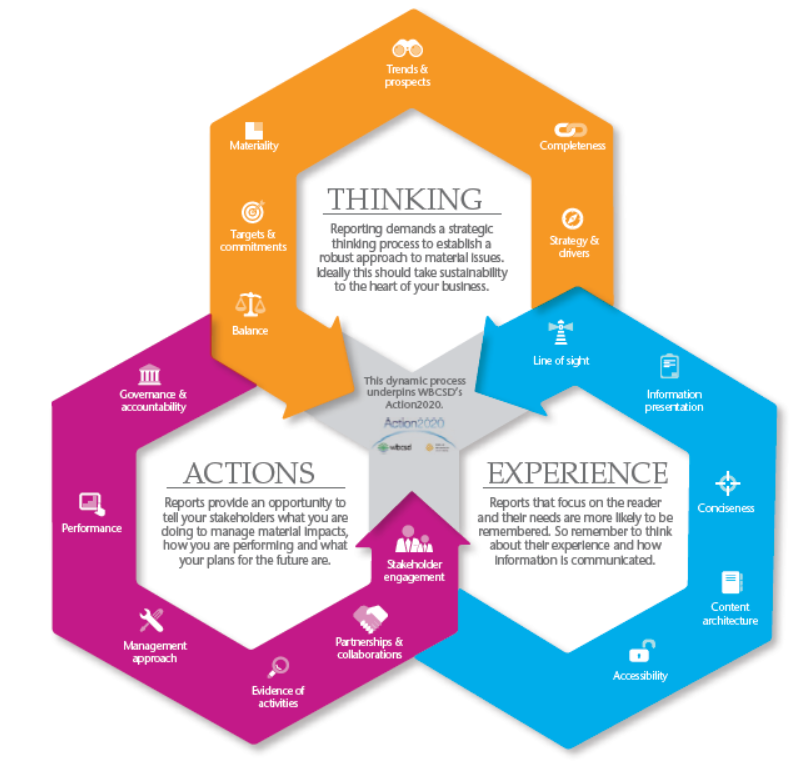
Reporting Matters measures the effectiveness of  corporate sustainability reporting and to do so, it defines an effectiveness framework based on three key elements: The Thinking that defines the report, the Actions (relating to material impacts) that the report discloses and the Experience that the reader has when reading the report.


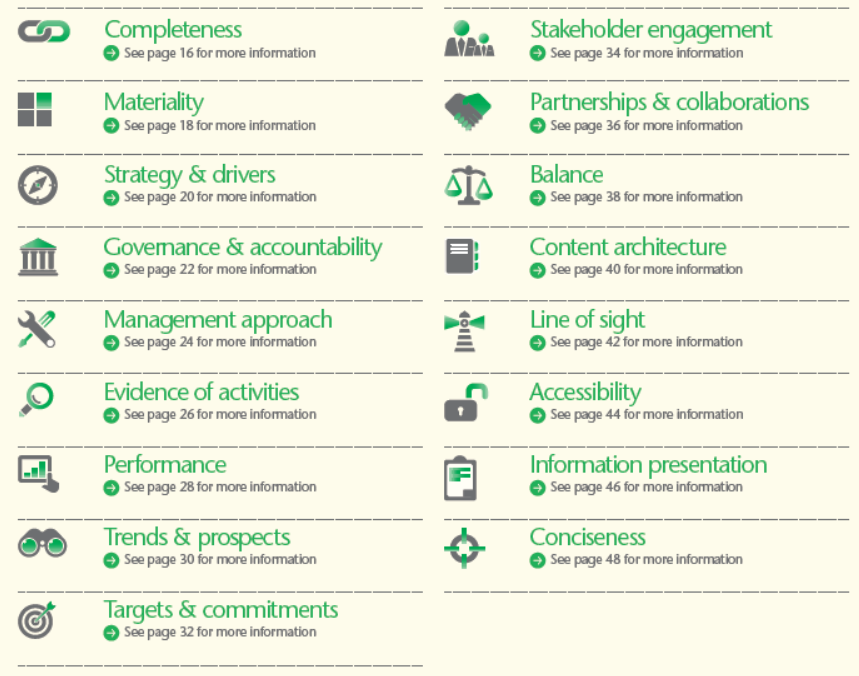
The Reporting Matters baseline examined 175 Sustainability Reports (including integrated reports) of WBSCD member companies across 20 sectors and 30 countries against 17 criteria (12 content-related and 5 experience-related).


For each of these criteria, Reporting Matters explains the approach, provides key findings from the research, offers recommendations and showcases best practice distilled from the 175 reports analyzed. Some of the overarching conclusions were:
  • Companies are reporting far more than a focus on material impacts might suggest. This makes for long, unwieldy reports and difficulty in finding the most relevant and useful information.
  • When combined with the annual report, the amount of sustainability content disclosed is generally less than a standalone report.
  • 75% of the reports analyzed follow GRI Guidelines and these tended to be the ones with the higher effectiveness scores.
  • 80% of the 175 reports analyzed were standalone sustainability reports. However, self-declared integrated reports scored higher on the WBCSD effectiveness scale than many standalones. 
  • 60% of companies have some form of external assurance at some level on some part of the report but only 4 companies (2%) used reasonable assurance for their entire report. 
But the real meaty stuff of this report is in the detailed analysis of the report against the stated criteria. Unfortunately, WBCSD does not share with us, the general professional public, the exact scores that each report received (though WBCSD member companies each receive their own scores and have the opportunity to discuss and review with WBCSD Reporting Matters experts). However, Reporting Matters shares enough for us to get the benefit of the learning and appreciate some great examples of reporting practice. Some examples follow.

Strategy and Drivers: Reporting Matters says: "A sustainability strategy is a clearly-articulated approach or plan to address material financial, environmental, social and governance risks and opportunities. It should link to a vision, a mission and provide an explanation of how the strategy will be delivered, including milestones and targets."

This made me stop and think, and agree, as more and more, I find that I read sustainability reports with a need to understand the strategic relevance and embedded approach that companies have adopted. In the early days of reporting, it was all about taking action in addition to doing your business. Reports were all about "we did this" and "we did that", where "this" and "that" referred to a volunteering activity, a charitable donation, a training event for employees or a LED lighting retrofit. No connection to an overall approach, strategic direction or business relevance other than the platitudes of "giving back", "doing the right thing" and "valuing our planet". Today, it's about being accountable for impacts across the value chain and through the core business. Today, if sustainability is not part of your business strategy, then your business strategy is not part of your future success. In any sustainable business strategy there is value, and that value should be clear as we read a company's sustainability report. Reporting Matters found that:
  • The most effective reporters disclose a business strategy that links to positive sustainability outcomes, such as the management or avoidance of sustainability risks or the development of opportunities through innovation. The strategy is supported by a detailed implementation plan. 
  • The most effective reporters define a specific business case for sustainability, referencing drivers such as cost savings, reputational benefits, and employee retention, as well as wider societal needs. 
  • Many reporters however do not establish a clear link between sustainability and their core business nor do they define a company-specific business case. 
  • Many reports do not include a sustainability vision and consequently do not communicate a clear sense of direction or purpose.
One of the three showcased examples includes Svenska Cellulosa:

Svenska Cellulosa is  a global hygiene and forest products company with around 44,000 employees that develops and produces sustainable personal care, tissue and forest products. The current Svenska Report for 2013 supports the insights noted by Reporting Matters about the prior report. Often, you can tell how much sustainability is embedded in a company's strategy simply by looking at what the company chooses to highlight. In 2013, Svenska highlighted real business developments that have sustainable value. 


While Svenska links its activities to business drivers and reports the results of activities, there is room to go further by reporting more outcomes and linking these outcomes to the business, as well as social and environmental value created. 

Evidence of Activities: Reporting Matters says: "Evidence of activities involves reporting on sustainability activities such as strategic programs and initiatives that occur during the reporting year, or progress of existing sustainability activities. It helps link management approaches to actions and performance and can substantiate statements and claims."

Well, evidence of activities may not seem too much of a stretch for most reporters. In fact, most reporters are more than happy to elaborate on things they did. I wonder if the focus here shouldn't be more on evidence of outcomes rather than activities. However, Reporting Matters 2013 made some relevant recommendations for reporters that refer to the way outcomes are included in disclosures. 
  • Include more specific narrative on strategic sustainability activities that address material issues during the reporting year. 
  • Illustrate sustainability activities through relevant and compelling case studies focusing on material issues, linked to a wider strategic program or management action and focused on outcomes. 
  • Provide appropriate background on the development of strategic programs and initiatives over time but focus on achievements and progress during the reporting year. 
  • Show how disclosed management processes and tools support the implementation of strategic programs and initiatives.
One of the three showcased examples of Evidence of Activities is the Lafarge 2012 report.

In Lafarge's subsequent 2013 Sustainability Report, the company continues its use of relevant case studies that provide evidence of Lafarge's progress.


This is sustainable core business, and references the difference (outcome) that Lafarge is making through sustainable innovation. I would welcome even more detail on the actual outcomes in case studies such as these, but in general, this is an effective way to get the message through.


Partnerships and Collaborations: Reporting Matters says: "Appropriate and strategic partnerships and collaborations can help accelerate action and scale up solutions by combining expertise, resources and networks across key stakeholders who share a common goal. Partnerships and collaborations should focus on addressing a company’s material issues and support the implementation of a company’s sustainability strategy."

This is an interesting criterion and one that is becoming more imperative for most companies as we speak. More and more, the revelation that collaboration is key to sustainability is affecting the way companies approach their own strategies and actions. Our client, Netafim, who recently published a Sustainability Report called "At the Heart of the Food, Water and Land Nexus", knows only too well that, just as all problems are interdependent, so are all solutions. Collaboration is therefore part of the solution. Where every material impact is at some form of nexus (my new sustainability buzzword), so every material action is also at some form of nexus. Collaboration at the Nexus - that's our future.

Reporting Matters 2013 shared these key findings:
  • The most effective reporters highlight strategic partnerships and collaborations that address material issues, and help to implement the company’s sustainability strategy. 
  • The most engaging reports provide details on the expected benefits of partnerships and collaborations for the business as well as for relevant stakeholders.
  • Companies however do not always consistently focus on establishing partnerships which are strategic and that have the potential to deliver the biggest value for the business by being closely aligned with the overall sustainability strategy. Such partnerships are typically philanthropic and not linked to core strategy.
One of the three showcased examples of Partnerships and Collaborations is the Vodafone plc 2012/2013 report which Reporting Matters says has a strong partnership-oriented focus. 


I checked out Vodafone plc's 2013/2014 Sustainability Report and this continues to play out. The word "partnership" features more than 50 times in this report and it's choc with partnership examples in the area of core business. These include partnership around e-mobility, M2M connectivity, technology-supported waste management, smart working solutions, women's security, sustainable agriculture and many more examples. 

I could go on (a lot) but I think this post is already long enough. The point is simply that Reporting Matters is an exceptionally useful document that helps us understand some of the ways in which reporting can become more effective, which according to the WBCSD approach means that it demonstrates strategic sustainability thinking and actions leading to materially relevant outcomes while being focused, balanced and engaging to read.

There are a couple of aspects relating to reporting that I might have added to the WBCSD effective-reporting criteria. There are some things I always look for that for me, really make the difference to the effectiveness and quality of a sustainability report. For example, the leadership statement. This is not directly covered by the defined Reporting Matters criteria. Interestingly too, because WBCSD is a "CEO-led" organization. The CEO statement in any report should not be just an evergreen boilerplaty platitudy we-love-ourselves cringe-piece. It should add value to the report by clearly framing the report context, the company strategic focus and challenges and the intentions to deliver improved material impacts on stakeholders. The CEO statement is the entrance-lobby of the report. If it's not compelling, you don't want to go any further.

Having said that, WBSCD seems to have a good recipe. What makes it truly worthwhile is the ongoing nature of this analysis. The 2013 report is interesting, but the trends and dynamics that will be observed over time with each successive report are the key. It'll be fascinating to see how things have changed during the past year. While we shouldn't get carried away and expect complete transformation of reporting in such a short time, the introduction of G4, the new IIRC framework, progress in SASB standards development, CDP expansion, consultations by WBCSD with its reporting member companies and a generally highly dynamic reporting environment with increasingly legislative orientation (such as the recent European directive) and greater SEC commitment (e.g. Singapore), it's possible that we might find that reporting effectiveness has turned up a notch.

But Reporting Matters 2014 is not the only reason I am looking forward to being in Atlanta. Guess what else I found to do. 


elaine cohen, CSR consultant, Sustainability Reporter, HR Professional, Ice Cream Addict. Author of Understanding G4: the Concise guide to Next Generation Sustainability Reporting  AND  Sustainability Reporting for SMEs: Competitive Advantage Through Transparency AND CSR for HR: A necessary partnership for advancing responsible business practices . Contact me via Twitter (@elainecohen)  or via my business website www.b-yond.biz   (Beyond Business Ltd, an inspired CSR consulting and Sustainability Reporting firm).  Check out our G4 Report Expert Analysis Service - for published G4 reports or pre-publication - write to Elaine at info@b-yond.biz to help make your G4 reporting  even better.   

Wednesday, October 22, 2014

Why YOU HAVE to attend.......

..... the fourth annual Smarter Sustainability Reporting conference. It's on February 24th, 2015 in London.  It's THE annual conference all about sustainability reporting that I chair every year. No, it's not just for reporting geeks, though geeks are thoroughly welcome.


And the reason YOU HAVE to attend is that, for three years now, we have held these totally amazing, informative, content-rich, expertise-packed, opinion-forming, insight-generating, brain-cell-activating, networking-supporting conferences and we still do not have the answer to the question: What is Smarter Sustainability Reporting? We've debated, discussed, shared, chaired, talked, balked, asked, answered, thought, contemplated, ruminated, instigated, irritated, cajoled, encouraged, suggested, digested and just about everything else you do and don't do at conferences... and we still don't have a definitive answer. That's sad. We may have had an answer in the second conference, but then the world changed and we went back to the drawing board at conference three. At this, the fourth annual, we simply have to have an answer. Maybe YOU are the one who can help?

We have a great line-up of expert speakers and panelists - and still more to confirm.

  • Nelmara Arbex, Chief Advisor on Innovation in Reporting, Global Reporting Initiative (GRI
  • Sarah Grey, Markets Director, International Integrated Reporting Council, IIRC
  • Steve Kenzie, UK Network Secretariat, Global Compact Network
  • Simon Howard, Chief Executive Officer, UK Sustainable Investment and Finance Association (UKSIF)
  • Dr. Paul Toyne, Sustainability Director, Balfour Beatty Construction Services
  • Louise Tyson, Head of Reporting, BP
  • Katie Buchanan, Head of Sustainability and Reporting, Virgin Media
  • Irene Jakobi, Sustainability Manager, Telekom Austria
  • Mardi McBrien, Managing Director, Carbon Disclosure Standards Board (CDSB)
  • Shaun Davis, Group Director of Safety, Health, Wellbeing &  Sustainability, Royal Mail
  • Crystal Crawford, Corporate Responsibility Manager, Liberty Global
  • Verity Lawson, Sustainability Reporting Manager, British American Tobacco
  • Michaela Rose, Sustainability Advisor, Forum for the Future

You would think that these fantastic experts would have ALL the answers but I can promise YOU, they can't do it on their own. They need YOU.

How do YOU define Smarter Sustainability Reporting? What makes smart smarter? And what makes reporting reporting? From GRI G4 to integrated reports to carbon disclosures to investor interest to innovation to local/global to transparency, creativity and materiality and a whole lot more, we'll be looking to get at the answer that has been evading tens of speakers and hundreds of delegates since the start of our conference series. Do YOU know? Are YOU harboring a totally intelligent response that we are all waiting for? Are YOU willing to share? Will YOU come to the conference and enlighten all of us? 

If YOU decide to come and help us out, I can offer YOU a discount (being the chair has some privileges) and I can promise to be eternally grateful. And so will everybody else. YOUR presence and contribution is absolutely what will make the difference.

That's not to say that in three years of conferences we haven't answered other questions about reporting, the reporting landscape, trends, challenges, risks and opportunities. A mix of practitioner and subject-matter experts, we have always had rich debate and generated a host of action-oriented insights. The feedback from attendees has always been strong. Each conference has been remarkable. The desire to share and learn more about what's going on in reporting is obviously very much alive for both reporting geeks and reporting non-geeks. That's why we keep doing it. 

You may be wondering by now, what's the point of having a conference every year that can't answer its own question? I remember someone quoting some smart famous person who said: if you keep doing the same things, you keep getting the same results. Or something like that, probably more elegantly put. Which is exactly why we continue to shake things up every year. No two conferences are the same. We have a different agenda, different speakers, different round-table talk sessions, different panel discussions and different areas of focus. We don't keep doing the same things but we still don't have the answer to this really truly completely fully exceptionally elusive question: What is Smarter Sustainability Reporting? Obviously, we have been missing something. Yes. We have been missing YOU. So, please come. Please share. Please tell us YOUR answer. Please help make this conference even  more remarkable. 

So: Block out the date in your diary. Contact me for a 15% discount code. Register. Get prepared to share. And watch this space in the run-up to the conference for more posts in conversation with some of our speakers.


elaine cohen, CSR consultant, Sustainability Reporter, HR Professional, Ice Cream Addict. Author of Understanding G4: the Concise guide to Next Generation Sustainability Reporting  AND  Sustainability Reporting for SMEs: Competitive Advantage Through Transparency AND CSR for HR: A necessary partnership for advancing responsible business practices . Contact me via Twitter (@elainecohen)  or via my business website www.b-yond.biz   (Beyond Business Ltd, an inspired CSR consulting and Sustainability Reporting firm).  Check out our G4 Report Expert Analysis Service - for published G4 reports or pre-publication - write to Elaine at info@b-yond.biz to help make your G4 reporting  even better.   

Monday, October 20, 2014

Summing up Sustainability!

Novus International released the company's sixth annual online Sustainability Report just recently, this time in accordance with GRI G4 at core level.


Novus International, Inc. is a privately-owned feed ingredients company, headquartered in St. Louis, Missouri, U.S., serving customers in nearly 100 countries around the world. A global leader in developing animal health and nutrition solutions, Novus products include feed supplements, additives and many specialty ingredients that help animals digest food better and improve their well-being. All of the products that Novus develops and markets to livestock farmers, small and large, around the world have sustainable benefits - improving feed efficiency, enhancing yield and quality, reducing costs and taking high levels of waste out of the supply chain. Both in established markets that face new economic and regulatory challenges on a daily basis, and for smallholder farmers in emerging markets where Novus has developed a strong presence, this can mean the difference between a successful, sustainable livelihood and hardly any livelihood at all. A more efficient farming operation can be the key not only to surviving but to thriving for many Novus customers.

Inherently sustainable products and services
Novus delivers products and services that are inherently sustainable and improve the efficiency of the entire food chain. In the 2013 report, Novus sums up several of the positive impacts achieved through the company's core business activity. One of my favorite examples is a story about the outcomes of the C.O.W.S. program.

Comfort. Oxidative balance. Well-being. Sustainability.

Over the past three years, Novus invested in a groundbreaking study, the largest of its kind in the world, to assess animal husbandry practices in the dairy industry, and the subsequent implications for both animal welfare and productivity. Novus maintains a team of qualified technicians, who work closely with farm owners, nutritionists, herd managers and veterinarians to understand herd practices and the impacts on cow comfort and productivity. Between 2010 and 2013, Novus assessed 75,000 cows and 400 farms, some multiple times. The results provide incredible insight into performance by size of farm, region, and general management practice, and help understand the bottlenecks that affect cow comfort and ultimately, dairy farm profitability. Novus repeated assessments at over 20 farms, thereby understanding the measure of improvement that was achieved following the implementation of changes made by farm owners after they were presented with herd information. The detailed assessment data helped them understand where productivity bottlenecks were occurring in their farm management practices.

Just one outcome story (and there are many) from this massive undertaking is about a family-owned dairy in New York that, in just one year, maintained milk production while reducing culling rate, halving the prevalence of lameness and knee injuries (which reduce milk production), and delivering improved milk quality for higher-profit sales. In several cases, data from the C.O.W.S. study was instrumental in helping farmers convince the banks that there is a good business case for making a loan to enable farmers to invest in efficiency improvements. In some cases, this made the difference between farmers continuing to produce or closing up shop. This is about sustainable value delivered through the core business, and summing up the research and outcomes of 75,000 cow assessments is one of the truly interesting parts of this report.

The report also contains many other examples of how Novus, through its core products and services, has enabled enhanced customer productivity and profitability. In doing so, Novus makes a strong contribution to overall food availability and cost-efficient food supply chains around the world.

Transitioning to G4 and material focus
The report is somewhat of a transitional report, making the change from GRI G3 reporting at B level for the past few years now, to a more ambitious report using the G4 framework, including consideration and declaration of material issues and the start of a more strategic approach to overall sustainability performance. 

One of the things I have always admired about Novus and the 50 or 60 people I have got to know during the time I have been working with the company is the deep sense of vision and mission. 


People talk this. They work the vision. It's not something I just see in a document somewhere. The many sales people out in the different markets and the extensive research teams in the U.S. and Spain describe their roles and ongoing activities in terms of the degree to which they are contributing to global food security. This plays out in the many conversations I have each year with many individuals around the Novus world. 

In preparation for this report, Novus assessed the issues that matter most, starting with a Materiality Map of more than one hundred potentially relevant areas of material impact. After discussion with stakeholders and internal reviews, Novus created a set of five core material sustainability impacts that reflect the way Novus both makes a contribution and manages its own performance.

The alignment of material impacts and G4 material Aspects, as well as Performance Indicators reported, can be found in the GRI G4 Content Index.


Materiality the heart of the compass
At the heart of the sustainability priorities compass are Novus customers and the sustainable contribution that Novus makes to ensuring they do well, as shown above in the C.O.W.S. story. This is by far the most important and most significant opportunity for Novus, and, by focusing on how customers can do better, Novus does better. And inherently, the world food chain, society in general and the environment all benefit. Reductions in nitrogen emissions from animal livestock, for example, is an outcome of using Novus products. One of the challenges, of course, is knowing how to measure these outcomes, and in preparation for the Summing Up Sustainability Report, many different measures were reviewed and assessed, and this will continue to be refined as Novus moves forward. 

Sustainable animal agriculture is also an important impact for Novus. The agriculture sector, despite its critical importance for our sustainable future, faces many challenges, not least the fact that agri-professions are apparently not as sexy as they used to be. With 70% of the global population migrating to city-living by 2050, as some projections point out, the need for agriculture to be and stay state-of-the-art is even more critical than ever. With 30% - 40% of food production being wasted before it even gets to the consumer, the need to employ skilled people, science-based solutions and enabling technology is no less critical. Novus identifies with these industry challenges and accepts its role in helping attract new talent to agriculture and supporting development scholarships for many agri-students around the world. 

Employee well-being
Another thing that has always impressed me about Novus is the attention paid to employee well-being through the Novus Live Well Program. Employees who subscribe to Live Well gain many personal incentives and benefits, simple by doing things that help keep them and their families fit and healthy. Employees participate in fun, healthy lifestyle events, often as part of teams, and this also contributes to an open and interactive networked culture within Novus. In return for investment in a workplace that supports healthy lifestyles, in addition to organizational and employee productivity benefits, Novus has experienced a reduction in healthcare costs. Win-win all around.  


As always, I recommend you take a look at the Novus International report and.... yes.... give feedback!


Disclosure: Novus International is a valued client and I worked on this report, the fourth I have supported for Novus during a time of significant business change and development for the company. Each year has been fascinating and none more fascinating than the last. 


elaine cohen, CSR consultant, Sustainability Reporter, HR Professional, Ice Cream Addict. Author of Understanding G4: the Concise guide to Next Generation Sustainability Reporting  AND  Sustainability Reporting for SMEs: Competitive Advantage Through Transparency AND CSR for HR: A necessary partnership for advancing responsible business practices . Contact me via Twitter (@elainecohen)  or via my business website www.b-yond.biz   (Beyond Business Ltd, an inspired CSR consulting and Sustainability Reporting firm).  Check out our G4 Report Expert Analysis Service - for published G4 reports or pre-publication - write to Elaine at info@b-yond.biz to help make your G4 reporting  even better.   
Related Posts with Thumbnails