Thursday, October 13, 2022

GRI Reporting: The Case of the Invisible Employees

In the middle of all the raging debates, exposure drafts, ESG wars and explosion in the number of ways you can say materiality, serious reporting companies are gearing up for their next reporting cycle. For those who report GRI, this includes getting ready for the introduction of the new GRI Universal Standards for reports published in 2023. 
You may have noticed that there are some early adopters of the new Universal Standards applied in reports published in 2022. It’s good to see companies showing leadership in transparency and paving the way for use of the Universal Standards. We can learn much from how they do things. Thank you to all the companies I mention below. 
The Universal Standards represent somewhat of a stretch for companies who have reported GRI Core Option in the past. Less so for Comprehensive Option reporters but still some adaptation is required. It’s not quite enough to continue to report as you were doing and just add new labels. 
Disclosure 2-8 is a case in point. This disclosure is an upgrade to previous GRI 102-8-d (2016) which required reporting of “Whether a significant portion of the organization’s activities are performed by workers who are not employees. If applicable, a description of the nature and scale of work performed by workers who are not employees.” A sub-clause of 102-8, this disclosure was largely overlooked and reported only occasionally by companies. Disclosure 2-8 now requires a detailed disclosure:


Let’s start by trying to understand who the workers are who are not employees. This is a tricky one and not as clear-cut as you might think at first glance. My initial assumption was that this refers to agency employees or contingent workers – people who work for an employment agency who replace employees on leave, or supplement employees at peak times etc. 
But, hey, wait, it’s not that simple. 
Reading the GRI guidance in the Standards, you realize it’s all about who controls the work. If the company controls the work of the worker who is not an employee, that worker is in scope for Disclosure 2-8. The guidance says: workers who are not employees are those who perform work for the organization and whose work is controlled by the organization but are not in an employment relationship with the organization. Control of work implies that the organization directs the work performed or has control over the means or methods for performing the work. 
But, hey, wait, it’s not that simple. 
How do you define “control of work”? Control can be interpreted in different ways. Does control mean setting wage scales? Supervising the work? Prescribing the work methods? Monitoring attendance? Defining materials to be used? Scheduling hours of work and rest? All of the above? GRI guidance talks about workers of one of the organization’s suppliers, where the organization instructs the supplier to use particular materials or work methods to manufacture the products or deliver the services
The “extent” of control plays a role here. If it’s control to a high extent, it’s control. If it’s control to a limited extent, it’s not control. Aaaaaaaaaaaargh. In order to solve this conundrum, I went straight to the source and would like to thank GRI's Bastian Buck, Chief of Standards, and Sharon Hagen, Senior Coordinator of Sustainability Reporting Standards, for their insights and guidance. Nothing like getting to folks who created the problem to sort it out for you 🤣. Ultimately, companies will have to define and declare the scope of control they apply in when using Disclosure 2-8. That’s comparability out of the window as reporters will inevitably report in different ways. But heck, comparability is a myth anyway. 

So now we know. Disclosure 2-8 is sort of a DIY disclosure. Make it up as you go along. 

Applying the insights above, here are examples of workers who are not employees, and how Disclosure 2-8 applies to them or not. 
INCLUDE Employees of high-control outsourced operations: An example is people employed by a contract manufacturer that provides a dedicated manufacturing operation (but not necessarily in a dedicated facility), employing a team of trained people to deliver defined products in accordance with a company’s specification. The company prescribes the work in quite some detail, defines the materials to be used, the nature of the work and even some or all of the work processes. Let’s call this high control.
EXCLUDE Employees of low-control outsourced operations: There are several examples – outsourced warehousing, outsourced logistics, outsourced call-centers etc. In these cases, although a company might prescribe an overall approach to the work, for example, safety standards, a Code of Conduct, ISO certification, or certain processes, generally it is the outsourced operation (supplier) that controls the practice of work on a day-to-day basis to meet contractual requirements. The outsourcing provider sets wages, manages employee terms and conditions, hours of work, shift patterns, training, discipline etc. In this case, the company has low control over the work itself. 
INCLUDE or EXCLUDE Employees of hard-to-define control outsourced operations: In some cases, operations may be outsourced with a high level of prescription about the work to be done and the processes to be used without detailing day-to-day specifics. It really depends on how much freedom the supplier of the service has to choose the way it instructs its workers to perform he work. Less freedom = more control. More freedom = less control. The rule of thumb here is: if in doubt, make a decision and explain it, and then apply it consistently. 
INCLUDE Employees of on-site service providers: Employees of contracted services usually performed onsite such as cleaning, catering and security services are usually required to perform their work under a high level of control by the company. Hours of work, place of work, type of work – generally it’s the buyer that decides. 
INCLUDE Agency or third-party contingent workers: These are individuals who are supplied by external employment agencies to do specific jobs in the organization, in place of or in addition to the permanent workforce. For example, cover for maternity leave or sick leave, additional resource on packing lines or in laboratories etc. They join the team and do the work required, directed by the Team Manager or Supervisor. Clearly high control is at work here. Haha. A pun. 
INCLUDE Contractors: Contractors manage and/or deliver construction or engineering-type projects. Often a General Contractor will bring in its own team and specialist sub-contractor companies and their employees to complete a project. They work on the company site or help build new sites, under the guidance and responsibility of the General Contractor who meets the contractual obligations of the contracting company who agrees the work plans and prescribes aspects of the work. 
INCLUDE Independent workers: This may include what GRI refers to as self-employed workers or home workers. They are generally considered an extension of the internal workforce, doing work an employee might do. For example, an independent laboratory worker who joins the team for a specific period of time to do work directed by the Lab Manager, or a homeworker who provides call-center services on contract to the company directed by the inhouse Call-Center Manager. 
INCLUDE Interns/Apprentices: These are included in GRI’s definition or workers who are not employees, even though, in many instances, interns and apprentices are not performing full work roles, but provide supplemental project work as they learn in the organization. For good orders’ sake, these we count these as in scope for 2-8 as control is with the company. 
INCLUDE Volunteers: If the reporting organization is a nonprofit or non-commercial entity, volunteers may be the primary providers of work in the organization, and may be managers, staff or occasional volunteers. Their work is determined by the organization. 
EXCLUDE Employees of general suppliers: Suppliers employ people to make and deliver goods and services. The people employed in the broader supply chain (excluding outsourcing examples above) are managed by their own organizations with no control of the procuring company. They would not be considered part of a company’s extended workforce unless they are specifically dedicated to providing custom work as noted in the examples above.  
EXCLUDE Employees of providers of professional service providers: Employees in legal and accounting firms, auditors, compliance organizations, manpower agencies, design firms etc. While these individuals provide a dedicated, custom service, their work is not controlled by the company.
EXCLUDE Independent consultants: An external consultant who works on contract to supply a service against a Statement of Work or other contract. Similar to providers of professional services.
EXCLUDE Robots: A robot performs work but is not an employee. But a robot is not a person. Well, not really.
EXCLUDE Non-Human Animals: If you use animals to perform work, for example, horses to pull carts, cats to catch mice, dogs to guard the yard, these would also be outside the scope of Disclosure 2-8. But you can report about them anyway. We love non-human animals. 

Complicated, isn’t it? 

But you get the picture. In order to understand a company’s full employment impacts, the categories to include above, in addition to the direct workforce, represent the overall number of people involved in a company’s activities. This number could be significantly larger than the direct workforce, especially in the case of organizations that outsource many operations. Take a company like Inditex. All garment sourcing is outsourced. Inditex employees 165,000 people directly. But has more than 1.3 million people employed in its supplier factories around the world. Although not yet using GRI Universal Standards 2021, Inditex reports extensively on workers in its outsourced factories and even publishes a special report: Workers at the Centre. 


Given the close control Inditex exerts over its garment suppliers, and the detailed strategies and due diligence deployed to drive responsible employment practices in the supply chain, with my new understanding of GRI’s guidance, I would expect these workers who are not employees to be in scope for Disclosure 2-8 when Inditex reports using the Universal Standards next year. 

Workers who are not employees – the invisibles 

Whichever category of “workers who are not employees” companies adopt, it seems that in any case, a lot of them are invisible in the disclosures of companies using the new Universal Standards. I have looked at reports from early adopters (selected randomly) and, in my analysis, in 16 reports: 
One company disclosed in compliance with the requirements of Disclosure 2-8 
Six companies provided some kind of information but not all required details or clarity 
Two companies omit Disclosure 2.8 from the GRI Content Index 
Two companies hide the disclosure 
Three companies advise that the information is not available 
One company provides the wrong information 
One company just doesn’t report
 
So, a one-in-sixteen (7%) hit rate for complete disclosure on workers who are not employees. 93% are more or less invisible. 

Let’s take a look: 

One company disclosed in compliance with the requirements of Disclosure 2-8 

Hong Kong power company CLP Holdings Ltd does a great job. CLP is no stranger to strong sustainability reporting and always delivers highly transparent, well considered reports. In this latest report using GRI Universal Standards 2021, CLP clearly identifies direct employees and different categories of non-employees where labour supply refers to people provided by manpower companies. See CLP’s GRI Content Index


Six companies provided some kind of information but not all required details or clarity 

Singapore-based City Developments Limited (CDL) is a global real estate company and another leading-light reporter and multiple times winner of the Asia Sustainability Reporting Awards over the years. No surprises that CDL is an early adopter of the GRI Universal Standards. CDL references construction workers in the 2021 Integrated Sustainability Report as workers who are not employees. No mention is made of other categories of workers, such as those involved in site services such as cleaning or security, nor whether this is a typical year or if there is significant fluctuation from year to year.  
 
Diageo discloses against 2-8 in the GRI Content Index of its 2022 ESG Report. This disclosure describes different categories of workers who are not employees, but makes no reference to workers in outsourced production operations. If any of Diageo’s outsourced plants operate under “high control”, they would need to be included. Also, no reference to year-on-year fluctuation. 


As with many global garment manufacturers, transparency of the supply chain is more common, whether or not the reporter uses GRI. H&M is however a GRI Reporter and Universal Standards early adopter and provides an overview of workers who are not employees in the supply chain in its 2021 Group Sustainability Disclosure. H&M also discloses much detail about the conditions of employment through their supply chain including wages paid to workers in supply factories in different countries. But as far as Disclosure 2-8 is concerned, there appears to be no mention of other agency or contractor workers at H&M’s own sites. 


Korean tire maker Hankook Tire & Technology’s ESG Report 2021/22 includes a brief response to GRI 2.8 in the GRI Content Index.  Short and to the point. Not clear whether subcontractors includes all types of services or only production-related work at the plants. But it’s something. 


Levi Strauss & Co’s 2021 Sustainability Report (with reference to GRI Standards, does not claim to be In Accordance but includes a GRI Content Index) includes a response to GRI 2.8 that is similar to the approach of H&M, referencing workers at supply chain factories but not other categories of workers.


Houston-based chemical company Westlake’s 2021 ESG Report’s GRI and SASB Appendix includes a GRI 2.8 disclosure that explains the company’s approach but provides no data. Better than no response at all. What’s an insignificant portion of the workforce? Less than 100? Less than 1,000? Westlake employees 14,000 people.


So far, all the companies mentioned have made some attempt at responding to GRI 2.8, even if all but one failed to provide a complete disclosure. The following companies did not provide any information or data, or provided the wrong information: 

Two companies omit Disclosure 2.8 from the GRI Content Index

U.S. based specialty food ingredients company Darling Ingredients2022 ESG Report GRI Content Index has a neat way of dealing with GRI 2.8. Just omit it from the Content Index.
 

Galaxy is a digital asset and blockchain leader providing institutions, startups, and qualified individuals access to the crypto economy. Hmmmm. There’s a business I don’t know much about. In any event, Galaxy had the same idea as Darling Ingredients. Just skip it. Galaxy’s Annual Sustainability Report 2021 includes a GRI Content Index. 


In fairness, both Darling Ingredients and Galaxy reference GRI Standards and do not claim to be In Accordance. 

Two companies hide the disclosure

These companies claim their reports are “In Accordance” and include a page reference for Disclosure 2.8 in the GRI Content Index. But, the disclosures are actually nowhere to be found is nowhere to be found in the reports. Hide and seek, anyone? 

Three companies advise that the information is not available

AT&T’s fiscal 2021 ESG Report GRI Content Index notes: 
AT&T is not able to provide this data, as it is proprietary and confidential. 
Hmm. I wonder what’s so proprietary and confidential about that?

Ford Motor Company's 2021 ESG Data Book notes: 
Information unavailable – this data is not readily available and is not tracked today. 

THREDUP’s 2021 Impact Report notes: 
This data is currently unavailable. We are working to expand how we report out these metrics in future reports. 

One company provides the wrong information 

Under Armour’s “In Accordance” 2021 Sustainability Impact Report responds to Disclose 2.8 by referencing the Human Capital section of the company’s Annual Report which provides data on employees who are employees and not workers who are not employees. 


One company just doesn’t report 

PepsiCo simply advises in the 2021 GRI Content Index
Not reported. 
But PepsiCo does not claim to report "In Accordance". Otherwise a reason for omission would be required.


Clearly, then, the Universal Standards may require a little extra consideration and in some cases, this is not so simple. Disclosure 2-8 in particular is a headache for most companies, as it requires securing data from sometimes complex supply chains. Not surprising then that in this first year of use of the Universal Standards, there are some inconsistencies and some gaps. It's all part of the learning curve and thank you again to all the sixteen companies who have already entered the GRI Brave New World and allowed me to see how it's going down and hopefully allow others to learn. 

Clearly, if GRI offered a free supply of ice cream for reporters for full and accurate reporting  against Disclosure 2-8,  I would have had nothing to write about. 

And if you are a worker who is not an employee. Don't despair. I am pretty sure you will become visible in future reporting cycles.


e
laine cohen, GCB.DESG Competent Boards Certified (2021)Sustainability Strategy and Disclosure Specialist, former HR Professional, Ice Cream Addict. Owner/Manager of Beyond Business Ltdan inspired Sustainability Strategy and Reporting firm having supported >160 client reports to date; author of three books and several chapters on Sustainability Reporting and the Human Resources connection to CSR; frequent chair and speaker at sustainability events and judge in several sustainability awards programs each year. Contact me via Twitter , LinkedIn or via Beyond Business

Friday, June 17, 2022

Perspectives from Mr. Impact: GRI CEO Eelco van der Enden

The new CEO of GRI, Eelco van der Enden is popping up everywhere these days. Webinars, round tables, conferences, colloquiums. And now he is popping up on the CSR Reporting Blog. Of course he is. The CSR Reporting Blog loves GRI (and loves to challenge GRI as well 😁). Eelco obviously has a lot to say on the topic of corporate sustainability disclosure, but then, these days, who doesn’t?! 

The current discourse is polarized into two camps: the let’s-live-better camp and the let’s-make-more-money camp. Of course, players in each camp acknowledge the relevance and importance of the other camp (as long as they don’t get too close to the campfire). Some talk about building blocks, some reference interoperability. Some say let’s live better comes before let’s make more money. Some say let’s make more money is necessary to achieve let’s live better. Some say these are equal grounds on the same camp site. Some say they will never be equal. Mervyn King, the South African governance guru, talks about moving from the “current clutter and confusion to a comprehensive global reporting system”. Frankly, the only clutter and confusion at the moment is the weird discourse that’s going on about how to change reporting. 

A new, better, fantastic, wonderful reporting system 
Everyone seems to think a new era has been ushered in with the development of modern standards, and observers are thrilled with the fact there is momentum, with more exposure drafts to review in these few months than there has been in years. But the reality is that the debate is now about the differences in the new standards and the relative merits of each, rather than about the overall value of better transparency and how it will help safeguard our future. So much so that ERM and Persefone invested time and effort in the production of a report that analyzes the differences between the ISSB, EFRAG and SEC proposals. I mean, where are we? Rather than deploying existing frameworks and standards, the new voices in sustainability reporting are creating new volumes of disclosure and metrics proposals that may have similar cores, but are sufficiently different to require separate reporting considerations, meaning that everyone is now engaged in comparing, contrasting and concluding, rather than in actually improving disclosure. There might be a reasonable endpoint after all of this, but the continued messiness of it all is quite exasperating. Has no-one ever heard of copy/paste? 

The let’s-make-more-money camp’s claim to fame is the premise that they know what investors want. Yes, you got it. Make more money. This seems to me to be a fundamental flaw. There are many types of investors, several of whom are looking to make a positive return on investment while aligning with the values of the let’s-live-better camp. I do not believe that a set of standards based solely on financial value creation, that may be influenced by estimated and extrapolated environmental and social factors, is enough to lead investors to decision making that will either deliver better returns or sustainable corporations. Eelco van der Enden often talks about the fact that there are two pillars of corporate reporting – the financial pillar and the impact pillar – and this is a winning concept. He says that each is widely used along fairly consistent lines by the largest companies around the world, and many of the not-so-largest. Eelco asks why we would reinvent the wheel when we have proof of concept? Financial reporting works; sustainability reporting works; taken together, and with ongoing improvements to the existing standards, all the information needed to assess corporate performance and risk is in place, he says. Maybe all we need to do is get better at that, rather than invent new stuff. Eelco told me:

“Thinking you can introduce a new comprehensive reporting system from nothing, I think, is fantasy. We have some very well proven concepts used by basically everyone, so it becomes about convergence and alignment, whether it’s mandatory or not or whether assurance is mandatory or not. But saying what we have all been doing to date is rubbish and now we need to change it all, is not going to lead us to a very good place. I represent a purpose, not a legal entity. This purpose is about reporting facts, not perceptions, for multiple stakeholders, not just investors. In the recent Amazon vote, more than 20% of independent shareholders, including some of the largest investors, voted in favor of greater tax transparency using the voluntary GRI Tax Standard. Other frameworks are using GRI – the WEF Stakeholder Capitalism Metrics use GRI for 17 out of 22 of their metrics. EFRAG is making use of GRI standards with some tweaks, to allow for local regulations, but they are keeping the baseline principles intact. I do not see a need to start all over again. On the other hand, there are proposals for mandatory assurance to put sustainability reporting on an equal footing with financial reporting. I say this is a good thing. If we are serious about the stakeholder-centric model, we must ensure that reported data is robust.” 

Christmas Parties with the ISSB 
Despite this, GRI has joined hands with ISSB with a Memorandum of Understanding. The ISSB proposals completely bypass anything GRI, other than giving a token nod to the fact that “impact” reporting is somewhere out there on the landscape in the let’s-live-better camp, and may be of interest to someone somewhere. The MOU is hyped as an agreement to create an interconnected approach for sustainability disclosures. What does this really mean? Eelco explains: 

“ISSB has an investor lens. But there is not one type of investor, not all of them are only looking at enterprise value creation. IFRS and ISSB appreciate there is a gap on their flank that needs to be covered. With this MOU, they endorse the role GRI has for the other stakeholders which are not in their target group. The symbolic significance of this is important; for the first time, capital markets are expressing themselves in a way that addresses broader needs, and this should be taken note of by investors. It’s definitely a polarizing discussion. Some of the comments we have been hearing include, say, on the one hand, that GRI has sold its soul to capitalism, while on the other hand, the IFRS foundation has taken a sharp turn to the left. The agreement with ISSB is not about the technical aspects – we have a very well-equipped standards division and 25 years’ experience, we will help ISSB if they need help. So, it really comes down to governance. If you believe in the two pillars approach, people will want to see how the balance between the two is being managed, so there will need to be an overarching, aligned governance mechanism that will enable regulators to have sufficient faith in the robustness of this structure and the roles of the players involved. At GRI, we have an extremely robust due process. I personally was on the Technical Committee for the new GRI 207 Tax Standard and I can tell you it was very hard work indeed. We need to get better at the fine art of compromise. Moving ahead, we will see how this convergence works. Focusing on governance rather than technicalities is what will make the difference for regulators.” 

My reading of this is that GRI and ISSB will continue to go their different ways, with different objectives, different audiences and different standards. However, rather than being public adversaries, it will be a sort of hands-off co-existence and an occasional joint Christmas Party. Which brings reporters back to where we have always been; a system for financial reporting (including financial-related sustainability topics) and a system for sustainability reporting. Plus ça change… But, in Eelco’s view, that’s not such a bad thing. 

GRI – is a 25 year legacy enough? 
GRI’s new Universal Standards kick in from January. The reporting burden will be more significant for companies who want to comply in full with GRI Standards. There are more extensive disclosures on governance, human rights, topic disclosures on material topics, and an entire restructure of the General (Universal) Standards, meaning that GRI reporters will have a LOT to do to reshape their disclosures for the next cycle if they want to remain compliant. Given that ISSB and ESRS drafts are now public, coupled with U.S. SEC requirements, reporters have a good idea of the direction of travel. Several companies already bypass GRI and report using SASB and TCFD only. The question will be whether companies will even bother to invest the extra effort to stay with the new GRI Standards, or whether they will simply pick’n’mix, choosing very selectively the individual GRI standards relevant to them, and bypassing the Universal Standards entirely? I wondered what Eelco thought about that. He shared as follows: 

“That’s a very good question. It’s more than just about whether the new Universal Standards are more complex or challenging for reporters. It relates to our vision about what the future reporting landscape should look like from an impact as well as a financial standpoint. Yes, it needs effort, the same as every new standard, it will add a burden for organizations because it is different. But the key point is that the Universal Standards are fit for purpose and fit for the future. Five years on from when GRI transitioned from providing guidelines to setting standards, it was time to modernize and renew these disclosure requirements. We have not heard from companies so far that they do not intend to continue to report fully using GRI Standards. But now, of course, there are new options, including the introduction of the ISSB and EFRAG standards. I can only answer fairly if we think about these other initiatives out there. And that’s why we are proposing two pillars. ISSB is based on IFRS international accounting standards. GRI is based on multistakeholder dialogue. Combine these two and you have a system that has been around for more than 20 years. Nearly 11,000 companies use GRI and also report against mandatory financial frameworks. The platform exists. It works. The mandate of the SEC in the U.S. will always be investors, that won’t change. Nothing new from that end. We might see more incorporation of SASB standards into these requirements but the focus will not change.” 

That’s an optimistic view. From my perspective, while it tends to make sense, the danger is that new standards may drive companies down to the lowest common denominator i.e., what regulation requires (assuming EU and ISSB standards become law in different jurisdictions around the world). In the absence of regulation, as has mainly been the case so far, voluntary disclosure not only flourished, but it also became a competitive advantage. If your peers use GRI, then you use GRI. In a brave new world where sustainability reporting (of sorts) is mandated, and required to be externally assured, and will carry the same regulatory and legal weight as financial reporting, companies may look to minimize the reporting burden to that which is unavoidable. I think a role of GRI through whatever this transition is will be to truly land the use of GRI Standards as the only way and the right way to provide impact transparency for all stakeholders, both as impact reporting in its own right and as a precursor for additional finance-related disclosures. If only a fraction of everything we have said about the value of sustainability reporting over the past 20 years is true, then ditching GRI for the let’s-make-more-money camp would be tragic. I predict there will be some fallout, and some lack of uptake, but I doubt most companies will do a full U-turn. I think GRI will continue to be the framework of choice for impact disclosure and the basis for effective sustainability disclosure as it affects the financials. 

Materiality – mind the gap 
So, let’s come back to materiality. Everything comes back to materiality. You all know by now that GRI’s version of impact materiality takes account of the organization’s most significant impacts on the economy, environment, and people, including impacts on their human rights. Impact materiality is central to GRI’s right to exist. Yet even the widespread use of GRI standards has not led to a consistent, clear, due-process-driven, transparent and verifiable methodology for determining material topics. The number of companies delivering a clear disclosure on how they actually determined material impacts, beyond asking selected (friendly) stakeholders for their multiple choice ticks, is probably less than the number of ice creams you can cram into a petri dish. Trying to work out how a company selected material topics is more often than not like staring down a black hole. There is some attempt to correct future practice in the new Universal Standards, in which the definition of materiality has been updated and there is more extensive guidance on process. But, as this is just guidance, I suspect that’s how companies will continue to treat it. (It’s guidance, let’s ignore it). I put this to Eelco: Why does GRI not bite the bullet and create a standard – not guidance or approach – for the process of developing a list of impact materiality topics? Given its central position in sustainability reporting, I find it baffling that GRI has never been willing to address this. Does it serve GRI’s purpose to deliberately leave this vague and open-ended? And his reply:

“Yes, I will go back to the Standards Team with this question. I do believe a systems audit approach is needed, but I am not sure that it’s within GRI’s remit to come up with a standard like this. We have never been prescriptive about defining materiality, and there are many possible ways to address this. We do get questions about whether GRI is planning to develop a standard for preparing a materiality assessment. Perhaps this is something we could influence in partnership with other groups who might be better positioned to develop such a standard. This is something for consideration.” 

I won’t hold my breath. The entire sustainability reporting proposition rests on how companies define materiality, and our trust in their process requires them to disclose it. I believe GRI is absolutely the best placed organization to develop a process standard such as this. Having companies everywhere using GRI standards without a consistent, auditable methodology for determining materiality is like inviting people to a Scrabble game where each player randomly decides the number of points for each letter. You can add up the scores but they actually mean nothing. 

When 5 months is like 50 years 
I asked Eelco how he would summarize his first five months at GRI and he replied: “Like 50 years”. That’s understandable. More has happened in the past five months in sustainability reporting than has happened since Adam ate the apple. 

I asked Eelco what legacy he wants to leave at GRI.

“I’d like to leave a resilient, financially independent organization that, in the two pillar structure, is the globally accepted pillar for impact reporting.” 

 And some of the challenges GRI is facing? 

“Externally, it’s getting GRI back in the front seat. We were not vocal enough about who we are and what we are all about. It’s very simple. We enable society to have a discussion based on facts, not perceptions, providing free standards as a public good. Internally, we need to increase our efforts to raise funds to help us deliver our purpose and create a stronger financial backbone. There is a lot to do. We need to double the size of the standards division, and generate revenues based on more services we provide. We must continue to recruit quality people who are or can become specialists in standard-setting. Our purpose appeals to people, it’s a fun workplace where everyone can make a difference. We must become more efficient, for example, we are now installing a new ERP which will enable us to get rid of a lot of manual work”. 

What is Eelco saying to reporters? 

“There are criticisms of sustainability reporting and questions relating to how serious companies are about their environmental, social and governance commitments. I think that’s dangerous. Cynicism kills everything. Business leaders and investors should be very serious about this topic, it’s about helping make the world better for everyone. Short-termism is a problem. We must keep the flame alive and also look at how regulators are dealing with this and how large intragovernmental organizations are getting on board. To achieve public accountability based on comparable data, you need to make an investment. You can’t manage with volunteers. It must be managed professionally. It’s too important. Organizations complaining about the burden of compliance are those who are not transparent. It’s exactly that which builds mistrust. At GRI, we advocate for two pillars of reporting, and we are expert in the impact reporting pillar. We encourage all companies to report their impacts on the economy, society and the environment with the necessary degree of investment and leadership attention to help continue to build trust, build inclusive economies and protect our shared future.” 

 ********** 

And a little note from me at the CSR Reporting Blog: I’d like to thank Eelco for generously spending time with me talking through these issues. We had a fun conversation and Eelco was not thrown by my direct and sometimes provocative questions. I believe the approach is clear. Do better what you do best and keep communication lines open. GRI’s focus is impact reporting, with a proven legacy of doing that best (although still not perfectly😏). All the peripheral noise around what investors need, want and how much data they can usefully integrate into their algorithms is exactly that: noise. I advocate for GRI-based impact reporting as the essential fundamental basis for corporate sustainability disclosure; starting with broad based GRI facilitates disclosure against every other standard and framework, as well as responses to mile-long investor analyst questionnaires. 

As usual, this post was written by me independently. No-one in GRI has influenced or requested to influence how I presented this conversation with Eelco. Of course, had they offered me a month’s free supply of ice cream, I might have used a few more superlatives 😁.


elaine cohen, GCB.DESG Competent Boards Certified (2021)Sustainability Strategy and Disclosure Specialist, former HR Professional, Ice Cream Addict. Owner/Manager of Beyond Business Ltdan inspired Sustainability Strategy and Reporting firm having supported >140 client reports to date; author of three books and several chapters on Sustainability Reporting and the Human Resources connection to CSR; frequent chair and speaker at sustainability events and judge in several sustainability awards programs each year. Contact me via Twitter , LinkedIn or via Beyond Business


Sunday, May 8, 2022

Spinning with Sustainability Disclosure

By now, everyone’s head is spinning, including mine, with the number of new frameworks and exposure drafts of sustainability disclosure requirements. With the hype being harmonization, decision-USEFULNESS, simplification, comparability and yes, interoperability, we might all be fooled into thinking that the life of a reporter will suddenly become a bed of roses. Let me correct that assumption. Perhaps a bed of nails might be a better analogy. Ha-ha. Better stock up on ice cream. 

The winds of change are whooshing in three standards that will influence reporting in the coming years. Much has already been shared to explain and interpret these new whooshes, but I keep getting asked to share my take on things so here are some preliminary thoughts. 

IFRS Sustainability Disclosure Standard: So far, there are two draft documents for public consultation until July 29,2022 
IFRS Standards, created by the newly created International Sustainability Standards Board (ISSB), are intended to be ratified by country jurisdictions to become law, in the same way as IFRS accounting standards are applied. These standards are geared to those who consider sustainability as an element of enterprise value creation only insofar as it affects the financial interests of those who fund and invest in companies. 
European Sustainability Reporting Standards (ESRS): The proposed draft for consultation by August 8, 2022, includes a suite of standards required under the EU Corporate Sustainability Reporting Directive (CSRD) proposal that covers the full range of sustainability matters - environment, social and governance - as developed by the European Financial Reporting Advisory Group (EFRAG). These standards, after conclusion of the consultation period and subsequent modifications, will become law, affecting around 50,000 large and listed companies in Europe. The ESRS are designed to address the needs of all stakeholders, not just those with a financial interest. In the next phase, EFRAG intends to publish a set of sector-related disclosure requirements (as they obviously have budget to spare – SASB standards and the ongoing GRI sector standards clearly aren’t European enough). When ratified, the intention is to apply ESRS to disclosures from publication year: 2024 (on a phased basis). 
U.S. SEC Climate-Related Disclosure rules for the inclusion of climate related risks and metrics in annual reporting on Form 10-K. This is another investor-focused initiative and will apply to listed companies, with a phased implementation starting from filing year 2024. 
Let’s not forget also GRI’s Sustainability Reporting Standards: The revised GRI Standards structure including the new Universal Standards kick in for reports published in 2023. GRI are voluntary standards that are not expected to become law. GRI is keeping behind the scenes when it comes to the EFRAG and ISSB developments, signing collaboration agreements with both, relying on its historical positioning, having driven sustainability disclosure for the past 30 years, well before the EU or any investor community even knew how to spell ESG. GRI may now have succeeded to the point of irrelevance, having created the conditions in which companies may bypass its standards and disclose only what the new laws will require. While the EU standards build on the basis established by GRI, the ISSB standards do not.

Richard Howitt, a long-time influencer in the European sustainability disclosure space, recently set out the forces for convergence and divergence in these new EFRAG and ISSB standards. With only the teeniest smidgeon of optimism regarding whether both the European and the international sustainability reporting standards will actually move in the same direction, he sets out a 10-point plan for better cooperation. Good luck with that. 
However, even if we end up with two sets of different standards (ESRS and IFRS/ISSB) (hint: we will), it’s not ever going to be an either/or. Companies in ISSB jurisdictions have stakeholders beyond the financial community and will not be reasonably able to limit themselves to financial-related sustainability disclosures. As we have seen time and time again, it’s the non-financial community that has driven disclosure on specific topics, and this will continue to be the case. This is where GRI claims its relevance – as a complement (or precursor) to finance-related sustainability disclosures as well as being the basis for non-financial disclosures. 
Before we do a deep-dive into each of these changes and what they mean for reporters, alongside the many other reporting demands that companies accommodate – local SEC rules in different countries, disclosure demands from rankers and raters, voluntary-non-voluntary frameworks such as TCFD, CDP and PRI, EU Taxonomy, SDG etc. – let’s look at the overarching directions that seem to be emerging.

Materiality: The Star(s) of the Show 

We have seen an explosion in materiality related terms – double materiality, blended materiality, nested materiality, ESG materiality, financial materiality and more recently, impact materiality. Materiality is apparently one of the most versatile words in the sustainability reporting lexicon. As I was writing, I even stumbled across a new term (though I doubt it’s likely to catch on): sesquimateriality. I even had to look up the definition of sesqui. This brilliant review by Frederick Alexander (The Shareholder Commons) takes us through the rationale for challenging the ISSB approach on ESG information that affects (only) enterprise value, saying that material beta (non-financial) information is just as necessary as material alpha (financial) information both for investors and for society. He writes: “On its face, the exclusive choice of enterprise value as the measuring stick for materiality means the standards will only be useful for investors who want to use environmental and social data to determine how a particular company will perform financially, in order to decide whether to buy or sell it, or perhaps to use their shareholder rights to push the company to change its practices to improve future cash flows. In light of the diversification mandate of Modern Portfolio Theory, and the importance of beta to diversified investors, this anachronistic hyper-focus on enterprise value is troubling.” Read this article. It’s excellent. (Even though the terminology is a bit of a mouthful). Essentially, the conclusion is that ISSB adopters should report more broadly on impacts and not limit themselves to the narrow scope of ISSB. 

A similar point was made by sustainability thought-leader Andrew Winston, who bemoans the use of the term ESG instead of sustainability. He says: Seeing all things through the lens of markets and the quest for shareholder maximization is largely how we got into this mess in the first place. We’ve put profits above literally all else, and it’s leading to ecological collapse and vast inequality……. Just as fossil fuel companies should not lead the planning of our energy future, it seems unwise to let finance lead the journey to a humane, more just, less greed-filled form of capitalism.

ISSB picks financial materiality in its proposed IFRS S1 General Requirements for Disclosure of Sustainability-related Financial Information. The materiality scope in IFRS S1 standard includes the following guidance: The objective of [draft] IFRS S1 General Requirements for Disclosure of Sustainability-related Financial Information is to require an entity to disclose information about its significant sustainability-related risks and opportunities that is useful to the primary users of general purpose financial reporting when they assess enterprise value and decide whether to provide resources to the entity. Sustainability-related risks and opportunities that cannot reasonably be expected to affect assessments of an entity’s enterprise value by primary users of general purpose financial reporting are outside the scope of this [draft] Standard. 
ESRS opts for double materiality – making the distinction between impact materiality and financial materiality. The materiality scope in ESRS 1 General principles includes the following guidance: The undertaking shall report sustainability matters on the basis of the double materiality principle. Materiality is to be understood as the criterion for the inclusion of specific information in sustainability reports. It reflects (i) the significance of the information in relation to the phenomenon it purports to depict or explain, as well as (ii) its capacity to meet the needs of the stakeholders of the undertaking, allowing for proper decision-making, and more generally (iii) the needs for transparency corresponding to the European public good. 
Double materiality means that if a topic is material EITHER from an impact standpoint OR from a financial standpoint, or of course, both, it must be included. 
Impact materiality is defined as: connected to actual or potential significant impacts by the undertaking on people or the environment over the short-, medium- or long-term, and covers upstream and downstream value chain impacts. 
Financial materiality is defined as: triggers or may trigger significant financial effects on undertakings, i.e., it generates or may generate significant risks or opportunities that influence or are likely to influence the future cash flows and therefore the enterprise value of the undertaking in the short-, medium- or long-term, but it is not captured or not yet fully captured by financial reporting at the reporting date. 

A shout out to Donato Calace of Datamaran who shared this example on LinkedIn of a new way of representing impact materiality and financial materiality in Enel’s 2021 Sustainability Report


GRI stays with materiality: As you all know, GRI updated its definition of materiality with the new Universal Standards and this remains plain old materiality (or what the EU is now calling impact materiality) that is defined as: topics that represent the organization’s most significant impacts on the economy, environment, and people, including impacts on their human rights. 
The irony is that most reporters have misrepresented materiality in GRI reporting, showing materiality matrices with one axis being the “interests of stakeholders” and the other axis being “importance to the business”. This is sort of double materiality by default, not by design, and it’s not always clear whether the impact on the business is the result of a considered analysis. 
For example, Mondelez 2020 ESG Report shows importance to stakeholders and influence on business success, not size or significance of impacts. 


Dell Technologies FY2021 ESG Report, on the other hand, shows importance to stakeholders and degree of impact, as defined by GRI Standards, i.e.: impact materiality.


What’s missing in materiality: The overarching issue with materiality assessments is of course the lack of standardized methodology. How does a company actually assess the severity of its positive and negative impacts on society and the environment? The guidance in the standards, old and new, is high-level and directional. Every company does it in a different way, some more structured, some less. Generally, that materiality assessment is the result of surveys and stakeholder opinion, with little consideration of the degree of impact. The results you get depend on the stakeholders you consult and what you ask them. 
Almost all materiality processes are not fully transparent. Even the presentation of Enel noted above describes a series of processes… first we analyzed… then we analyzed… and a set of approaches: “The main impacts identified, both negative and positive, were considered respectively according to their degree of severity or magnitude and probability, in the case of potential impacts.” Well, that doesn’t tell us very much, really. 
GRI guidance recommends assessing the severity of an actual or potential positive or negative impact by analyzing scale (how grave/beneficial the impact is), scope (how widespread the impact is) and irremediable character (for negative impacts, how hard it is to counteract or make good the resulting harm) as well as the likelihood of the potential impacts occurring. Given the fact that materiality is so fundamental to how sustainability disclosures are defined and developed, I have been advocating for years for the development of a standard that would provide a structure and logical process for materiality assessments, and enable understanding of how impacts are prioritized. The lack of attention to this point in both the ISSB and the ESRS (I gave up on GRI long ago) is a missed opportunity to align companies on how to prioritize material topics for sustainability disclosures as the new standards are being developed. 

Getting Closer to the Money 

Both standards move sustainability disclosure closer to financial reporting, in an attempt to raise the status of the former to equal or near equal to that of the latter. This is a bit of an uphill battle. Sustainability disclosure may never be anything more than a poor relative in the eyes of the financial wizards, but it’s true that the life of financial analysts will be easier when both types of reporting show up on the same playing field. This has two main implications: 

First: Reporting period and publication timing 
Both ESRS and ISSB require for sustainability disclosure to align with the period and timing of financial disclosure. 
ESRS 1: The undertaking shall retain a reporting period in its sustainability report consistent with the one retained for its financial statements. 
IFRS S1: The sustainability-related financial information must be for the same reporting entity as the financial statements and published as part of its general purpose financial reporting. This means the information must be disclosed at the same time as the financial statements. 

This is logical development, and not just for the money folks. Too many sustainability reports are published so late after the end of the reporting period, they are already stale before you even get to page one. The late publication of sustainability information may result from a lack of urgency and discipline in organizations for sustainability information, and/or a lack of infrastructure in gathering and organizing data. For sustainability to be better integrated and for decisions to be made in real time (to advance sustainability, not just for reporting), this needs to be professionalized. No more endless excel files for data collection, no more begging colleagues for collaboration, no more scrambling around at the last minute for missing data points. The new standards will force companies to get onto the same timeline as financial reporting, and this will require a step change in both process, resourcing and supporting technology. That’s good for the financial community and, arguably, better for company decision making. But it won’t be easy for most. 

Second: Auditing and assurance 
The other longstanding complaint about sustainability information is that most of it is not externally assured and therefore confidence in its accuracy is low. The move to auditable and audited sustainability information is also a good thing. This addresses more than verification of GHG inventories or climate reporting, which many companies now externally assure, but all the material quantitative and much of the qualitative information that companies disclose. With sustainability being incorporated as part of financial disclosures (ISSB) or management reports (ESRS), they will be required to be assured to at least a limited level. What a gift for the accounting/assurance firms who are now gearing up for a fuller workload and an even fuller revenue stream. And companies that have never assured data in the past, be prepared for some surprises in your audit results. 

Silo Busting: Sustainability Connectivity 

The new standards whoosh in the concept of connectivity between financial and ESG information. This is not so new. It was attempted with the six capitals approach of the Integrated Reporting framework, but it never made real headway in practice in demonstrating true linkage, I believe. With both ISSB and ESRS standards emphasizing the principles of connectivity, we may start to see some new tools to help this understanding. The EU Taxonomy is perhaps one, and the scenario-planning approach that became the high-jump of the TCFD guidelines is a driver of more holistic thinking about the way the risks will affect the numbers. ISSB is also planning the release of the IFRS Sustainability Disclosures Taxonomy (yes, they have a big budget too). 
IFRS standards allow information to be referenced i.e., it can be part of a separate document. ESRS requires all information to be contained in the management report… a throwback to the days when GRI reporting purported to have sustainability information “all in one place”. Today, GRI reports are often a menu of references to many other documents, making it difficult to actually track what’s being reported.
However, the focus by both on connected information and impacts is explicit: 
IFRS S1: An entity shall provide information that enables users of general purpose financial reporting to assess the connections between various sustainability-related risks and opportunities, and to assess how information about these risks and opportunities is linked to information in the general purpose financial statements. 
ESRS 1: The undertaking shall adopt presentation practices that promote cohesiveness between its sustainability report and: (a) the information provided in the other parts of the management report ... (b) its financial statements; and (c) other sustainability-related regulated information. …
 
The implication for organizations is not to be underestimated here. Some might see it as an elevation of the role of the CSO to the level of the CFO. Others might see it as the gobbling up of the CSO by the CFO. Either way, it will be interesting to see how this develops in corporate organization structures. Both standards are saying that the sustainability voice must be heard more clearly. It’s no longer just about disclosure. It’s about strategy that, for the first time in many companies, should actually integrate sustainability thinking, and not as a series of projects (emissions reduction, diversity and inclusion etc.) but as a way of doing business through the entire value chain and reflecting the interconnectedness of it all on society, the environment and on the sustainable profitability and growth of the company. No more part-time sustainability leadership. No more adding it on to an already busy executive’s to-do list. The new standards give more oomph to the role of sustainability leadership in an organization and it must be resourced appropriately.
 

History Lesson Over. Enter Goals, Pathways and Glidepaths 

The sustainability report as a history book is now a thing of the past. Sustainability disclosures of the future are expected to be a set of promises, a pathway to deliver and an update on progress. The TCFD four-part model of Governance, Strategy, Risk Management, Metrics & Targets has become a useful role model, leading to more of a forward-looking disclosure than has ever been common practice. ISSB’s draft Climate Standard IFRS S2 adopts this approach in full, possibly an indication of things to come in future ISSB standards. The ESRS standards also emphasize the need to report on the future: ESRS 1 When defining its action plans and setting targets, the undertaking shall adopt time horizons that reflect its strategic planning horizons and resource allocation plans. Also, in ESRS_E1 Climate Change standard, companies are required to disclose plans to ensure the business model and strategy are compatible with the transition to a climate-neutral economy and with limiting global warming to 1.5 °C in line with the Paris Agreement. 
This is another good development. Way back in 2018, when we all lived in a very different world, I wrote about the importance of targets in sustainability reporting. I continue to find many reports that talk a great sustainability story but do not back it up with clear commitments. And I don’t mean just an emissions or energy efficiency target, but a set of targets that underpins strategy and promises progress across a range of environmental and social impact areas. But if in 2018 I talked about setting targets, today, it’s about setting targets AND (alert: jargon ahead) transition pathways. We all want to know not only what your target is, but how you plan to deliver. 

There is SO MUCH MORE to say about these new standards proposals. I didn’t even mention the new Climate Disclosure Rules of the SEC. I am hoping to carve out enough time to post detailed analyses and commentaries about the ESRS and ISSB drafts, and the SEC new rules in the coming month or so. In the meantime, on the whole, the developments are positive. They are raising the bar for sustainability disclosure and driving the integration of sustainability thinking and practice to become the new business as usual. While I believe the ISSB standards are not tenable as disclosures for stakeholders (as opposed to shareholders), they were never intended to be. On the other hand, ESRS has totally gone to town with their standards: 560 pages of detailed requirements and guidance may be just a little too much for companies to handle. 

And will all this make life easier for reporters? Hmmm, not so much. The interoperability approach only goes so far and there will still be multiple and more extensive disclosure demands. New legally-binding standards will require greater compliance effort than the largely voluntary disclosures to date. Digitization with new taxonomies, assurance and scenario analysis will add new challenges to the mix. 

Ultimately, the question is whether all this information will actually be used in a meaningful way to further us along the path to sustainable investment and a sustainable world, or whether it’s all just spin. Will ISSB make more money for investors in the long run? Will ESRS help make life better for all Europe’s grandchildren? Will ice cream continue to be the solution to everybody’s problems? I know the answer to the last question. The jury is still out on the former two.


elaine cohen, GCB.D: ESG Competent Boards Certified (2021), Sustainability Strategy and Disclosure Specialist, former HR Professional, Ice Cream Addict. Owner/Manager of Beyond Business Ltdan inspired Sustainability Strategy and Reporting firm having supported >140 client reports to date; author of three books and several chapters on Sustainability Reporting and the Human Resources connection to CSR; frequent chair and speaker at sustainability events and judge in several sustainability awards programs each year. Contact me via Twitter , LinkedIn or via Beyond Business

Monday, November 1, 2021

Going for G in ESG

For too long, governance has been a grudging afterthought in sustainability disclosure. It’s probably the most boring part of any Sustainability Report. Like gruellingly yawnful. More often than not, it’s selective copy/paste from the Annual Report, with links to the full report. Occasionally, you get a more compelling disclosure from a company that actually injects some passion into the governance arena. You might be forgiven for thinking that the trend of ESG reporting might actually indicate that governance disclosures would be more extensive than in plain sustainability reporting. Not so. In most cases, the governance elements are sparse. Most ESG Reports should be called “ES and a little bit of G Report” or even “ES and hardly any G Report”. 

Not surprising then that the forthcoming fifth Asia Sustainability Reporting Summit, always at the cutting edge of tough sustainability topics, on December 9 and 10 (virtual), will focus on Spicing up the G in ESG. Two half-days of learning and lively debate, with a global speaker line-up and your regular co-chair team of Rajesh Chhabara and Elaine Cohen (me 😊). We will be delighted to hear from Helle Bank Jorgensen, CEO of Competent Boards, the Board and Business Professionals ESG certification program, Judy Kuszewski, CEO of Sancroft and Chair of GRI’s GSSB (Global Sustainability Standards Board), Rajeev Peshawaria, CEO of Stewardship Asia Centre, Singapore as well as from several senior leaders and governance specialists in Asia. See the speaker line-up so far here

As many of you will have noticed, the new GRI Universal Standards published last month expand the governance disclosures required for reporting companies to remain In Accordance with GRI Standards. I covered the changes to governance disclosures when the Exposure Draft was published back in July 2020 in this post: GRI Governance Galore

Let’s recap: 
In the current GRI Standards, at Core level, all you need to do is report Disclosure 102-18 covering governance structure and Board Committees, including those with responsibility for economic, environment and social topics. 

“The reporting organization shall report the following information: 
• Governance structure of the organization, including committees of the highest governance body. 
• Committees responsible for decision-making on economic, environmental, and social topics.” 

With the elimination of the Core and Comprehensive options with the new Universal Standards, companies will be required to disclose ALL governance disclosures in order to be In Accordance.

Most Core option reporting companies report 102-18 minimalistically. The other non-Core governance disclosures – all 21 of them – are mandatory for companies reporting In Accordance at the Comprehensive level – around 20% of reporters according to GRI data. Conclusion: When the Universal Standards kick in in January 2023, 80% of those currently In Accordance at Core level will have to up their game. 

My personal view is that it’s rather overkill and that required disclosures are nauseatingly detailed and go beyond the specific elements of corporate governance that are not addressed by other corporate disclosures. After all, sustainability reporting has a unique purpose. It’s not simply a place to repeat what you have already reported elsewhere. I’d have preferred to see a middle ground – more than now but less than new – as well as a requirement to report changes in (sustainability-related) corporate governance that have occurred in the reporting year. Most of the (old and new) governance disclosure requirements are evergreen policy and approaches, rather than reporting on what’s happened or what’s planned. 

There are 13 governance disclosures in the new Universal Standards (compared to 22 in the current standards) But don’t be fooled. This reduction in the number of separate disclosure items is the result of combining several current disclosures into single disclosures in the Universal Standards. In fact, little has changed, except reordering and tidying up of the language. Companies reporting GRI Comprehensive option (and reporting in full) will not be challenged by the new Universal Standards on governance. Companies reporting Core may well be. 

Here’s my summary of the new governance disclosures in the updated Universal Standards: 

My shorthand: 
  • Current GRI General Disclosures (102 series): GD2016 
  • New Universal Standards: UD2021 
  • Board of Directors (highest governance body): BOD 

Disclosure 2-9 Governance structure and composition: This is the same as 102-18 and 102-22 combined. But the combinations now means reporters must add six sub-clauses that require details of composition of the BOD AND its committees according to various parameters including gender, stakeholder representation, under-represented social groups, competencies relating to the organizations impacts. Oh my, this is almost report all in itself. 
Disclosure 2-10 Nomination and selection of the highest governance body: Description of how BOD and committee members are nominated and selected, including diversity and other considerations. Minor wording changes from GD2016. 
Disclosure 2-11 Chair of the highest governance body: UD2021 includes the requirement to explain, if the chair and the senior exec are one and the same, the how conflicts of interest are mitigated. Split personalities is not an acceptable response (I assume). 
Disclosure 2-12 Role of the highest governance body: This UD2020 requirement combines five GD2016 disclosures (102-21,102-26,102-29, 102-30 102-31) and relates to the BOD role in setting purpose, values, mission and strategy relating to sustainable development and overseeing due diligence regarding management of impacts. Due diligence has snuck into UD2021 quite a lot so you had better start integrating due diligence wording into your reporting. Quite a lot. 
Disclosure 2-13 Delegation of responsibility for managing impacts: This UD2021 requirement combines two GD2016 disclosures (102-19, 102-20). Companies often report this as the sustainability management structure, or sustainability governance. 
Disclosure 2-14 Role of the highest governance body in sustainability reporting: This replaces GD2016 102-32 with a report or explain requirement i.e., if the BOD does not approve the report and material topics, explain the reason. Lack of interest, time, energy, ability to read or watching Grey’s Anatomy are not trust-building reasons. 
Disclosure 2-15 Conflicts of interest: This replaces GD2016 102-25 with slightly revised language and covers prevention, mitigation and disclosure to stakeholders of conflicts of interest. 
Disclosure 2-16 Communication of critical concerns: This UD2021 requirement combines two GD2016 disclosures (102-33,102-34) with slightly revised language. It includes reporting the total number and the nature of critical concerns that were communicated to the highest governance body during the reporting period. Just so that the BOD can’t say they didn’t know, right? 
Disclosure 2-17 Collective knowledge of the highest governance body: Replaces 102-27 and requires reporting report measures taken to advance the collective knowledge, skills, and experience of the highest governance body on sustainable development. Reading their own company’s sustainability report might be a good start. 
Disclosure 2-18 Evaluation of the performance of the highest governance body: Replaces GD2016 102-28 and covers the BOD’s evaluation of its performance in overseeing the management of the organization’s impacts on the economy, environment, and people. 
Disclosure 2-19 Remuneration policies: Replaces 102-35 with little change. This is the place to show how the remuneration of your BOD actually aligns with your sustainability objectives. 
Disclosure 2-20 Process to determine remuneration: This UD2021 disclosure combines 102-36 and 102-37 and covers the process of designing BOD remuneration policies and who is involved and stakeholder voting on remuneration. 
Disclosure 2-21 Annual total compensation ratio: This UD2021 disclosure combines 102-38 and 102-39 and requires reporting of the ratio of the annual total compensation for the organization’s highest-paid individual to the median annual total compensation for all employees and the percentage increase of same to the median percentage increase of same for all employees. This is a much simplified version of former requirements which referenced not only the top dog but also the top dogs in each country of significant operations. 

Now for some examples:

Dow Corporation 2020 ESG Report

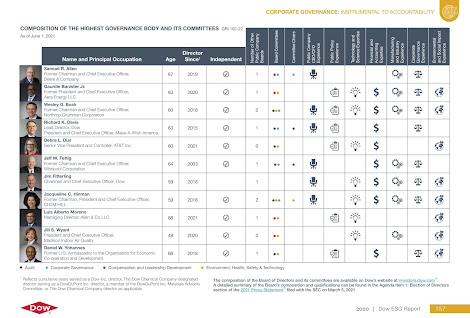
This is one of the few reports that applies the Comprehensive option of the GRI Standards. Dow reports on each governance disclosure with due attention and completeness in the body of the report – not sliced and diced from different publications.


For example, current GRI 102-22, soon to be Disclosure 2-9, includes detailed composition of the Board of Directors by age, role, experience and expertise. There are even headshots for good measure.

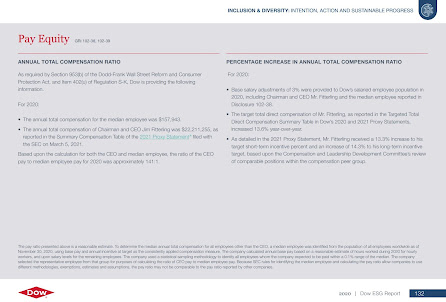
Pay ratios, one of the more sensitive elements of sustainability reporting, is also clearly reported.


Infosys ESG 2020-2021 Data Book

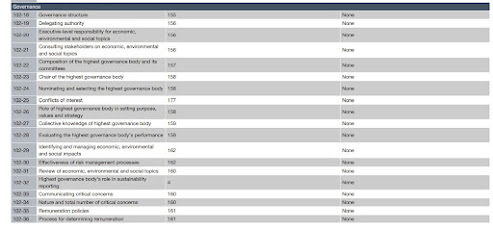
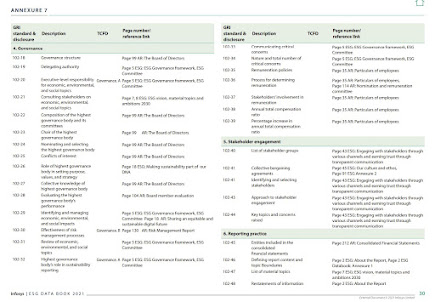
Infosys also reports GRI Comprehensive option and the governance disclosures are partly in the ESG Report, partly in the separate ESG Data Book and partly in the Annual Report.  

The Annual Report includes a 40-page Governance Report which is incredibly detailed. It took me quite some time to locate one or two of the specific GRI-based disclosures, but I got there in the end. Mostly, it was easy, even if it meant straddling three different documents.

Hankook Tire 2021 ESG Report

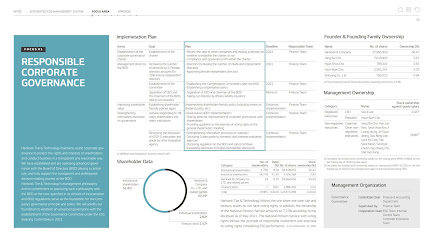
Hankook always delivers detailed, clear and meticulous reports, using the GRI Comprehensive option. This is the only company I have observed actually publishing a set of governance targets in its three-page governance coverage in its ESG report. 


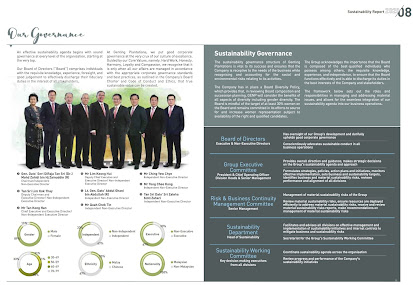
I looked at more than 100 reports from global, large, small and unlisted companies in preparing this post to see if I could find a really exciting or impressive disclosure on corporate governance. Nada. There are some that are nicely designed with graphs and pie charts, a few with Board photos, a few with tables and charts. This one from Genting Plantations Berhad is a little more pleasing to the eye than plain words on a page.  


Most governance disclosures remain general, minimal and uninspiring. Going for G in ESG will require a step change in transparency for many companies. Spicing up the G will require a step change in thinking. I foresee a global shortage of ice cream as companies struggle to get more transparent on governance. Everything is better with ice cream.


elaine cohen, CSR consultant, Sustainability Reporter, HR Professional, Ice Cream Addict. Owner/Manager of Beyond Business Ltdan inspired Sustainability Strategy and Reporting firm having supported 119 client reports to date; author of three books and several chapters on Sustainability Reporting and the Human Resources connection to CSR; frequent chair and speaker at sustainability events and judge in several sustainability awards programs each year. Contact me via Twitter , LinkedIn or via Beyond Business
Related Posts with Thumbnails