Showing posts with label triple bottom line. Show all posts

Sunday, June 10, 2012

First time reports : 8 examples from 2012

Don't you just love first reports? I do. Ha ha. That's not just because I am a reporting geek. It's because a first CSR Report signifies a major step out of the darkness and into the light of transparency. No matter how minimal or even clumsy a first report may be, it represents the fact that one more company has realized that responsibility without transparency is like ice cream without cream, and that sustainability without sustainability reporting is like, well, ice cream without cream.

Apart from the fact that they are first publications, there are no unique defining traits of first reports. They are as varied and multifarious (thanks to Thesaurus.com for multifarious) as second, third and even tenth reports. There are no specific commonalities or characteristics - or even special formulas - which define a first report. There is no template that works for all first reports. What's special about the first report is the breakthrough it represents. Even if it's marketing motivated and greenwash packed, it's a breakthrough. Though don't be fooled - some first reports are highly polished and project a mature approach to reporting.  

Once a company has published a first report, they open themselves up to scrutiny and criticism, (though they might prefer praise and recognition). The fact is, though, that people increase their trust in companies after reading their CSR Reports. And this is even more significant for first timers.

First time reporting inevitably raises new questions for management and sparks healthy internal discussion. This can support decision making and business development, and generally offer another prism through which execs can see their business and its role in society. It's a worthwhile process and every single client I have ever worked with has experienced this.

Having said that, though, there are some first reports which do stretch the term "Sustainability Report" or "CSR Report" to the upper limits of what might reasonably be expected. There are some which are blatantly inadequate to the point of being almost amusing or totally depressing.

If I had a few tips for first time reporters, they would be these:

Get really clear on materiality and your company's sustainability story - don't just list all the good stuff you are doing - make the good stuff count by linking it to both material issues and outcomes.

Keep it short but relevant- some shorter reports can knock the socks off many of the longer ones.

Take it seriously - the best demonstration of a serious approach is to set targets and publicly commit to them. While some reporters use the current reporting year as a baseline, it is still possible to set quantitative targets for future performance. External assurance also lends an additional dimension to a serious approach to reporting - more for its internal value of adding rigor to the process  than because of the additional credibility it affords in the eyes of stakeholders. Use your first report to cut your transparency teeth - have the discussions in the business, and with external stakeholders, hear what they are telling you and shape your program accordingly. Remember that, even though your report might not be a bestseller,  someone somewhere will read it. Make sure your report stands up to scrutiny by each stakeholder who happens to take an interest.

Explain the challenges - no one expects you to be perfect because no one is. Expressing some of the more challenging aspects of your performance adds to your report's credibility.

Always - always - always include personal perspectives - from a range of employees or from external stakeholders. No matter how dry the narrative, real people in your report liven things up and make it much more palatable and credible.

This post is in honor of some of the first timer reports I have come across in 2012, in no particular order. Congrats to all! I  have only included a few and there are tens more published this year that I wanted to highlight as well, but well, even us bloggers have our limits. Maybe I will do another post on the first timers - they are a great bunch.

This is a list of the reports covered in this loooooooooooooooooong post:

Alpha Natural Resources 2011 Sustainability Report (U.S.)
Cogeco Cable,Inc. Canada,2011 Corporate Responsibility Report
Flowserve Corporation U.S. 2011 Sustainability Report
GAIL (India) Ltd, FY 2010-2011 Sustainability Report
Omnicane, Mauritius, 2011 Sustainability Report
Taj Pharmaceuticals Ltd, India, 2011 Sustainability Report
The North Face, U.S. 2010 Sustainability Report
Yüksel İnşaat A.Ş, Turkey, 2011 Sustainability Report

Format: PDF 30 pages and flipper book online
GRI: No
Assurance: No
Materiality Matrix: No
Future Performance Targets: No.
External Stakeholder Commentary: No
Internal Stakeholder Commentary: No
Picture of a Child or a Tree or a Globe on the Cover: No, but there is a green landscape view.
Mentions Ice Cream: No - no ice cream at the coal face.

About the Company
Alpha Natural Resources, headquartered in Virginia, U.S., is the world’s third largest metallurgical coal supplier with production capacity of nearly 126 million tons of steam and metallurgical coal. (Steam coal is primarily purchased by large utilities and industrial customers as fuel for electricity generation and manufacturing, and metallurgical coal is used primarily to make coke, a key component in the steel making process.) Alpha employs 14,000 people, extracting coal from 145 active mines, shipping over 100 million tons of coal worldwide in 2011 and turning over around $7 billion.

About the Report
This report is a very nice first publication. It shows evidence of a company taking a serious approach to managing its own direct impacts. Very early on, Alpha establishes its unique sustainability language - Running Right, Leading Right and Living Right and this leitmotif, which is at the root of Alpha culture, is the basis of the story that Alpha tells. The report has three core sections - our people, our environment and our communities.

Stakeholder Engagement
A nice touch for this first report is a process of stakeholder engagement - Alpha consulted with a list of external organizations representing different stakeholder groups - in order to seek input on material issues. Alpha confirms having learned a lot in the process, and having used this input to crystallize and report on material issues. Unfortunately, beyond disclosing that this process had taken place, Alpha does not share the issues raised, nor does the report present a materiality matrix, leaving us to guess what most important issues came up in consultation. While most of the value, I will admit, is in the stakeholder conversation, I fail to understand why Alpha would not share at least a partial outcome with all stakeholders.

Is Coal Sustainable?
Alpha sidesteps the issue of the overall sustainability of the coal industry and concentrates squarely on the way it does its business. In fairness, the CEO hints at an underlying blip: "At Alpha, we believe there’s a higher purpose to what we do: we’re fueling progress around the world. Coal is an affordable, abundant energy source that plays a key role in producing electricity and steel. We know people’s lives improve – their education levels, quality of life and overall health – when they have access to electricity. And 1.5 billion people currently lack that access. Yet the perception of the coal industry is not particularly good, and our social license to operate is threatened. I think the image of the industry and reality are different – but I also know that perception matters."

In other words, Alpha makes no apologies for being in the coal business -people need coal, and heck, it's legal - and the expression of their Corporate Responsibility is to do it in the right way. This is probably a sensible path for a first report. However, some discussion of the impacts of that perception on Alpha's business might be welcome in future reports - not just about (un)sustainable supply of their core raw material, but also the ways the business will need to navigate an increasingly hostile perception about the role of coal in our society, the way this will impact the cost of doing business and upcoming regulatory issues. How will Alpha deal with this threat to its social license to operate?

Formats
One final point about accessibility: Alpha's ebook report is hosted on issuu.com in a flipper book format - which I find rather illegible. To download it as a PDF you have to register. Normally, I don't bother to go through this hassle but for the purposes of this post, I made the effort. I wish companies would not make it so hard for us to access their reports.
Format: PDF 30 pages
GRI: GRI Application Level B
Assurance: No
Materiality Matrix: No
Future Performance Targets:  Yes - some environmental targets.
External Stakeholder Commentary: No
Internal Stakeholder Commentary: No
Picture of a Child or a Tree or a Globe on the Cover: No - no picture at all.
Mentions Ice Cream: No -  no VOIP ice cream.

About the Company
Cogeco Cable is a telecommunications corporation, the second largest hybrid fibre coaxial cable operator in Ontario, Québec and Portugal. The company has revenues of CA$1.9 billion in Canada and employs 2,511 people in Canada.

About the Report
The report covered Cogeco Cable's operations in Canada only, and the company promises to expand the scope with future reporting. The report is structured about four main sections: economic performance, customers, social performance and communities. The narrative is well and clearly written, follows the GRI structure quite closely, and is easy to read. There are some short case studies throughout the report which add nice perspective. It's concise and factual, no literary creativity here, but it works well enough. A good, solid, first report, testifying to some decent CSR initiatives.

As a first report, meaningful transparency is on the low side, and Cogeco Cable reports on 22 indicators, just two above the level required for GRI Application Level B, and not all are strictly compliant with the GRI requirements.

An interesting point that Cogeco takes care to note, when confirming their self-declared Application Level B is "This grade is not an actual rating of our performance or the implementation of our corporate social responsibility initiatives." - just in case anyone mistakenly thinks that the GRI A, B and C levels are a performance quality grading system :)


Format: PDF 30 pages
GRI: Yes, contains an Index and Performance Indicators are noted throughout the report.
Assurance :  No.
Materiality Matrix:  No.
Future Performance Targets: No.
External Stakeholder Commentaries: No.
Internal Stakeholder Commentaries: No.
Picture of a Child or a Tree or a Globe on the Front Cover: Yes, both plants and kids.No Globe though!
Mentions Ice Cream: No ice cream flows in the Flowserve report.

About the Company
Flowserve supplies pumps, valves, seals, automation, and services to the power, oil, gas, chemical, and other industries. The company has more than 16,000 employees in more than 50 countries.

About the Report
This is short report, demonstrating limited progress, signaling the company's intentions as it builds its sustainability approach. Grouped around the traditional quadrant model - marketplace, workplace, environment and community- this report picks off the bits that Flowserve is already addressing in the business - this is primarily employee safety, energy consumption, brief references to water and waste, and community involvement. The report covers 16 indicators, not all fully. Data is provided at different levels - some covers 26 sites, some covers 21 sites.

As far as it goes, this report is clear, although it is somewhat repetitive and emotionless. In a short report of 30 pages, there is an overview of 9 pages, some of which is repeated in the report sections, and later in the report, there is a one-page summary of data which has already been presented. Aside from the CEO and COO introductions, there are no people in the report, and no stories. As a factual status of Flowserve's status, it's ok. For future reports, a little more passion would be nice.


Format:  PDF 84 pages
GRI: Yes, B+
Assurance : Yes, very clear Assurance statement.
Materiality Matrix: Yes, list of top six issues and detailed explanations.
Future Performance Targets: No specific, quantitative targets but a strong statement of intent.
External Stakeholder Commentaries: No.
Internal Stakeholder Commentaries:  No.
Picture of a Child or a Tree or a Globe on the Front Cover: No - it's a gas processing unit.
Mentions Ice Cream: No. Apparently ice cream is not material for gas production.

About the Company
GAIL is a CPSE (Central Public Sector Enterprise) and is the largest state-owned natural gas processing and distribution company in India, headquartered in New Delhi. Revenue is about $7 billion and GAIL has about 3,800 employees.

About the Report
This report is entitled "Value Beyond Business". As my consulting firm is called Beyond Business, I naturally formed an immediate bond with this report :). In his opening remarks, the Chairman and Managing Director says: "Being India’s premier natural gas company for over 25 years, we recognize that our maiden Sustainability Report was indeed overdue but our commitment to the concept of sustainability has always been embedded in our systems, processes and activities."  That's a nice admission, and sets a credible and frank tone for the rest of the report.  A further nice touch is that all the executive directors of the business offer their own perspectives in a short piece which sets out the key focus and challenges from their respective disciplines. (Just a shame that they are all male - a little gender diversity would be a good thing).

(Hardly Any?) Women at GAIL
A propos the all-male Executive Team, I suspect this is a sensitive point at GAIL - in response to indicator LA2 which requires breakdown of workforce by age and by gender - GAIL, despite claiming to respond fully, does not show the gender split of the workforce. In fact, this report refers only very briefly to gender diversity. "A special Women’s Cell at GAIL is focused on reaching out to the women workforce, initiate discussions and adequately address their concerns including sexual harassment at the workplace. Additionally, we have set up Ladies’ Clubs at our operational sites and have instituted GAIL women’s awards to promote their involvement and enhance satisfaction" A women's cell? A Ladies Club? Sounds like GAIL needs to rethink the concept of gender equality. Any guesses on the percentage of women at GAIL?

Thorough reporting
In other respects, GAIL does a very comprehensive job with this first report, and has not spared words and data. Every section is well detailed. The report includes five pages of the history of natural gas development in India, linked to the development of GAIL. India is one of the top five consumers of energy in the world, with gas representing 11% of this consumption and more than half of this is traded by GAIL. The company grew 30% in revenues last year.

Materiality is assessed through an internal process which includes a review of challenges to the global gas and oil industry - but not explicit stakeholder consultation. For a first report, this is a good baseline, and the 32 issues identified were whittled down to the top six which includes sustainable gas sourcing, continuing to grow the business in the face of competition, availability of skilled employees and more. Environmental reporting is detailed and safety figures are clearly stated including reportable, minor and near miss incidents for both payroll employees and contractors. The report even includes a glossary and cross references to the Global Compact Principles and other local reporting frameworks in addition to the GRI Index.

If anything, the overall message of GAIL's contribution to sustainable development and quality of life in India gets a little lost in the fine detail of this long-ish first report. I would recommend a little more focus on the story, and less on the activities, for future publications.  


Format: PDF 46 pages
GRI:  Yes, Application Level C.
Assurance :  No
Materiality Matrix:  No
Future Performance Targets:  No
External Stakeholder Commentaries: No
Internal Stakeholder Commentaries:  No
Picture of a Child or a Tree or a Globe on the Cover: No. But there's a nice blue sky.
Mentions Ice Cream: No. But then, there's no sugar in ice cream. Is there?

About the Company
Omnicane is a Mauritius-based sugar producer, created in 2009 following the rebranding of Mon Trésor Mon Désert Limited (MTMD), a long-established sugarcane group in Mauritius whose origins can be traced back to the 1850s. MTMD was amongst the first companies to be listed on the Stock Exchange of Mauritius and, Omnicane has successfully transformed itself from a basic-commodity supplier into a multi-product, vertically integrated agro-industrial cluster. The company’s main  operations are: sugarcane cultivation, sugar milling and refining and energy production. Omnicane has 1,132 employees and makes around $3.5 billion. Kudos to one of the very few operations in Mauritius to report on sustainability.

About the Report
The report is a well-prepared, professional, clear document - formal in style and following the GRI C Level framework very closely, addressing the GRI disclosure headlines  more or less in the order they appear in the Framework. Performance is disclosed  at minimum level, reporting fully on 11 performance indicators (ten required at Level C) , and in addition, provides a high level of detail by month on chemicals consumed and by week on water discharge quality etc, which is probably unnecessary at this level of detail. The report focuses on environmental sustainability and provides very detailed disclosures about the sugar processing and energy generation aspects of the business.

Bagasse
Did you know what bagasse is? Hmmm, showing my ignorance again. Bagasse is the fibrous matter that remains after sugarcane or sorghum stalks are crushed to extract their juice. (Thanks, Wikipedia). Omnicane assumes that we all know what bagasse is. It would have liked to see this explanation in the report. Omnicane does explain other terms such as fly ash, coal ash, bottom ash, boiler slag, molasses and vinasse - an ethanol manufacturing by-product. Omnicane produces over 2 million Gj per year of bagasse renewable energy which is used in consumption and sold to the National Grid.

CSER
Omincane use the acronym CSER for what we know as CSR or CR. Corporate Social and Environmental Responsibility. Add that to your lexicon.

Closing a Factory
One nice piece in this report is the very detailed disclosure of provisions provided for 152 employees affected by a site closure. CSR is not only about the employees you hire, it's also about the employees you fire. Omnicane deals with this openly and responsibly.

No Sugar
Despite the "sweetness" of Omnicane's business, there is no sugar in this report. It's formal, dry and even a little boring. There are no case studies, no testimonials and while it's just about readable for the lay person, it's rather technical and  unexciting. As a first report, it does a good job in getting Omnicane's performance message through, but the story gets lost. I think this group  plays a much bigger role than this report reflects. In future reporting, I would recommend adhering to the GRI Framework but being less constrained by its structure, and focus on the true story of Omnicane's impacts and contribution to sustainable society.  Nonetheless, this is great progress.


Format: PDF 30 pages
GRI: No
Assurance : No
Materiality Matrix: No
Future Performance Targets: No
External Stakeholder Commentaries: No
Internal Stakeholder Commentaries: No
Picture of a Child or a Tree or a Globe on the Cover: Yes, classic. Hands cupping a sapling.
Mentions Ice Cream: No - no ice cream medicines.

About the Company
Taj Pharmaceuticals Limited is a pharmaceutical company founded and based in India. The company manufactures pharmaceutical formulations and API for India and other countries of world, owning about 450 brands and 600 generic licenses. The company was established in 1995 as an enterprise and in 2004 became a public limited company with about $1Bn in sales.

About the Report
This is the kind of report that makes you smile. Or grimace. It's not really a report, but it's a cute attempt to represent a certain social philosophy that is present in the business in an authentic way, with half an eye on the potential reputational benefits of adding Sustainability Report to your corporate resume. It's mainly a copy of the relevant website pages which have some vague connection to CSR, plus a whole set of pages containing legalese disclaimers and website terms of use. The actual Sustainability Report content of this not-really-a-report can be accommodated in a few short pages. There is no data on any aspect of Sustainability Performance.

How do I know that it's half a marketing document? Read this: "We will welcome any Export / Import business partnership with Canada, Mauritius, U.S.A., Moscow, London, Brazil, foreign manufacturers and Indian manufacturers and large or small-scale regional distributors, medical and prophylactic establishments and drugstores. Cooperate with us and we shall together develop the pharmaceutical market for the welfare of the World people, so that we could say together "curing life…". "

The Gems
There are some more "gems" in this report:
"At Taj Pharmaceuticals, we keep to the definition spelt out in the 2004 Brundtland Report ...." (ahem... just a few years too late, but who's counting?)
"We still believe that good corporate citizenship should be a matter of course and is not something to be shouted from the rooftops." ( but ... this report is on the rooftop anyway...)
"Taj Pharmaceutical is your gateway to doing business with people who can make procurement decisions in the rounding antibody Company of World Wide." (and I thought this report was written in English)

Next Report
So, come on Taj Pharma, if you want to produce a second Sustainability Report, it's time to make a more serious effort.  It looks as though the company has some good intentions, but in practice, this "report" is not worthy of its title.


Format: Online only, no download.
GRI: Yes, Application Level C.
Assurance : No
Materiality Matrix: No - but focus areas are defined and key outcomes of a Stakeholder Feedback session are disclosed.
Future Performance Targets: Yes, 2013-2015 goals.
External Stakeholder Commentaries: Yes, several.
Internal Stakeholder Commentaries: Yes - many videos and personal commentaries.
Picture of a Child or a Tree or a Globe on the Cover: No - rock climbing is cooler.
Mentions Ice Cream: Lots of ice, but no ice cream - surely ice cream would help at the North Face?

About the Company (Brand)
The North Face designs and delivers an extensive line of high performance outdoor apparel, equipment and footwear, founded in 1966 and owned by VF Corporation, the guys that bought Timberland. (The North Face is the coldest, most unforgiving side of a mountain). The North Face employs 2080 people across the world and has $1.5 billion revenues in 70 countries.  

About the Report
The North Face is actually a brand, operating as a division of the $7 billion apparel corporation VF. As such, this represents a great initiative - I have often believed that Sustainability Reporting should be by brand, and not just by company. This is a great example. It reads well and oozes credibility.

Presenting the Challenges
The North Face Report is a modest and authentically written account of the  brand at the start of a sustainability journey, supported by its parent company infrastructures (though VF Corporation does not report on sustainability), and declaring the report as presenting the challenges of the road (mountain?) ahead, and not just the successes. It has very much a work-in-progress feel, though core elements of the baseline are nicely presented: stakeholder consultation with external experts, key performance indicators (Fabric Sourcing, Fabric Content, GHG Emissions reductions and Offsets, Office and Packaging Waste, Community Outdoor Participation and volunteerism) and defined program focus areas. Although this is a first report, data is presented since 2009 against KPI's, evidencing the fact that this report is the result of efforts to date, and not simply a declaration of intent.

Online Reporting
This is probably one  of the best online examples of a Sustainability Report presentation, and very fitting for this outdoor brand with appeal to the under-35's including many college students, as well as other consumers, who stay connected using the internet and rely on the web as a main source of information. The online report is on its own mini-site, packed with videos, infographics, plain language "equivalencies" (56 million gallons of water saved = 85 Olympic sized swimming pools) and other helpful design elements. The only personal problem I have with this report is that nothing is downloadable. For those who have an interest in the report content, not the interactive experience, it would be helpful to have the narrative in the form of a document which can be saved and read offline - even a summary document. The online report has no download options at all, not even by section. However, I can, grudgingly, understand the exclusively online presentation, and, in this case, it works.  

Looking Ahead
The North Face has done a great job with this report. In the future, I would like to see a deeper look at employee practices - environmental stewardship is what drives the  sustainability passion at The North Face, but with over 2,000 employees, the brand is still a big employer and I would like to see more of a reference to how the brand maintains a fair, diverse, nurturing workplace, beyond the involvement of employees in outdoor inspiration trips and community programs.


Format: PDF 56 pages
GRI: Yes, Application Level C.
Assurance : No
Materiality Matrix:  No
Future Performance Targets: Yes
External Stakeholder Commentaries: No 
Internal Stakeholder Commentaries:  Yes, many personal quotations from employees.
Picture of a Child or a Tree or a Globe on the Cover:  No. But there is a bird, hovering....
Mentions Ice Cream:  No mention of ice cream. Maybe in the next report ?

About the Company
Yüksel İnşaat A.Ş. was established in 1963 and is an engineering and construction group specializing in transportation, highways, dams, marine structures and other building projects.  The company has several subsidiary companies which are included in the scope of the report. The Group employs 11,360 people, including 3,708 contractor employees and has a turnover of around $1 Billion.

About the Report
This report covers Employees, Environment and Community, and is focused on the direct sustainability impacts of the Yüksel group. The group has been a participant in the UN Global compact since 2006 - proudly, the first company in the construction sector to take on this commitment - and has produced COP's on an annual basis, but this is the first Sustainability Report.

Overall, the report seems authentic and shows evidence of genuine progress and good intention - a local company doing its best to be a responsible citizen in its country, displaying national pride and a keen sense of community responsibility. One of the best pages in the report is a matrix of targets for the subsidiary companies, each of which has three targets, one each in the area of economic, environmental and social. I like this. It shows that this complex group of 18 subsidiary companies is trying to get eveyrone on the same page (no pun intended) and embed a common approach throughout the group. The targets are not quantitative in the main, but aspirational type directions, but it's a fine list all the same. There are a couple of amusing targets: one has as a social target "to train employees in sales and diction in order to increase quality" :), and another has "the creation of a Perfection Center" as their economic target.  I love reports that make me smile!  

Women in the Construction Industry
Yes, you guessed it. Not too many, and Yüksel is not exception. In Turkey, there are 285 women out of a total 4,343 employees (6.56%). Yüksel doesn't make any reference to this. Ironically, though, there are many positive  personal quotations from  Yüksel employees dotted throughout the report - and most of them are women! Perhaps this is Yüksel's way of attracting more women. Data on women in management is not presented.

Happy Employees
Employees are, apparently, deliriously happy at Yüksel. Here is just one quotation from Elif (female) which is pretty representative of most of the others: "It is wonderful to work with Yüksel. Working with Yüksel means working with a young and enthusiastic team, while at the same time benefiting from the experiences of competent masters of their work, developing you being a member of a large and happy family, who can turn work into fun with their smiling faces and working in the shadow of a half a century old sycamore with hundred percent security" Maybe something is lost (or gained?) here in translation, but this is a little too mushy for my liking. Including employee testimonials is a very useful and valid tool in reporting, but there is a fine line between inspiring and mushy. Still, it's nice to see happy employees.  

Assurance, Audit or both or none?
The Yüksel report is declared at GRI C+ level, where the "+", as we all know by now, represents an assurance statement. In fact,  the statement included in the report, by the CSR Association of Turkey,  does not provide any evidence of there having been an assurance process. The brief statement says that the report was sent to the CSR Association for audit. But whether an actual audit took place is not clear. In any event, the "assurance" statement is well short of what I would regards as acceptable practice.

Report Style
This report is obviously translated from Turkish, so it is hard for me to assess if the language, which is a little child-like at times, is representative of the original. It projects a certain authenticity, even though there are errors and awkward phraseology in English. I would always recommend those publishing in English to have the report fully proofed by a native speaker. For just a little extra effort, the report could project a much higher quality. 

Well, got this far? Maybe you also find first reports fascinating! Now you definitiely deserve a rest. And ice cream.

PS: Thanks to CorporateRegister.com , where I found many of the first reports mentioned above.

elaine cohen, CSR consultant, Sustainabilty Reporter, HR Professional, Ice Cream Addict. Author of CSR for HR: A necessary partnership for advancing responsible business practices   Contact me via www.twitter.com/elainecohen   on Twitter or via my business website www.b-yond.biz  (Beyond Business, an inspired CSR consulting and Sustainability Reporting firm)

Thursday, December 22, 2011

A COP can be a good thing

Some people think of the UN Global Compact Communication on Progress (COP) as a lightweight entry into the world of transparency. In some cases, they would be right. To submit an Active level COP, all you need to do is describe how you uphold the 10 Principles of the UNGC, describe the positive things your company is doing and sit back and wait for next year's deadline. However, in November 2011, 106 companies were delisted for not communicating, bringing the total delistings to 2,953 companies, so maybe it's a little more challenging.

Last year, the UNGC made a change to the COP structure, introducing what the UNGC calls the "Differentiation Programme". This gives companies two choices: Active Level and Advanced Level. Basically, "Active" means the old-style COP, in which companies do the Good News thing, saying how good they have been in advancing the 10 Principles. This could be compared to an Application Level C Report using the GRI Framework, though it doesn't quite require the same degree of rigor in terms of Management Disclosures. "Advanced" is another affair, requiring companies to report on how they meet 24 criteria of responsible and sustainable business practice, grouped in 5 broad categories:
  • strategy, governance and engagement
  • UN goals and issues
  • implementation of Global Compact principles
  • value chain implementation
  • verification and disclosure
Essentially, anyone aiming for an Advanced level COP is working at the level of a GRI Application Level A Report. But, as anyone who has ever written an A Level report knows, this is no small task. If you have the capability of producing an Advanced Level COP, in practice, you are capable of writing a Sustainability Report and posting it on the UNGC Website, thereby also fulfilling the UNGC COP requirements. The Sustainability Report will include a reconfirmation of the CEO commitment to the UNGC and a cross-reference index of UNGC principles to GRI Indicators.  In practice, this is what most companies who report at GRI B or A Level do.

For companies which are not quite ready to report at this advanced level, an Active COP could be a positive alternative. It provides an opportunity for transparency in a globally recognized context and allows some flexibility regarding what to disclose.  In some cases, companies invest quite a significant amount of effort to deliver an Active Level COP.

Take a look at this (Active Level) COP by (my client) , ECI Telecom.


ECI Telecom is a global provider of telecommunications networking solutions and this is the Company's second COP. Beyond confirming the Company's commitment to the 10 principles of the UNGC, ECI discloses how the company makes a Green Impact with ICT Technology. If you don't know your DSL from your VDSL, ADSL and HDSL, or the environmental significance of Vectoring, you can learn a lot from reading ECI's COP. ECI is a champion in low-power applications and E-band technologies. If this is all gibberish to you, don't worry. It was to me until I started to learn what it all means. It's actually surprisingly simple, once you get the letters in the right place, and confirms that ICT is one of the most significant opportunities for companies to provide services which improve their environmental footprint and those of consumers.


Additionally, ECI makes many environmental disclosures relating to  its own environmental impacts. With an E-TASC (Electronic Tool for Accountable Supply Chains) score of 96%, the company's best to date, ECI demonstrates a commitment to managing, measuring and reporting. The company achieved a 20% reduction in paper consumption in 2010, a 20% reduction in electricity consumption per employee, a 12% reduction in water consumption and a 9.75% reduction in waste. Great progress.

However, my favorite part of this COP is the description of the Green Camera project that ECI Telecom's CSR Manager, Eynat Rotfeld, organized in 2010. Employees were invited to submit their "green" photographs and the three winning photos were selected from around the ECI globe. The photos were breathtaking. Here are the winning photos:

My Green Life in Huangzhou by Tony Xu (China)
Tony Xu said about this photo: "Bicycle is a green, healthy and convenient choice for me. In Hangzhou, the government purchased a mass of bicycles and offer free use for residents in order to improve the condition of traffic and reduce the usage of cars. You can borrow near the home and return at your destination. It is very convenient, saves money and good for health for everyone. That is my reason for choosing this picture."


Harvesting the power of nature by Glenn Leis (ECI Philippines)
Glenn said about this photo: "I was amazed when I saw those windmills up-close and personal and wonder how the force of nature, which is the wind, drives those giants to produce electricity without any bi-products / pollutants. I’ve been to some power plants during my college day field trips and I have compared it to those diesel-fed engines that are very dependent in oil in which we do not have here (yet) in our country. The power of nature is everywhere, we just need to harvest it in a way we do not destroy it in the end because it's FREE...."

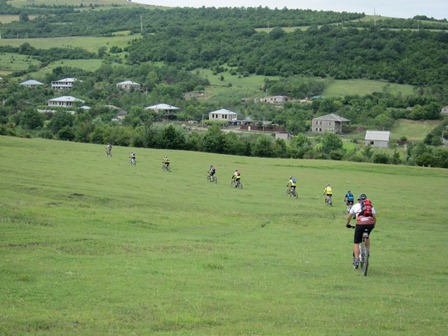
The ECI Biking Team in Georgia by Amit Singer (Israel)
Amit said about this photo: "This picture was taken during our "green" sporting activity, an ECI team bike ride, which doesn’t cause any form of pollution. The team also gets involved in a lot of volunteering activity, including making donations to hospitals, supporting underprivileged children and more. The photo itself represents the spirit of the group – riding in an atmosphere of calmness and blending with the green of nature."

ECI Telecom's 2011 COP is a comprehensive document of 65 pages covering a wide range of social and environmental disclosures, demonstrating year on year progress in advancing sustainable practices. Not a lightweight entry by any means.


elaine cohen, CSR consultant, Sustainability Reporter, HR Professional, Ice Cream Addict. Author of CSR for HR: A necessary partnership for advancing responsible business practices Contact me via www.twitter.com/elainecohen  on Twitter or via my business website www.b-yond.biz/en  (BeyondBusiness, an inspired CSR consulting and Sustainability Reporting firm)

Tuesday, December 20, 2011

18 Examples of (Not-So) Integrated Sustainability Reports

Last week, I dutifully submitted my feedback to the International Integrated Reporting Committee on their discussion paper. It was an interesting exercise. Here are a few of my responses:

Do you believe that action is needed to help improve how organizations represent their value‑creation process?
Me: I believe companies need to take responsibility and be held accountable for their impacts on society. Action is needed to improve the number of companies who do this and the way in which they do it. This includes value companies create for society, but it is also about negative impacts on society and accounting for them.

Do you support the development of an International Integrated Reporting Framework?
Me: In principle yes, but on page 8, the Discussion Paper says that the IR framework will provide "high-level" guidance - I think it should provide very detailed guidance. Similarly, the approach states that it is focused on the needs of investors in the initial stages. I believe this is absolutely wrong. Integrated Reporting should AT THE VERY OUTSET focus on the needs of all stakeholders, otherwise it misses the point. Clearly, financial stakeholders are looking for tools to quantify the social/environmental risks and impacts in terms of shareholder value, but if this is the prime direction of Integrated Reporting, we are back to Square One, where sustainability is relegated to almost no influence on financial decisions and shareholder considerations. Once the framework has been developed for investors, there will be zero motivation to change or enhance it for all stakeholders.

Do you agree that Integrated Reporting will drive the disclosure of information that is useful for integrated analysis (from the perspective of investors)?
Me: Yes. In fact, that's pretty much all it will do. I don't think that's enough.

So, as I am having an integrated thinking week, I thought I would take a look at what's really happening out there and scan the 18 Integrated Reports that are contestants in the largest online annual Corporate Responsibility Reporting Awards - CRRA12.

Ultimately, a truly integrated report would show connectivity between the sustainability parts and the financial parts. Ultimately, a truly integrated report would make linkages between business strategy and sustainability strategy and define financial and social/environmental impacts of both in a seamless way. As I review the 18 reports entered in the Best Integrated Category, this is primarily what I am looking for. Connectivity. Linkage. Causality. Integration.

The IIRC discussion paper contains a couple of examples, including this one from Akzo Nobel:
Here we can an example of demonstrating financial value generated through response to global (green) market drivers. 

As you will discover, in most reports, I don't find this degree of linkage. Most integrated reports today are  a juxtapositioning of two separate reports. In the better cases, some of the narrative is blended so that business strategy appears to take financial, social and environmental aspects into account. Finding a report that actually considers the financial implications of sustainability actions is more difficult, though in some cases, the opportunities of sustainability strategy are discussed - sometimes using the Porter Creation of Shared Value Concept as inspiration.

One thing that puzzles me, for example, is why the cost of energy or other environmental or social factors are not considered. Only one company in this Integrated Reporting Category reports the cost impact of energy - all others report only the KWH consumed and the GHG's emitted. Surely, energy conservation is both a sustainability and a financial risk/opportunity? Why would companies not wish to understand (and disclose) the financial impacts of their energy practices? This seems obvious to me but no-one does it. Yet.

Here are the 18 reports in the Best Integrated Report category (in alpha order):

Alma Media Oy, Annual Review 2010, Finland, 43 pages, GRI B

This is the first integrated report of Alma Media Oy, "the voice of sustainable media", a company whose reporting I have always loved, and this integrated version is great. It looks and feels like a Sustainability Report while ensuring the financials are included and well presented. There is a good deal of contextual information about markets and sustainability considerations. While it doesn't go quite as far as to truly integrate CSR issues into financial and business strategy, and lacks a materiality analysis (though it does include top subjects raised by stakeholders), this report is so well written that it almost make me want to read newspapers again!


Altron - Allied Electronics Corporation, Integrated Annual Report 2011, South Africa, 259 pages, GRI B+


This is Altron Group's second integrated report prepared in line with the King Report on Governance for South Africa (King III). It's a very official looking sort of report, not something you would want to enjoy reading, though it does provide a good range of data. The Company has identified 11 Strategic Themes and a set of Material Issues which are analyzed in the report in detail. There is a clear financial flavor to this report - although consolidated financials start only on page 143, in the early part of the report, much space is devoted to financial impacts and market reviews, including a CFO review and results highlights. 

 A material issue for Altron, energy consumption, shows a massive increase, from a total of 113,000 Mkwh to 218,000 Mkwh in one year, more than double:


In fairness, there is some discussion of this in the report, and Altron is committing to improving measurement procedures and initiatives to reduce the Group's carbon footprint. However, I couldn't help wondering what the financial impact of this single environmental indicator had on Altron's overall budgets and exactly what Altron is planning to do to to make a change, and how this will impact operations and people.

Cebu Holdings Incorporated Integrated Annual and Sustainability Report 2010, Philippines, 174 pages, GRI B

This real estate company in the Philippines has been an integrated reporter now for 4 years, and although the Chairman's review opens with Dear Stockholders (and not Stakeholders), the company has a nice sustainability framework and the report is quite a pleasant read. Sustainability issues are dealt with well, and include external stakeholder commentaries. The Financial part of this report begins officially on page 123.

One of the things this company integrates alongside financial, social and environmental performance is its core values - Cebu is one of the only companies I have seen whose core values include the Love of God. I wonder if this is a condition of hiring?


Cermaq ASA Annual Report,  Norway, 131 pages, GRI B+

This is a fascinating report about a company who makes a living from salmon farming and making salmon feed. Did you know that 70% more salmon was consumed in Norway in 2010 versus 2009? Rising salmon eating trends is due to more sushi and sashimi consumption by younger people in the West, emulating Japanese fish eating habits. As salmon demand increases and supply falls behind, salmon is getting much more expensive. This is good news for Cermaq who made more profits than ever before in 2010. Another fascinating aspect of fish farming is the monitoring of salmon stress levels. Did you know that salmon could be in stress? Did you ever think about how much that salmon fillet you ate for dinner last week was stressed-out during its lifetime? Cermaq is able to identify stress levels in salmon and in 2010, was able to reduce stress levels by 60%. Wow. (Perhaps they could do the same for Sustainability Consultants?) Another fun fact is that Cermaq have 46 million fish in the sea as part of their farming effort and not one managed to escape. Hey, I bet prison services around the globe would be interested in Cermaq's methodologies.  

Cermaq's Integrated Report is really a joined Sustainability Report and an Annual (Financial) Report. The Sustainability part takes up the first 55 pages and pages 61-131 are in the form of a traditional Annual Report. There are separate Auditor's Reviews for the Sustainability content and the Financial content. The Sustainability part contains a nice Materiality Matrix:

Cermaq - nice Materiality Matrix presentation

Cermaq have even created customized indicators for reporting on their own kind of sustainable aquaculture:
Cermaq's propietary reporting indicators


Deloitte LLP USA Fiscal Corporate Responsibility Report, 50 pages, GRI B

Oops! What' this doing here? This is a CSR Report and not an Integrated Report. How come it snuck into the Integrated Reporting category:). If this report wins, the IIRC will go a little crazy, I suspect :)

Clearly Deloitte are a little confused :). Perhaps their involvement in the IIRC Pilot program may help.

NOTE: UPDATE 23 December:  Following my comments above, Deloitte has now confirmed that this report entry in the Integrated Category was an error and it has now been removed. However, Deloitte's report is still in the running in the Best Creativity Category. Clearly, Deloitte is not confused. Just a small error. These things happen. Thanks, Deloitte, for the clarification. 

Flughafen Muenchen Sustainability and Annual Report 2010, Germany, 194 pages, GRI A+

The Munich Airport Sustainability and Annual Report is a fascinating look at the full scope of sustainability issues which are relevant to airport operations which are complex and cover a wide range of social and environmental impacts. This report nicely discloses on workplace, climate change and environment activities, community engagement and stakeholder interests, and includes a full Materiality Matrix. The consolidated management report, beginning on page 130, contains financials as well as sustainability risks. As far as integration goes, it does a good job, though as with all other reports in the integrated category, financial impacts and sustainability impacts are handled as separate entities and the connectivity between them is not clearly articulated. 


Hyundai Engigeering & Construction Co, Korea, Sustainability Report, 88 pages, GRI A+

The Hyundai Report also seems to be misplaced in this category. There are two pages of headline economic or financial data in a total report of 88 pages. Hardly an Annual Report and hardly an integrated one. Hyundai should have read the fine print more carefully!

The report does include an explanation of the difference between a Triple Bottom Line Report and an Integrated Report and includes economic impact discussion and targets, though there is no direct linkage between these and other ESG performance areas.


The Hyundai Report includes a thoughtful Materiality Matrix which shows how issues have moved between one year to the next. This is a nice touch which most companies fail to consider.

The Hyundai report also features several external stakeholders and their responses to business and sustainability issues which are important to them as they consider their relationship with Hyundai. Overall, this is a great Sustainability Report showing consideration of social and environmental performance. The fact that some economic factors are mentioned and discussed does not make this a truly integrated report.

Indra Sistemas SA Annual Report 2010, Spain, 148 pages, GRI A+

Indra Sistemas offer a report which provides me with an opportunity to check out how much Spanish I don't know. I did try to use Google Translate, but when it converted a piece in Spanish to "The accountability that is presented below was carried out following the guidelines of the G3.1 Global Reporting Initiative application level A + and as AA1000 APS (2008), Accountability, including our behavior on the Global Compact principles with which we compromised ...", I decided to give up and let the Spanish speakers among us analyze the degree of integration of this report. (The GRI Index is in Spanish and English).  I did discover the Indra Sustainability website which is in English with an online report which is rather pleasant, including a "Sustainability Balanced Scorecard" which presents all sustainability data in great detail for a six year period. However, the website was not entered in the CRRA '12 competition so it is not really fair to comment on that.

Korea Railroad Corporation 2010 Sustainability Report, Korea, 105 pages, GRI A+

This report is called a Sustainability Report and follows a classic structure of sustainability reporting, with economic performance, social performance and environmental performance making up the core sections of the report. The economic section includes 7 pages of business descriptions and profiles, but not a full set of financials and there is no reference to any other report which does include the full financial data. Here again, this report doesn't fit the bill for what I believe constitutes an Integrated Report, even using the "light" definition which may indicate a "combined" report.  


MOL Group 2010 Hungary, Annual Report, 251 pages, GRI A+

This mammoth report  by MOL Group oil and gas producer in Hungary, Slovakia and Croatia, includes a separate section on Sustainability non-financial performance which starts at page 175 and runs through to page 210 - 14% of the total report. More if you include the separate governance section which is a further 23 pages - bringing total sustainabiilty and governance content to 22%. One of the disturbing things about this report is the title of the sustainability section - "non-financial performance". Surely, in an integrated world, social and environmental performance can no longer be solely non-financial? MOL is not the only Integrated Reporter which uses this terminology which I think is misleading and not representative of integrated thinking.  Aside from a mention of MOL's position in the Dow Jones Sustainability Index, sustainability issues are conspicuously absent from all discussion of MOL's business strategy and market performance. Sustainability data is assured separately from financial data.

The MOL sustainability component is very detailed and covers all transparency bases very well. However, the narrative is dry and factual and certainly not appealing to anybody other than those specifically searching for data and facts. In fact, MOL understands this, stating "While the Annual Report’s main audience is assumed to be our shareholders, investors and sustainability analysts, our webpage is tailored to answering the information needs of all stakeholders." The website is a little more friendly for us non-financial people - it has a few more photos and the language is a little friendlier, though the pages are long and very detailed.

One thing I have never seen before in a published report is a draft GRI Application Level Check statement!
MOL - getting ahead of themselves - confident of the GRI check!
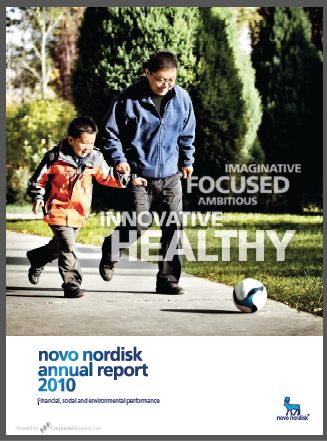
Novo Nordisk Annual Report 2010, Denmark, 115 pages, GRI A+

Novo Nordisk is often held up as the go-to-company for Integrated Reporting excellence, and has been a winner of the Best Integrated Report category in CRRA several times. Certainly, Novo has been doing this a lot longer than most companies (since 2004), so one might expect them to have developed a methodology which works for the company and for all stakeholders, not just financial stakeholders.

Novo says about their own report: "We believe Novo Nordisk creates value in ways that are not captured on a balance sheet or income statement and this is one of the reasons we publish an integrated report. Managing a business sustainably involves looking at risks holistically and taking a long-term perspective. In our 2010 Annual Report we exemplify this in a number of ways: comparing our sales growth with CO2, emissions, water usage and waste to better reflect relative performance and setting and reporting on long-term targets for diversity and engaging corporate culture."

De-coupling business growth from environmental impacts, is excellent, though Novo Nordisk continues to refer to non-financial targets and does not make the direct linkage between business and sustainability issues.

At the risk of becoming repetitive (yawn, zzzzzzzzzzzzzz), how can employee turnover, energy consumption, water consumption etc, not include an element of financial impact? Since 2007, Novo has achieved big reductions in water and energy consumption (37% and 28%) - I am sure this has made a significant financial contribution which is not specifically identified in Novo Nordisk's integrated reporting.

However, perhaps there is light at the end of the tunnel. I noted in an interview with Lise Kingo of Novo Nordisk, included in the report, that she says: "Together with experts and with inputs from stakeholders we have developed a methodology that enables us to value the contribution of our Triple Bottom Line approach in a profit and loss perspective. We have called this initiative our Blueprint for Change programme, and we have conducted Triple Bottom Line reviews looking at our climate action strategy and our business approach in China." I found more about this Blueprint for Change in China on the Novo Nordisk website - this is indeed an excellent document showing how Novo built business while creating very positive social and environmental impact. Again, I miss seeing an assessment of the impact of significant environmental benefits on the profitability and affordability of diabetes healthcare as part of this initiative, but this report does go further than most in identifying economic, social and environmental impacts for value creation as an integrated strategy.  

The consolidated financial and non-financial statements start in the Novo report at page 57, though both financial and "non-financial" figures remain separate, with 7 pages out of around 58 referring to social and environmental impacts.

Solar World AG Annual Group  Report 2010, Germany, 327 pages, GRI A+

This report is very long - at 327 pages, it weighs in as the second longest report in the entire competition. The report structure goes from corporate background and profiles (often quite technical) and then to consolidated financial statements, followed by a sustainability section which is made up of the GRI Index, the UNGC Index and the KPI's of EFFAS, all of which take up a further 16 pages  and is followed by some more detailed disclosures against performance indicators. There is little in the form of sustainability narrative - mainly data and while this is a business all about sustainability, I didn't detect too much overall integration in between financial and sustainability performance. It's quite a techy impersonal report in simple b/w design, making for a not terribly entertaining reading experience.  


There is one page of economic narrative in this Sustainability Report. It's a Sustainability Report. Do Sustainability and Integrated sound so alike?

In fact, this report only barely qualifies as a Sustainability Report. It is so light on sustainability data that it would not make a GRI C Application Level. It's more of a marketing-oriented brochure that reflects Siveco's business performance with a couple of CSR themes thrown in for good measure.

While I commend Siveco for being one of the few Romanian sustainability reporters, and the only Romanian report entered in the entire CRRA competition, the Company needs to develop its understanding of what CSR and Sustainability really mean, and how this can be presented more effectively and transparently.


Syngenta International Annual Review 2010, Switzerland, 58 pages, GRI A+

Hah! This is the only report in this entire category which makes a connection between environmental impacts and financial results. Syngenta says: "We monitor energy use to identify opportunities to improve efficiency. Our energy strategy encourages local teams to select the best ways to reduce energy at local sites. By 2012, we aim to decrease global greenhouse gas emissions by 40 percent relative to EBIT from the 2006 baseline."

Energy consumption, GHG  and other air emissions and water consumption all carry a $ value and are measured in terms of their impact on financial results as well as environmental sustainability.


The nature of Syngenta's business, developing seeds for more sustainable agriculture, advancing food security, lends itself well to a blended business and sustainability discussion, which makes the narrative in this report readable, informative and quite enjoyable. (Check out also Syngenta's Grow More from Less website).The people section is light, and I would have welcomed more discussion about responsible workplace practices and a similar assessment and measurement of sustainable people practices in relation to cost efficiencies. Much of this can be quantified, and it would be an interesting next step for Syngenta to incorporate measurable people impacts in their next report.

In the meantime, given that Syngenta is the only report in this category which has made the connection I was looking for, as well as providing an integrated view of the business in a readable and accessible manner, without too much financial geek jargon and headaches, this report has my vote as the category winner!

(At this point, I will overlook the fact that this is a self-declared GRI A+ level report, and that several core indicators are not fully reported, which to me seems to fall below the A level threshold.)

Takeda Pharmaceutical Company Annual Report 2011, Japan, 150 pages, GRI A+

Takeda is a 230-old corporation so I guess they must be doing something right that supports their sustainability as an organization, although 2010 marks the first year of "Transformation into a New Takeda" strategy, driven by innovation, culture and growth. The reports looks and feels  more like a Sustainability Report than an Annual Report, and includes extensive interviews with company people, and a thorough explanation of a significant acquisition, Nycomed, including aspects of culture and management style. (Most company reports do not examine in detail the basis for and impacts of acquisitions - this is a nice approach).

Financial results and discussion takes up 41 pages (27%) of this report, and some of the business and market disclosures in the body of the report are rather too detailed for the lay stakeholder to read and engage with, but overall, the report hangs together nicely, even though, as with other integrated reports, I could not find and direct connectivity between environmental or social performance and business results.

Takeda has adopted the seven core subjects of ISO26000 as a basis for CSR policy and reporting and structures disclosures around these themes. Takeda also publishes a CSR Data Book which replicates all the information in the Annual Report and adds some, and also includes the GRI Index. So if you are looking for a more traditional standalone CSR Report, this is the one to view.

As with most Japanese reports, many messages are formulated into charts and diagrams. I liked this one which explains Takeda-ism and Takeda stakeholders.


Vancouver City Credit Savings Union (Vancity) 2010 Annual Report, Canada, 94 pages, GRI A+

Vancity is a member-owned, community-based credit union seeking to develop member and community value through everything it does. Vancity is Canada’s largest credit union, with $14.5 billion in assets, more than 417,000 members and 59 branches. Vancity calls this report "their first truly integrated Annual Report", and in my view, they have done a good job. Vancity's report gives a reasonably integrated business overview, with a financials taking up only 28 pages. One of the few integrated reports which has less bespoke financial content - and one of the few which is actually quite pleasant to read, with many nice visuals and a good storyline in the narrative. If you are wondering how Vancity manages to do this - I suspect I know why :)  Take a look at the following shot of the Chair of the Board and the CEO! Women power is obviously the key!

Vancity's reporting on Materiality is interesting. In fact, they produce a whole separate report about it - it's 4 pages long, and defines the materiality process undertaken and the specific priority responses received by stakeholders from different forms of engagement with them, and how these issues have been addressed in the Annual Report. While this is excellent practice and transparency, I do wonder about the decision to omit this, beyond a mention and referral to the separate report, from the Annual Report main document. Materiality process is so core to reporting, particularly integrated reporting - why push it out of the main document? Another nice touch I have always liked about Vancity's reporting is the way their targets are clearly laid out and the specific accountability for achieving each target is noted- once upon a time, Vancity included actual names of people but today, it's just the job title, such as VP Human Resources, CFO or other. Still, it's good to know who in the organization is accountable for what.

Wilderness Holdings Ltd, Integrated Annual Report, South Africa,
153 pages, GRI Undeclared level


Wow. You have to look at this report, just to see the spectacularly breathtaking photography! It's just too beautiful for words. The second reason you need to look at this report is to learn about the intricate details of cultural and sustainable tourism - the high level of detail this report provides is also breathtaking - some might say overkill - but it has a certain authenticity and charm which makes you want to read more. The report includes a list of issues raised by stakeholders and Wilderness's response to them.

Consolidated financial statements begin on page 108, however, so that is where I stopped :)


Wyndham Worldwide Corporation Sustainability Report 2009-2010, USA, 56 pages, GRI C

Oops! Another Sustainability Report. Not integrated. No vote in this category. It does include 2 pages about business performance and revenues, but this hardly constitutes a full set of financials. This report belongs in the Best First Time Report category. Phew! It's there. And also in the Best Carbon Disclosure Category. So that's alright then.

I couldn't resist taking a little peek, though! Two things caught my eye. First, is the Wyndham has a website dedicated entirely to women travelers. I will have to see what that offers the next time I am off somewhere. I wonder if they supply people to pack and unpack my bags. That's by far the worst part of travelling.

The second thing I noticed is Wyndham's Sustainability structure, which seems highly slanted towards Environmental Sustainability.
  
Wyndham - green is it

Overall, the Report is a lightweight GRI level C report, responding to just 11 performance indicators in full. But a nice first time effort, all the same. Hmm. Wonder how it got into that Integrated Category, though!

And to round it all off...if you got this far ....

Of the 18 Reports entered in the Best Integrated Report category, there are five which I believe cannot be classified by any stretch of the imagination as integrated. Reporting companies should be more careful about how they define their entries in CRRA in future years. Also, some more specific guidance from CRRA might be helpful.

Of the remaining 13 reports, all go some way to presenting financial information blended, to a greater or lesser degree, with social and environmental impacts. However, very few manage to make a connection between business strategy and sustainability material issues in a way which shows how value is created or destroyed in both financial and sustainability terms. This shows the true nature of the leap that Integrated Reporting needs to drive. It is more than developing green products or delivering new drugs. It's about truly connecting all aspects of all business initiatives in which the sustainability impacts of business are represented in financial terms (where possible) and the business impacts of sustainability are represented in social and environmental terms (where possible). I fully recognize that 100% integration may be hard to achieve, but, based on my review of the Integrated Reports that are showcased here, even some first tentative steps would be significant.

Oh, and by the way, my own company Sustainability Report, which is not integrated (phew!) is entered in the Best Report, Best First Report, Best SME Report and Best Creativity categories in CRRA 12. I would be delighted if you would consider voting for Beyond Business Sustainability Report. Check out the CRRA 12 Awards here. PLEASE vote for your fave Integrated Reports AND for the Beyond Business report :))


elaine cohen, CSR consultant, Sustainability Reporter, HR Professional, Ice Cream Addict. Author of CSR for HR: A necessary partnership for advancing responsible business practices  Contact me via www.twitter.com/elainecohen  on Twitter or via my business website www.b-yond.biz/en  (BeyondBusiness, an inspired CSR consulting and Sustainability Reporting firm)
Related Posts with Thumbnails