Showing posts with label social media. Show all posts

Friday, May 30, 2014

Digitizing materiality


This week was a fun week! Amidst all the intensely intensive intensity of G4 reporting for several months as clients race to meet reporting deadlines and us with them, I was able to take a couple of serene days to spend time with fabulous people, enjoy fabulous food in a fabulous setting, and hear some fabulously new stuff.
 
Yes, I was at the Lundquist 6th annual CSR Awards conference and event in Milan, a gathering of specialist communications and CSR experts from all over Europe. Lundquist is a strategic communications consulting firm based in Italy, and the company boasts a team of leading thinkers in the digital corporate communications space. The recently published Lundquist survey results with trends and practices around CSR and the online universe can be downloaded here:
 
 
The research shows an acceleration of the uptake of social and digital technologies compared with previous editions of the research. Now, virtually all sustainability professionals (94%) are on social media with three quarters of these doing so in relation to CSR and sustainability. Video and infographic content are gaining popularity and CSR Managers have become the new social media stars, with everyone wanting to hear from them online. It's always fun to know what frustrates people and the Lundquist research confirmed what we already know - that too much good news is not good news.


The full results and the details of the CSR award winners can be downloaded here. Deutsche Post DHL took first prize, with Nestle and Unilever close behind.
 
 
In the Lundquist home market, Italy, Telecom Italia, Hera Group and Snam took the trophies.

Lundquist's research and analysis is really quite fascinating and contains much that should be of interest to CSR corporate communicators. Well worth studying!

During the two day conference, I was pleased to facilitate a workshop with presenters and panelists from Hera Group, Birra Peroni (SAB Miller) and Adidas. I opened up (my presentation embedded below) with an overview of opportunities and risks in the digitization of materiality and stakeholder engagement. While there is incredible potential to reach to stakeholders using online tools, there are also dangers arising from inappropriate use. Not everything that is online provides real insight that is relevant enough to deliver a robust materiality conclusion. The fact that Survey Monkey is free and there is a (G4) stakeholder engagement materiality box to tick does not mean that stakeholder engagement happens. As an element in a set of digital and non-digital tools, there is a place for online surveys. But let's not dumb down stakeholder engagement to the point of mindlessness by going through the motions without due planning and focus.


One of the questions that generated the most debate in our workshop was how to find the right balance between, on the one hand, targeted engagement of experts that can make a contribution based on knowledge, experience and critical analysis and, on the other hand, reach to the general mass consumer population that is, after all, the group that decides whether to buy a company's product or not. We shared lots of views and recognized that each company needs to assess what tools will deliver the most useful materiality input and most reflect stakeholder views in a representative way. Not all stakeholders are equal but no single algorithm can determine which are the most equal.

All in all, a stimulating couple of days, professionally and skillfully organized by the Lundquist team.


My photo gallery from the CSR Awards conference and event
a fabulous colorful place to stay - Hotel Mediolanum

Kicking things off with digital disruption

Joakim Lundquist who kept the two days moving at a pace

Are sustainability reports really dinosaurs? 

The Gala Dinner - in anticipation

The Gala Dinner - home straits

Gotta keep talking

James Osborne, the CSR social media stats and trends wizard
hate turgid

David Connor @davidcoethica raring to present on the ways of using social media
Christine Hermann of Orange talks about what's important

My daughter's new ear piercing  - oops, how did that get in here? 


elaine cohen, CSR consultant, award-winning Sustainability Reporter, HR Professional, Ice Cream Addict. Author of Understanding G4: the Concise guide to Next Generation Sustainability Reporting  AND  Sustainability Reporting for SMEs: Competitive Advantage Through Transparency AND CSR for HR: A necessary partnership for advancing responsible business practices . Contact me at www.twitter.com/elainecohen   or via my business website www.b-yond.biz   (Beyond Business Ltd, an inspired CSR consulting and Sustainability Reporting firm)

Saturday, May 26, 2012

16 Great Corporate CSR Blogs

These past few years have witnessed a multitude of corporate CSR and/or Sustainability blogs. These are immensely valuable for companies as a way to update all those who might be interested in the way the focus on CSR is maintained throughout the year and not just at Sustainability Report time. Blogs are also a way for companies to tell their stories through the faces and voices of employees (and most seem to be genuine, rather than ghosted), thereby gaining both internal momentum as well as an external presence. Also, corporate CSR blogs are an opportunity to elicit feedback. We should not be concerned that very few people actually engage on blogs. As I know from experience with my own blogs, posts spark the discussion but very often, the conversation takes place off-blog. Companies who share via their blogs demonstrate that they are open to these conversations. A case in point is the great example of my interaction with Microsoft a few weeks back.

Here, in alfa order, are ten of the companies whose corporate CSR Blogs are on my radar.

adidas Group Blog
This is a nice blog from members of the adidas team, headed up by the adidas Chief Communications Officer, covering, as you might imagine, all things related to sport, adidas brands, and often, things related to CSR and community involvement. While the blog has a broad scope, clicking the Sustainability Aspects category via the Category Search function brings up some interesting material including the latest post about German TV's visit inside adidas factories in China and a frank look at working conditions. The Community Involvement Category showcases adidas's volunteering and other projects for society.

Applied Materials Blog
The "About this Blog" page explains that the Applied Materials Blog is "dedicated to a global discussion about the ideas, actions and products changing the world as we know it.  Here we will provide insight into the innovations being created by our employees, technologists and global workforce as well as continue to drive the conversation about the role clean technology can play in saving our planet, while also creating jobs and other economic benefits by helping promote energy independence. We will also discuss the importance of being a leading global citizen and operating in an environmentally and socially responsible manner." Bloggers include members of the Applied team, including the CEO, though he has obviously been rather busy of late as his last post was in 2010. For those interested in renewable energy, this is quite an interesting blog.

BT Better Future Blog
This blog is subtitled "Join the Debate, We Want your Views". However, there are not yet any comments on any of the  posts so far, dating back, as far as I can tell, to February 2012.  The BT blog is a hybrid, containing posts from BT people and also external stakeholders, such as this post about "Embracing all in the digital revolution" by John Fisher, Chief Executive of Citizens Online, or this one, from a  Year 10 pupil at a school in Northern England, who participated in BT’s Big Voice competition gives young people the chance to make short films on inclusion and diversity issues. It's a nice touch to have external stakeholders on the blog. I always say that there is a great credibility advantage in letting others help tell your  story. The BT blog is not so active - only 10 posts in around four months - but it's a presence and the material is interesting and informative. Suggestion for improvement: Add an "About this Blog" page, tell us what you are trying to do with the blog and provide the bios of the key regular contributors.  Who is writing the blog is as important as what they are writing :).
(N.B. Kevin Moss, BT Americas CSR head also maintains a private-business BT blog at CSR Perspective, which is always a worthwhile read.)

Centrica's Blog
Centrica, with its vision to be the most trusted energy company, has been running a blog now since 2008, managing to maintain around three to four posts per month.  It is populated with a range of CSR related stories, news about Centrica's Sustainability Reporting, and market developments which affect energy consumption and practices. Authors have a short profile on the blog, on their landing page. The blog forms a part of Centrica's overall communications strategy  to get more online more frequently, with a plan for weekly updates throughout 2012. A good example of how blogging can be used to change or correct perceptions is this post on the value of windpower in cutting CO2 emissions. Following a public report that the economic and emissions benefits of windpower are just hot air (ha-ha, couldn't resist), Centrica provides their own perspective on why windpower is an important alternative renewable energy source.

Citi Blog from Citi group
This blog covers information about Citi's citizenship and community activities, and other topics relevant to Citi's role in society. Some of the posts are rather finance-geek oriented, through many of more general interest for CSR fans. Despite the topical relevance of this post, entitled "Executive compensation at Citi", no comments were left by readers. On the other hand, this post, entitled "You Spoke. We Listened" generated 385 comments, many of which were complaints and requests for better service. To Citi's credit (no pun intended :), a post responding to the 385 was published soon thereafter. This is the power of the blog and  one instance in which I see a blog truly engaging customers and responding to them in a considerate way. Citi celebrated its 200th anniversary with a series of posts from the Bank's history, including this latest one about what is probably one of the earliest graduate training programs on record, the hiring of 20 graduates in 1915 to train for careers overseas, to boost the Bank's international presence.  
This is a lively and informative blog which covers a wide range of topics related to CSR, offering information about food, eating and nutrition habits, food preparation, environmental tips and more, as well as updates about what's going on in the world of Delhaize CSR activities. Archives go back to June 2011 and the blog has maintained a good stream of content since then, using pictures and videos to liven things up, and even the occasional smiley. There is an About Us page, which describes the blog's purpose, but no details of who is doing all the writing. In fact, all the posts are anonymously authored. Suggestion for improvement: Let us know who is behind the Delhaize posts!  Even if the blog is authored by a professional communications company, it's still pretty good!   

This is part of the FedEx corporate blog and the CSR bit represents the posts that are tagged with CSR. However, the overall blog tag cloud has CSR, sustainability, environment, disaster relief etc as the most prominent keywords, so the CSR elements of the FedEx blog dominates. Posts are written by FedEx people and clicking on each author's name takes you to a bio page so that you can see who you are reading. The FedEx blog is followed by FedEx people as is evidenced by frequent comments, many of which express pride at being part of the FedEx company. What a great way to showcase this organization's culture.

GlaxoSmithKline (U.S) More than Medicine
This is a very interesting blog, rooted in GSK's U.S. operations, which covers the role of Big Pharma in healthcare, appropriate for the company which heads up the Access to Medicine Index.  The purpose of the blog, which has been running consistently for a few years now, is stated as "Our goal is to encourage an open, productive discussion about a range of topics related to the US healthcare system and how it can be improved. And we're going to try and do our best to provide a GSK perspective that doesn't sound like it's written in "legalese." But the blog doesn't cover only healthcare issues. It includes a wide range of posts on different aspects of GSK's CSR programs and employee volunteering events. The blog also has an "About this Blog" page so you know the rules and who is doing the editing and posting.

Intel CSR Blog
No summary of CSR Blogs would be complete without the Intel CSR Blog. I don't know if it's the longest running, but it started in 2007, when very few corporates had even heard of the Internet, let alone think of blogging on it. The Intel blog has maintained a consistently high quality of posts at the rate of about 8 posts per month since then, and is still going strong, also being used as a platform for sharing "bite-sized" pieces of the annual CR Report. Contributors to the Intel CSR blog are a range of Intel execs from all over the world, and from a range of business functions. You can get to meet them on the "Meet the Bloggers" page, where each has a short bio and there is also an About this Blog page. What's nice about this Intel Blog is that it covers a broad spectrum of topics under the CSR umbrella and often includes special posts, such as this one,  from Intel volunteers  with the Intel Education Service Corps, who tell first hand of their experiences in different countries around the world. Quite an inspiring program.  

Johnson and Johnson BTW Blog
The "About BTW" page on the J&J BTW blog starts with the line: "Everyone else is talking about our company, so why can’t we?" How true! This is also one of the veteran blogs, which joined the blogosphere in June 2007, and its blog tag cloud clearly makes citizenship the number one topic. We are introduced to the bloggers  on a separate page. From disease to diversity to greening the healthcare system, the J&J blog covers a lot of ground and is well written, mainly by the J&J team, presenting personal views and perspectives on CSR and healthcare related issues, using plenty of videos and infographics to make the reader experience a little more fun. It's a serious, intelligent blog which offers good information and an occasional external post from a relevant expert. 

McDonald's Open for Conversation Blog
The blog is Open for Conversation and conversation it gets. Most posts yield several comments, including this one, about  McDonald's bold decision to stop gestation stalls for sows. The blog is sponsored by McDonald's VP for Sustainability, Bob Langert,  and is edited by McDonald's Community Manager and appears to have been running since July 2011, which is the first archived post, in which Bob Langert outlines the three big shifts in business that underpin sustainability. It's an interesting blog and one which, you will be surprised to find, hardly mentions hamburgers, though the juicy double cheeseburger and chips on the blog graphics reminds you where you are. A good blog and worth a look in for important insights and yes, discussion.

Dating back to February 2008, the Microsoft blog is a combination of technical tips and updates and other aspects of Microsoft's CSR performance.  Posts are coordinated by the Microsoft Citizenship team but names are not named and bios are not bio'd. This blog is of less interest to the general CSR reader, though anyone wanting to keep up to date with the latest software for non-profits will enjoy it. Suggestion for improvement: Expose the Microsoft Citizenship Team!

Microsoft also maintains an excellent environmental blog called Software Enabled Earth which is the official blog of Microsoft's environmental sustainability team. It's a great round-up of everything environmental and includes a weekly post of what's topical.

Netafim Blog- Pioneering Irrigation
This is a great blog from a great company with a great story to tell. The impact of drip-irrigation on sustainable agriculture is powerful. The blog is written by Netafim's CSO, Naty Barak, and contains a range of perspectives and updates on Netafim's activities to advance agricultural productivity around the world.  The blog started in 2010 with a short but sweet post on how Netafim broadened its outlook from a small desert Kibbutz to global sustainability, and has maintained a flow of one to two posts per month since then.

Telefonica Public Policy Blog
"With this blog, Telefónica wishes to share its views on global policy issues concerning Digital communication, Internet, Broadband and Sustainability, but also receive your feedback and ideas."  This is a line from the "About this Blog" page, where the key authors and their bios are also provided. Archives go back to January 2011, and the top post ever got close to 7,000 hits on the subject of "Europe leading social innovation".  The Telefonica blog is highly informative about public policy issues, as its name suggests, with a focus on European Commission and changes and developments of legislation in the ICT sector. A very useful blog for those with an interest in this field. I particularly liked (and learned from) this recent post about the new European Commission strategy for making the internet safer for children.

This blog is for stories from the Timberland community about the Timberland brand, business, products and passions. The blog has archives back to mid 2008 which makes this another veteran corporate CSR blog. Posts are by Timberland people who have a landing page with their job title and personal information such as what they do in their spare time. This is a blog for those who love the Great Outdoors, though it also covers different aspects of Timberland CSR performance and initiatives, such as this post which describes how a Timberland jacket is made from recycled plastic bottles and even recycled coffee grounds. Coffee grounds are, apparently, excellent at absorbing odor. If you can't wear it, as they say, drink it!

Beware though if you are a CEO Blogger. If you leave the company under a cloud, your blog gets taken down. Brian Dunn, the former BestBuy CEO blogger,  knows this from first-hand experience.

Finally, there are many other great corporate CSR blogs out there, and all differ  in style, tone, content and focus. I have covered but a few. I feel sure that all companies reap major benefits from blogging, and it's an informal and inviting way to communicate, personalize the business and create trust.


Disclosure: Netafim in Israel, Intel in Israel, GSK in Romania are clients of my company, Beyond Business.

elaine cohen, CSR consultant,  winning Sustainability Reporter (CRRA '12 Best SME Report), HR Professional, Ice Cream Addict. Author of CSR for HR: A necessary partnership for advancing responsible business practices  Contact me via www.twitter.com/elainecohen   on Twitter or via my business website www.b-yond.biz (Beyond Business, an inspired CSR consulting and Sustainability Reporting firm)

Wednesday, January 25, 2012

10 ways to liberate the sustainability report

Yesterday saw the publication of the SMI-Wizness Social Media Sustainability Index, a must-read for anyone who wants to know who are the corporate movers and shakers of the social media cypermap and what they are doing and why.  According to the report, authored by the social-media master Matthew Yeomans, "a new landscape of social media sustainability has emerged. Today, at least 250 major corporates are engaged in some form of social media sustainability comms and more than 100 have a blog, YouTube, Facebook or Twitter channel dedicated to talking about sustainability."

The report ranks the social media practices of 100 top rated sustainable companies (selected from existing listings and green rankings) provided they have a blog, Facebook page, Twitter account or YouTube channel..  If you are serious about socmed, then at least one of these options is a must-have.
Companies today are using social media "to not just communicate their sustainability stance but also to involve the public in building a better world". The main ways in which they do this include hiring experienced filmmakers, writers and reporters to tell a complicated story well, crowdsourcing, crowdfunding, creating alliances with NGOs, charities and conservation watchdogs to support common goals and raise awareness, leveraging the public through campaigns and contests, and more. Twitter is the main platform used by corporates, followed by Facebook, YouTube and a Company blog. See the full report to see who does what best. But here's a hint. The top ten in social media.


The methodology of calculating the ranking for the 100 companies in the sample is based on a score of a maximum 100 points which include the following parameters:

• Useful communication: possible 20 points
• Commitment to community: possible 20 points
• Transparency (allowing comments and replying) - 10 points
• Communicating actions not beliefs - possible 10 points
• Social media shareable CR/Sustainability Report - possible 10 points
• Regular updates of social media communication - possible 10 points
• Creative storytelling - possible 20 points

GE came out as the overall best with a score of 93 points, retaining its first place from last year because of consistent leverage of social media channels to advance the Ecomagination and Healthimagination agendas, and also because of its "App". There are actually several companies who are using Apps to make their reports accessible to a wider audience, as I mentioned in my CSRwire.com article earlier this month. Apps will become commonplace for Sustainability Reports, I have no doubt. Pretty soon we will need an App to track the Sustainability Report Apps. VF corporation made it into 7th place with 84 points (from nowhere last year) , mainly because of its Timberland acquisition. The Top Ten SocMed Swingers' best practices are profiled in the report which makes for fascinating reading and offers inspiration for companies which haven't yet staked their claim.

One thing that was of particular interest to reporting geeks like me was Matthew Yeoman's analysis entitled "10 ways to liberate the sustainability report". This year, 36% of the 100 companies reviewed in the index have used social media to "liberate their reports from the dungeons of disinterest" (wow, a little harsh, maybe? Remind me to take a look in my local dungeon for the 64% which have apparently stayed there). Anyway, 36% is more more than double the number of companies which were reported to be dungeon-free  last year. The ones who are picked out for commendation are:
Finally, the report also lists the top 100 Sustainability Twitterers (among which I am proud to be counted) and I will now happily call myself a member of the Wizness Green Twitterati. 22 of the 100 are company twitter handles and 20 are NGO's. A good a #CSR #FF list as ever there was.

By now it is clear that Sustainability without Social Media is like Ice Cream without a Spoon. It's all in the delivery. The SMI-Wizness Social Media Sustainability Index will help you think about what companies are doing today to leverage their sustainability platforms through all the social media possibilities that are available. The author even offers a checklist to help companies get thinking about telling their social stories. The only thing that's missing is what flavor ice-cream the corporate bloggers prefer.


elaine cohen, CSR consultant, Sustainability Reporter, HR Professional, Ice Cream Addict. Author of CSR for HR: A necessary partnership for advancing responsible business practices Contact me via www.twitter.com/elainecohen  on Twitter or via my business website www.b-yond.biz/en  (BeyondBusiness, an inspired CSR consulting and Sustainability Reporting firm)

Tuesday, June 21, 2011

Who moved my Cottage Cheese 2.0 ?

The world of social media has its upsides and its downsides and recent events in Israel prove that you never know which side is coming next!  We have all been witness to major social media campaigns serving uprisings in the Middle East about freedom, the fabric of democracy and human rights, while acknowledging the critical role that social media has to play in the role of disaster relief and recovery. More and more Corporate Social Responsibility Reports are now online, and with them, the link to Facebook pages, Twitter accounts and Linked In conversations. Just recently, I wrote about the digital advances of the Strauss Group in Israel whose recent CSR report publication was digital, facebooked and launched with a live-streamed stakeholder engagement discussion.

I am not sure that Strauss really expected their conspicuous (and earnest) commitment to dialog and engagement to be put to the test so quickly in what has become one of the almost unheard-of protests by the normally fairly lethargic Israeli public. What's it all about? You may find this hard to believe.. but the issue that has engaged (at the last count) 93,269 consumers in a Facebook campaign is all about... the price of cottage cheese! 

No, it's no joke. The Israeli public is  finally moving out of its comfort zone and leveraging 2.0 tools of the day (in some very creative ways) to make their voice heard in a campaign which has become the talk of the nation in just a few short days and which may well be the first iconic 2.0 consumer Israeli pushback.

Cottage cheese in Israel is one of the most basic elements of the local diet with Israelis spending almost half a million $ a year on the stuff. The price of cottage cheese has risen by 39% in since 2008 and the price that sparked the protest is close to 8 shekels ($2.33) for a 250 gram carton. See this article written for Bloomberg News for more background. The protesters argue that cottage cheese is a staple and should be priced accordingly. 

The major cottage cheese producers in Israel are Tnuva who holds 70% of the market, Strauss Group and Tara. Both   Tnuva's Facebook Page and Strauss's Facebook Page have been inundated with comments, questions, complaints, photos and even a video clip with a Cottage Song comparing the price of cottage cheese to taking out a mortgage. Now it's cottage cheese, tomorrow it's your house! 

The subject has been on the daily news and was the highlight of, coincidentally and perhaps unfortunately, a high-profile annual Food Conference taking place just this week, at which the big shots representing all the relevant food manufacturers were present. The Minister of Finance may not have clicked "like" on Facebook but he certainly backed the consumers' corner, threatening to reduce protection on the local milk market and allow foreign exports, or even bring back price control on these products. The manufacturers, however, are seeking joint solution - farmers, regulators, retailers and all those involved in the supply chain - claiming they are being witch-hunted on price drivers which are not entirely their responsibility. Consumers are not convinced. The call to boycott cottage cheese throughout the month of July continues and 200 more people just "liked" the Facebook campagin in the time it has taken me to write these few lines.

What can we learn from all this and where's the sustainability message?

Consumer 2.0 is alive and kicking. If the most apathetic consumer in the Western Hemisphere is getting riled about cottage, then we can truly believe that consumer 2.0 is here to stay and that every consumer issue will now be an Issue 2.0. The full arsenal of social media tools are available to Consumer 2.0's and no manufacturer has any corner to hide in. As I have said in the past: either you are transparent, or you are transparent. 

If you can't stand the heat, get out of the kitchen. Not much point in declaring that you are committed to dialog if you do not engage when the issues get scary. It's one thing to open up your "good news" corporate responsibility report for debate, and seek feedback, as many companies do. It's another to respond promptly and pertinently to consumers when they voice a concern about the way you are conducting your core business and its effect on them. Both Strauss and Tunva have responded on their Facebook pages, in alignment with the Messages at the Top of their Companies, which are not quite satisfying the angry protesters, but they are nevertheless responses, and for that, they should be commended.  

When the market's don't self-regulate effectively, regulation happens. Here we see a beautiful case study in market dynamics. Sooner or later, someone wakes up. If the businesses involved do not skillfully manage this cottage cheese situation, the government will do it for them. What's preferable? Concede the battle (partially at least) in order to win the war, or have the government decide for you and restrict your trading practices indefinitely?  I can think of many who would opt to take control rather than be controlled. Before anyone moves your cheese, you better be sure you move it yourself.

There's opportunity in crisis:  The cottage cheese scenario an example of a situation in which a smart company can win major reputation (and business) points, By responding humbly, by accepting accountability, by taking practical steps to address a situation which is clearly high on the materiality stakes, the protest can be broken and a competitive edge can be secured. Fear of precedents should never immobilize real action. However, the realization that there is already a precedent (in the way consumers are finding their Voice 2.0) should lead to new ways of thinking and responding. What we need is Response 2.0 to Consumer 2.0 about Issue 2.0 in the battle of Cottage Cheese 2.0.

In the meantime, maybe I will start a Facebook campaign to make ice cream a basic human right.

elaine cohen, CSR consultant, Sustainability Reporter, HR Professional, Ice Cream Addict. Author of CSR for HR: A necessary partnership for advancing responsible business practices Contact me via www.twitter.com/elainecohen  on Twitter or via my business website www.b-yond.biz/en  (BeyondBusiness, an inspired CSR consulting and Sustainability Reporting firm)

Sunday, June 12, 2011

Strauss: a lesson in stakeholder engagement

Working in my home market, Israel, on sustainability, I am often reminded of the two shoe salesmen who visit Africa and find that people do not wear shoes. The first reports back to his boss: "They have no shoes. Great. What a market opportunity!". The second reports back, saying: "They have no shoes. Terrible. We have no market." Here in our small market, the advancement of corporate responsibility and sustainability should be characterized by the first approach, but  is regrettably, mostly characterized by the second. The number of companies which have shown leadership in truly advancing sustainable practices is low, the number which operate with a respectable degree of transparency is even lower, and the number of companies which engage in stakeholder dialog in a meaningful way is lower still. Against this background, it is a pleasure to praise one company who has taken the lead in demonstrating all three. It is no coincidence that I write this post now, having just returned from participating in a stakeholder engagement event which is certainly a first in our market and, I believe, a world first.

The company is Strauss Group, Israel's second-largest food and beverage company and also an international corporation with approximately 13,500 employees operating 25 production sites in 21 countries around the world. The Group has partnerships with leading multinationals such as Danone and PepsiCo and recently Strauss Water and the global electronics giant Haier Group entered into partnership to produce, market and sell watermakers in China. Strauss is an iconic brand in Israel, carrying the name of the even more iconic Strauss family, who have been admired and respected business leaders in Israel since their humble beginnings in the 1930s. Today the Group is skillfully led by the First Lady of Israeli business, Ofra Strauss, granddaughter of the founders, who took over the helm as Chairwoman in 2001. Ofra Strauss has always been a visionary, strategic, thoughtful businesswoman who has steered the Strauss company into globalization with a good measure of talent and the entire legacy of the Strauss family values and ethical approach to business.

Strauss Group published a first Corporate Responsibility Report in 2008 (covering year 2007 and 70% of Strauss operations) and today launched their fourth report, compliant with GRI at Application Level A, covering 100% of the Company's global business. Strauss is the only company in Israel to have issued four reports, consistently, year after year, once having set the ball rolling.  The 2010 report is at present online in the local Hebrew language only but the English version will be out in a week or two.


The report is in digital / social media format, and closely linked to the Company's Facebook activity. On each page of the report, there is room to include feedback or questions (and receive responses), with all posts feeding directly to Strauss's Facebook page. Equally, there are a range of social media sharing tools for each page to Twitter, Facebook, Linkedin and RSS. This is a first for our local market and is a sign of a company who is boldly embracing transparency (Strauss has been in the top three in the Israeli Transparency Index for the past three years) and using cutting edge social media tools to do so.

However, equally important as the report itself is the way the report was launched. The Company held a Stakeholder Dialog meeting with 90 representatives of business, academia, government and non-profits, who had previewed the report a week before the launch. The stakeholders were split into different groups focusing on workplace, environment, governance, ethics, community involvement and product responsibility and all were able to provide feedback to Strauss on the report, ask questions and engage in open discussion. The entire meeting was streamed live to Facebook, and those not present were able to ask questions which were answered by a panel of senior managers in the closing session.


Stakeholder discussion on responsible workplace

Opening the meeting, Ofra Strauss, Chairwoman of Strauss Group, said that you are never 100% prepared to receive criticism. "It is not always pleasant but it is always necessary." She added that transparency is an essential part of the way Strauss runs its business, and this is not only due to increasing pressure from regulators. "It is good that the regulators are waking up", she said, "but it's not enough. As a business, we have to do more. Change is only possible when we do it together".

Ofra Strauss opening the 2010 CR Report dialog launch meeting

This launch dialog is important in many ways, and not just for Strauss. The digital format will ensure ongoing accessibility and engagement but the face-to-face meeting was pivotal.

First, I am sure that the company received important insights  - I know that in our discussion group, many important comments were made and I believe that the Strauss representatives in our group found them interesting and not entirely predictable. There is a great tendency to publish a report and sit back thinking that everyone will rush to shower praise and congratulations. In the frank discussion that took place, while there was praise, there were also clear expectations and some criticisms. I believe this form of dialog is very humbling and ensures that the report lives longer than it takes to upload it to the internet.

Second, the 90 people in the meeting all learnt something new. By participating in the dialog, they heard new perspectives and perhaps, for those who don't live sustainability reporting (guilty), gained a new paradigm about the value of reporting and how to read reports. Talking about sustainability reports is a form of educating stakeholders, not just involving them.

Third, the participation of a wide range of Strauss managers in this process placed them in the frontline of stakeholder interest and influence. None of them can now say that "CSR is not my responsibility". All of them now have a direct experience of how stakeholders feel. This reinforces their roles not only as managers but also as CSR ambassadors in their organization.

Fourth, this meeting represents a commitment to ongoing dialog. The written word, published to anonymous stakeholders, is a form of commitment. Talking about the content with real people face-to-face reinforces that commitment in an acute way. When Strauss managers think about their responsibility, they will see the faces of those who attended the stakeholder dialog meeting.

I will keep you posted when the English report is published. In the meantime, I add my praise and congratulations to the Strauss leadership and hope they are charting a path that many other local companies will follow.

Oh, and before you ask, no, there was no ice cream.

elaine cohen, CSR consultant, Sustainabilty Reporter, HR Professional, Ice Cream Addict. Author of CSR for HR: A necessary partnership for advancing responsible business practices  Contact me via www.twitter.com/elainecohen  on Twitter or via my business website www.b-yond.biz/en  (BeyondBusiness, an inspired CSR consulting and Sustainability Reporting firm)

Friday, November 19, 2010

The New CSR Social Media Index. Essential Reading

The big news this week is the publication of the Social Media Sustainability Index. It has a short subtitle: "An essential guide to how the world's most sustainable companies are communicating their green convictions and deeds through social media". Haha. Real short, right ? But this new Index  is a delight. It's well researched, well written and quite illuminating. I love it! (I don't usually go overboard with the superlatives, being a British-born restrained sort of type, but I really do like this index which combines two of my favourite worlds - CSR and Social Media). Let's dive in:

Commissioned by SMI,  and authored by Matthew Yeomans of Custom Communications, an experienced business and environmental journalist, the report provides an overview of "The changing world of sustainability communications", a useful series of tips on the Do's and Don'ts of CSR in Social Media for optimum reputation management and  a list of Green Twitterati from the media, consultants (including yours truly and most of my other faves), companies, NGO's and academia/politics. This is a #FollowFriday list if ever I have seen one. The report continues with an overview of Sustainability Social Media elements such as online publishing of sustainability information, campaigns and reporting, showing how companies are currently leveraging these channels. Then comes a list of 15 companies "to watch", those who demonstrate best Sust-Soc-Med practices. AMD, Allianz and Dell are at the top of the list. This concludes the report narrative. The remainder of the report is the result of a detailed analysis of the way companies are using SocMed, providing a matrix showing each comany's Sust-Soc-Med activity, sector by sector. There are 10 sectors (sector leaders in brackets) :
  1. Basic Materials (Alcoa)
  2. Consumer Goods (Ford)
  3. Consumer Services (Starbucks)
  4. Financials (BBVA)
  5. Healthcare (Novartis)
  6. Industrials (GE)
  7. Oil&Gas (ENI)
  8. Technology (IBM)
  9. Telecoms (Telefonica)
  10. Uilities (PG&E)

As with any index of this nature, what is of most interest, serving to establish credibility, is the methodoloy used to perform the analysis. Here the Sust-Doc-Med-Index is quite clear: each company (using the North America and Europe DJSI list of 287 companies) has the possibility of scoring up to 100. Marks were given for how actively companies were in using social media for sustainability, how creative they were and how accessible their stuff is. This is how it goes:

If companies had a social media channel - blog, twitter account, YouTube channel - devoted to CSR then they got 40 points. (This is a "dedicated" social media channel)

If companies used a general corporate social media channel to sometimes discuss CSR then they got 30 points.

THEN....

If companies were also running a social media campaign dedicated to a CSR cause (for example,  Pepsi Refresh ) then they got another 20 points.

If companies were opening up their social media channel to comments and conversation then they got 10 points.

If companies were making their Sustainability Report accessible using social media they got 10 points.

Finally, companies were ranked on how creative they were in conveying sustainability through social media (storytelling, creative ideas) with a score of 1 - 20. This is the only part of the methodology which requires an assessment and a differentiated  rather than an absolute score for the elements described above. Getting a full 100 points therefore is possible only if companies are really really creative, as judged by the analyst. This is a clear, logical methodology which makes for good credibility of the ranking results. No companies scored a full 100, but a few came very close with GE, Starbucks, IBM, Ford and Dell all earning 95 points or more.

A few quick facts from the analysis:

85% of companies use social media as some part of their communications or PR portfolio.

All 3 companies in the Telecommunications sector and 10 out of 13 companies in the Technology sector have blogs, but NONE of the companies in the Basic Materials, Health Care or Oil and Gas sectors have blogs.

The vast majority of Consumer Goods companies have Twitter accounts,  Facebook pages and You Tube channels.

Technology was by far the most engaging sector for the author of this report. He found that the US tech companies all have dedicated social media sustainability communication channels. Only 4 companies out of the 25 surveyed in the Oil and Gas sector use Social Media.

5 of the top 10 scoring companies are in the consumer facing sectors: Ford, Starbucks, Puma, Pepsico and Svenska Cellulosa. err wait. Svenska Cellulosa ? Had to take a look at that. Here is their website. The first things that stands out on their sustainability section is a survey ...but when I clicked on "Take the survey" I ended up in a Google Docs page with no survey. However, despite the fact that this company doesn't blog or tweet, they do do Facebook and YouTube.

Nestle would have scored higher were it not for their now infamous Facebook blunder, which lost them 40 points. If they had been a little more prudent, they might have just nudge into the top 20.


Matthew Yeomans  told me about Sust-Soc-Med:
Companies that make best use of social media for CSR communications understand that online communities care about sustainability and, as companies, they are interested in the input of all their stakeholders. What's more, they understand that social media allows the smart companies to show how they can be useful to society, allowing them to walk the walk rather than just talking about how sustainable they are.

But be warned, says the report, "social media communities are notoriously quick to spot fakery and dismantle corporate spin. The companies that try to hoodwink the public or inflate their claims of sustainability using social media will be found out very quickly".

To round off, CSR and Social Media need to be on the same page. As a route to engagement, dialogue and  building reputation, the power of Social Media is huge. Companies who think this through well, and execute well, will gain immeasurable benefits. Perhaps many companies shy away from the Soc-Med thing because of the potential risks. I think the balance has now changed and the potential risks are greater by not engaging in social media.

The Sustainability Social Media Index will be updated annually. A full 12 months for all the laggard companies to check out their ranking and get blogging. Looking foward to seeing the changes next time around, oh, and to reading the plethora of corporate blogs that are likely to appear in 2011. And as I write, I just got followed by @ecomagination. How did they know I was writing this piece?


elaine cohen, CSR consultant, Sustainabilty Reporter, HR Professional, Ice Cream Addict. Author of CSR for HR: A necessary partnership for advancing responsible business practices  Contact me via www.twitter.com/elainecohen  on Twitter or via my business website www.b-yond.biz/en  (BeyondBusiness, CSR consulting and Sustainability Reporting firm)

Saturday, October 16, 2010

GSB and a better future

I can't close this week without a mention of the newly relauched Guardian Sustainable Business website, which "marks a significant step in the Guardian's efforts to help build a better future", as Jo Confino says in a blog-post. "The free GSB website will act as a hub of the best information and debate on the subject available across social media ."

The website includes news on sustainable business topics, the sustainable business blog, a focus on the Global Cleantech 100, a useful series of sustainability (mainly envronment) profiles of leading companies and more. You can also register to join the Guardian community, complete surveys and win points to be redeemed at Amazon. Yeah! The site also contains a twitter stream including yours truly, humbled to be in company with other outstanding tweeps such as @fabianpattberg, @davidcoethica and @futerra. Fabian also blogs for the site - see his excellent inaugural post on the events which have changed corporate sustainability in the past 12 months. You can follow GBS on Twitter at @GuardianSustBiz.  

What I like most about the Guardian Sustainable Business site is not only the content, and that's pretty good!, but the fact that this is brought to us by a company that walks the talk. There are so many companies, vendors, actors, players in the sustainability space that preach but do not practice. They are more than happy to advise others, but do not engage in sustainability from within. The Guardian has demonstrated quite clearly that Sustainability means Business for them, as well as values, and they have embraced sustainability practice, including  excellent, transparent, sustainability reporting which is groundbreaking progress for a media company. Somehow, sustainable news is more interesting when it is delivered by a sustainable company.

GSB is one of my go-there-every-day-websites. I recommend that you make it one of yours too!


elaine cohen, CSR consultant, Sustainabilty Reporter, HR Professional, Ice Cream Addict. Author of CSR for HR: A necessary partnership for advancing responsible business practices  Contact me via www.twitter.com/elainecohen  on Twitter or via my business website www.b-yond.biz/en  (BeyondBusiness,  CSR consulting and Sustainability Reporting firm)

Sunday, September 12, 2010

Jo's Gems - Confino in action!

Today, I had the most wonderful of days hosting Jo Confino of the Guardian. Jo was interviewed by a leading daily business newspaper in Israel, The Marker, spent an hour talking to about 20 editors and journalists of The Marker in an open discussion about sustainability and the media, and  further two hours or so talking to a large group of CSR and sustainability professionals from the Israeli market. All in all, a fascinating day loaded with insights from the inspiring, multi-faceted, values-led and sustainability-minded Jo. Before I summarize the key insights, here are the fotos (especially for those who would scroll to the bottom first in any case):

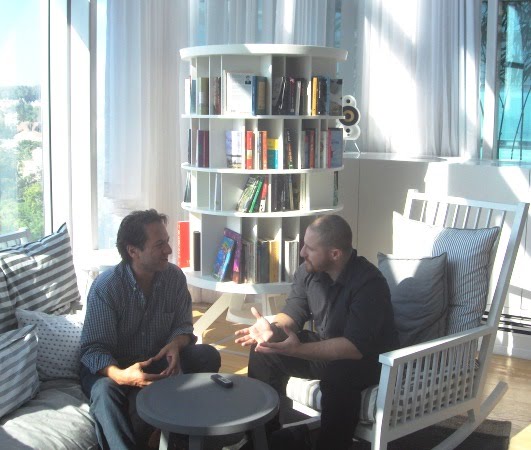
Jo being interviewed for a front -page story in The Marker


Jo in full flight


Part of the audience enjoying Jo's insights
 

Ok, that's the easy bit over with. Now for some of Jo's Gems. Jo's talk was a fascinating mix of philospophy, the expression of values, the business case for sustainability, the difference sustainability can make to the Guardian and vice versa, and some practical tips and advice for companies. Below are just a few of the insights Jo shared.  

On Life and Zen
Everyone has to have meaning. Even someone who buys paperclips can have as much meaning as journalists.

A Zen Buddhist Master told me that "we are eating our children" (but neglected to say whether this is after they have been seasoned with organic herbs) (sorry, couldn't resist that last comment).

On values
Integrity is not just a physical thing. You must also have integrity on the indside.
There is a point at which you can hide from truth and change, and a point at which you cannot.
You have to have a sense of purpose.  

On Web 2.0 and a new approach to journalism
We are opening ourselves up, allowing others to see what we are doing and get involved. Once, a newspaper printed an article and put it out there, and that was that. Now, putting the story on the website is just the beginning. It's like saying: Here's the article, now let's have a conversation.

The web is about sharing and becoming a hub, and not being proprietorial.

On Sustainability Strategy
It all depends on how you frame things. Once we started thinking in terms of "How can sustainability help ensure the long term success of the Guardian?", a whole new world of possibilities opened up. This was a positive framing of the issue, rather than the negative framing we usually hear (stop doing this, don't do that, reduce this, change that etc.)

Businesses can now see that they can make money from sustainability and that it can be a core business benefit. 

CSR is like the American Cavalry Bugle for businesses. Years ago, the only thing that  businesses knew what to talk about was money, there just wasn't a vocabulary of sustainability.

It is hard to envision exactly what the future will be. We can't see beyond the current system. But you have to set goals, even if you dont know how you are going to achieve them.

On Sustainable Consumption
We are on a runaway train to hell .
We are using 5 planets.
Sustainable consumption may invite a lot of cynicsm, but all the major companies are now talking about this.

On Sustainability Reporting
Good reporting should be a force for change.
It is important to have an independent verifier. For the Guardian, this was critical because of the Guardian's independent voice in the media and the desire not to compromise that.

On the role of the media
Companies are very fearful of the media, but if you are open and honest, you gain more respect.

On the future of the printed press
We have to accept that eventually, the printed newspaper will become a niche product. The only thing that will keep newspapers going is the lack of technology to provide adequate alternatives.

On the Guardian's Prokect in Katine
We wanted to tell the real story about the way community development took place in a local community.. not just tell the good news .. but tell the truth. We wanted to focus on one project and "get under the skin" of what's happening and leverage this in a transparent way. The success of the project wasn't the success of the project. It was how successfully we managed to bring out the true story, day by day. Our commitment was demonstrated by having two Ugandan journalists, one actually living in Katine, covering the progress and events on a regualr basis.  

On Leadership:
The biggest Agent of Change is the leadership. The leaders have to "get it".
It is important to get the leaders on board, but then you have to create structures to make things happen.
One of the core challenges at the Guardian has been to ensure Directors set their own measurable targets in the areas they manage.

THANK YOU to Jo for giving of his time and thoughts so generously. Thanks to the local CSR organization, Maala, for working so hard to organize this event with us. Thanks to the local office of BBDO (Gitam) for hosting the event with Jo. Thanks to The Marker newspaper for their interest in what Jo has to say and for, we expect, great coverage of his visit in the local press. And thanks to all those who attended Jo's talk.

This was a great event and Jo was an inspiration to all, despite the fact that he didn't mention Chunky Monkey even ONCE in all the time he talked.

elaine cohen, CSR consultant, Sustainabilty Reporter, HR Professional, Ice Cream Addict. Contact me via www.twitter.com/elainecohen   on Twitter or via my business website www.b-yond.biz/en  (BeyondBusiness, an inspired CSR consulting and Sustainability Reporting firm)
Related Posts with Thumbnails