Showing posts with label women in leadership. Show all posts

Tuesday, September 11, 2018

Story of a Sustainability Superwoman

There are plenty of excellent reasons to attend the Asia Sustainability Reporting Summit on 2nd and 3rd October 2018. I won't list them all here.

Just take a look at the website and you'll be convinced. Instead, I'll tell you a story. 

Once upon a time, there was a little girl called Suyin. Suyin lived with her mother and father and seven younger siblings in a remote part of Asia, in a wooden hut, far from the hustle and bustle of the big cities and the stresses of daily living in modern times. Suyin and her family were a close-knit group, relying on each other for love, support and inspiration. They lived on the resources of the earth, fishing, hunting and farming, taking from the land only what they needed to survive without wasting any precious resources. It was a simple existence, but it was a good one. 

As Suyin advanced in age, she noticed with each passing year that life in their region was becoming tougher. Rainfall patterns were changing, water levels were dropping in nearby streams, the soil was not as fertile as it once was, local wildlife had ceased to thrive. Slowly, Suyin was perceiving that her land was refusing to provide for them. And when she was just 19, there was a major typhoon that shook their wooden hut to its foundations, barely leaving it standing.

Suyin was worried about the long-term survival of her family. She knew she had to do something. Amid tears of farewell, she left her family, promising to return. She travelled by foot without a cent to her name until she reached a major city and there, she begged for food and money. What she was given, she saved. And when she had saved enough money, she rented a small room, and took a job in a small store. She did well. She was intelligent, capable and thoughtful and soon enough, she had enough money to fund a place at university, as she knew that without education, she would not advance and be able to help her beloved family. 

After studying, she was fortunate to be offered a job in a large corporation, in the Sustainability Department. In that role, she campaigned to mitigate climate change and advance social programs that would help families living in remote areas. She became a true sustainability leader, speaking all around Asia on the need to save the land and prevent environmental degradation, as well as taking care of communities and their ability to survive and thrive. Many companies followed her lead and joined the sustainability movement to drive positive change for prosperity. During this time, Suyin returned frequently to visit her family, provide them with resources and help them overcome their challenges. For example, she purchased a small farmer irrigation kit from Netafim so that they could irrigate the couple of acres they farmed and gain greater yields of fruit and vegetables with less water. 

In 2018, a colleague nominated Suyin in the annual listing of exceptional female sustainability leaders in the region, Asia's Top Sustainability Superwomen, an initiative of CSR Works International. Suyin was overwhelmed. She had never received such recognition for doing only what she thought was right. But will Suyin's nomination be accepted? Will Suyin shine through? How many more Sustainability Superwomen have been nominated and who will gain recognition at the Asia Sustainability Reporting Summit?

You can discover if Suyin is included in this prestigious list of Sustainability Superwomen in October in Singapore, at the Asia Sustainability Reporting Summit. Even if you don't get to meet Suyin, you will be able to engage with a host of inspiring women sustainability leaders and experts who have driven the sustainability agenda in Asia with passion and overcome challenges to ensure their voice is heard and improve life for all of us.


Come to the summit and celebrate Sustainability Superwomen with all of us. Overall, there'll be more than 60 international speakers (not ALL of them are women, however!) who will cover every important aspect of sustainability reporting in depth. You will hear directly from top leaders from

• Agility
• AIG
• Bangchak Corporation
• Baoviet Holdings
• Bombay Stock Exchange
• CapitaLand
• CDP
• City Developments Limited (CDL)
• CLP Power
• CP Group
• DBS Bank
• EcoVadis
• Golden Agri-Resources
• GRI
• Hang Lung Properties
• Intel
• International Integrated Reporting Council (IIRC)
• John Swire & Sons
• JSW Group
• Kalbe Farma
• Maritime Ports Authority Singapore
• Microsoft
• MSCI
• RobecoSAM (DJSI)
• Schneider Electric
• Sime Darby
• Singtel
• SM Investments
• Suntory Food & Beverage
• Sustainability Accountability Standards Board (SASB)
• Tata Consultancy Services
• Union Bank of the Philippines
• Viego Eiris
• WWF
and the list goes on

And of course, I will be there, co-chairing the summit with the man behind it all, Rajesh Chhabara.

Exciting debates and insights that will help you move the needle include:


Looking forward to a fun couple of days of learning, sharing, challenging and celebrating. Hope to see you there!


elaine cohen, CSR Consultant, Sustainability Reporter, former HR Professional, Trust Across America 2017 Lifetime Achievement Award honoree, Ice Cream Addict, Author of three totally groundbreaking books on sustainability (see About Me page). Contact me via Twitter (@elainecohen) or via my business website www.b-yond.biz (Beyond Business Ltd, an inspired CSR consulting and Sustainability Reporting firm). Need help writing your first / next Sustainability Report? Contact elaine: info@b-yond.biz 
Elaine will be co-chairing  the  second annual Asia Sustainability Reporting Summit 2018 in Singapore on 2/3 OCtober. Join me there!

Wednesday, March 11, 2015

Businesses (still) discriminate against women

So. Another International Women's Day has come and gone. Celebrating the achievements of women. Doesn't do much for me, I have to say. The implication is that it's sort of amazing or even surprising that women achieve anything at all. Unlike men, for whom achievement is apparently quite natural as they don't have a Day all to themselves, international or otherwise. International Women's Day to me is quite unnecessary. As a woman, wife, mother, business-owner and yes, achiever, in my own modest way, I don't really need a Day. I am happy to celebrate my own achievements in my own way whenever I feel I want to.  

On the other hand, none of us can have any doubt that the need to create a society in which fair and equal opportunity for women exists is no less acute than it ever was. And that, apparently, takes longer than a Day. The position of women in society - certain societies - has improved over the years, but women are still discriminated against. This applies to business as much as it applies in other walks of life. No matter how many sets of Women's Empowerment Principles exist, gender equality in business is still somewhat of a distant dream. 

Sustainability. How can business be sustainable when it discriminates against women? Even the most advanced "sustainable" businesses discriminate. Let's be clear. If women do not have balanced representation in business, discrimination is present. It may not be overt, declared or even desired, but it's there. This is not resolved by adding women to Boards of Directors. It's fairly easy to pluck selected distinguished women and place them on (rather impotent) Boards of Directors so that the numbers look better. I would be interested in seeing research that shows what influence women Directors are actually having in influencing the way business does business. Forgive me for being a little skeptical.

I am more interested in how women have equal opportunity to enter and advance in business, especially the large, typically male-dominated companies that do business around the world. Many consumer goods companies actually target women who make most of the purchasing decisions for their products and yet women's representation in their senior management committees is pathetic. 

Corporate Knights makes a big splash every year announcing the Global 100 - most sustainable corporations - at the World Economic Forum. By all accounts, this is one of the better lists (although all rankings serve the rankers more than the ranked). With the Global 100, the methodology is clear, transparent, and covers the spectrum of sustainability performance areas. In 2015, however, the ten companies that headed up the Global 100 list have just 11% of women in their Executive Committees. They have a higher rate of women on the Boards of Directors, but where it really counts, women in senior executive roles, the figures are rubbish. At the same time, most of these companies have workforces that are 40 - 60% composed of women. What happens to women when they join these companies? How come that, in a combined workforce of almost 200,000 women in these ten top companies, only 9 get a key to the executive committee room? Men, on the other hand, have a better chance of getting a seat on the Executive Committee by a factor of almost five. Three of these top ten companies have ZERO women on their executive committees. So you tell me, are these companies discriminating against women or aren't they? (Hint: not no).


Biogen Idec: The world's most sustainable company has 17% women representation on it's executive management team. That's 2 women out of a team of 12. The two women are the Chief Legal Officer and the VP for Technology and Business Solutions. This is what Biogen Idec says about women in its 2013 Sustainability Report:

"To continue to thrive as a company and an industry, we must advance leadership opportunities for women. In 2013, the Women’s Forum of New York formally recognized our commitment as one of the 174 U.S.-based companies honored at the event for having a board of directors that is at least 20 percent women. Women currently make up just over half of our global workforce, and 40 percent of our management team. As we continue to advance in this area, one way we are striving to close this gender gap is through our Women’s Innovation Network (WIN) Employee Resource Group, which provides opportunities for women to network, learn, seek out mentors and develop their careers. Though primarily focused on women’s careers and leadership, WIN proactively recruits and welcomes employees of all gender identities who wish to act as allies. At present, more than 800 women and men from across the enterprise are members of the network."

This is how Biogen Idec represents the numbers visually:
Note how the high numbers stand out... 51.5% total women  and 40% women in management. Wonder why there is no visual presentation of women on the Executive Management Team. That would read:
17%
Aside from a resource group (dubious effectiveness in actually helping get women promoted), I don't see evidence of a plan to improve women at executive team level.

Allergan: The world's second most sustainable corporation has ZERO women on its executive management team. Yes, ZERO. Yet, this is what Allergan says about women in its 2013 Sustainability Report

"In 2013, women comprised 53% of our workforce and 40% of our leadership roles. This includes more than 39% of our manager and director roles, and nearly 27% of our executive positions. We were also fortunate to have one exceptional female member of our Board of Directors who brings truly exceptional credentials to our organization and is committed to its development."

Note how the high numbers stand out. 53% of the workforce at Allergan means more than 6,100 women. Not a single one worthy of helping to run the company. And the "exceptional" female director doesn't seem to be able to do anything about it. Allergan says nothing about any plans to address this gender imbalance in its organization. 

Allergan website - gender balance in action. Not.
Instead of talking about 27% of executive positions, Allergan should highlight the percentage of women executive team members, i.e.  
0%
And perhaps in its reporting, the company might like to explain how it is that zero women are worthy of senior leadership, and what if anything, the company plans to do about it. 

adidas: The third most sustainable corporation in the world has ZERO women on the Executive Team. The Adidas 2013 Sustainability Report includes a 2014 milestone to "Systematically increase the percentage of women in leadership positions." The website expands a little, stating: "The adidas Group has set itself concrete goals in line with its corporate culture and employee structure to increase the number of women in leadership positions in the coming years. The proportion of women in management is to be increased to at least 32% by 2015 (currently, the proportion is 26% in Germany and 28% worldwide). To achieve this goal, we have increased the proportion of women participating in our leadership development programmes to 35%. This is to help more women take up leadership positions in all areas of the company. We had already achieved this corporate goal at the end of 2012."

Note how adidas quotes the big numbers relating to women in leadership. But, if Adidas were to highlight the number of women on the Executive Management team, the result would look like this
0%
adidas employs more than 50,000 people. Not one single woman worthy of an executive team position. 

Keppel Land: This is the fourth most sustainable company in the world, according to Corporate Knights. And Keppel Land has the highest ratio of women on the senior management team, 2 out of a team of 6, which is 33%. Keppel Land is a real estate company, employing less than 4,00 people in total. And yet, even with such a small total workforce compared to other companies in the top ten sustainables, Keppel Land managed to identify two worthy women leaders, both of them in significant business P&L roles. 
33%

Kesko: The fifth most sustainable corporation has 1 woman out of a team of 8 on the senior executive team (Group Management Board). This is with a workforce of 45,000 employees of whom more than 50% are women. The one woman is the General Legal Counsel.  Rate of women in executive management? 
13%

BMW: The sixth most sustainable company with more than 100,000 employees can manage just 1 woman on the Board of Management out of a team of 8. The woman is the Human Resources Manager. Despite this, BMW has by far the lowest rate of women out of these top ten companies in the total workforce at 17%. Don't women buy cars? I hope they don't buy BMWs.


BMW women in Management:
13%

Reckitt Benckiser Group: The seventh most sustainable company has 1 woman on an executive team of 8.

13%

Centrica: Centrica has one woman in a team of seven top execs. Centrica's website displays some interactive charts that show different performance indicators, including this one for women. Lots of room on this chart for improvement.....


14%

Schneider Electric: This ninth most sustainable company has the largest senior management team of all the top ten. A whopping 15 members. You might think this would give opportunity to find a few women from the 153,000 people in the Schneider workforce to help lead the company. As it stands, just one makes the grade.


Overall women in the Executive Team?
6%

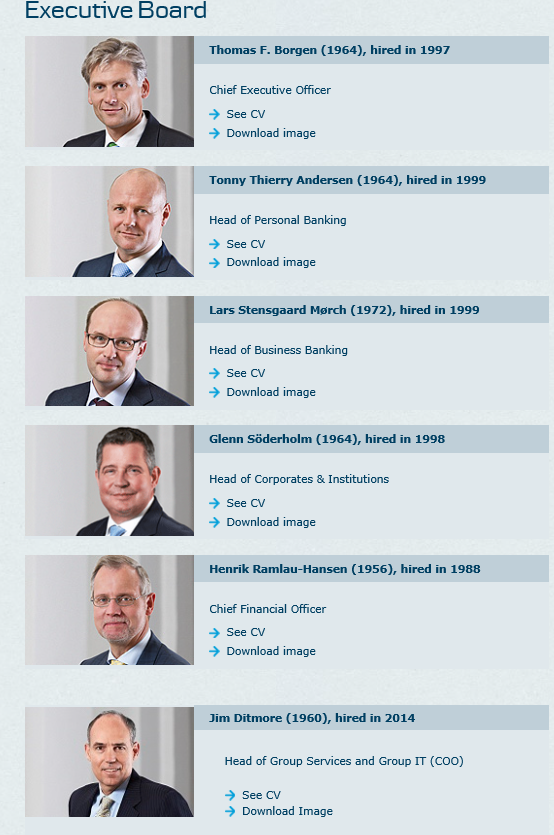
Danske Bank: Perhaps it's fitting that the tenth most sustainable company in the world rounds off this sorry state of women's affairs with a big ZERO women in the management Executive Board.


However, Danske Bank does make a commitment - one of the few that does:

This is not entirely out of the blue. This is what prompted Danske Bank to get more women-action-oriented: 

"In 2012, the Danish Parliament adopted legislation to ensure equal rights for men and women in private organisations. The law requires Danish companies to set specific targets for the number of women on the Board of Directors and to develop policies to increase the number of women in leadership positions. In their annual reporting, companies must also report on the progress made towards these targets and on the implementation of a diversity policy. We have already come a long way in developing a diversified and inclusive workforce, but we recognise that we still have some work ahead of us.

12.5% women on the Executive Board  of six members adds up to 0.75 women. I wonder which 0.25 part they are planning to leave out? Nonetheless, appointing three quarters of a woman executive by 2017 (four years from the 2013 report publication) is some sort of commitment, but forgive me if I am not falling off my seat. Today the score is:
0%


Well, all that was rather disappointing. I confess to being a little surprised that companies that are named as "most sustainable" are so unwilling to promote women. I am sure none of them will admit to discrimination among their ranks. But look at the numbers. Draw your own conclusions. It will take more than an International Women's Day to fix this. In fact, several Days haven't. Let's move on from a Day to Every Day.  


elaine cohen, CSR consultant, Sustainability Reporter, HR Professional, Ice Cream Addict. Author of Understanding G4: the Concise Guide to Next Generation Sustainability Reporting  AND  Sustainability Reporting for SMEs: Competitive Advantage Through Transparency AND CSR for HR: A necessary partnership for advancing responsible business practices . Contact me via Twitter (@elainecohen)  or via my business website www.b-yond.biz   (Beyond Business Ltd, an inspired CSR consulting and Sustainability Reporting firm).  Need help writing YOUR Sustainability Report? Contact elaine: info@b-yond.biz   

Thursday, April 5, 2012

Five insights on Accenture and Women

Let me start at the end. After reviewing Accenture's global 2010-2011 Corporate Citizenship Report, recently released, I have been encouraged by Accenture's performance in gender diversity and advancing women. In many ways, I now believe that Accenture is showing leadership in providing a working environment which repects women's leadership and encourages women to advance.

But that's the end. The beginning is that I wasn't fully convinced of this after reading the Accenture Corporate Citizenship Report. Fortunately, I didn't stop at reading the report. I talked to Accenture. And this is the story. From the beginning.

I didn't have time to study Accenture's report in full (it's online and available as a download) but I  can never resist having a quick look at new report releases, so I did, just in passing, in-between things. Kinda by auto-pilot, my screen navigated to the page entitled "An inclusive, diverse environment".

 What stood out for me on this page is this:


My first reaction was this:

I was disappointed. For the past 5 years, female intake has been static at 34-36 percent. And the number of women senior executives has been static at 16-17 percent of the  senior executive workforce. Accenture has a Diversity Council and a Diversity Advisory Forum. There are leadership courses for women and a Women's Network. Accenture celebrates International Women's Day and in 2010, senior women participated in events in 146 locations across 35 countries, and in 2011,  events took place in  162 locations across 40 countries. Accenture conducts research every year on women in business, and has Women's Mentoring Programs which pair women with senior executives. Yet only 17 percent of the senior executives are women.

Accenture writes: "Increasing the representation of women and minorities among our leadership and welcoming all diverse employees will remain ongoing priorities for us." For the past 5 years, there appears to have been almost no increase of women representation in the senior executive ranks, despite this having been, apparently, a priority during these years.

It therefore seemed to me that, whatever Accenture has been doing for the past five years, it hadn't worked. Whatever Accenture plans to do for the next five years, has to be different. As I have said in the past, down with womenwashing!. "Fixing" women through leadership programs and women's networks doesn't create space for women to move into leadership positions.

Admittedly, Accenture has three women on the Board of Directors (out of a total of 10 non-management Directors) and 26% (5 out of 19) of its global Executive Leadership Team are women, which stacks up pretty well against most large companies and other companies in this sector. However, this just made me wonder why more women do not achieve senior executive status, and, apart from continuing the current initiatives, what Accenture plans to do differently to ensure that 17% could become more than 17% in the next few years.
  
But then......

I contacted Stacey Jones, who is Accenture's reporting contact point for Corporate Citizenship to see if there is perhaps an explanation that I am missing. I was totally impressed that Stacey came back to me immediately and we chatted by phone about what Accenture is doing to advance women. This is fabulous responsiveness, way beyond that which I experience from most companies (and I write to many!).

And then ......

From our conversation I understood that the "senior executives" is actually quite a small proportion of the overall management population at Accenture, as 17% is based on a group of some thousand within the company’s population of nearly 250,00 employees. The percentage of women overall in all management positions is much higher.

I also saw that the total workforce increased by 40% in the same 5 years, so the female workforce in 2007 was 61,200, while in 2011, it was over 80,000. This means that absolute numbers of women in senior positions has increased, even if the percentage figure does not reflect this. Maintaining this level, then, actually represents an achievement.

In addition, Stacey talked with passion about the programs to advance women at Accenture, especially the Diversity Council. "Diversity Council membership includes representation of our most senior male and female executives who have key leadership positions within the business. They play important roles in succession planning and sponsoring women to be groomed for leadership positions and ensuring they have the opportunity to advance. I have been here for 18 years, and I personally observe the investment of time and energy that goes into creating an inclusive culture that works for women."

All this was enough to convince me that there is genuine openness and encouragement for women's advancement at Accenture.

And so .....

I changed this post from what have been a rather critical post to one which highlights the value of stakeholder engagement. Here are my five insights:

Number Uno: As stakeholders, take the time to give feedback and ask questions.
Had I not fed back my observations to Accenture, I would have written an overly critical piece. Knowing what I do now, this would have been unjustified. I like being critical :), but I prefer to be fair.

Numero Two: As corporations, listen and be responsive to stakeholders.
My conversation with Accenture provided them with some value. Through my feedback, they were able to gain some new perspectives about how to present their performance in the Corporate Citizenship Report and a couple of insights into aspects of diversity management.

Number Trois: Things are not always what they seem.
It's always worth checking the facts and hearing the other side of the story. It's easy to jump to conclusions, and be judgmental, especially when the numbers seem straightforward. But just asking a simple question led to a great conversation and a much fuller understanding of the situation on my part. It's easy to be critical of companies. It's less easy to take the time and consider a more balanced view. 

Nombre Four: Transparency builds trust.
This is the whole point of Sustainability Reporting. Transparency opens you up to scrutiny. It exposes you to criticism and external interventions. As a result, I now have a much higher level of trust in Accenture's reporting, and corporate integrity, and Accenture has avoided what might have been some rather unpleasant publicity, and has gained new insights about their reporting.

Nummer Cinq: Make sure your Sustainability Report has an accessible contact point.
If the whole point of Sustainability Reporting is to engage stakeholders, make sure you publish an accessible contact point. It's so frustrating when you send an email and it ends up in a black hole. Accenture's timely and friendly response is a best practice example of stakeholder engagement and deserves a CSR Reporting Blog Double Cone Award.


The End.


elaine cohen, CSR consultant, Sustainability Reporter, HR Professional, Ice Cream Addict. Author of CSR for HR: A necessary partnership for advancing responsible business practices  Contact me via www.twitter.com/elainecohen on Twitter or via my business website www.b-yond.biz/en  (Beyond Business, an inspired CSR consulting and Sustainability Reporting firm)
Related Posts with Thumbnails