Showing posts with label WBCSD. Show all posts

Friday, November 14, 2014

The VITA Model for future Sustainability Leaders

And now for my third and final post about my adventures in Atlanta at the World Business Council for Sustainable Development (WBCSD) Council Meetings last week. I has to share this piece, as it's where everything comes together, and also, one of the most fun-important parts of the WBCSD activities. It's about the Future Leaders of our businesses and our sustainability efforts.

WBCSD has a fabulous program to educate future business leaders of the WBCSD member companies. It's a year-long program that provides tomorrow’s business leaders with "the skills and competencies to cope with an increasingly complex world as well as the social and environmental challenges across a changing competitive landscape."  Each year is themed, and the 2015 program is all about "scaling up business actions on climate change & improving the business case" with modules in the U.S., Hong Kong and Paris. Wow. Wish I were 10, 20, ok 30 years younger.

The 2014 Future Leaders Program (FLP) was populated with young up-and-coming mainly finance professionals from member companies and its theme was "Bridging the Capitals: Accounting for Natural & Social Capital in Business Decision Making".  25 young business people worked on this for a year, and delivered impressive outputs at the close of the program. In five teams, they worked on different aspects of the Bridging the Capitals theme and created reports that contain genuinely original and useful insights about reporting, measurement, materiality and more.


I highly recommend you take a look at some or all of these publications. I have read them all end-to-end and it was worth it.

Integrated Reporting in South Africa - From Concept to Practice: insights from interviews with South African reporting companies and investors.

Unraveling the Business Value Landscape: defining what value really means and recommendations on how to describe business value.

Integrated Performance Management: a quality approach to following through on sustainability commitments.

Sustainability - A new competence for financial leaders: a guide to help finance folks  understand, navigate and even influence the sustainability agenda.

Journey to materiality- A guide to achieve corporate goals by applying materiality to environmental, social and governance issues: views and recommendations around the challenges of defining materiality.

One of the highlights of my week in Atlanta was being asked to present my perspectives and insights  as an "expert" to this group. It's always nice to talk to young leaders and help shape their journey. Thinking about this, I wasn't quite sure what I could usefully add, given they were at the end of a year-long learning process. What could I tell them that they hadn't already heard? What could I add that could shape their journey further as they prepare for re-entry into the workplace with new sustainable-business shaded lenses? So, I used my trusty fall-back. When all else fails, build a model. In this case, I created a simple model designed to help these impressive young leaders remember to apply their learning as they grow and develop in their own professions. I called it the VITA model. Vita, according to the dictionary, is a biography or a resume. Quite fitting, I thought, because what I wanted to leave with the FLP participants was a thought about what they would want to see on their resume in 20 or 30 years time. What is the legacy of business activity they want to be proud of? How will their sustainability orientation show up in that 2030 resume? The VITA model has four main tenets:


VALUE – IMPACTS – TRANSPARENCY – ACCOUNTABILITY

VALUE:  It may still be of value even if it you can't put a money number on it.
IMPACTS: We must talk impacts not actions and get better at defining them.
TRANSPARENCY: Transparency is not the goal, relevant transparency is the goal.
ACCOUNTABILITY: The finance function must be accountable to all its stakeholders.

In talking to these points, I shared some true (and in some cases, quite incredible) stories from my own experience as a business person over thirty years, and from my work with clients (no names named!).  I won't fill up this post with stories ... but I will comment briefly on each part of the model.

VALUE:  It may still be of value even if it you can't put a money number on it. Essentially, here, despite a week about capitals, costing externalities, measurement and metrics, I couldn't help but make the point that not everything can be quantified scientifically. For example, the impact of corporate culture. Sure, we can measure employee engagement, retention, attrition, satisfaction, development and even conflict in an organization, and we can measure the cost of non-compliance or non-ethical conduct to some degree, but can we truly measure a the money value of a culture that is ethical, open and empowering? In corporate cultures where there are aspects of complicity, lack of freedom to express new ideas or lack of respect for human worth, the ripple effects are far-reaching but we don't know exactly how to count them. As young leaders, especially ones with a head for finance, it is crucially important to remember that, at the end of the day, business is just people trying to survive and thrive. Valuing them and valuing values is just as important as valuing value. Even if you can't count it.  

IMPACTS: We must talk impacts not actions and get better at defining them. I have said this many times, and often refer to "shopping-list" reports where I get what companies did but I didn't get what difference it made. Companies, and finance experts in companies, are soooooo good at calculating the last cent of the return on a capital investment. Yet companies are proud to say they donated (or even invested) tens of millions of $ in the community when they have no idea what a difference it made. We need to get better at why we are doing stuff and what impact we are trying to have. The ways of calculating impacts are partly about money but also about a range of intangibles that affect people lives which are harder to calculate. But that doesn’t mean we should ignore these impacts or even attempt to define them in at the planning stage. 

I work with a company called Netafim. Netafim is a world leader in drip irrigation – a climate-smart agricultural process that enables better yields, using less water and less fertilizer and less energy. The economic cost benefits of drip irrigation can be calculated and in each market, Netafim has amassed a range of data that supports and quantifies the environmental and economic impacts of using drip irrigation. However, there are also many intangibles. How do you factor them into the equation? How do you design them into the planning?  Rachel Shaul, the Marketing Director of Netafim went to Gujarat in India to talk to women farmers as part of a research project. Women's empowerment is a big thing in smallholder agriculture. The impact of using drip irrigation for them was the possibility of sending their kids to school, being able to buy a house for the first time or the ability to help other women become independent and self-sufficient. 

from Netafim Sustainability Report 204

How do you calculate the impact of that? Can you monetize that? Where would that get prioritized in the allocation of resources? Are these kind of impacts defined up front or are they a by-product that happens by doing business differently? Intuitively, supporting women smallholders makes sense. Objectively, data shows their economic situation improves. But how are all the other impacts on  the quality of their lives calculated? When you are looking at the difference your company makes, these are the sort of things that should also be understood more deeply and taken into account. We must get better at defining impacts in economic, social or environmental terms. We must get better at getting clearer about how a company is changing the world. And we must plan more holistically to deliver the impacts we desire to deliver. Some of that is about money, some of it is not.

TRANSPARENCY: Transparency is not the goal, relevant transparency is the goal. Everyone talks transparency, everyone believes that transparency is the goal. Everyone thinks that if they cram as much information as possible into a sustainability report or a website, that they will improve their reputation. Well, that may be. But in this world of overload, and with the increasing complexity of business, we don't need or want to know EVERYTHING. We want to know the most important things. How are those things defined and by whom? It's not easy. A materiality process can be designed to deliver the results you want to achieve. Getting granular and relevant on materiality requires good engagement. Engagement does not mean sending out a survey or having a meeting about your next contract with a supplier. Engagement means truly understanding the measure of impact you are having in a specific context and looking for the business risk and opportunities associated with that. 

ACCOUNTABILITY: The finance function must be accountable to all its stakeholders. As finance managers or business leaders, who are your stakeholders? Who is affected by the impact of your decisions?  Employees, of course. Management and their ability to advance positive reputation for your company and support business success, of course. But beyond that? Who do you have an impact on? What are the policies that you create that have an impact on society, the environment, the well-being of communities? How you establish investment policies, payment terms, restructuring frameworks and more? These all have an impact on the lives of people. This is often highly relevant when businesses undergo restructuring. The key partners in any company that manage processes such as these are the Human Resources and the Finance teams. We decide, with our policies, whether people have a future or what kind of future they can start to plan. It's that simple. 

U.S. Census data shows that more than 7 percent of American workers fell below the poverty line in 2012. Similar figures show up in Europe. Workers. Not people sitting on a beach somewhere. Workers. Going out every morning to a job and coming home and not being able to maintain a decent standard of living. Who's responsible for that ? HR? Finance? No-one? The competitive landscape? In the post-2015 agenda, the UN has begun to talk about eradicating poverty. Business has a role to play here, and so do finance managers and other business leaders. Who are your stakeholders? Are they the working poor? Or are they your management who wants to make more profit and show a better balance sheet? Of course a business must make money, profit is crucial to any business. But ultimately finance and business managers must be accountable for the impacts of their decisions, policies and actions on the way people live. And these elements must be factored into day-to-day decisions as well as in the bigger strategic directions. This means considering all stakeholder impacts up-front in the decision-making process, and not just about balancing a budget. As well as considering the long-term impact of doing business in a world where poverty is omnipresent. Behind every number is someone's life. This isn't about the financial crisis, or big events that need big responses. This is about the day-to-day of our jobs and how they have an impact on stakeholders.

That was pretty much my message to these young leaders. VITA: Value, Impacts, Transparency and Accountability. That's the legacy. That's the 2030 resume. You'll notice that most of what I said was about people not about money and not about numbers. As young business leaders, this group has the power to make change and impact people's lives for the better. They can drive a different way of doing business that is led from a new vision, a new way of thinking about the role of business in society, a new way of creating value and a new way of being accountable. In some cases, that means accounting for externalities. In other ways, it means being a decent person and making decent decisions. It always means knowing what impact you are having on all your stakeholders.

*********

Finally, with this third and final piece in a trilogy of posts, I want to extend my personal thanks and gratitude to the folks on the WBCSD team that totally impressed my with their dedication, drive and skill and made me feel so welcome. Triple fudge with sprinkles to Rodney Irwin, Anne-Leonore Boffi and Susanne Feinman.


PS: One thing can't resist adding. I was very pleased to see in Peter White's (WBCSD COO) plenary presentation about WBCSD priorities, that he mentioned my company, Beyond Business Ltd. Hahahahah. Well, he didn't really. But it looks like he did. Or maybe it's just a case of "great minds think alike"!


elaine cohen, CSR consultant, Sustainability Reporter, HR Professional, Ice Cream Addict. Author of Understanding G4: the Concise guide to Next Generation Sustainability Reporting  AND  Sustainability Reporting for SMEs: Competitive Advantage Through Transparency AND CSR for HR: A necessary partnership for advancing responsible business practices . Contact me via Twitter (@elainecohen)  or via my business website www.b-yond.biz   (Beyond Business Ltd, an inspired CSR consulting and Sustainability Reporting firm).  Check out our G4 Report Expert Analysis Service - for published G4 reports or pre-publication - write to Elaine at info@b-yond.biz to help make your G4 reporting  even better. 

Sunday, November 9, 2014

Reporting is seriously undervalued

This past week, I was privileged to attend as a guest speaker the World Business Council for Sustainable Development (WBCSD) 2014 Annual Council Meeting in Atlanta. This will be the first of a few posts reporting from the field about the sessions where I was involved in Atlanta and highlighting the work of the WBCSD, which I found to be compelling, engaging and very leading-edge. For a quick look at what WBCSD is all about, check out the website or take a look at this post.

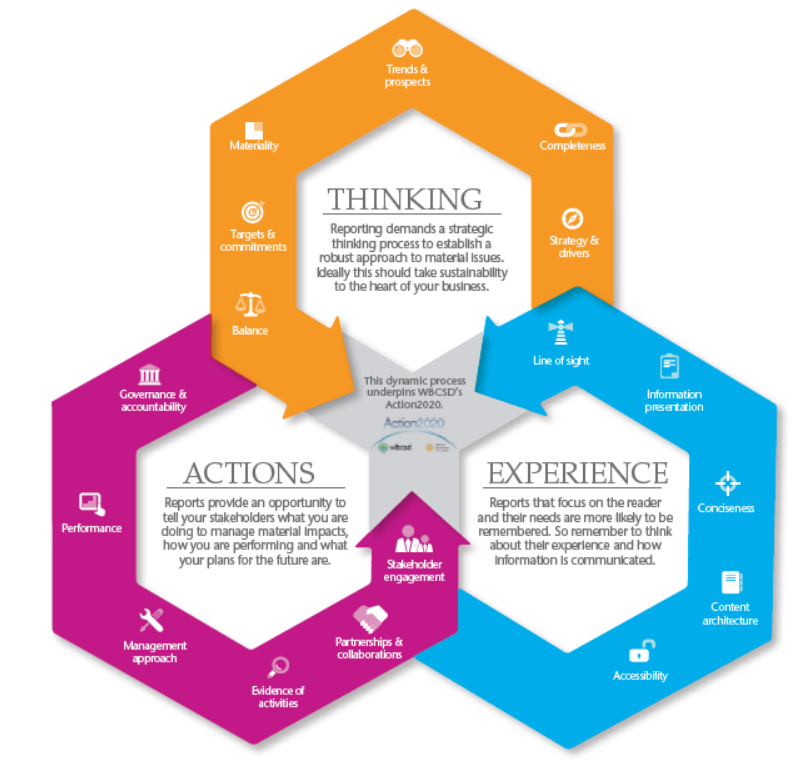
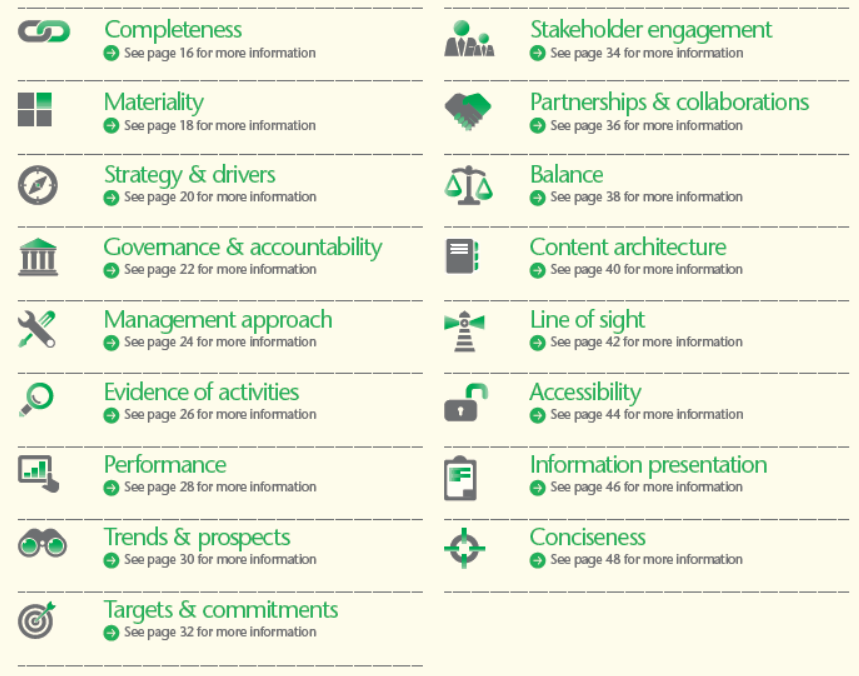
The first of the three sessions I took part in was the presentation of the 2014 (second annual) edition of Reporting Matters.  Reporting Matters is the bible of reporting effectiveness, using reports of WBCSD members as the basis for an analysis against 18 criteria (a "reliability" criterion was added in 2014). The new report showcases best practice examples selected from 162 sustainability and integrated reports analyzed across all criteria. This is a tremendous resource for any reporter. The Reporting Matters team from WBCSD and Radley Yeldar have done a great job in pulling this all together. What's more, overall, reports show an improvement over 2013 with 25% of reporting companies showing better materiality disclosure. 86% of reporters use GRI guidelines (up from 75% in 2013)  with 25% of reporters already having transitioned to G4. This year again, GRI reporters tended to score better than non-GRI users.

Reporting Matters 2014 was unveiled in Atlanta by the Redefining Value team. Redefining Value is one of the WBCSD's priority work areas to help deliver its Vision2050 which proposes that a "business should be measured by its ‘True Value’ and should use ‘True Costs’ and ‘True Profits’ in its internal and external reporting." This means including the costs and benefits of externalities and reporting in a way that links profit and loss, performance and value creation in the context of longer-term environmental and social impacts.

After presentation of the report and other insights from the Future Leaders development program (more about this in a future post), I was asked to share some insights about reporting. Below is the gist of what I said (including the bits I skipped over for lack of time)(I get carried away talking about reporting)(Did you notice?)

"

I have studied the new Reporting Matters report and find it very valuable for any company to learn and improve. Sustainability reports are meant to be used. To be used, they must be effective. Peter Bakker (WBCSD President and CEO) states in the introduction to Reporting Matters 2014 : "The end goal [of reporting] is concise corporate disclosure that brings together financial, environmental and social performance to reflect improved risk and performance management within companies, as well as to drive more accurate valuation of companies and improved allocation of capital market investments." Improving performance. Improving allocation of investments. That means change. Reporting both reflects and DRIVES change. 

Here is the key message I want to share with you today.

Reporting is seriously undervalued – the failure to capture the power of the reporting process to drive performance, engagement and empowerment is probably one of the biggest failures of business over the past 10 years. Let's face it. Whenever anyone talks about reporting, all you hear is groans and sighs. All people do is moan that their reports don't get read. Everyone talks about the cost and resources required for reporting but very few people actually refer to it as an investment. No-one smiles when they talk about reporting. Quite the opposite in fact. Mention sustainability report and people's jaws drop to the floor or they go into a deep coma. Hardly anyone actually says: "Wow, we derive real benefit from our sustainability reporting. It's a fantastic and fun activity. It's really worth our time and effort." 

So, how did that happen? How did we turn sustainability reporting into everyone's biggest headache? How is it that companies who are expert at squeezing every cent out of a capital investment get barely a quarter of the value from their report? Let me tell you why. It's because reporting is, sadly, very misunderstood. And who misunderstands reporting the most? Yes, you guessed it. Pretty much everyone. CEOs. Investor Relations folks. Managers. And, don't fall off your seat… Chief Sustainability Officers. Yes. Quote me on that. Chief Sustainability Officers don't understand reporting. Haha. I'll probably never work in this industry again, but what the heck. I can prove it. Just go back home to your workplace and see how many managers and employees know about your sustainability report and have actually taken an interest in any part of it. Call up any of your key suppliers and ask them if they have noticed your report. Talk to a few customers. See what they say. Ask your Sustainability Officers how many conversations they have had about their latest report with just about anybody. I am prepared to guarantee that, for most of you, the responses won't be very encouraging. 

So let me present another perspective. Sustainability Reporting has business value, it engages internal and external stakeholders, it empowers people and it's fun. Notice that I talk about reporting, not just reports. Because the PROCESS is just as important as the OUTPUT. What you do with the output is also part of the process. A Sustainability Report is made up of three parts: the preparation process, the publication and the engagement process following publication. Most people undervalue the first part, minimize the second part and completely ignore the third part. 

Sustainability Reporting has business value, it engages internal and external stakeholders, it empowers people and it's fun. 

Business value: The minute you follow a reporting framework, you are forced to think about issues in a different way. If you take a framework such as the GRI G4 framework, you are asked to give deep consideration to material impacts and the focus of your sustainability activities. The minute you publicly declare what's material, your paradigm of what you are doing, measuring and reporting changes. And when it does, you start to create a different kind of business value and business commitment. But only if you do this as a serious activity. If you just go through the motions, all you get is motions.

Engagement: The reporting process is a fantastic platform to engage internal and external stakeholders on what's important to them and their expectations of you. You may think you know. Maybe you do. But asking the questions creates ownership, partnership, commitment, motivation. Talking in a different way to stakeholders will deliver you a different kind of stakeholder relationship. 

Empowerment: I say that everyone engaged in the reporting process is empowered by it. Sustainability reporting is a way to bring people out of their regular activities, allow them to tell their stories, shine a little. With so many online platforms for reporting, employees are now even becoming movie stars .. reporting videos featuring employees are becoming much more popular. Take a CEO. CEOs have almost no involvement, I might say, even no ownership, for the reporting process. Most of them probably hardly even read their own opening statements. Yet, look what happens to a CEO when she has a great sustainability report to share … suddenly the CEO can join a conversation about sustainability, can showcase her organization on world stages, is seen as progressive or at least, legitimate. It's highly empowering for a CEO to be able to demonstrate – through a Sustainability Report – that her company is behaving in a sustainable manner. 

Don't let the technobabbling frameworks misguide you. Part of the headache around sustainability reporting is that we all think it's so complicated. GRI, SASB, CDP, Integrated Reporting… finding your way through a labyrinth of conflicting and disconnected guidance documents written in language that you need to be a professor of law to understand doesn’t really help anyone. But it's not that tough. Don’t let all these technobabblers derail you. It really is quite simple. Work out what your unique contribution to the world is. Define how you are materially impacting stakeholders. Prioritize. Act. Measure. Report. Engage. Voila. Don't let the framework builders define what's important for you. You have to do that yourself. Don't let SASB tell you biodiversity is important. Let your stakeholders tell you. Don’t let the Integrated Reporting framework scrunch up your brain with so many different capitals if they don't have meaning for you. Since when was a person "HUMAN CAPITAL"? How weird is that? Sustainability reporting in its simplest essence about the way your company impacts the world, how it measures and accounts for doing so. Doing it well adds value to your business, it's engaging, empowering and fun. 

Put comparability back in its box. One of the big dilemmas of course is how to tell who is better than the rest. We are all obsessed with ranking and ratings, and yes, wait for it, the Holy Grail of Comparability. Companies are competitive and sustainability is a competitive differentiator. GRI was set up with a goal (among others) of establishing comparability. It never worked. Even CDP, where the focus is on a single set of KPIs, I suggest, does not achieve true comparability. So you know that Company X has lower GHG emissions than Company Y. That single data-point is connected to so many other data-points that it's just not enough as a basis for making an informed decision about investing, buying from or working for that company, or allowing it into your neighborhood. I say comparability is a diversion. What we should be looking for is good process that delivers intended results and consistency over time that enables us to see how a company does better than itself. 

Consistency is the differentiator. Some of the best companies in this space are most respected because they demonstrate consistency over time. A single report is a drop in the ocean. Sustainability credibility is a series of action and reporting cycles over several years, where progress can be demonstrated. M&S and Plan A, Kingfisher and Net Positive, Patagonia and the Footprint Chronicles, Pepsico and Performance with Purpose, Nestle and Creating Shared Value, Unilever and the Sustainable Living Plan, Skanska and Deep Green, H&M and Conscious Fashion. The value in this program branding is its consistency year after year of delivering sustainability results. All these companies set multi-year targets and follow through, coming clean about where they are not delivering. 

Don't force it (all). I am often asked about mandatory reporting. Should all companies of a certain size be FORCED to report and FORCED to report the same things? There is no doubt that voluntary reporting has not evolved as a universally accepted norm in a consistent way. There is also no doubt that legislation changes the way companies behave. The Denmark report or explain experience caused more companies to report and some to actually derive benefit from it. In an ideal world, companies would want to use reporting to derive the value it brings for their companies. However, there's something else. If we believe that reporting has value and is a catalyst for performance improvement, why would governments not be more interested in having companies do things that will help them create performance improvement? It's in the economic, social and environmental interest of governments to have more companies report, and use the output to drive allocation of resources and plan future infrastructure. I therefore believe that governments should mandate sustainability reporting of policy, process and a  set of core indicators that should be disclosed by all companies. Exactly what and how companies report this and more can be discretionary. Those companies who, as now, see it as valuable will invest more and derive more value from it. Those who want to tick the box will do the minimum and get the minimum in return. But as a minimum, governments are also accountable for corporate impacts and should legislate to know what they are dealing with. 

Reports are people. Legislation alone is not going to make the transformation here. Companies are. CEOs are. People are. Stakeholders are. Sustainability reporting is one of the tools that can help this transformation. Rounding off, my message is that Sustainability Reporting has business value, it engages internal and external stakeholders, it empowers people and it's fun. If you approach reporting with this mindset, you will be amazed at what reporting can do for your business and for your stakeholders. You might even find it raises a smile. Or two.

"


elaine cohen, CSR consultant, Sustainability Reporter, HR Professional, Ice Cream Addict. Author of Understanding G4: the Concise guide to Next Generation Sustainability Reporting  AND  Sustainability Reporting for SMEs: Competitive Advantage Through Transparency AND CSR for HR: A necessary partnership for advancing responsible business practices . Contact me via Twitter (@elainecohen)  or via my business website www.b-yond.biz   (Beyond Business Ltd, an inspired CSR consulting and Sustainability Reporting firm).  Check out our G4 Report Expert Analysis Service - for published G4 reports or pre-publication - write to Elaine at info@b-yond.biz to help make your G4 reporting  even better.   

Monday, October 27, 2014

Reporting Matters.. more

Last year, the WBCSD (World Council for Sustainable Business Development), headed by the fearless Peter Bakker, published a review of sustainability reporting called Reporting Matters. I didn't get to blog about it at the time (I wish I could do nothing but blog) but I have taken it up again in the run-up to the invitation-only WBCSD Council Meeting in a couple of weeks in Atlanta, where I will be speaking and moderating in some sessions. The Atlanta meeting is themed: "Business - Setting the Pace". At this meeting, with the belief that business is a driving force for delivering sustainable solutions to the world’s most pressing challenges, senior executives of WBCSD member companies come together to explore opportunities to advance WBCSD's Action2020 strategy. The Council Meeting draws CEOs, Council Members and thought leaders from across all sectors and geographies in a high-level game-changing outcome-oriented week of debates and decisions. 


For those not familiar with WBCSD, it is an organization with a powerful voice in our sustainability landscape and a leading authority on natural and social capital risk management, disclosure and valuation. I include a brief blurb from the WBCSD website. 


"The WBCSD is a CEO-led organization of forward-thinking companies that galvanizes the global business community to create a sustainable future for business, society and the environment. From its starting point in 1992 to the present day, the Council has created respected thought leadership on business and sustainability. The Council plays the leading advocacy role for business. Leveraging strong relationships with stakeholders, it helps drive debate and policy change in favor of sustainable development solutions. The Council provides a forum for its 200 member companies - who represent all business sectors, all continents and combined revenue of over $US 7 trillion - to share best practices on sustainable development issues and to develop innovative tools that change the status quo. The Council also benefits from a network of 60 national and regional business councils and partner organizations, a majority of which are based in developing countries. By thinking ahead, advocating for progress and delivering results, the WBCSD both increases the impact of our members’ individual actions and catalyzes collective action that can change the future of our society for the better." 

Now you know. Check out the website. It's a wealth of resources. 

Anyway, back to the matter in hand and that's Reporting Matters. (Matter, matters. Good, right ?)


WBCSD produced this report in partnership with communications consultancy Radley Yeldar as a tool to help improve the effectiveness of reporting. Member companies can use the WBCSD analysis of their reporting to help improve different aspects of their own disclosure. Reporting Matters 2013 the baseline report and the research is ongoing with reports planned to be published annually. In early November, in Atlanta, the new Reporting Matters 2014 will be presented to give an updated view of data and trends in reporting effectiveness.

Peter Bakker introduced the 2013 baseline report with the words (among others): "We believe that reporting practices need to change to ensure that businesses are truly valued on what is important, that stakeholders have timely information, and that reports are read and used by investors and other stakeholders."

Reporting Matters measures the effectiveness of  corporate sustainability reporting and to do so, it defines an effectiveness framework based on three key elements: The Thinking that defines the report, the Actions (relating to material impacts) that the report discloses and the Experience that the reader has when reading the report.


The Reporting Matters baseline examined 175 Sustainability Reports (including integrated reports) of WBSCD member companies across 20 sectors and 30 countries against 17 criteria (12 content-related and 5 experience-related).


For each of these criteria, Reporting Matters explains the approach, provides key findings from the research, offers recommendations and showcases best practice distilled from the 175 reports analyzed. Some of the overarching conclusions were:
  • Companies are reporting far more than a focus on material impacts might suggest. This makes for long, unwieldy reports and difficulty in finding the most relevant and useful information.
  • When combined with the annual report, the amount of sustainability content disclosed is generally less than a standalone report.
  • 75% of the reports analyzed follow GRI Guidelines and these tended to be the ones with the higher effectiveness scores.
  • 80% of the 175 reports analyzed were standalone sustainability reports. However, self-declared integrated reports scored higher on the WBCSD effectiveness scale than many standalones. 
  • 60% of companies have some form of external assurance at some level on some part of the report but only 4 companies (2%) used reasonable assurance for their entire report. 
But the real meaty stuff of this report is in the detailed analysis of the report against the stated criteria. Unfortunately, WBCSD does not share with us, the general professional public, the exact scores that each report received (though WBCSD member companies each receive their own scores and have the opportunity to discuss and review with WBCSD Reporting Matters experts). However, Reporting Matters shares enough for us to get the benefit of the learning and appreciate some great examples of reporting practice. Some examples follow.

Strategy and Drivers: Reporting Matters says: "A sustainability strategy is a clearly-articulated approach or plan to address material financial, environmental, social and governance risks and opportunities. It should link to a vision, a mission and provide an explanation of how the strategy will be delivered, including milestones and targets."

This made me stop and think, and agree, as more and more, I find that I read sustainability reports with a need to understand the strategic relevance and embedded approach that companies have adopted. In the early days of reporting, it was all about taking action in addition to doing your business. Reports were all about "we did this" and "we did that", where "this" and "that" referred to a volunteering activity, a charitable donation, a training event for employees or a LED lighting retrofit. No connection to an overall approach, strategic direction or business relevance other than the platitudes of "giving back", "doing the right thing" and "valuing our planet". Today, it's about being accountable for impacts across the value chain and through the core business. Today, if sustainability is not part of your business strategy, then your business strategy is not part of your future success. In any sustainable business strategy there is value, and that value should be clear as we read a company's sustainability report. Reporting Matters found that:
  • The most effective reporters disclose a business strategy that links to positive sustainability outcomes, such as the management or avoidance of sustainability risks or the development of opportunities through innovation. The strategy is supported by a detailed implementation plan. 
  • The most effective reporters define a specific business case for sustainability, referencing drivers such as cost savings, reputational benefits, and employee retention, as well as wider societal needs. 
  • Many reporters however do not establish a clear link between sustainability and their core business nor do they define a company-specific business case. 
  • Many reports do not include a sustainability vision and consequently do not communicate a clear sense of direction or purpose.
One of the three showcased examples includes Svenska Cellulosa:

Svenska Cellulosa is  a global hygiene and forest products company with around 44,000 employees that develops and produces sustainable personal care, tissue and forest products. The current Svenska Report for 2013 supports the insights noted by Reporting Matters about the prior report. Often, you can tell how much sustainability is embedded in a company's strategy simply by looking at what the company chooses to highlight. In 2013, Svenska highlighted real business developments that have sustainable value. 


While Svenska links its activities to business drivers and reports the results of activities, there is room to go further by reporting more outcomes and linking these outcomes to the business, as well as social and environmental value created. 

Evidence of Activities: Reporting Matters says: "Evidence of activities involves reporting on sustainability activities such as strategic programs and initiatives that occur during the reporting year, or progress of existing sustainability activities. It helps link management approaches to actions and performance and can substantiate statements and claims."

Well, evidence of activities may not seem too much of a stretch for most reporters. In fact, most reporters are more than happy to elaborate on things they did. I wonder if the focus here shouldn't be more on evidence of outcomes rather than activities. However, Reporting Matters 2013 made some relevant recommendations for reporters that refer to the way outcomes are included in disclosures. 
  • Include more specific narrative on strategic sustainability activities that address material issues during the reporting year. 
  • Illustrate sustainability activities through relevant and compelling case studies focusing on material issues, linked to a wider strategic program or management action and focused on outcomes. 
  • Provide appropriate background on the development of strategic programs and initiatives over time but focus on achievements and progress during the reporting year. 
  • Show how disclosed management processes and tools support the implementation of strategic programs and initiatives.
One of the three showcased examples of Evidence of Activities is the Lafarge 2012 report.

In Lafarge's subsequent 2013 Sustainability Report, the company continues its use of relevant case studies that provide evidence of Lafarge's progress.


This is sustainable core business, and references the difference (outcome) that Lafarge is making through sustainable innovation. I would welcome even more detail on the actual outcomes in case studies such as these, but in general, this is an effective way to get the message through.


Partnerships and Collaborations: Reporting Matters says: "Appropriate and strategic partnerships and collaborations can help accelerate action and scale up solutions by combining expertise, resources and networks across key stakeholders who share a common goal. Partnerships and collaborations should focus on addressing a company’s material issues and support the implementation of a company’s sustainability strategy."

This is an interesting criterion and one that is becoming more imperative for most companies as we speak. More and more, the revelation that collaboration is key to sustainability is affecting the way companies approach their own strategies and actions. Our client, Netafim, who recently published a Sustainability Report called "At the Heart of the Food, Water and Land Nexus", knows only too well that, just as all problems are interdependent, so are all solutions. Collaboration is therefore part of the solution. Where every material impact is at some form of nexus (my new sustainability buzzword), so every material action is also at some form of nexus. Collaboration at the Nexus - that's our future.

Reporting Matters 2013 shared these key findings:
  • The most effective reporters highlight strategic partnerships and collaborations that address material issues, and help to implement the company’s sustainability strategy. 
  • The most engaging reports provide details on the expected benefits of partnerships and collaborations for the business as well as for relevant stakeholders.
  • Companies however do not always consistently focus on establishing partnerships which are strategic and that have the potential to deliver the biggest value for the business by being closely aligned with the overall sustainability strategy. Such partnerships are typically philanthropic and not linked to core strategy.
One of the three showcased examples of Partnerships and Collaborations is the Vodafone plc 2012/2013 report which Reporting Matters says has a strong partnership-oriented focus. 


I checked out Vodafone plc's 2013/2014 Sustainability Report and this continues to play out. The word "partnership" features more than 50 times in this report and it's choc with partnership examples in the area of core business. These include partnership around e-mobility, M2M connectivity, technology-supported waste management, smart working solutions, women's security, sustainable agriculture and many more examples. 

I could go on (a lot) but I think this post is already long enough. The point is simply that Reporting Matters is an exceptionally useful document that helps us understand some of the ways in which reporting can become more effective, which according to the WBCSD approach means that it demonstrates strategic sustainability thinking and actions leading to materially relevant outcomes while being focused, balanced and engaging to read.

There are a couple of aspects relating to reporting that I might have added to the WBCSD effective-reporting criteria. There are some things I always look for that for me, really make the difference to the effectiveness and quality of a sustainability report. For example, the leadership statement. This is not directly covered by the defined Reporting Matters criteria. Interestingly too, because WBCSD is a "CEO-led" organization. The CEO statement in any report should not be just an evergreen boilerplaty platitudy we-love-ourselves cringe-piece. It should add value to the report by clearly framing the report context, the company strategic focus and challenges and the intentions to deliver improved material impacts on stakeholders. The CEO statement is the entrance-lobby of the report. If it's not compelling, you don't want to go any further.

Having said that, WBSCD seems to have a good recipe. What makes it truly worthwhile is the ongoing nature of this analysis. The 2013 report is interesting, but the trends and dynamics that will be observed over time with each successive report are the key. It'll be fascinating to see how things have changed during the past year. While we shouldn't get carried away and expect complete transformation of reporting in such a short time, the introduction of G4, the new IIRC framework, progress in SASB standards development, CDP expansion, consultations by WBCSD with its reporting member companies and a generally highly dynamic reporting environment with increasingly legislative orientation (such as the recent European directive) and greater SEC commitment (e.g. Singapore), it's possible that we might find that reporting effectiveness has turned up a notch.

But Reporting Matters 2014 is not the only reason I am looking forward to being in Atlanta. Guess what else I found to do. 


elaine cohen, CSR consultant, Sustainability Reporter, HR Professional, Ice Cream Addict. Author of Understanding G4: the Concise guide to Next Generation Sustainability Reporting  AND  Sustainability Reporting for SMEs: Competitive Advantage Through Transparency AND CSR for HR: A necessary partnership for advancing responsible business practices . Contact me via Twitter (@elainecohen)  or via my business website www.b-yond.biz   (Beyond Business Ltd, an inspired CSR consulting and Sustainability Reporting firm).  Check out our G4 Report Expert Analysis Service - for published G4 reports or pre-publication - write to Elaine at info@b-yond.biz to help make your G4 reporting  even better.   

Friday, May 2, 2014

What would you say to the UN?

If you had the attention of the UN General Assembly in a debate about "Elements for a Monitoring and Accountability Framework for the Post-2015 Development Agenda", what would you tell them? I suppose it depends on who you are, where you come from and what you see.

If you have been one of the leaders of the most dominant business accountability organizations for the last ten years and have had a top position in the Dutch government, in charge of human rights, climate change, and scientific research, and had several international leadership positions, such as chair of an OECD Working Group, OECD President of donor governments to the Sahel, and Vice Chair of the Oversight Committee of the Consultative Group on International Agricultural Research (hosted at the World Bank, with UNPD, FAO, IFAD and 60 governments) and climate change director during COP 6, when agreement was reached on the Kyoto protocol under the UN Climate Change Convention, what would you say?

If you are also a board member of WWF Netherlands, the second largest national WWF network with almost 1 million contributing members, and of  the International Institute of Environment and Development, a global leader in sustainable development, and of CORDAID, a large international development organization with almost a thousand partner organizations in 36 countries, combining emergency aid and structural poverty eradication, and of the SEED Initiative, a global partnership for action on sustainable development and the green economy, and of  Women in Europe for a Common Future (WECF), an international network of over 100 women’s, environmental and health organizations implementing projects in 40 countries and advocating globally for a healthy environment for all, assuming you found the time to take a trip to New York, what exactly would you tell the UN General Assembly, headed by Ban Ki Moon and including delegates from 193 countries?

If you are a dynamic, thoughtful leader with a vision for a better world where business plays a positive role, how would you formulate your advice to the UN delegates?

This person did that yesterday, May 1, 2014, in the General Assembly. Yes, of course, I am talking about Teresa Fogelberg, Deputy Chief Executive of the Global Reporting Initiative. And this is what she said: 

"
A successful post-2015 Development Agenda will require a robust, inclusive and transparent monitoring and accountability framework. Accountability extends beyond government, and applies to all stakeholders being held accountable for their role in implementing a universal development agenda. And that is what I will do today: address business accountability.

There is a unique momentum bringing together two global currents, two movements: 1) the business and stakeholder movement behind the growing integration of sustainability considerations in business and 2) the growing accountability practice developed in the field of Sustainability Reporting over the past years, with the overall inter-governmental monitoring of Sustainable Development Goals (SDGs).

The reality is that the private sector is diverse. Fortunately the number of companies that appreciate the importance of their social and environmental performance is growing. But this realization is still far from universal. The UN Global Compact, the World Business Council for Sustainable Development and the Global Reporting Initiative are the central global players advancing this practice. We have joined forces in a new Alliance to establish a strong link between this growing practice among business and their stakeholders and the SDGs. We call our alliance the Post-2015 Business Engagement Architecture. We felt proud when UN Secretary-General Ban Ki-moon launched it in September 2013.

The plan is to develop private sector guidance that will help companies enhance their sustainability management and reporting with a view to global sustainable development goals and targets. The Alliance partners will work together to add a chapter to GRI’s global standard to make the connection to the forthcoming SDGs. This would provide an important element; a crucial piece of the jigsaw in crafting the Monitoring and Accountability Framework for the Post-2015 Development Agenda. It would mean that the wheel would not have to be re-invented, and that thousands of companies would bring their commitment and experience to the post-2015 implementation arena.

So what is the current global business accountability mechanism, used today as standard practice by thousands of companies from all continents? The topic of private sector accountability has appeared prominently on the agenda for over two decades now. The drivers have been a lack of public trust and a more restrictive operative license for companies. Opportunities for establishing a green economy and new markets have also arisen. There is no accountability without transparency – so sustainability reporting has become a key accountability tool for many companies and their stakeholders.

This is how the Global Reporting Initiative (GRI) was born. It started as a multi-stakeholder movement by companies, civil society, labour unions, the World Bank and various foundations.The UN Environment Programme (UNEP) welcomed GRI as a collaborating center and facilitated its establishment as an independent international organisation, based in the Netherlands (and now with satellite offices on all continents). GRI established key partnerships through Memorandums of Understanding with inter-governmental organisations like UN Global Compact (UNGC), the OECD and UNCTAD, where GRI actively contributes to the intergovernmental Working Group on International Standards on Accounting and Reporting (ISAR). Over the years, investors and stock exchanges have increasingly become engaged in business accountability and sustainability reporting or disclosure, as they call it. One important initiative launched in Rio in 2012 is the Sustainable Stock Exchanges Initiative, hosted by UNEP/FI, UNGC and UNCTAD.

Governments first referred to environmental reporting at the United Nations Conference on Environment and Development in 1992. In Agenda 21 of the Conference, they agreed that business and industry should be ‘encouraged to adopt and report on their environmental records, as well as on the use of energy and natural resources’. Building on this, the World Summit on Sustainable Development also underlined the importance of reporting by noting the need to enhance corporate environmental and social responsibility and accountability, including through actions such as ‘public reporting on environmental and social issues’.

In 2002, at the UN World Summit on Sustainable Development in Johannesburg, GRI launched the first mature version of the GRI Guidelines. These had been created as a de facto standard through a formal multi-stakeholder due process, with all stakeholder constituencies and geographic regions represented. GRI was referenced in the World Summit’s Plan of Implementation. Paragraph 18 of the Report reads as follows:

Enhance corporate environmental and social responsibility and accountability. This would include actions at all levels to: (a) Encourage industry to improve social and environmental performance through voluntary initiatives, including environmental management systems, codes of conduct, certification and public reporting on environmental and social issues, taking into account such initiatives as the International Organization for Standardization standards and Global Reporting Initiative guidelines on sustainability reporting, bearing in mind principle 11 of the Rio Declaration on Environment and Development; (b) Encourage dialogue between enterprises and the communities in which they operate and other stakeholders; (c) Encourage financial institutions to incorporate sustainable development considerations into their decision-making processes; (d) Develop workplace-based partnerships and programmes, including training and education programmes. 

The GRI Guidelines consist of accountability principles and standard disclosures or indicators in the environmental, social, and economic and governance spheres. Examples of standard disclosure fields are employment, gender equality, human rights, climate change, biodiversity, pollution, water use, corruption, as well as payments to governments and local communities. All of these disclosures are based on key sustainable development-related UN Conventions (for example, the Universal Declaration of Human Rights, the three Rio Conventions, many ILO conventions, and CEDAW). In addition, the GRI guidelines provide a reporting language for three of the most important international normative frameworks: the UNGC ten principles, the OECD Guiding Principles for MNEs and the UN Guiding principles for Business and Human Rights.

In May 2013, GRI launched the fourth generation of the most widely used comprehensive sustainability reporting framework in the world, its Sustainability Reporting Guidelines - G4. The launch marked the culmination of two years’ extensive stakeholder consultation and dialogue with a diverse constituency of hundreds of experts across the world. G4 places the concept of materiality at the heart of sustainability reporting. This means encouraging organizations to report only on issues that are material to their organization, on the basis of a dialogue with their stakeholders. This in turn will result in sustainability reports that are more strategic, more focused, more credible, and easier for stakeholders to navigate. Such reports will center on the issues critical for achieving the organization’s main goals, and managing its economic, environmental and social impacts. An organization might monitor many sustainability indicators, but it should report only on the most material ones.

The result is stunning. Today, 5,800 companies from around the world measure their sustainability performance, and can be held accountable through their public reporting. The majority of these (3,600) are officially registered GRI reporters. However, 5,800 companies is just a small part of the 80,000 or so existing large companies. The single largest factor in the acceleration of business accountability is government policy. Governments use different policies to advance sustainability reporting, ranging from incentives such as transparency awards (for example in the Netherlands), credit and investment facilities, and voluntary guidelines, to regulation and mandatory reporting. As the “Carrots and Sticks” research by UNEP, GRI and Stellenbosch University has shown, there has been a steep increase in reporting policy. The latest data - collected in 45 countries - indicate that there are 180 regulations, of which over 70% are mandatory. Research by the Harvard Business School has revealed that mandatory corporate sustainability reporting increases the social responsibility of businesses.

In the last month alone, there have been three key examples of government policy and regulation in this area:

The EU Directive on disclosure of non-financial and diversity information by certain large undertakings and groups which was adopted last month by the European Parliament introduces measures that will strengthen the transparency and accountability of about 6,000 companies in the European Union. Public interest enterprises with more than 500 employees will soon have to report on environmental, social anti-corruption, bribery and human rights-related matters on a ‘report or explain’ basis. The statement will have to include a description of the policies, outcomes and the risks related to those matters. There will be no strict requirement on the reporting framework, however, – companies are expected to rely on one of the internationally recognized frameworks (GRI amongst them). The EU regulation is inspired by Danish national reporting legislation. The Danish Government has held an annual review of effectiveness and impact of this regulation, performed by the Copenhagen Business School in collaboration with the Danish Business Authority. The results are quite encouraging. More information is available on the business performance on sustainability and human rights; and the motivation by business is high.

The State-owned Assets Supervision and Administration Commission of the State Council in China is currently working on an updated document called the Suggestions on State Owned Enterprises’ Fulfilment of Social Responsibilities, the first iteration of which was issued in 2008. They have invited a team of experts to review the first draft and provide feedback. The Head of the GRI Focal Point China was included in the consultation process.

India has legislated company expenditures on Corporate Social Responsibility, as of April 1 of this year. The Companies Act 2013 mandates that companies—including foreign firms—with a minimum net worth of $500 million and net profit of at least $5 million spend two percent of their profit on CSR. An estimated 8,000 companies are affected. All these regulations will have a multiplier effect on business accountability.

The Group of Friends of Paragraph 47 is a government-led initiative that was born in June 2012 following acknowledgement of the importance of corporate sustainability reporting in Paragraph 47 of the Outcome Document of the 2012 United Nations Conference on Sustainable Development (Rio+20) – ‘The Future We Want’. The Group, which was initially formed by countries who were pioneers in the practice of sustainability reporting such as Brazil, Denmark, France and South Africa, now has ten government representatives. UNEP and GRI support the group in a Secretariat capacity and provide technical support and guidance in concert with others.

As I explained above, the Alliance partners will work together to add a chapter to the GRI’s global standard to make the connection to the forthcoming Sustainable Development Goals (SDGs). This adapted Sustainability Reporting Framework will provide business, stakeholders AND governments with a tool to assess and to create dialogue about their contribution to the SDG’s. Governments can use the disclosure and reporting by companies at an aggregate level, to review the performance of the companies in their countries. But they can also use it to get information about foreign companies investing in their countries. And civil society and consumer or research organisations can use the data to benchmark business performance per sector, per region.

Preparation work is now fully underway. We cooperate with the Sustainable Development Solutions Network (SDSN), which maps and develops performance indicators, targeted at government and national levels. Performance indicators for business demand a specific methodology. This addition to the global standard would include new elements, depending on the goals that are agreed. One example could be more explicit or detailed disclosure on the financial contribution by companies to the post-2015 means of implementation. That would help governments, auditors general and other stakeholders, to monitor and review business contributions in their own countries. There is also cooperation with the UN Statistics Division: here, the ambition is to facilitate the capture of the private sector’s contribution to sustainable development in the macro-economic indicators being developed to measure progress on SDGs. Sustainability reporting can help with data publicly disclosed by companies.

In conclusion: the private sector is a huge force in a post-2015 development agenda. It is extremely important that companies around the world measure, monitor and report publicly on their contribution to the SDGs – both in terms of their financial contribution to the means of implementation, as well as on the impact of their core business. Let’s use today’s business accountability framework in the field of sustainability reporting: and let’s transform this into a post-2015 Business Accountability Framework. GRI, as a member of the Business Architecture Alliance, and its many partners, is ready to help make it happen.
"

That's what Teresa Fogelberg said, and it was well said.

In a world where not enough companies are engaged in advancing sustainable development,  and those that are have a lot more to do, despite progress made so far, Teresa's call to action to make sustainability reporting more central to business, more relevant, more transparent where it counts, and more aligned with the needs of our shared future, is exactly what the UN General Assembly needed to hear. I just hope they listened.


elaine cohen, CSR consultant, winning (CRRA'12) Sustainability Reporter, HR Professional, Ice Cream Addict. Author of Understanding G4: the Concise guide to Next Generation Sustainability Reporting  AND  Sustainability Reporting for SMEs: Competitive Advantage Through Transparency AND CSR for HR: A necessary partnership for advancing responsible business practices . Contact me at www.twitter.com/elainecohen   or via my business website www.b-yond.biz   (Beyond Business Ltd, an inspired CSR consulting and Sustainability Reporting firm)
Related Posts with Thumbnails