One of the numerous tests I use when I am reading and reviewing sustainability reports is how far into the report I can get before it becomes tedious, boring or generally rather meaningless. Some reports are so full of verbiage before they tell you anything substantive that it rather turns you off and makes the rest of the report hard to digest. This is the problem with looooong reports. No-one has the patience these days to read long waffly explanations of every thought process about every bowel movement of the reporting team.
Reports today need to be concise: they need to state clearly and quickly the most material impacts of the business and efficiently update us on what has changed over the past year. Companies that maintain an online "policy bank" - a list of policies and positions on core aspects of sustainability - save themselves time and space in the annual sustainability report. They also gain reader attention, as we don't exhaust our patience on long diatribes and lose energy before we get to the main course. Let's face it, when you go out for a meal, if the first course is massive, you don't have room to eat the main course, let alone dessert. It's the same way sustainability reports. Your material content is your main course. A light starter provides context and background, and a healthy dessert provides the GRI content index and other references. The main course, your materiality process, topics and performance, is where companies should focus their reporting efforts. You can offer a menu of snacks - sustainability stories, anecdotes and case studies - on your website.
Here's an example of a report I came across while doing some research on the consumer goods sector. Ontex Group is a Belgian-based company listed on Euronext Brussels, employing more than 11,000 people and enjoying sales of almost Euro 2 billion. Ontex is a supplier of disposable personal hygiene products including diapers and pants, pads, tampons and panty liners in more than 110 countries. The Ontex 2016 Sustainability Report is a credible report that focuses on its defined most material impacts of the business.

It's a GRI Standards core report, crafted around SDG priorities, and does its stuff in 44 pages (including 5 pages of GRI Content Index) in an attractive, pleasant and clean design. Ontex provides contextual background on trends that have influenced the selection of material impacts and sustainability strategy.

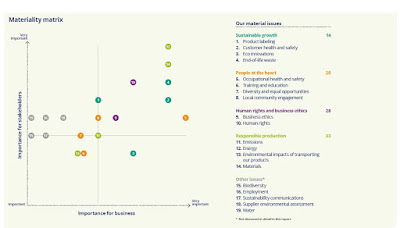
And presents a materiality matrix
While aligning the report with Sustainable Development Goals

And on the Ontex website, the company discloses specific strategy and policy documents to complement and complete the sustainability picture.

But beware: Concise does not mean skeletal.
Reports that are 2-page infographics are not reports. Four-page summaries are not reports. If they are not infographics of a concise report, or summaries of a longer report, they are not useful in lieu of a sustainability report. While it is possible to reference a host of other documents where disclosures may be located (and the GRI framework allows this), in practice, the beauty of a sustainability report is that key information is on one place and we don't have to go searching for all the individual elements separately. We want the essence of everything that's material without having to trawl the web, download multiple other documents and search forever for references that all too often are not there anyway. So, up to around 45 pages, for me, is concise enough to deliver a complete story with enough detail and context for me to understand the company's impacts and accountability. If I want supplementary information for interest or deeper understanding of quantitative data, I am happy to get this online, via a policy bank or other downloadable appendix.
I know that many people will consider even 40 pages too long....and there are many reports that are much shorter than that and do a good job. While the quality of reporting should not really be measured in terms of the number of pages, my rule of thumb for something that fits in the space between feeling stuffed and still feeling hungry - sort of nicely satiated - is around 40 pages.
Here's another nice example: Ramboll's 2016 Corporate Repsonsibility Report.

Ramboll is an engineering, design and consultancy company founded in Denmark in 1945. Ramboll employs 13,000 people across the world. This is a 40-page GRI G4 almost-core report that packs a ton of information in a well-structured concise framework, pleasingly designed and easy to read, with no distracting glossies and frills. The GRI Content Index and key KPI tables take up 4 pages.
One of the positive things about this report is that the material impacts are right there up front on page 5, immediately after the CEO statement, making it very clear what we are going to learn about Ramboll in the remaining pages. I like reports that state materiality up front - not only does this help clarify the report context, it also drives credibility. If it's one of the first things a company reports, it must be one of the first things a company thinks. And that's what materiality means. It should never be an afterthought or a summary of what you are doing. Materiality is a guide to what you should be doing.

The remainder of the report is split into two main sections, a format that I particularly favor. The first section is called "Shaping sustainable societies" and it addresses what are broadly the indirect impacts of the company's business - through the projects it advances and the role it takes in shaping the sector and public policy. The second section covers direct impacts, called "Demonstrating our progress", and includes sections on employer of choice, environment, safety and integrity - linking these also to UN Global Compact and SDG priorities.

Ramboll also uses its website to supplement information with policy statements and commitments - here's an example from one of the sections:

While this report could be even more reporting-year focused, with fewer perennial policy statements that could be policy-banked on the website, this report offers comprehensive coverage of material impacts in a concise way.
So, if your report is long, it is almost certainly also boring (at least in parts). It's totally worth reconsidering how you can deploy other ways of getting your content out there and delivering on your transparency obligations without crowding your report with content that causes us to doze off instead of inspiring us to buy in. Incentivize yourselves. For every page you save, treat yourself a scoop of salted caramel ice cream.
(NB: I have previously written about Liberty Global's last Corporate Responsibility Report - a masterpiece in concise, precision reporting).
elaine cohen, CSR Consultant, Sustainability Reporter, former HR Professional, Trust Across America 2017 Lifetime Achievement Award honoree, Ice Cream Addict, Author of three totally groundbreaking books on sustainability (see About Me page). Contact me via Twitter (@elainecohen) or via my business website www.b-yond.biz (Beyond Business Ltd, an inspired CSR consulting and Sustainability Reporting firm). Need help writing your first / next Sustainability Report? Contact elaine: info@b-yond.biz
Elaine will be chairing the edie Conference on Smarter Sustainability Reporting in London on 27th February 2018
Here's an example of a report I came across while doing some research on the consumer goods sector. Ontex Group is a Belgian-based company listed on Euronext Brussels, employing more than 11,000 people and enjoying sales of almost Euro 2 billion. Ontex is a supplier of disposable personal hygiene products including diapers and pants, pads, tampons and panty liners in more than 110 countries. The Ontex 2016 Sustainability Report is a credible report that focuses on its defined most material impacts of the business.

It's a GRI Standards core report, crafted around SDG priorities, and does its stuff in 44 pages (including 5 pages of GRI Content Index) in an attractive, pleasant and clean design. Ontex provides contextual background on trends that have influenced the selection of material impacts and sustainability strategy.

And presents a materiality matrix

While aligning the report with Sustainable Development Goals

And on the Ontex website, the company discloses specific strategy and policy documents to complement and complete the sustainability picture.

But beware: Concise does not mean skeletal.
Reports that are 2-page infographics are not reports. Four-page summaries are not reports. If they are not infographics of a concise report, or summaries of a longer report, they are not useful in lieu of a sustainability report. While it is possible to reference a host of other documents where disclosures may be located (and the GRI framework allows this), in practice, the beauty of a sustainability report is that key information is on one place and we don't have to go searching for all the individual elements separately. We want the essence of everything that's material without having to trawl the web, download multiple other documents and search forever for references that all too often are not there anyway. So, up to around 45 pages, for me, is concise enough to deliver a complete story with enough detail and context for me to understand the company's impacts and accountability. If I want supplementary information for interest or deeper understanding of quantitative data, I am happy to get this online, via a policy bank or other downloadable appendix.
I know that many people will consider even 40 pages too long....and there are many reports that are much shorter than that and do a good job. While the quality of reporting should not really be measured in terms of the number of pages, my rule of thumb for something that fits in the space between feeling stuffed and still feeling hungry - sort of nicely satiated - is around 40 pages.
Here's another nice example: Ramboll's 2016 Corporate Repsonsibility Report.

Ramboll is an engineering, design and consultancy company founded in Denmark in 1945. Ramboll employs 13,000 people across the world. This is a 40-page GRI G4 almost-core report that packs a ton of information in a well-structured concise framework, pleasingly designed and easy to read, with no distracting glossies and frills. The GRI Content Index and key KPI tables take up 4 pages.
One of the positive things about this report is that the material impacts are right there up front on page 5, immediately after the CEO statement, making it very clear what we are going to learn about Ramboll in the remaining pages. I like reports that state materiality up front - not only does this help clarify the report context, it also drives credibility. If it's one of the first things a company reports, it must be one of the first things a company thinks. And that's what materiality means. It should never be an afterthought or a summary of what you are doing. Materiality is a guide to what you should be doing.

The remainder of the report is split into two main sections, a format that I particularly favor. The first section is called "Shaping sustainable societies" and it addresses what are broadly the indirect impacts of the company's business - through the projects it advances and the role it takes in shaping the sector and public policy. The second section covers direct impacts, called "Demonstrating our progress", and includes sections on employer of choice, environment, safety and integrity - linking these also to UN Global Compact and SDG priorities.

Ramboll also uses its website to supplement information with policy statements and commitments - here's an example from one of the sections:

While this report could be even more reporting-year focused, with fewer perennial policy statements that could be policy-banked on the website, this report offers comprehensive coverage of material impacts in a concise way.
So, if your report is long, it is almost certainly also boring (at least in parts). It's totally worth reconsidering how you can deploy other ways of getting your content out there and delivering on your transparency obligations without crowding your report with content that causes us to doze off instead of inspiring us to buy in. Incentivize yourselves. For every page you save, treat yourself a scoop of salted caramel ice cream.
(NB: I have previously written about Liberty Global's last Corporate Responsibility Report - a masterpiece in concise, precision reporting).
elaine cohen, CSR Consultant, Sustainability Reporter, former HR Professional, Trust Across America 2017 Lifetime Achievement Award honoree, Ice Cream Addict, Author of three totally groundbreaking books on sustainability (see About Me page). Contact me via Twitter (@elainecohen) or via my business website www.b-yond.biz (Beyond Business Ltd, an inspired CSR consulting and Sustainability Reporting firm). Need help writing your first / next Sustainability Report? Contact elaine: info@b-yond.biz
Elaine will be chairing the edie Conference on Smarter Sustainability Reporting in London on 27th February 2018







 Posts
Posts

