Showing posts with label adidas. Show all posts

Wednesday, March 11, 2015

Businesses (still) discriminate against women

So. Another International Women's Day has come and gone. Celebrating the achievements of women. Doesn't do much for me, I have to say. The implication is that it's sort of amazing or even surprising that women achieve anything at all. Unlike men, for whom achievement is apparently quite natural as they don't have a Day all to themselves, international or otherwise. International Women's Day to me is quite unnecessary. As a woman, wife, mother, business-owner and yes, achiever, in my own modest way, I don't really need a Day. I am happy to celebrate my own achievements in my own way whenever I feel I want to.  

On the other hand, none of us can have any doubt that the need to create a society in which fair and equal opportunity for women exists is no less acute than it ever was. And that, apparently, takes longer than a Day. The position of women in society - certain societies - has improved over the years, but women are still discriminated against. This applies to business as much as it applies in other walks of life. No matter how many sets of Women's Empowerment Principles exist, gender equality in business is still somewhat of a distant dream. 

Sustainability. How can business be sustainable when it discriminates against women? Even the most advanced "sustainable" businesses discriminate. Let's be clear. If women do not have balanced representation in business, discrimination is present. It may not be overt, declared or even desired, but it's there. This is not resolved by adding women to Boards of Directors. It's fairly easy to pluck selected distinguished women and place them on (rather impotent) Boards of Directors so that the numbers look better. I would be interested in seeing research that shows what influence women Directors are actually having in influencing the way business does business. Forgive me for being a little skeptical.

I am more interested in how women have equal opportunity to enter and advance in business, especially the large, typically male-dominated companies that do business around the world. Many consumer goods companies actually target women who make most of the purchasing decisions for their products and yet women's representation in their senior management committees is pathetic. 

Corporate Knights makes a big splash every year announcing the Global 100 - most sustainable corporations - at the World Economic Forum. By all accounts, this is one of the better lists (although all rankings serve the rankers more than the ranked). With the Global 100, the methodology is clear, transparent, and covers the spectrum of sustainability performance areas. In 2015, however, the ten companies that headed up the Global 100 list have just 11% of women in their Executive Committees. They have a higher rate of women on the Boards of Directors, but where it really counts, women in senior executive roles, the figures are rubbish. At the same time, most of these companies have workforces that are 40 - 60% composed of women. What happens to women when they join these companies? How come that, in a combined workforce of almost 200,000 women in these ten top companies, only 9 get a key to the executive committee room? Men, on the other hand, have a better chance of getting a seat on the Executive Committee by a factor of almost five. Three of these top ten companies have ZERO women on their executive committees. So you tell me, are these companies discriminating against women or aren't they? (Hint: not no).


Biogen Idec: The world's most sustainable company has 17% women representation on it's executive management team. That's 2 women out of a team of 12. The two women are the Chief Legal Officer and the VP for Technology and Business Solutions. This is what Biogen Idec says about women in its 2013 Sustainability Report:

"To continue to thrive as a company and an industry, we must advance leadership opportunities for women. In 2013, the Women’s Forum of New York formally recognized our commitment as one of the 174 U.S.-based companies honored at the event for having a board of directors that is at least 20 percent women. Women currently make up just over half of our global workforce, and 40 percent of our management team. As we continue to advance in this area, one way we are striving to close this gender gap is through our Women’s Innovation Network (WIN) Employee Resource Group, which provides opportunities for women to network, learn, seek out mentors and develop their careers. Though primarily focused on women’s careers and leadership, WIN proactively recruits and welcomes employees of all gender identities who wish to act as allies. At present, more than 800 women and men from across the enterprise are members of the network."

This is how Biogen Idec represents the numbers visually:
Note how the high numbers stand out... 51.5% total women  and 40% women in management. Wonder why there is no visual presentation of women on the Executive Management Team. That would read:
17%
Aside from a resource group (dubious effectiveness in actually helping get women promoted), I don't see evidence of a plan to improve women at executive team level.

Allergan: The world's second most sustainable corporation has ZERO women on its executive management team. Yes, ZERO. Yet, this is what Allergan says about women in its 2013 Sustainability Report

"In 2013, women comprised 53% of our workforce and 40% of our leadership roles. This includes more than 39% of our manager and director roles, and nearly 27% of our executive positions. We were also fortunate to have one exceptional female member of our Board of Directors who brings truly exceptional credentials to our organization and is committed to its development."

Note how the high numbers stand out. 53% of the workforce at Allergan means more than 6,100 women. Not a single one worthy of helping to run the company. And the "exceptional" female director doesn't seem to be able to do anything about it. Allergan says nothing about any plans to address this gender imbalance in its organization. 

Allergan website - gender balance in action. Not.
Instead of talking about 27% of executive positions, Allergan should highlight the percentage of women executive team members, i.e.  
0%
And perhaps in its reporting, the company might like to explain how it is that zero women are worthy of senior leadership, and what if anything, the company plans to do about it. 

adidas: The third most sustainable corporation in the world has ZERO women on the Executive Team. The Adidas 2013 Sustainability Report includes a 2014 milestone to "Systematically increase the percentage of women in leadership positions." The website expands a little, stating: "The adidas Group has set itself concrete goals in line with its corporate culture and employee structure to increase the number of women in leadership positions in the coming years. The proportion of women in management is to be increased to at least 32% by 2015 (currently, the proportion is 26% in Germany and 28% worldwide). To achieve this goal, we have increased the proportion of women participating in our leadership development programmes to 35%. This is to help more women take up leadership positions in all areas of the company. We had already achieved this corporate goal at the end of 2012."

Note how adidas quotes the big numbers relating to women in leadership. But, if Adidas were to highlight the number of women on the Executive Management team, the result would look like this
0%
adidas employs more than 50,000 people. Not one single woman worthy of an executive team position. 

Keppel Land: This is the fourth most sustainable company in the world, according to Corporate Knights. And Keppel Land has the highest ratio of women on the senior management team, 2 out of a team of 6, which is 33%. Keppel Land is a real estate company, employing less than 4,00 people in total. And yet, even with such a small total workforce compared to other companies in the top ten sustainables, Keppel Land managed to identify two worthy women leaders, both of them in significant business P&L roles. 
33%

Kesko: The fifth most sustainable corporation has 1 woman out of a team of 8 on the senior executive team (Group Management Board). This is with a workforce of 45,000 employees of whom more than 50% are women. The one woman is the General Legal Counsel.  Rate of women in executive management? 
13%

BMW: The sixth most sustainable company with more than 100,000 employees can manage just 1 woman on the Board of Management out of a team of 8. The woman is the Human Resources Manager. Despite this, BMW has by far the lowest rate of women out of these top ten companies in the total workforce at 17%. Don't women buy cars? I hope they don't buy BMWs.


BMW women in Management:
13%

Reckitt Benckiser Group: The seventh most sustainable company has 1 woman on an executive team of 8.

13%

Centrica: Centrica has one woman in a team of seven top execs. Centrica's website displays some interactive charts that show different performance indicators, including this one for women. Lots of room on this chart for improvement.....


14%

Schneider Electric: This ninth most sustainable company has the largest senior management team of all the top ten. A whopping 15 members. You might think this would give opportunity to find a few women from the 153,000 people in the Schneider workforce to help lead the company. As it stands, just one makes the grade.


Overall women in the Executive Team?
6%

Danske Bank: Perhaps it's fitting that the tenth most sustainable company in the world rounds off this sorry state of women's affairs with a big ZERO women in the management Executive Board.
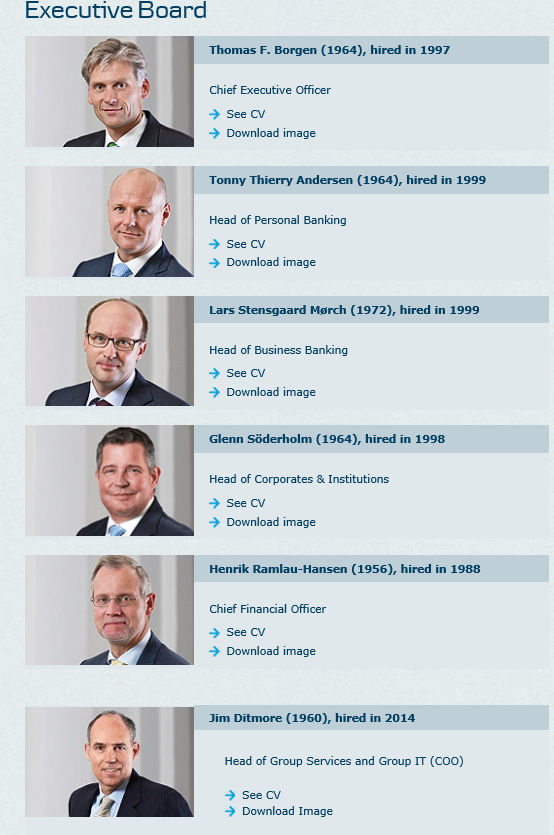

However, Danske Bank does make a commitment - one of the few that does:

This is not entirely out of the blue. This is what prompted Danske Bank to get more women-action-oriented: 

"In 2012, the Danish Parliament adopted legislation to ensure equal rights for men and women in private organisations. The law requires Danish companies to set specific targets for the number of women on the Board of Directors and to develop policies to increase the number of women in leadership positions. In their annual reporting, companies must also report on the progress made towards these targets and on the implementation of a diversity policy. We have already come a long way in developing a diversified and inclusive workforce, but we recognise that we still have some work ahead of us." 

12.5% women on the Executive Board  of six members adds up to 0.75 women. I wonder which 0.25 part they are planning to leave out? Nonetheless, appointing three quarters of a woman executive by 2017 (four years from the 2013 report publication) is some sort of commitment, but forgive me if I am not falling off my seat. Today the score is:
0%


Well, all that was rather disappointing. I confess to being a little surprised that companies that are named as "most sustainable" are so unwilling to promote women. I am sure none of them will admit to discrimination among their ranks. But look at the numbers. Draw your own conclusions. It will take more than an International Women's Day to fix this. In fact, several Days haven't. Let's move on from a Day to Every Day.  


elaine cohen, CSR consultant, Sustainability Reporter, HR Professional, Ice Cream Addict. Author of Understanding G4: the Concise Guide to Next Generation Sustainability Reporting  AND  Sustainability Reporting for SMEs: Competitive Advantage Through Transparency AND CSR for HR: A necessary partnership for advancing responsible business practices . Contact me via Twitter (@elainecohen)  or via my business website www.b-yond.biz   (Beyond Business Ltd, an inspired CSR consulting and Sustainability Reporting firm).  Need help writing YOUR Sustainability Report? Contact elaine: info@b-yond.biz   

Monday, July 4, 2011

Deutsche Post, Adidas and Gazprom. Three reviews.

Three companies, three sectors, three sustainability reports, three sustainability report reviews. Every couple of months I publish a report review on Ethical Corporation. Here are the last three:

Deutsche Post DHL CR Report 2010
Here are selected paragraphs from my review of this report (you can find the rest here, online, on Ethical Corporation's website):  

Deutsche Post DHL’s 2010 online corporate responsibility report is designed like a complex logistics network navigated via a sleek online route map. It starts with a home page overview showing possible routes to a mass of information in a cleverly planned navigation hierarchy. You can start at the beginning or go directly to what interests you. Amply signposted, your journey is supported with infinite hyperlinks, in-section menus and an online mouse-over glossary for those bits of Deutsche Post DHL jargon that you might not be entirely familiar with. The complete content of this report is downloadable in a 246-page PDF or an at-a-glance overview of 21 pages. Report assurance is indicated online on each assured page. Accessibility and seamless navigability are best-practice features of this presentation, complete with an online feedback questionnaire and a promise that Deutsche Post DHL will make a €5 donation to Plant-for-the-Planet for each of the first 200 fully completed questionnaires received.

Deutsche Post DHL has 467,000 employees and operates in 220 countries. By far the most interesting aspect of its business is how the company could use its massive infrastructure and influence to transform the transportation landscape across borders and influence customers to adopt resource-efficient practices through new business models and collaborative initiatives.

Go Help is Deutsche Post DHL’s programme to address disaster relief, the new de rigueur corporate responsibility platform for logistics and technology companies, given the frequency of major natural tragedies that are occurring around the globe. Deutsche Post DHL has established disaster response teams, which have been deployed in many countries, providing local assistance in ensuring relief supplies get through. DHL has even developed an innovative form of waterproof packaging – “DHL Speedballs” – which can hold up to 25 kilograms, withstand airdrops better and stay afloat longer than other containers. They have been used in several relief efforts.

Overall, however, it is not easy to get to what really counts in this GRI B+ level report. There is no distillation of core issues raised by stakeholders about different aspects of Deutsche Post DHL’s business and no materiality prioritisation. The three pillars of the company’s strategy are surely worthwhile, but the lack of analysis of stakeholder expectations on a broader range of Deutsche Post DHL impacts and performance is an omission. Apparently materiality is the road less travelled on the Deutsche Post DHLhighway to CR transparency in an otherwise impressive report.

Here are selected paragraphs from my review of this report (you can find the rest here, online, on Ethical Corporation's website):

The title of Adidas Group’s 11th sustainability report is: In the Real World, Performance Counts. And an intensive 116 pages of performance it is. Light on design creativity but heavy on content, the Adidas report is an example of attention to detail and thoughtful preparation. Complete with analogies from the world of sport, giving the air of a disciplined approach to sustainability, this is probably the group’s best report yet.

In the world of sustainability, performance is only part of the story. What counts are impacts. Adidas rarely ventures into the world of reporting impacts that describe what has happened as a result of their performance in terms of consumer impact, supplier training and even community engagement. This report stays very much at the level of the home game with the spotlight on what’s taking place on the Adidas field, but far less on the way Adidas is driving substantive and systemic change for stakeholders.

While it’s nice to see how many warning letters outsourced suppliers have received for not complying with ethical standards, some perspective of how Adidas has managed to change the game in over 10 years of focused working with suppliers would be welcome. In addition to data, the overall KPI score aggregating audit results in Adidas’s outsourced factories’ is lower than it was in 2007. The percentage of 3C (60% KPI score) or higher scoring suppliers is lower than it has been for the past two years and the number of warning letters issued to suppliers is higher.

An ethical supply chain is one of the most material issues and Adidas discloses how the group has responded to issues raised by stakeholders, including freedom of association issues in Cambodia, workers’ rights in Bangladesh and labour standards in El Salvador. But just how Adidas justifies the massive level of resource to support a sub-compliant supply chain is something that can be explored more fully in future reports. Performance is not only conducting audits. Monitoring is not the end result. Of greater interest is the effectiveness of such training, auditing and warning-letter activity and discussion of the outcomes of such changes.

Adidas is improving sustainability performance and does a serious job with this report. However, while the group is making progress, a step change in strategy and disclosure could reasonably be expected in future reports to achieve the standard required, in Adidas’s terms, for completing a marathon rather than running a sprint.

Here are selected paragraphs from my review of this report (you can find the rest here, online, on Ethical Corporation's website):

Gazprom’s first sustainability report portrays a rather different story to the one told in Roman Kupchinsky’s 2009 paper: Gazprom’s European Web. This alleges secrecy around Gazprom’s potential control of the European energy landscape via nameplate gas companies throughout Europe as well as links to organised crime and political corruption. Clearly these are not activities Gazprom would relish disclosing in a sustainability report. The question is whether Gazprom is a puppet of the Russian political machine – the Russian government still holds a 50.002% controlling stake in the company and is represented by six members on the 11-strong board. Or, has Gazprom been able to transition into a western-style market competitor that plays by the rules of a sustainable market environment?

The world’s largest natural gas producer, Gazprom has been issuing environmental reports since 2002, nine years after its break from full government ownership to become an open joint stock company in Russia. This now is the company’s first full sustainability report, covering years 2008 and 2009. Gazprom’s main activities are the geological exploration, production, transportation, storage, processing and marketing of gas. It is a giant in the Russian economy, employing nearly 400,000 people, holding 18% of global gas reserves, operating 600,000km of pipeline and supplying nearly 70% of Russian consumers and export markets with more than 400m cubic metres of gas.

The implications of Gazprom’s transformation are not trivial by any means. Establishing a global position in a competitive capitalist market and contributing to local socio-economic stability while distancing its reputation from former Kremlin political dictates will have demanded more than the average level of leadership skills. Gazprom’s report is an impressive 104 pages with no frills and no special effects, just plain, direct disclosures. It’s a rather dry read – hardly any stories, case studies or warming community photos – but it is detailed and meticulous. An example of this attention to detail is the chronicle of a safety incident. At 10.23am on July 24 2008 in Moscow, an explosion followed by a gas blaze took place at the Petrovsk to Novopskov gas trunkline. By 11.05am the following day, Gazprom teams completed repairs and resumed gas supplies to consumers. Forty-four metres of pipe were replaced during the repairs.

The report contains a comprehensive assurance statement written by the council for non-financial reporting of the Russian Union of Industrialists and Entrepreneurs. RUIE has done as good a job as any with a four-page assurance statement including recommendations for future reporting. However, a more neutral voice on assurance might have offered greater credibility. RUIE is the mouthpiece of Russian industry associations and might be expected to provide positive assurance for the member companies it represents. Overall, Gazprom presents a comprehensive, transparent picture of its operations and offers a credible picture as a global competitor in (sustainable) energy markets. Assuming of course that there is nothing hidden between the lines.

Three companies, three sectors, three sustainability reports, three sustainability report reviews.

Ice cream, anyone ?


elaine cohen, CSR consultant, Sustainability Reporter, HR Professional, Ice Cream Addict. Author of CSR for HR: A necessary partnership for advancing responsible business practices  Contact me via www.twitter.com/elainecohen  on Twitter or via my business website www.b-yond.biz/en  (BeyondBusiness, an inspired CSR consulting and Sustainability Reporting firm)

Sunday, November 22, 2009

HR behind the times on CSR

The Human Resources function is a critical partner in the development of a responsible and accountable corporate culture. Corporate Responsibility is often referred to as improving impacts on stakeholders. Nothing new here. Employees are stakeholders. Nothing new here either. The better you treat, or impact on, your employees, the better the business will perform. Numerous statistics and surveys prove this correlation. The engagement of every employee in the business is really the only way to ensure flawless corporate responsibility.  I am reading Adam Werbach's book at the moment, Strategies for Sustainability, and quite by chance, or not, he makes the same point - more eloquently than I do, I must admit. However, it's nice to be in such illustrious Company. Adam says: ... "to execute a strategy for sustainability, you must engage individuals personally" (page 132).

Ultimately, corporate reponsibility is not just about treating employees well, or investing in their development, or providing a ramp if they are in a wheelchair. It's not only about how satisfied they are on the job. Corporate responsibility is transforming every employee into an ambassador of the corporate responsibility message of the business. Ensuring that they understand, are involved, are inspired and know where they can play a role. This means moving from impacts ON employees to impacts OF employes. Each employee in the business interacts with any number of stakeholders every day, maybe thousands of daily connections. This potential, to turn every single stakeholder interaction into one which moves the CSR agenda forward, is more powerful than almost any other single business activity.

CSR reporting is often seen as something which primarily benefits employees. Through the report, they get a comprehensive view of the way their Company interprets and progresses sustainability themes. Often, the CSR report contains news and information which had not cascaded through to them via regular internal communication channels.  In some cases, Corporate Reponsibility reports even state the names of individuals in the Company who are responsible for progressing different action items - an example of this is Vancouver City Savings Union (Vancity) (page 35). But when I recently tried to ascertain how many Companies actually track how many employees read all or part of their reports, I couldnt get an answer.

I found one example of something coming close to this on the Adidas website where readers of their online report are asked to own up and identify themselves. The results are displayed in a neat graph.


We dont know how many people took this survey, and I am not quite sure what the difference is between an employee and a worker, but this is a great way to see what kind of people are taking interest in the report. And a very brave move on the part of Adidas to have an open survey such as this on their reporting site . In a recent dialogue with Symantec,  i understood  they progress many activities in the framework of internal communications to ensure employees are aware and engaged. But, bottom line is, overall, we DON'T KNOW if employees take any sort of interest in one of the most important documents the Company publishes to stakeholders, and if they are capable of being the ambassadors for that document, and the Company.

 
Who is repsonsible for this ? After the CEO, it has to be the HR Function. The HR function must ensure proceses are developed within the busnesss to raise employee awareness of key strategies and processes, especially those which are in the public domain. Why doesnt HR do this ? Because, I submit, most HR Managers just don't see how they link to Sustainability strategy, beyond matters relating to ethics and values, and sometimes, community volunteering (because no-one else does it). Most HR Managers really don't see the relevance of ensuring high quality communications and dialogue about sustainability programs. When was the last time you had a progressive conversation with an HR Manager about sustainability in the supply chain and the HR role which supports that ? How do HR Managers recruit people into sustainability jobs ? In what ways does HR adopt sustainable practices  as a function ? Most HR Managers cannot tell you. The HR function has still not grasped the principles of a stakeholder society and stakeholder-driven business.

 
This is a pretty damming picture of HR people. This is why i am writing a book as a guide for HR Managers on all things sustainability and corporate reponsibility, due for publication next year. In order to test my theory, I produced a short survey for HR Managers. Of the lowish number of responses I have had to date, this is some of the initial data:
  • 100% of HR Manager responders say that HR Managers need to have some understanding of Corporate Social Responsibility
  • 54% of HR Managers say CSR  is something they are involved with as part of their ongoing role
  • 80% and 70% respectively say this involvements relates to ethics and community involvement, with zero being involved in supply chain practices and external stakeholder engagement.
  • 45% said that HR Managers need additional skills (and knowledge) to support CSR
  • 30% said they had targets related to CSR
and one HR Manager, in responding to the question "What does the concept of Corporate Social Responsibility mean to you ?"  wrote : "Sustainability" . Well, at least that's something.

So, they all think it's important, half of them are responsible for it (in a limited way), and a third are measured on it. Less than half think they need to learn new ways of doing things in order to do it. Frankly, I think this is a saddish picture of the HR function. And i am keen to get a wider sample of opinions from a broader range of HR Managers so PLEASE pass this on to any HR Manager you know and request they complete the survey HERE: http://bit.ly/3HpxnS
I promise to update you all with the results. Thank you !

elaine cohen is the joint CEO of BeyondBusiness, a leading reporting and social-environmental consulting firm . Visit our website at: www.b-yond.biz/en
Related Posts with Thumbnails