Showing posts with label corporate citizenship. Show all posts

Monday, September 4, 2017

People Planet Play at Caesars

Over the past couple of weeks, I have been horrified (as I am sure we all have) by heartbreaking first-hand accounts of people fighting for their safety and facing the loss of their homes in Houston, Texas and the region in the wake of Hurricane Harvey. I am sure we cannot begin to understand the challenges each is facing, nor the length of time it will take for the people of the area to achieve some sort of return to normal life. Our hearts go out to all those affected.

In the corporate world, many are mobilizing to provide emergency assistance and relief to the people of the area. It is no surprise to me that Caesars Entertainment was one of the first to announce support. See this post on LinkedIn:


This doesn't surprise me because I know Caesars Entertainment to be a genuinely caring company that invests in communities without hesitation all year round and not just in times of crisis. But when a crisis hits, Caesars can be counted on. I have been working with Caesars Entertainment for several years now, supporting annual citizenship reporting and other initiatives. I have had the privilege to personally engage and interact with hundreds of team members at Caesars in the U.S. and other parts of the world, from the President and CEO and senior executives to a very wide range of individuals in diverse roles. 

Without exception, I am struck every single time by the genuine passion and deep engagement of those I talk to, and their appreciation for the caring, nurturing, inclusive culture that is easily recognizable throughout the organization. Whether it's the CEO, Mark Frissora, who places employee engagement on a par with customer satisfaction and financial performance as a fundamental tent of the company's success (check out his  welcome message in the Caesars 2016-2017 Corporate Citizenship Report), or Mary Thomas, Executive Vice President of Human Resources, who says: "Our employees want to feel that our company is contributing to a better world," or a Caesars HERO (community volunteer), or a Health Wellness Nurse, or a Responsible Gaming Ambassador, or, in fact, just anyone at all, the folks at Caesars care. So it was certainly no surprise to see that Caesars is one of the first corporations out there taking action to support fellow citizens through the trauma and devastation that Hurricane Harvey has wrought. 


Which brings me back to Caesars eighth annual 2016-2017 Corporate Citizenship Report, this time under the theme of 

People Planet Play


People Planet Play is the new way Caesars is talking about citizenship and sustainability - to employees, to guests and to all of us. It's a corporate strategic framework for planning, reporting and communicating, setting out clearly what Caesars stands for as it does business. Jan Jones Blackhurst, Caesars' Executive Vice President of Public Policy & Corporate Responsibility explains:


People Planet Play enables the organization of all citizenship themes and programs under one umbrella:


So, for example, highlights for 2016 are organized in this format.


In this report, key members of the Caesars Executive team explain how this People Planet Play framework works for them and how it aligns with the vision of Caesars business development and growth in coming years. The report is written in accordance with GRI Standards, core option. More compact than prior years, it covers all key areas of progress in the past year or so, including:

Development of science-based emissions targets: For the past ten years, Caesars has set ambitious environmental intensity targets and has steadily achieved them each year. In establishing science-based targets, Caesars joins industry leaders in respecting planetary limits with absolute emissions targets through 2050.

Continued achievements in employee wellness: The Wellness Rewards program helps employees get healthier as they get older and in 2016, another year of strong participation enabled Caesars 50,000+ employees in the U.S. to feel well, save money and enjoy life. 


Ongoing leadership in Responsible Gaming: This is a core element of citizenship at Caesars, and has been for more than 25 years when Caesars developed the first industry efforts to address problem gambling among guests. Caesars continues to demonstrate leadership wherever it operates so that people who choose to take part in gaming activities can have fun doing so and know that help is at hand if this is not the case. This report includes major strides to advance responsible gaming in the UK where Caesars operates several casinos, as well as ongoing activity in the U.S.


Economic and social contribution in communities: Caesars has established strong ties within all the communities that host its properties, and makes a significant economic contribution. In addition to the >400,000 hours of community service that Caesars volunteers invested in their communities last year, Caesars distributed more than $9 billion of economic value to its stakeholders. A third-party analysis shows that contributed value by Caesars (wages, taxes and corporate giving) was almost three times the estimated average of U.S. corporations. 

Taking a public stand: As usual, Caesars doesn't shy away from speaking up for justice.  Whether it's on policy relating to LGBTQ rights or taking a stand against human trafficking, Caesars voice is where it counts. Gwen Migita, Vice President, Sustainability & Corporate Citizenship puts it like this:


(By the way, if you are heading to Singapore in September by any chance, come and join us at the Asia 2017 Sustainability Reporting Summit where Gwen will be speaking on embedding a culture of citizenship and the People Planet Play framework.)

Finally, who said sustainability reporting is not fun? Caesars 2016-2017 Citizenship Report also gives you the opportunity of a chance to win two nights at Caesars Palace in Las Vegas. Just by completing a super fun crossword.


Check it out, follow the instructions and you could be waking up to breakfast in Nevada. But even if crosswords are not your thing, I recommend you taking a look at this report from a clear citizenship leader in the gaming-entertainment-hospitality industry. There's much more in there that I have been able to mention in this post. As usual, send your feedback!


Disclosure: As you probably realized, I worked on this report (as well as on Caesars' prior four reports).  It's always a pleasure and honor to work with Caesars. But shucks, that makes me not eligible to enter the draw for the crossword prize.


elaine cohen, CSR Consultant, Sustainability Reporter, former HR Professional, Trust Across America 2017 Lifetime Achievement Award honoree, Ice Cream Addict, Author of three totally groundbreaking books on sustainability (see About Me page). Contact me via Twitter (@elainecohen) or via my business website www.b-yond.biz (Beyond Business Ltd, an inspired CSR consulting and Sustainability Reporting firm). Need help writing your first / next Sustainability Report? Contact elaine: info@b-yond.biz 

Elaine will be chairing the Asia Sustainability Reporting Summit in Singapore on 19-20 September 2017 and the edie Conference on Smarter Sustainability Reporting  in London on 27th February 2018

Friday, May 8, 2015

Between the Lines in CSR Reports

I consider it a great privilege to do the work that I do, helping companies develop a strategic approach to corporate responsibility and account for their impacts on society through reporting. While, in general, I am guided by a business approach to corporate responsibility and sustainability, with lots of formal frameworks and disclosures and numbers and charts and value accounting in different forms, some things just make you sit up and stand back and realize again that, ultimately, it's all about people, relationships and solidarity. My work exposes me to the so many ways that companies touch people's lives that even the longest Sustainability Report in the world could never even begin to capture the positive ripple effects on individuals and communities. There are some things so inspiring and so moving that they truly change your awareness and appreciation of the real meaning of community at work. The workplace does not have to be only somewhere you go to earn a paycheck or learn new skills. It can be a place where people thrive and help others to thrive, and this is something you just can't adequately reflect in a Report. I am often deeply moved by the dedication and selflessness of individuals as I talk to so many people in the course of gathering information for the reports that I work on with different companies. I have many stories, but this one, this week, was exceptional. 

I am working on helping to prepare the Caesars Entertainment Corporation Citizenship Report for 2014-2015, the third G4 report that Caesars will publish later this year. We have a lot of numbers to crunch and narrative to edit before then! But in meantime, I have had the privilege to connect directly with some of the Caesars HEROs. HEROs is Caesars long standing corporate volunteering initiative that engages thousands of employees, collectively clocking up almost 200,000 hours each year to engage with causes they are passionate about, including initiatives funded by the Caesars Foundation. The opportunities that Caesars Entertainment creates for employees to get active in their communities help employees enrich their own lives and the lives of others in incredible ways. There are so many HEROs throughout the Caesars organization and each one is deserving of recognition. I have had the good fortune to connect with several during the work on this and prior Citizenship Reports and all are equally inspiring. The one that prompted this post is the story of Joan Bish, Boat Operations Supervisor at Horseshoe Hammond Casino. 

Joan is a dedicated volunteer, donating hundreds of hours of her time each year to several causes. One is the Employee Garden where employees come together to nurture vegetables and sell the resulting produce, directing funds to a local food bank to help in the  fight against hunger. Another is the St.Baldrick's Foundation's event, where employees shave their heads or donate their locks to raise money for childhood cancer research. And at the American Cancer Society's Relay for Life, Joan completed a walk of more than 50 miles. However, what really caught my eye and captured my emotions was the initiative Joan undertook to recognize, support and pay tribute to fellow workers who are fighting their battle with cancer. In a personal mission, covering hours of travel across two U.S. states and visiting with 7 families, Joan created a video that is... well.. I have no more words. Watch it for yourself. 


Watching this video brought home to me the many ways that workplaces become communities of people, good people who want to be good to others, who want to leave a legacy of good and who actually do. The opportunities that companies create that enable employees to step up and get involved are probably one of the most important  aspects of corporate citizenship, and so often, we report that as a number or a result in a chart. There is no chart than can express the profound meaning of this kind of activity and no spreadsheet that can express the way this activity truly enriches lives. That's why I had to stop and share my reflections with you. Perhaps there may be some inspiration you can gain from this in your workplace. 

Perhaps this story touched me so specifically because, just a couple of years ago, my dearest sister-in law heartbreakingly lost her battle with ovarian cancer at the young age of 63 after a three year heroic fight with the support of our family and community. Ovarian cancer is the one that, by the time it's diagnosed, it's usually too late, as it creeps up on women, almost symptomless, until it's so deeply embedded in your body that you can never cut it out. Early detection is the only way to beat ovarian cancer, and new research proves that. I am incredibly proud of my two nieces who, as they continue to suffer the pain of losing their mother, maintain the fight to raise awareness for ovarian cancer, support cancer research and help women be proactive about demanding tests for early detection. My niece, Sarah, who runs her own consultancy, The Athena Programme, that supports safeguarding of children in our communities and workplaces, was interviewed this week for the local news in the UK.


As, during this period, I am deeply embedded in "reporting season",  which consumes pretty much all my time and energy for several months, I have to put my other true passion, blogging about reporting (you know I am a geek) on a back-burner until I resurface in another few weeks. But I couldn't help stopping everything and writing this post to recognize Caesars, all the hundreds of Caesars HEROs including Joan, Sarah and Susan (my nieces) and all the unsung heroes who are making the world a better place. It's worth remembering that, as you look at numbers and charts in Sustainability Reports, there's a another dimension that's only visible between the lines, but it's no less relevant and probably, in the long run, more important.


elaine cohen, CSR consultant, Sustainability Reporter, HR Professional, Ice Cream Addict. Author of Understanding G4: the Concise Guide to Next Generation Sustainability Reporting  AND  Sustainability Reporting for SMEs: Competitive Advantage Through Transparency AND CSR for HR: A necessary partnership for advancing responsible business practices . Contact me via Twitter (@elainecohen)  or via my business website www.b-yond.biz   (Beyond Business Ltd, an inspired CSR consulting and Sustainability Reporting firm).  Need help writing YOUR Sustainability Report? Contact elaine: info@b-yond.biz   

Thursday, November 13, 2014

7 short CSR reports - the better and the less better

I was asked by @jenniferwoofter on Twitter if  I can recommend any short reports - under or around 20 pages - that are effective in communicating sustainability. I always have a problem remembering where I found good reporting practice. I ought to develop a system. (Note to self: that to-do list just keeps getting longer). So, in order to respond to Jennifer, and refresh my thinking, I did a little research using the GRI Global Reporting Sustainability Database. It's very hard to find reports that are under or around 20 pages (excluding executive summaries of longer reports) (and, of course, I only look at reports in English (or sort-of English)). It's almost impossible to find short reports in Asia or Latin America and most of Europe. Shorter reports tend to be from U.S. companies. Also, short reporting does not correlate absolutely to company size. It's not just SMEs and local companies that keep reports compact. My list below includes some large global companies with tens of thousands of employees.

Here's what I came up with - the better and less better. I will say that even the less better reports are evidence of some level of commitment and action and while my, as usual, fairly direct criticisms reflect my honest professional opinion in the hope of helping reporters get better value from reporting, I continue to commend and be grateful to companies who report. Reporting is always a challenge and always an achievement. Even short reports can be powerful. Some more than others.

The better

GRI Application Level C, GRI checked, 12 pages excluding GRI Index

Datwyler Cabling Solutions is a supplier of system solutions and services for electrical and ICT infrastructures in public and commercial buildings and in data centers and networks.This is a report for a medium-sized business (less than 1,000 people) that really does the job. It's short, no frills, no stories and no case studies, but it covers the ground and credibly represents a sustainable approach with just about enough data to make it meaningful. Don't look for more sophisticated reporting content, such as a materiality matrix or impact assessments, but for the size of the organization, the report is a simple, concise and clear communication of the organization, its values and its approach in practice. As short reports go, I like this one. 


Sanoma CSR Report 2013, Finland
GRI Application Level C report, 22 pages including GRI index.

Sanoma is a media and learning company based in Finland with operations in several countries and almost 11,000 employees. Sanoma is publicly listed in Finland. This report is delightfully colorful - as we might expect from a media company - and the social mission is clear. "We help people access and understand the world" and the passion "actively shaping the world around us" is well projected. The report is structured with people first (how many reports put people last?), then responsible business activities, then community, then environment. It's an interesting read, although a bit too general in places. The attractive design helps the flow. One thing that is missing, though, despite a tick of the box in the GRI Content Index, is a statement from the leadership. No CEO or General Manager. Maybe this is because Sanoma is just one big team, but without a leadership statement, this report lacks a bit of punch for me. However, it's a good report certainly one of the better shorter ones.

Downer 2013 Corporate Responsibility Report, Australia
GRI Application Level B+, 21 pages, excluding GRI Content index but including Assurance Statement.

Downer is a mining, infrastructure and rail company, listed on the Australian Stock Exchange. Downer employs more than 20,000 people and operates primarily in Australia and New Zealand. This report packs a punch for its 21 pages. It's compactly designed and I love the photography of what appear to be real people that work at Downer and not stock photos of anonymous citizens of the world. The CEO statement is short and to the point and actually evidences some element of strategic thinking. Disappointingly, although Downer attests to following a materiality process, material issues are not listed explicitly, but are said to be the basis for the report content. Data is nicely presented and a few short case studies add to the credibility and interest in this report. Some stakeholder voices are included (internal). The report is well-written and easy to read. This is probably one of the best short reports I have come across.


The less better

A&E 2013-2014 Sustainability Report, USA
Non GRI report, 16 pages

A&E is a provider of threads and yarns for the global fashion industry. It employs more than 10,000 people, a fairly large organization, something you wouldn't guess from the format of this report. This is a home-made report in word format that is rather difficult to read due to the awkward formatting, errors and inconsistent language style. The CEO statement is rather platitudy and weak, although the company does provide evidence in a short 16 pages of sustainable practice. A&E presents Ten Threads of Sustainability and shows a long history of data on environmental impact reduction. However, while the delivery of a report is always a good thing, and far better than not reporting, this report lacks balance, structure and relevance. I am sure that a stronger investment in the reporting process and output would deliver greater value for A&E.


Williams-Sonoma Inc. Corporate Responsibility Report 2013, USA 
Non-GRI report, 22 pages

This is a approach and story-based report that projects a strong commitment and a community orientation for this specialty home-products retailer and e-commerce company, with brands including Pottery Barn and west elm and around 600 retail stores. Williams-Sonoma employs around 28,000 people of whom 7,800 are full time. However, it is almost completely devoid of data. Just to find how many people the company employs, I had to search for the most recent Form 10-K. There are a few numbers around sustainable sourcing of wood and expenditure with artisan workers, but not much else. Despite "forging new relationships to advance our energy goals", we are not treated to a peek at what these energy goals are, not any data about energy consumption, or any other aspect of this company's supply chain. In this case, this short report is too short. It's a nice sustainability-oriented brochure but doesn't pass the litmus-test for a CR Report. 


The Carlyle Group Corporate Citizenship Report 2014, USA
Not GRI Report, 18 pages

The Carlyle Group is an American-based global asset management firm, specializing in private equity, based in Washington D.C employing around 1,700 people. In 2013, Carlyle appointed a first Chief Sustainability Officer. This report is about how Carlyle practices responsible investment and through its investment policies, drives increased awareness and advancement of sustainability practices, as well as helping change practices at portfolio companies. Indeed, there are some very positive initiatives in place.  There is  a section on environmental initiatives in portfolio companies, and a couple of pages on community involvement and work culture. Nice stories and snapshots of responsible investment, but not enough quantified sustainability impacts. A sustainability report that presents almost no data is always rather a disappointment. Disclosing approaches, policies and individual initiatives is always better than no disclosure at all, but credibility increases when we read reports that actually describe performance rather than treat us to story snapshots.


Thermo Fisher Scientific 2013 Corporate Responsibility Report, USA
GRI-based report, undeclared level, 12 pages including GRI Content Index

Thermo Fisher Scientific is an American multinational, biotechnology product development company with 50,000 employees in 50 countries and revenues of $17 billion. The report is organized around the three sustainability priorities of the company - business sustainability (process improvement and efficiencies), employee engagement and philanthropic giving. As such, it's what I call a "shopping-list" report - what we did, where we went, how much we donated. All this is very fine, and although a GRI Content Index is included, there are very few performance indicators of substance. For a company this size and of such breadth, with such an important role to play in the world, we might expect a little more depth to the CR approach and disclosure. The report is pleasant, representing early CSR thinking but lacking the maturity of today's sustainability orientation.  


Writing short reports is not a substitute for acting short on sustainability. Where there is little action of substance, a short report will not fill the gap and show the company up as a sustainability leader just because there are some nice stories and policies. On the other hand, short reports can reflect extensive performance almost as well as long reports, if done well. Interestingly, I realize that the reports I found to be more credible and useful were GRI-based. I hadn't specifically tried to demonstrate that GRI reports are better, but perhaps there is something about working to a framework that helps structure the content and flow of a sustainability report. 

Thanks to Jennifer Woofter for asking me about short reports. I love reports of any length  and this was an interesting analysis. You can guess what I am going to do now.... mmm, maybe banana pecan flavor....


elaine cohen, CSR consultant, Sustainability Reporter, HR Professional, Ice Cream Addict. Author of Understanding G4: the Concise guide to Next Generation Sustainability Reporting  AND  Sustainability Reporting for SMEs: Competitive Advantage Through Transparency AND CSR for HR: A necessary partnership for advancing responsible business practices . Contact me via Twitter (@elainecohen)  or via my business website www.b-yond.biz   (Beyond Business Ltd, an inspired CSR consulting and Sustainability Reporting firm).  Check out our G4 Report Expert Analysis Service - for published G4 reports or pre-publication - write to Elaine at info@b-yond.biz to help make your G4 reporting  even better.  

Sunday, September 28, 2014

Serious Play with Caesars

As you know, we LOVE reports. And we LOVE to have FUN. So working on a report that's fun is exactly what Serious Play is about for us. For Caesars Entertainment, it's pretty much the same. As a company whose entire DNA is all about inspiring grown-ups to play, Caesars takes corporate citizenship as seriously as it takes the memorable entertainment experiences it provides for its guests.

And here you have it, Caesars Entertainment's second G4 (core) report now published. And it's called Serious Play. 


and the infographic of 2013 highlights


As with any self-respecting G4 report, material issues are clearly stated:


And the issues link to G4 material Aspects and performance indicators in this chart, so that it all hangs together as a G4 report should do.


Now, getting past the G4 basics,  you will notice a mix of serious and play in the Caesars report this year, supported by an outstanding contribution in corporate citizenship - including achievement of some ambitious environmental goals. At Caesars, corporate citizenship is not just a project or something people do in addition to their work. It's the way people work. After conversations with more than fifty managers and staff at Caesars, in the preparation of this report, I can personally testify to a spirit of citizenship - and fun - as well as strategic vision, that is rarely found in  organizations. 

The Caesars Code of Commitment was created in 2000 and at the time, led the industry in establishing a framework of behavior that continues to guide the way Caesars work. 


Today, this supports an entire strategic approach to citizenship that is embedded in everything the company does. Some examples:

Horseshoe Cincinnati: The report showcases the new city-integrated casino that opened up in 2013 in Cincinnati, and the ways in which this downtown casino-entertainment property has become an important contributor to city life. More than 92% of the 1,500 strong workforce is from the Cincinnati area, 75% of contracts for goods and services are locally sourced and a large part of this is with diverse suppliers, and during construction, nearly 37% of all contracts worth more than $55 million were awarded to minority or women-owned construction firms. Kevin Kline, Horseshoe Cincinnati GM, supports the city in a variety of ways. For example, he co-chairs the Cincinnati Mayor’s Economic Inclusion Advisory Council to help make inclusion part of the Cincinnati business culture and develop best practices for achieving greater diversity in city contracts. Members of the management team at Horseshoe Cincinnati maintain board level positions with 18 local city and community organizations and the property is a home to many fundraising events for local charities. Horseshoe Cincinnati also takes part in Caesars CodeGreen environmental strategy and made a strong contribution to delivering goals of energy and emissions reductions, water use reduction and increased waste diversion this year. This is Serious Play in Cincinnati, showing how doing business with a Code of Commitment mindset generates positive social, environmental and economic outcomes for all.  

Harrah's Cherokee: Caesars' partnership with the Eastern Band of the Cherokee Nation dates back to 1997, and in 2013, the partners completed a $633 million expansion project representing the largest hospitality development project in the U.S. It was fascinating for me to research and hear about the way revenues from casino and hospitality offerings have transformed the lives of the members of the Eastern Band of Cherokees. This is how it's described in the report:

"Most Native American communities reside on reservation properties, far from mainstream economic activity. As a result, it has been difficult for many Native American tribes to gain access to capital and community services such as education, healthcare and employment opportunities. Data from the U.S. Census Bureau shows, for example, that 29.1% of Native Americans (and Alaska Natives) were in poverty in 2012 versus 15.9% in the nation as a whole. We believe that our partnership with Native American tribes makes a contribution to the prosperity and perpetuity of the Native American way of life that serves the interests of our society as a whole." I think this is the ultimate goal of corporate citizenship - doing business ethically, transparently, in partnership and driving social benefits. 


It's not all serious, though, at Cherokee. There's also lots of fun going on. That's serious fun. Several Caesars properties take part in the annual National Breast Cancer Pink Week where everything from poker table felts to golf balls to balloons and more are colored pink. Harrah's Cherokee won an award among Caesars properties for a magnificent Pink Week which included days such as Mammo Monday, Wacky Smack Wednesday and Bra Fight Friday where both employees and guests enjoy the fun while learning about breast cancer, remembering lost loved ones and making a contribution to support breast cancer research. The highlight of the week is the pageant. How many senior managers in how many organizations would get up on stage wearing a wacky bra designed by an employee? See how it happens at Cherokee.


Citizenship is Citizenship: One of the most touching things for me in the Caesars report is a description of how Caesars supports its employees to receive U.S. citizenship. There is a Caesars Citizenship Rewards Program for Las Vegas employees who become naturalized citizens of the United States. Caesars recognizes employees for their dedication and commitment to becoming naturalized citizens with a refund of up to 100% of the application. Around 250 employees have received this benefit to date. 


Caesars 2013-2014 Corporate Citizenship Report is full of examples of how Caesars engages in Serious Play in many other aspects of the company's daily life - whether this is taking a stand in public policy support for LGBT rights, climate change and more, supporting social causes through the Caesars Foundation and HERO Volunteer programs or leading the way in Responsible Gaming with a range of resources to raise awareness and provide assistance to those who need it. 

But I won't go into too much detail. You can guess why.... that's it... take a look and give feedback. You'll find a few surprises among the pages too.... just for fun.


elaine cohen, CSR consultant, Sustainability Reporter, HR Professional, Ice Cream Addict. Author of Understanding G4: the Concise guide to Next Generation Sustainability Reporting  AND  Sustainability Reporting for SMEs: Competitive Advantage Through Transparency AND CSR for HR: A necessary partnership for advancing responsible business practices . Contact me via www.twitter.com/elainecohen   or via my business website www.b-yond.biz   (Beyond Business Ltd, an inspired CSR consulting and Sustainability Reporting firm).  Check out our G4 Report Expert Analysis Service - for published G4 reports or pre-publication - write to Elaine at info@b-yond.biz  to help make your G4 reporting  even better.   

Monday, July 7, 2014

How secure is your cyber?

It was wonderful to reconnect recently with Cecily Joseph, VP, Corporate Responsibility & Chief Diversity Officer at Symantec Corporation and hear about a fabulous new initiative that I was very impressed with. And let's face it, you know that I don’t get impressed all that easily. The program is an inspired combination of meeting an array of social needs, supporting Symantec's business, building and consolidating meaningful social partnerships and engaging employees. Roll all that into one program, with a clear target outcome, and it seems to me you have a sustainability winner. This is what powerhouse Cecily Joseph and her team and partners have achieved with the new Symantec signature program, the Symantec Cyber Career Connection (SC3) . The focus of the program is on closing the cyber workforce gap. I'll share a few insights from Cecily, and then, I will go on to tell you about some other things about Symantec's sustainability communications which impressed me as well. Hmm, don't want to overdose on being impressed, but if the shoe fits…. 

SC3 is based on the fact that cybersecurity is becoming a necessary part of what almost every company does. Research has shown that an estimated 300,000 cyber security jobs in the U.S. cannot be filled, and 20 percent of these jobs could be filled by people without college degrees. Symantec’s Internet Security Threat Report has shown that the amount of data breaches grew by 62% in 2013 and that approximately 552 million identities were exposed worldwide as a result of data breaches. Many of the companies that need cybersecurity talent, such as data analysts, security analysts or network defense technicians are customers of Symantec's information security programs and services. By investing in developing the cybersecurity talent pool, Symantec is serving its customers while supporting its own sustainable business value proposition. Symantec's long-term commitment is to put 15,000 individuals a year through the SC3 program (after it has been piloted successfully and reached scale) and equip them to become our cyberprotectors of the future. Typically, these will be individuals from underserved populations that would otherwise not have had a similar opportunity to become qualified to perform meaningful (and interesting) work. 

How's it going to work? 
"The program will run as a pilot, starting in three cities – New York, New Jersey and Baltimore. We are working with experienced non-profit partners, for example, Npower has vast experience of delivering similar programs and LifeJourney has a tried and tested record on digital learning environments to support STEM education. The idea is to encourage economically disadvantaged people between the ages of 18 to 29 who have not had the means to pursue a college degree. We will link in to existing programs and curricula, adding our own specialized cybersecurity syllabus." 

Will this be an online learning program? 
"No, this can't be an online program. It's more than just learning the technical aspects. We are helping prepare individuals for getting out into the job market – preparing resumes, interviewing etc. That's why our initial reach will be limited. The nature of the study requires a hands-on learning environment." 

Symantec is a big company. Why don't you just hire people and train them for jobs in cybersecurity at Symantec? 
"We have a cybersecurity (information security) department here at Symantec just like everyone else. We need such a department to protect our own systems and networks. The sort of people that are needed in that department are very different from the software engineers and programmers who develop our products and make up a large part of our population. So it wouldn’t be realistic to think we could fit thousands of cybersecurity analysts into our own company, though we will of course consider hiring SC3 grads if we can. Our contribution is much greater when we create a pool of talent that is so needed in the industry, and help SC3 grads get jobs through the connections we have with our corporate customers." 

How did you hit on this idea? 
"We wanted to make our impact resonate. We have been doing so much over the years, but we hadn’t come up with a leading program that we felt was having enough of an impact and reflecting our investment. We also wanted to create an initiative that would engage our employees in a more compelling way. We could have gone down the route of combatting cyberbullying or other such social impact programs, but we were hearing loud and clear that there is a real shortage of skilled people and we felt that was a need we were uniquely equipped to meet." 

What about women? Have you made women a specific target of this program? 
"Getting more women in technology is difficult to say the least. However, we have a program goal of at least thirty percent women as a first step. We are working with our partner organizations to do the outreach. We will be involving our own women employees to help mentor and support the SC3 students. Many of our target group have not had an inspiring woman role model in technology and that's something we have quite a few of at Symantec." 

How many employees will be engaged in this program? 
"That's hard to say, there will be many opportunities in different parts of the SC3 program. One of the things I am most proud about is that I have already had many employees come up to me requesting to participate. Our employees get this. It resonates with them. They understand well the threat of cybersecurity, of course, and they know they have skills to contribute. This is a really exciting aspect of the program for me. It's creating a new momentum in the company". 

It seems to me that Symantec have hit on a good thing. I wish Cecily and her team success. The better we get at cybersecurity, the better off we will all be.

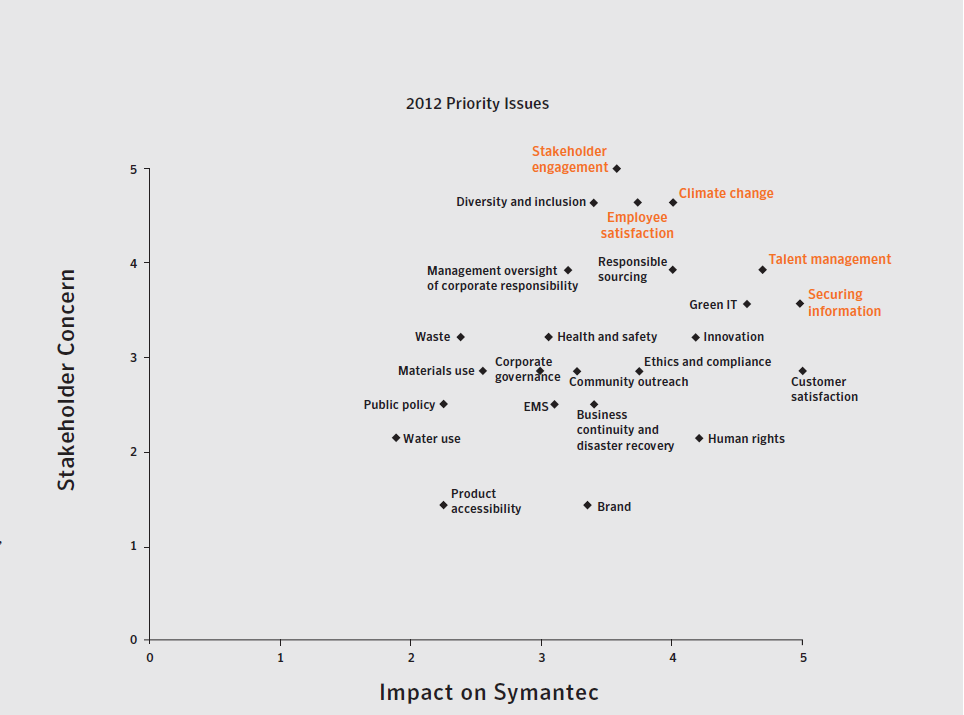
Before I close, I wanted to share that second great impression I mentioned earlier. It's this. Symantec has as wonderful an array of CSR communications as I have seen at any company. In addition to the annual CR Report (every two years, a full GRI Index report and every in-between year a shorter non GRI report), Symantec maintains a suite of communications second to none, including: 

The last annual "Vision" trade convention that Symantec held in Las Vegas was eco-managed to perfection and you can read all about the efforts to greenify that conference in a full event sustainability report. Really great stuff. 


Cecily noted "Sometimes, you have to say things in 10 different ways for it to reach all the people and for them to actually hear it. A single annual CR report is not enough. We believe it's really important to maintain a range of communications that will reach all our employees and diverse stakeholders in different ways that will attract their interest." 

Symantec's next CR Report to be published later this year will be a G4 report. With a materiality matrix in place, and existing strong engagement processes, the fundamental processes at Symantec make G4 a natural evolution. 


In the meantime, looks like cyber is going to get lots more secure with the new SC3 program. I guess all my attempts to hack into the world's leading online ice cream recipes may not come to fruition after all. 


elaine cohen, CSR consultant, Sustainability Reporter, HR Professional, Ice Cream Addict. Author of Understanding G4: the Concise guide to Next Generation Sustainability Reporting  AND  Sustainability Reporting for SMEs: Competitive Advantage Through Transparency AND CSR for HR: A necessary partnership for advancing responsible business practices . Contact me via www.twitter.com/elainecohen   or via my business website www.b-yond.biz   (Beyond Business Ltd, an inspired CSR consulting and Sustainability Reporting firm

Thursday, April 5, 2012

Five insights on Accenture and Women

Let me start at the end. After reviewing Accenture's global 2010-2011 Corporate Citizenship Report, recently released, I have been encouraged by Accenture's performance in gender diversity and advancing women. In many ways, I now believe that Accenture is showing leadership in providing a working environment which repects women's leadership and encourages women to advance.

But that's the end. The beginning is that I wasn't fully convinced of this after reading the Accenture Corporate Citizenship Report. Fortunately, I didn't stop at reading the report. I talked to Accenture. And this is the story. From the beginning.

I didn't have time to study Accenture's report in full (it's online and available as a download) but I  can never resist having a quick look at new report releases, so I did, just in passing, in-between things. Kinda by auto-pilot, my screen navigated to the page entitled "An inclusive, diverse environment".

 What stood out for me on this page is this:


My first reaction was this:

I was disappointed. For the past 5 years, female intake has been static at 34-36 percent. And the number of women senior executives has been static at 16-17 percent of the  senior executive workforce. Accenture has a Diversity Council and a Diversity Advisory Forum. There are leadership courses for women and a Women's Network. Accenture celebrates International Women's Day and in 2010, senior women participated in events in 146 locations across 35 countries, and in 2011,  events took place in  162 locations across 40 countries. Accenture conducts research every year on women in business, and has Women's Mentoring Programs which pair women with senior executives. Yet only 17 percent of the senior executives are women.

Accenture writes: "Increasing the representation of women and minorities among our leadership and welcoming all diverse employees will remain ongoing priorities for us." For the past 5 years, there appears to have been almost no increase of women representation in the senior executive ranks, despite this having been, apparently, a priority during these years.

It therefore seemed to me that, whatever Accenture has been doing for the past five years, it hadn't worked. Whatever Accenture plans to do for the next five years, has to be different. As I have said in the past, down with womenwashing!. "Fixing" women through leadership programs and women's networks doesn't create space for women to move into leadership positions.

Admittedly, Accenture has three women on the Board of Directors (out of a total of 10 non-management Directors) and 26% (5 out of 19) of its global Executive Leadership Team are women, which stacks up pretty well against most large companies and other companies in this sector. However, this just made me wonder why more women do not achieve senior executive status, and, apart from continuing the current initiatives, what Accenture plans to do differently to ensure that 17% could become more than 17% in the next few years.
  
But then......

I contacted Stacey Jones, who is Accenture's reporting contact point for Corporate Citizenship to see if there is perhaps an explanation that I am missing. I was totally impressed that Stacey came back to me immediately and we chatted by phone about what Accenture is doing to advance women. This is fabulous responsiveness, way beyond that which I experience from most companies (and I write to many!).

And then ......

From our conversation I understood that the "senior executives" is actually quite a small proportion of the overall management population at Accenture, as 17% is based on a group of some thousand within the company’s population of nearly 250,00 employees. The percentage of women overall in all management positions is much higher.

I also saw that the total workforce increased by 40% in the same 5 years, so the female workforce in 2007 was 61,200, while in 2011, it was over 80,000. This means that absolute numbers of women in senior positions has increased, even if the percentage figure does not reflect this. Maintaining this level, then, actually represents an achievement.

In addition, Stacey talked with passion about the programs to advance women at Accenture, especially the Diversity Council. "Diversity Council membership includes representation of our most senior male and female executives who have key leadership positions within the business. They play important roles in succession planning and sponsoring women to be groomed for leadership positions and ensuring they have the opportunity to advance. I have been here for 18 years, and I personally observe the investment of time and energy that goes into creating an inclusive culture that works for women."

All this was enough to convince me that there is genuine openness and encouragement for women's advancement at Accenture.

And so .....

I changed this post from what have been a rather critical post to one which highlights the value of stakeholder engagement. Here are my five insights:

Number Uno: As stakeholders, take the time to give feedback and ask questions.
Had I not fed back my observations to Accenture, I would have written an overly critical piece. Knowing what I do now, this would have been unjustified. I like being critical :), but I prefer to be fair.

Numero Two: As corporations, listen and be responsive to stakeholders.
My conversation with Accenture provided them with some value. Through my feedback, they were able to gain some new perspectives about how to present their performance in the Corporate Citizenship Report and a couple of insights into aspects of diversity management.

Number Trois: Things are not always what they seem.
It's always worth checking the facts and hearing the other side of the story. It's easy to jump to conclusions, and be judgmental, especially when the numbers seem straightforward. But just asking a simple question led to a great conversation and a much fuller understanding of the situation on my part. It's easy to be critical of companies. It's less easy to take the time and consider a more balanced view. 

Nombre Four: Transparency builds trust.
This is the whole point of Sustainability Reporting. Transparency opens you up to scrutiny. It exposes you to criticism and external interventions. As a result, I now have a much higher level of trust in Accenture's reporting, and corporate integrity, and Accenture has avoided what might have been some rather unpleasant publicity, and has gained new insights about their reporting.

Nummer Cinq: Make sure your Sustainability Report has an accessible contact point.
If the whole point of Sustainability Reporting is to engage stakeholders, make sure you publish an accessible contact point. It's so frustrating when you send an email and it ends up in a black hole. Accenture's timely and friendly response is a best practice example of stakeholder engagement and deserves a CSR Reporting Blog Double Cone Award.


The End.


elaine cohen, CSR consultant, Sustainability Reporter, HR Professional, Ice Cream Addict. Author of CSR for HR: A necessary partnership for advancing responsible business practices  Contact me via www.twitter.com/elainecohen on Twitter or via my business website www.b-yond.biz/en  (Beyond Business, an inspired CSR consulting and Sustainability Reporting firm)
Related Posts with Thumbnails