Showing posts with label csr report. Show all posts

Sunday, September 9, 2018

Cosmetic materiality

This week, a Press Release announcing the publication of AS MADARA Cosmetics ESG Report for 2017 caught my eye for several reasons. (1) Madara is a Latvian company - not too many of those publish reports - the GRI Database lists just 5 reports in 2017/2018 from Latvia. (2) It's a FIRST report - and you know how much I 💗 first reports. (3) It highlighted a CEO pay ratio of 1.68:1 and (4) It follows the NASDAQ ESG Reporting Guidefor Nordic and Baltic Markets.

Now, as some of you may recall, I wrote about this guide a while back in a post entitled: Materiality: from meaningless to differentiating. The thing about materiality is that so many companies today use it as a box to tick rather than a considered strategic framework for sustainable development and reporting. The low-level thinking on materiality where people, society and the environment are material to every company has rendered materiality fairly meaningless as all companies, no matter what sectors, are driven to report on the same thing. Advanced materiality thinking is differentiating; it identifies those unique impacts where a company has the power to change lives and society for the better. So, a broadscale, unimaginative, limiting approach to materiality doesn't serve to advance sustainable development, it simply serves the purpose of transparency and accountability, albeit that is also a worthy and necessary purpose. I call this operational materiality, and it is reflected in the NASDAQ reporting indicators for all companies, all sectors, all sizes.


Thirty-three basic measures of the ESG performance of the business provide a positive overview of how a company performs from a sustainability standpoint. 

Madara Cosmetics is a woman-led Latvian-based natural cosmetics firm traded on NASDAQ. The Madara report uses this framework, responding to all NASDAQ indicators (most are labelled - five are not labelled but the disclosures are present). Thus, in a refreshingly clean and attractively designed 50-page report, Madara covers off the bases using a compact set of universal indicators in a coherent way. 


However, the brand has gone beyond a simple response to a set of measures. It tells a story.


And it takes a stand.


Part One of the report is an education on organic and/or natural ingredients and the different certifications and standards that govern claims that cosmetics companies make on their labels. While intuitively, anything labelled natural or organic sounds environmentally friendly and healthy, this may not always be the case. 

It is clear where Madara stands here. A new ISO Standard 16128 for natural beauty products permits petrochemical and GMO-based ingredients, according to Madara, and is in general an inadequate and inappropriate standard for natural cosmetic products. Madara also attacks new EU regulation governing claims that can be made on cosmetic products, commenting that the new regulation compromises the rights of consumers to information about products they use and the ability to prefer products that do not contain certain ingredients. This is getting a bit messy according to Madara and may encourage greenwashing rather than science-based true and accurate product labelling.

A bold move. In this first report, Madara has chosen to take a strong and well-articulated stand against market regulatory developments that influence how consumers perceive natural cosmetics and influence competition for natural and organic share. This is a good use of the Sustainability Report. It helps us get to know the company and what it stands for. It places the company operations in a market context that showcases how Madara positions its brand and stands out from the crowd. This is part of the brand identity and a clear element of the way Madara impacts lives. Had the company developed a differentiating set of materiality topics, "accurate natural product labelling" and "influencing regulation governing natural cosmetics for the benefit of consumers" might well have appeared on the list.  

What I am missing, however, are the rest of these broader impacts. After the regulatory and ingredient-type discussions, the report continues in three sections - environment, social and governance - using the NASDAQ guidelines as a (mainly chronological) basis to report. However, beyond product formulations, I am wondering how the company reaches and impacts the lives of consumers. "Deeper than skin" is the company motto. I would like to understand why Madara's products are so transformational for consumers and what a difference they really make. What consumer needs are Madara products responding to and how successful are they? These impacts are overlooked in this report. 

However, this first report is a good example of an activist company using reporting to amplify its message and differentiate itself while observing stakeholder expectations on transparency and disclosure. In fact, with a report such as this, you wonder - would using the GRI Standards have made any difference? Or would it have simply complicated the reporting process? 

I tend to think that identifying material impacts is a positive step and creates a clear focus that guides the reader. A materiality assessment, robustly developed and clearly presented is a good backbone for reporting and I would have appreciated this addition in the Madara report. On the other hand, there are interesting and important disclosures in the NASDAQ framework that I believe all companies should report, whether or not their materiality assessment picks them up (and we all know that processes for determining materiality are somewhat arbitrary in most cases). A GRI-compliant report would probably not have included these disclosures.

In my post of last year, then, I talked about operational and differentiating materiality. Those who read GRI's Annual Report for 2016-2017 will have noticed a similar presentation.


As you can see, this matrix is split into two parts: operational and mission effectiveness, which, coincidentally or otherwise (who knows!?) are pretty much how I was seeing it in August 2017, a little before the publication of the GRI Annual Report in May 2018. Operational issues are the ones GRI directly controls - transparency, advancing people, and partnerships. Mission effectiveness are the indirect impacts - the difference the organization makes in society as a result of its operational activities - driving better sustainability performance, reporting and harmonizing the sustainability landscape. The thing you notice about this is that the operational impacts could relate to any company. The mission effectiveness topics are differentiating and unique to GRI. 

(As an aside, not all indirect impacts are linked to mission effectiveness. An indirect impact of GRI, for example, might be job creation in the sustainability sector, as more reports means more reporters. But this is not the mission.)

I think we are at the point where we must elevate our approach to materiality so that it refers to real ways that companies affect our lives, and not just the things that companies do. We are lacking a robust process for determining materiality. Currently, each company individually defines the degree of stakeholder engagement required to define material topics and ranks the topics raised in unclear ways. The was the big fail of G4 (and now GRI Standards) when it first put materiality center-stage in 2013. It made materiality pivotal but did not provide the tools for companies to apply it adequately. If materiality is at the center of sustainability strategy and reporting, and not just a cosmetic addition, the process for defining the material topics should be more clearly prescribed and evidence-based.

Well done to Madara Cosmetics for reporting and for speaking out on issues that affect people's lives. Materiality or otherwise, this is an authentic and credible report. I give it three cones -  🍦🍦🍦 - including one for a first report. 


elaine cohen, CSR Consultant, Sustainability Reporter, former HR Professional, Trust Across America 2017 Lifetime Achievement Award honoree, Ice Cream Addict, Author of three totally groundbreaking books on sustainability (see About Me page). Contact me via Twitter (@elainecohen) or via my business website www.b-yond.biz (Beyond Business Ltd, an inspired CSR consulting and Sustainability Reporting firm). Need help writing your first / next Sustainability Report? Contact elaine: info@b-yond.biz 
Elaine will be co-chairing  the  
second annual Asia Sustainability Reporting Summit 2018 in Singapore on 2/3 OCtober. Join me there!

Tuesday, October 3, 2017

#ReportingMania: Owning the Space at StarHub

Another highlight for me of the 2017 Asia Sustainability Reporting Summit was listening to the keynote of Mr. Tan Tong Hai,  StarHub's CEO and Executive Director, and hearing from Jeannie Ong, StarHub's Chief Strategic Partnership Officer in the closing plenary panel.

Mr Tan Tong Hai. Photo courtesy of CSRWorks.
Jeannie Ong. Photo Courtesy of CSRWorks.

StarHub is Singapore's first fully integrated info-communications company offering mobile, Pay TV, broadband and enterprise services to millions of customers in Singapore region employing close to 3,000 people. StarHub was the 2016 Winner of Asia’s Best Sustainability Report within Annual Report at the Asia Sustainability Reporting Awards and also the 2015 Highly Commended Finalist of the Asia’s Best Community Reporting at the Asia Sustainability Reporting Awards.

StarHub integrates sustainability information in its annual report - check out the 2016 report here.  The sustainability information is a report within a report, 37 pages of GRI Standards Core option content, including, of course, a set of material priorities.


In his opening keynote, Tan Tong Hai shared his experience of being appointed CEO and being "taught" that the value of business was to deliver (financial) value for shareholders. But, it did not take him long to realize that this is no longer the full story. "Over the years, I think the role of business in society has changed. It's no longer just to create value for shareholders, it's now about creating value for stakeholders. Stakeholders include employees who you need to generate the wealth, customers who use your services and your business partners who help you in the whole supply chain, and also the regulatory framework and the society we live in. When I looked at our vision statement, it was rather technical, so we gathered our employees together to create a new vision statement - "Creating Happiness, Inspiring Change". Creating happiness first for our employees, and for our customers, partners and all citizens."

You will note that Tan Tong Hai first refers to employees. Those that know me and remember my book, "CSR for HR: A necessary partnership for advancing responsible business", may be reminded of the point that CSR begins at home - with the first stakeholders of any business. Since that publication in 2010, I have heard very few CEOs put people first, and read very few Sustainability Reports that truly reflect a culture where employees are engaged, empowered and equal. Tan Tong Hai's reflections on his approach to business were a breath of fresh air in this respect. He chose to talk FIRST about employees as he has chosen to put them FIRST in his business. 

"I believe that you can't have happy employees if you don't have healthy employees. Health is wealth. We have generated a lot of health activities for employees and of course I participate in those too. How we create happiness by helping others is also important. We encourage our employees to help in society by helping disabled people to use information skills to prepare them for work in society. That is what we mean by happiness - getting employees involved, knowing that happiness is not only their own health but also helping others. That's one part of how we create value."

Tan Tong Hai also referred to the way StarHub creates value for customers - not only though the products and service offering StarHub sells, such as unlimited viewing - but also through the way StarHub pioneered in 2012, an inclusive and extensive electronic waste recycling program, providing receptacles for customers to send their electronic items for recycling. Since 2012, more than 150 tons of electronic waste have been handled in this way. "You can create value by helping customers to become more responsible and helping them dispose of electronic waste."

Jeannie Ong, StarHub's Chief Strategic Partnerships Officer, also referred to this program in the closing plenary panel session. The program is called RENEW (REcycling Nation’s Electronic Waste) and it is now an award-winning initiative aimed at encouraging the public to recycle their e-waste. In collaboration with logistics provider DHL and waste recycler TES-AMM, the RENEW program provides a public service free of charge to collect e-waste from the public (not just from StarHub's customers) through 325 collection bins (in 2016) in Singapore. 59 tons of e-waste were collected in 2016 alone.


Jeannie explained: "We were very honored to be ranked in Corporate Knights top 100 Sustainable Corporations for the last five years and the highest-ranking Singaporean company. We studied the criteria to understand why .. it has got a lot to do with, believe it or not, NOT your sustainability reporting, it is about how sustainable your business is. Reporting is just a tool - it is really how you are able to embed sustainability into your operations and performance that is key. I don't have a secret recipe, but I believe it's because in our approach, we try to own a space. For example, looking at environmental issues some years ago, I looked at our business - we are a technology company and a media company, and one issue that stood out was that we are the source of a lot of electronic waste. We sell devices, set-top boxes, modems, routers etc.. at home, people don't have good possibilities to dispose of electronic waste. When I looked at all this, I founded the electronic waste project six years ago. We decided to own that space. Till today, electronic waste is a space StarHub owns in Singapore. For your line of business, look at where you make an impact and own that space.  Own something that you uniquely have in your line of business and as you do that, it shows in your entire sustainability journey. It also helps you win awards 😀."

Solid advice from Jeannie supported by practical action and much success. Both Tan Tong Hai and Jeannie Ong talked about much more than I can repeat here, and shared fabulous insights, including perspectives on the Sustainable Development Goals, the future of work, the Internet of Things and the challenges of the reporting process. StarHub's contribution to the 2017 Asia Sustainability Reporting Summit was tremendous and earned much respect from attending delegates. 

I asked Tan Tong Hai if he would be open to being cloned about 5,000 times and placed strategically in corporations around the world. While he considers his response, we will have to be content with the enlightened leadership he shows at StarHub and learning from him and his team at conferences, and reading StarHub's annual sustainability report.

I will therefore leave the final word to Tan Tong Hai:

"As a service provider, we play a key role but we must also participate in the whole system with employees, customers and partners, and play a key role helping Singapore become a smart nation but also a responsible nation."


elaine cohen, CSR Consultant, Sustainability Reporter, former HR Professional, Trust Across America 2017 Lifetime Achievement Award honoree, Ice Cream Addict, Author of three totally groundbreaking books on sustainability (see About Me page). Contact me via Twitter (@elainecohen) or via my business website www.b-yond.biz (Beyond Business Ltd, an inspired CSR consulting and Sustainability Reporting firm). Need help writing your first / next Sustainability Report? Contact elaine: info@b-yond.biz 

Elaine will be chairing the edie Conference on Smarter Sustainability Reporting  in London on 27th February 2018 


Monday, October 2, 2017

#ReportingMania highlights from SIngapore: SET

The inaugural Asia Sustainability Reporting Summit, organized by CSRWorks International, in Singapore earlier this month, which I was honored to chair, was one of the most successful events on the reporting calendar that I have personally attended, a view supported by everyone else that was there. The caliber of the speakers, the (largely corporate) audience from all over the region and beyond, the engagement of delegates during all the conference sessions, the fun and informal style and the overall organization and attention to detail were all superb, making this Summit a model to be replicated. And it will be, every year, I am sure. 

Photo courtesy of CSRWorks


One of the highlights of the conference, for me, was learning about the leading practices of the Stock Exchange of Thailand (SET). It was  a pleasure to listen to Mrs. Kesara Manchusree, President of SET, and Guest of Honor at the Summit, who I came to realize is a powerhouse in the Thai market and has driven major advances in sustainable practice and disclosure. SET joined the Sustainable Stock Exchange Initiative in 2014, the first Asian Stock Exchange to do so.  

Mrs. Kesars Manchusree. Photo courtesy of CSRWorks

Mrs Manchusree said: "ESG disclosure continues to be an integral part of sustainable practice as companies move from ambition to action. Our ambition for the Stock Exchange of Thailand is to make the capital market work for everyone.....The Exchange started on its journey in 2002, with the issue of guidelines to listed companies. We followed OECD principles and established a voluntary basis for disclosure, creating an environment for companies with a set of guidelines, training and talking with the organizations and explaining the benefits. Along the way, we moved to CSR practice in 2008, and issued CSR Reporting guidelines in 2012. However during the past two years, I moved from a CSR approach to sustainability guidelines, strengthening sustainability as a key mechanism to help listed companies prepare for long term value. 85% of listed companies have participated in the training sessions of SET. We have to prove to our listed companies that sustainability will benefit for them for a longer period." 

Ms. Manchusree talked about forward-thinking Thai companies that are sector leaders in the Dow Jones Sustainability Index. This is not by chance. In order to drum up support for DJSI inclusion, Ms. Manchusree described inviting all the CEO's of the leading companies in Thailand to "sit in the same room". "We wanted them to know that this is important for them and to point out who has already got in, and you haven't got in! Once the CEO's knew and took on this mission, we were sure that we would get more companies listed on DJSI and later we would invite their teams to learn more. Every year we decide to do more and have more companies listed in DJSI - institutional investors use DJSI as a benchmark. But we realized that not all companies could achieve inclusion in the global DJSI list, which is why we created a domestic list for Thai companies of any size who have published an ESG report  - we have 51 companies on this list."

From Mrs. Manchusree's presentation

These kinds of initiatives have delivered strong reputational and economic outcomes for Thailand with high rankings in different indices such as the Asean Sustainable Cities Scorecard, a billion dollars a year in IPOs and a high level of market liquidity. Thailand has the highest number of companies with DJSI inclusion among Asean countries. 

Not only this, SET has published its own Sustainability Reports regularly since 2012, the latest one covering 2016, written in accordance with GRI G4 Core option. 


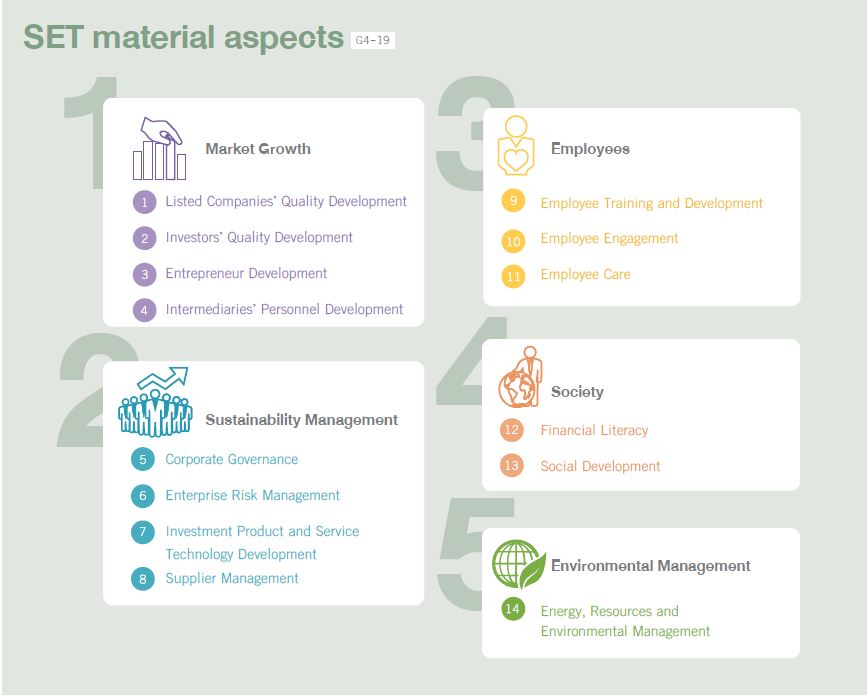
The report is structured around material impacts which are clearly stated and also aligned with the Sustainable Development Goals.


The report is fascinating as it gives an overview of the Thai culture which embraces the "Sufficiency Economy Philosophy of His Majesty King Bhumibol Adulyadej which consists of 3 key components: moderation, reason and self-immunity, based on knowledge and ethics.", providing an environment in which business can advance sustainability in line with the leading values of the country as well as sustainability principles.

This report, as did Mrs. Manchusree, clearly emphasizes the significant role that SET has played in educating, encouraging and supporting businesses along a sustainability journey. This enlightened, proactive approach has earned SET significant respect from other markets in the region, and, in the recently published 2017 Ranking of World Stock Exchanges, SET ranks in the Top Ten Stock Exchanges for sustainability disclosure (out of 55 ranked), having improved its ranking every year since 2013 when SET was ranked at number 40.


Mrs. Manchusree gave examples of two impressive Thai companies that have achieved strong DJSI positions. 

Thai Oil pcl is a supersector DJSI leader heading the global oil and gas sector for four consecutive years in DJSI. According to DJSI, Thai Oil is largely recognized as one of the most modern oil refinery plants in Asia Pacific Region. Thai Oil leadership has also been very proactive in helping advise and instruct other Thai companies and demonstrating the benefits of sustainable practice. You can see Thai Oil's latest Sustainability Report here:


It's a beautifully designed report, written using GRI G4 guidelines, structured around material sustainability impacts. Four pages in this report are dedicated to sustainability awards and recognition. Just think how proud the 1,400 employees of this company must be!

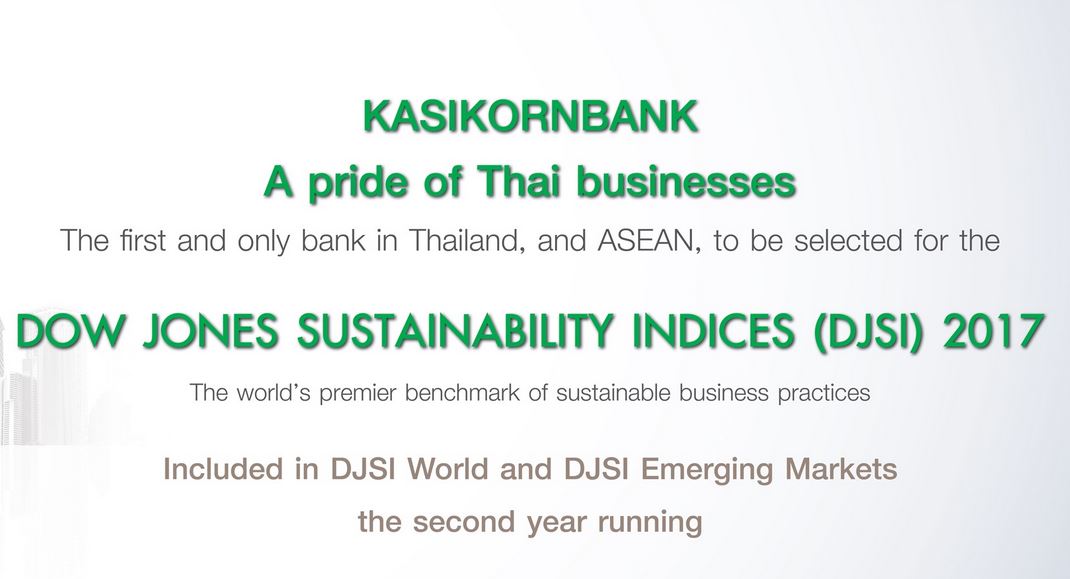
The second example quoted was that of Kasikorn Bank, another leading Thai company that sets an example for all the rest. Describing itself as the Bank of Sustainability, Kasikorn Bank "aims to harmoniously combine technology and human resources to sustainably create world-class-quality financial services, so as to achieve optimal benefits for all stakeholders." You can see their latest Sustainability Report here.

The report identifies its most material sustainability impacts and the report content addresses these.


Ms. Manuschree left us with an important thought.
"The sustainability strategy will only be successful when the top management is committed.  Even though embedding sustainability into the company is important, it is the role of the top leader in the company to create an environment conducive to sustainability. Visionary leaders see the opportunity to change the world for the better."


In summary, I found SET to be a shining light for Stock Exchanges around the world, which, individually and collectively have such potential to foster and environment in which sustainable markets and sustainable economies can flourish. I have often believed that sustainability is driven by business opportunity - for SMEs, this is the opportunity to access supply chains of larger companies through demonstrating and disclosing sustainable practice, and for larger (public) companies, it's through the possibility to access capital markets. Stock Exchanges are pivotal to driving a such disclosure and as we know, disclosure is a catalyst for performance improvement. The leadership of Mrs. Kesara Manuschree was, for me, quite energizing.

And that's just ONE of the highlights of #ReportingMania at the Asia Sustainability Reporting Summit. Watch this space for more. 


elaine cohen, CSR Consultant, Sustainability Reporter, former HR Professional, Trust Across America 2017 Lifetime Achievement Award honoree, Ice Cream Addict, Author of three totally groundbreaking books on sustainability (see About Me page). Contact me via Twitter (@elainecohen) or via my business website www.b-yond.biz (Beyond Business Ltd, an inspired CSR consulting and Sustainability Reporting firm). Need help writing your first / next Sustainability Report? Contact elaine: info@b-yond.biz 

Elaine will be chairing  the edie Conference on Smarter Sustainability Reporting  in London on 27th February 2018

Monday, September 4, 2017

People Planet Play at Caesars

Over the past couple of weeks, I have been horrified (as I am sure we all have) by heartbreaking first-hand accounts of people fighting for their safety and facing the loss of their homes in Houston, Texas and the region in the wake of Hurricane Harvey. I am sure we cannot begin to understand the challenges each is facing, nor the length of time it will take for the people of the area to achieve some sort of return to normal life. Our hearts go out to all those affected.

In the corporate world, many are mobilizing to provide emergency assistance and relief to the people of the area. It is no surprise to me that Caesars Entertainment was one of the first to announce support. See this post on LinkedIn:


This doesn't surprise me because I know Caesars Entertainment to be a genuinely caring company that invests in communities without hesitation all year round and not just in times of crisis. But when a crisis hits, Caesars can be counted on. I have been working with Caesars Entertainment for several years now, supporting annual citizenship reporting and other initiatives. I have had the privilege to personally engage and interact with hundreds of team members at Caesars in the U.S. and other parts of the world, from the President and CEO and senior executives to a very wide range of individuals in diverse roles. 

Without exception, I am struck every single time by the genuine passion and deep engagement of those I talk to, and their appreciation for the caring, nurturing, inclusive culture that is easily recognizable throughout the organization. Whether it's the CEO, Mark Frissora, who places employee engagement on a par with customer satisfaction and financial performance as a fundamental tent of the company's success (check out his  welcome message in the Caesars 2016-2017 Corporate Citizenship Report), or Mary Thomas, Executive Vice President of Human Resources, who says: "Our employees want to feel that our company is contributing to a better world," or a Caesars HERO (community volunteer), or a Health Wellness Nurse, or a Responsible Gaming Ambassador, or, in fact, just anyone at all, the folks at Caesars care. So it was certainly no surprise to see that Caesars is one of the first corporations out there taking action to support fellow citizens through the trauma and devastation that Hurricane Harvey has wrought. 


Which brings me back to Caesars eighth annual 2016-2017 Corporate Citizenship Report, this time under the theme of 

People Planet Play


People Planet Play is the new way Caesars is talking about citizenship and sustainability - to employees, to guests and to all of us. It's a corporate strategic framework for planning, reporting and communicating, setting out clearly what Caesars stands for as it does business. Jan Jones Blackhurst, Caesars' Executive Vice President of Public Policy & Corporate Responsibility explains:


People Planet Play enables the organization of all citizenship themes and programs under one umbrella:


So, for example, highlights for 2016 are organized in this format.


In this report, key members of the Caesars Executive team explain how this People Planet Play framework works for them and how it aligns with the vision of Caesars business development and growth in coming years. The report is written in accordance with GRI Standards, core option. More compact than prior years, it covers all key areas of progress in the past year or so, including:

Development of science-based emissions targets: For the past ten years, Caesars has set ambitious environmental intensity targets and has steadily achieved them each year. In establishing science-based targets, Caesars joins industry leaders in respecting planetary limits with absolute emissions targets through 2050.

Continued achievements in employee wellness: The Wellness Rewards program helps employees get healthier as they get older and in 2016, another year of strong participation enabled Caesars 50,000+ employees in the U.S. to feel well, save money and enjoy life. 


Ongoing leadership in Responsible Gaming: This is a core element of citizenship at Caesars, and has been for more than 25 years when Caesars developed the first industry efforts to address problem gambling among guests. Caesars continues to demonstrate leadership wherever it operates so that people who choose to take part in gaming activities can have fun doing so and know that help is at hand if this is not the case. This report includes major strides to advance responsible gaming in the UK where Caesars operates several casinos, as well as ongoing activity in the U.S.


Economic and social contribution in communities: Caesars has established strong ties within all the communities that host its properties, and makes a significant economic contribution. In addition to the >400,000 hours of community service that Caesars volunteers invested in their communities last year, Caesars distributed more than $9 billion of economic value to its stakeholders. A third-party analysis shows that contributed value by Caesars (wages, taxes and corporate giving) was almost three times the estimated average of U.S. corporations. 

Taking a public stand: As usual, Caesars doesn't shy away from speaking up for justice.  Whether it's on policy relating to LGBTQ rights or taking a stand against human trafficking, Caesars voice is where it counts. Gwen Migita, Vice President, Sustainability & Corporate Citizenship puts it like this:


(By the way, if you are heading to Singapore in September by any chance, come and join us at the Asia 2017 Sustainability Reporting Summit where Gwen will be speaking on embedding a culture of citizenship and the People Planet Play framework.)

Finally, who said sustainability reporting is not fun? Caesars 2016-2017 Citizenship Report also gives you the opportunity of a chance to win two nights at Caesars Palace in Las Vegas. Just by completing a super fun crossword.


Check it out, follow the instructions and you could be waking up to breakfast in Nevada. But even if crosswords are not your thing, I recommend you taking a look at this report from a clear citizenship leader in the gaming-entertainment-hospitality industry. There's much more in there that I have been able to mention in this post. As usual, send your feedback!


Disclosure: As you probably realized, I worked on this report (as well as on Caesars' prior four reports).  It's always a pleasure and honor to work with Caesars. But shucks, that makes me not eligible to enter the draw for the crossword prize.


elaine cohen, CSR Consultant, Sustainability Reporter, former HR Professional, Trust Across America 2017 Lifetime Achievement Award honoree, Ice Cream Addict, Author of three totally groundbreaking books on sustainability (see About Me page). Contact me via Twitter (@elainecohen) or via my business website www.b-yond.biz (Beyond Business Ltd, an inspired CSR consulting and Sustainability Reporting firm). Need help writing your first / next Sustainability Report? Contact elaine: info@b-yond.biz 

Elaine will be chairing the Asia Sustainability Reporting Summit in Singapore on 19-20 September 2017 and the edie Conference on Smarter Sustainability Reporting  in London on 27th February 2018

Thursday, September 1, 2016

Connecting for #Citizenship at Caesars

The publication of Caesars Entertainment's seventh annual 2015-2016 Citizenship Report is a testimony to the value of connecting all year round, and not just during reporting season. Caesars Entertainment is one of the best companies I know that connects on several social media platforms across a range of topics with regularity, creativity and consistency. That's why, in this Citizenship Report, the theme of connecting is highlighted and illustrated with Tweets and hand-held Message Boards. 


Caesars Entertainment Corporation is the world’s most diversified casino-entertainment provider and the most geographically diverse U.S. casino-entertainment company. A regular feature of the report is the Footprint, updated each year, showing the size and scale of the company.


Connecting is something Caesars does well. Perhaps this is what you might expect of a hospitality company. However, it's not to be taken for granted. Connecting at many levels with stakeholders is a cornerstone of sustainability and citizenship practice, and becomes a regular feed of interactions, sharing, learning and supporting that builds familiarity and trust. And add a little fun into the mix. The new Citizenship Report reflects this, from the senior management team right through the organization. 

Jan Jones Blackhurst - Executive Vice President of Government Relations and Corporate Responsibility

 
Alex Dixon, Assistant General Manager, Horseshoe Baltimore

Brooks Robinson, Regional Senior Vice President & General Manager, Harrah’s Cherokee

Jessica Rosman, VP, Procurement
Tweets in the report are dispersed throughout, supporting the narrative. This of course was only possible because Caesars maintains strong Twitter streams throughout the year from a variety of Twitter handles. The main one is the Citizenship stream (@CitizenCaesars). Then there is  Caesars diversity and supplier-diversity stream (@CZRDiversity) and Caesars charitable Foundation (@CaesarsFdn) and the corporate stream that includes many citizenship-related updates (@CaesarsEnt) and the Caesars "We Mean Business" Responsible Meetings stream (@CaesarsMeetings). And that's just to start with. Most of the 50+ properties at Caesars have their own Twitter streams where they amplify many of the citizenship messages to followers. There are few companies around that maintain such a pace on social media. It's a testimony to Caesars' respect for its stakeholders and openness to engage. 

For example, on a page where Caesars talks about advancing diverse suppliers, two Tweets are integrated into the story.


On a page where Caesars talks about creating memorable experiences for guests, with the new Jennifer Lopez sell-out residency, Tweets illustrate guests' excitement with the show of shows.


For every story in the report, and there are lots of stories, there's a Tweet, or several Tweets. As a channel of communication and engagement, Caesars gets the message real-time to where its followers are and listens to what they say back. It's modern, it's fun, it's transparent, it's citizenship. Of course, the publication of the report had to be followed up with a Twitter Chat. You can read the summary of the chat, hosted by Triple Pundit, here

But Caesars' report is more than Tweets and Message Boards. It's 110 pages of GRI G4 compliant reporting of advances in citizenship performance during the past year. It's also a first alignment with 8 of the 17 the Sustainable Development Goals, integrated with Caesars citizenship and sustainability strategy.


Overall, Caesars makes a strong contribution to economic development, with $9 billion in economic value created for stakeholders in 2015, bringing the total close to $40 billion in the past five years. Relatively speaking, Caesars contributes to communities more than three times the equivalent average value contributed by U.S. corporations.

This is not just about money. It's about the many different ways of being part of local communities, engaging and collaborating to support economic development and improvement in the quality of life. For example, 55% of Caesars employees are involved and invested in voluntary community activities in some way. Caesars' leadership in the development of responsible meetings defines specific sustainability standards for the thousands of meetings, conventions and conferences that Caesars hosts at its properties each year. The standards that Caesars requires of its suppliers through its Responsible Suppler Statement and the advancement of supplier diversity, engaging with diverse supplier communities and offering mentoring programs, are part of the social and economic value that Caesars creates. Also, Caesars takes a public stand against social inequalities and in favor of human rights, for example, as a founding partner of the Businesses Ending Slavery and Trafficking (BEST) Employers Alliance formed in September 2015. BEST is the first public-private partnership in the U.S. to work across industries to prevent sex trafficking and sex buying. 


Caesars reports strong progress (again) in environmental efficiencies through Caesars' CodeGreen strategy, both in 2015 and since the start of the initiative in 2007.


And guess what, as they get older, Caesars employees are getting healthier. With an award-winning Employee Wellness Program that demonstrates incredible levels of participation and outcomes, employees can enjoy a healthier and happier... and hopefully longer life.


It would be remiss of me not to mention Responsible Gaming when talking about Caesars. But there's no news here. Caesars was the industry leader in Responsible Gaming programs as the first commercial company to address the issue of problem gambling in 1989, and Caesars remains the industry leader today.  Caesars continues to invest in training, communications and providing practical tools, such as self-exclusion, to ensure that people who come to gamble do so because they want to have fun. With 796 trained Responsible Gaming Ambassadors throughout properties in the U.S, and tens of thousands of employees trained each year, this for Caesars is par for the course. No news, but good news.

Caesars 2015-2016 Citizenship Report covers all of this, and more, in a clearly structured GRI G4 (core) report that is supported by a year of Tweets from multiple Twitter streams. This makes the report fun to read (maybe one of YOUR Tweets got into the report?) and also validates the content by demonstrating that citizenship, at Caesars, is day-by-day and not report-by-report.

As always, take a look. Give feedback!

Disclosure: You probably guessed that I worked on this report (as well as on Caesars prior three reports).  It's always a pleasure and honor to work with Caesars. Maybe one day, I might even get to meet Jennifer Lopez. If I do, I'll Tweet about it.


elaine cohen, CSR consultant, Sustainability Reporter, HR Professional, Ice Cream Addict. Author of Understanding G4: the Concise Guide to Next Generation Sustainability Reporting  AND  Sustainability Reporting for SMEs: Competitive Advantage Through Transparency AND CSR for HR: A necessary partnership for advancing responsible business practices . Contact me via Twitter (@elainecohen)  or via my business website www.b-yond.biz   (Beyond Business Ltd, an inspired CSR consulting and Sustainability Reporting firm).  Need help writing your first / next Sustainability Report? Contact elaine: info@b-yond.biz 

Monday, August 29, 2016

First Reports -Ten Trust Factors

It's almost Q4 and you know what that means. It's almost the start of the reporting season.

YAY! 

In the final quarter of the year, many companies are starting to plan their next report, or even their first report. There is a certain seasonality to reporting, by and large: Q4 planning, Q1 preparing, Q2 publishing, Q3 recovering. Of course, not every company is on that cycle.. but about now is usually the calm before the storm.

As we anticipate the next reporting season, we can expect a flurry of fabulous new first-time Sustainability Reports that will be published in 2017. It's not that I am especially optimistic about the impact of the EU Directive that will require 6,000 companies who do not currently report to start thinking about what they will write in their Sustainability Reports for 2017. Each year brings a flurry of new reports, with or without the Directive. And that means that each year, more companies have thought just a little more about the impact they have on our lives and are taking the first steps to be held to account.

Let's face it. Reporting is a little bit of a risky business. Take for instance, Dollar Tree Inc., a Fortune 500 American chain of discount variety stores that sells items for $1 or less in 13,600 stores around the country. Dollar Tree just published its 2016 Sustainability Report . Full marks for effort but this 14-pager 7-minute read is a list of environmental and social practices with barely any meaningful performance data. Not surprising then, perhaps, that there has been some backlash.

In a press release published in PR Newswire,  angry activists representing the Campaign for Healthier Solutions  berate the company for not addressing their concerns relating to chemical toxicity in the company's products after laboratory testing has found "potentially dangerous levels of lead, phthalates, and other toxic chemicals" in Dollar Tree's products. Comparing the current report to prior reports, these stakeholders find that there is almost no difference. So, although the folks at Dollar Tree have taken some steps along the transparency journey, they still have to find the path of accountability. Reporting is risky. Arguably, the fact that Dollar Tree has made efforts to publish a Sustainability Report has added fuel to the frustration of stakeholders. But, in fact, the Campaign for Healthier Solutions is doing Dollar Tree a favor. It's creating pressure that will ultimately lead to a safer planet, a safer society and a stronger business. If Dollar Tree embraces its critics, and takes responsible action, next year's headline may well be: "Dollar Tree's Sustainability Report reflects significant progress."  Reporting, whatever your motivation, even if it's just to tick a box, sooner or later becomes part of a greater whole relating to a company's role in society. Sooner or later, Dollar Tree will change. And it will benefit from that change.

So, even with some risk, reporting adds value and first-time reports hold a special significance for reporters, report users and me. I love first-timers. There is something about the special efforts necessary to deliver a first-time report and starting to flex those transparency muscles. I believe this starts to transform the internal conversation in any company, and eventually transforms the external dialogue too (as it has done at Dollar Tree Inc.). So many first-time decisions challenge any company that's reporting for the first time that it's a bit like navigating a minefield. And almost as risky.

As you all know by now, I generally tend to be a little critical when looking at reports so here's my upfront disclaimer. Every first report is a commendable venture into accountability and transparency and the start of what is hopefully a meaningful reporting journey for any company and its stakeholders. As a reporting consultant for hundreds of years now working with many companies, I can testify to the fact that no report is easy and every first report double-proves it. Before we go any further, I say: CONGRATS to ALL first-time reporters ever - you all deserve a triple scoop. Good luck to all those first-timers planning to break through the transparency barrier in 2017. (Remember, help is at hand - you don't need to go it alone :-)).

In looking at any report, including first-timers, it's important to consider that the overarching purpose of any Sustainability Report is to build trust. If it doesn't do that, heck, you're wasting your time. I've been taking a look at first-timers - it's always fun - to see how this is working. There are probably a thousand ways in which reports build trust, but, in order to help me apply a consistent approach when looking at first-timers from around the world, I  selected ten basic aspects of a first-time Sustainability Report that, for me, help build trust. These aspects do not carry equal weighting and they are far from scientific. These elements contribute to building any report's TF (Trust Factor) in my personal and subjective view. In sharing my thoughts, as always, my goal is to encourage reporting, in the hope that first timers will become second and third timers. My intention is not to be overly critical, but in some cases, forgive me if I can't help myself!

Here are the ten TF (Trust Factor) elements I  consider in my series of first-timer report reviews:
  • The CEO Statement: Must be meaningful, relevant and authentic, not just some generic any-company rhetoric about "how proud we are of what we have achieved but there is more to be done". 
  • Material focus: Must state the most important sustainability impacts and provide relevant disclosures. Oh, and that doesn't mean a list of material topics somewhere at the beginning of  the report, and no further reference to materiality. It means using materiality to frame the content of the report.
  • Adherence to GRI: Yes, a GRI compliant report gains a point in my book. While there are many fantastic and genuinely impressive non-GRI reports, using GRI implies for me a predisposition to align with the most widely-used global reporting framework that relies on general stakeholder expectations of rigor in reporting content and quality. 
  • Transparency maturity: This means  providing a critical mass of relevant sustainability performance data, not just declarations of approach and positions. No numbers, no good.
  • Challenges: No company has no challenges. Authentic reports discuss challenges. 
  • Examples of practice: Yes, I believe case studies build trust. They also help make the report more interesting and reduce yawn-time. 
  • Stakeholder voices: I think reports that contain direct opinions from stakeholders tend to show that the reporting company has good relationships, a collaborative culture and appreciates stakeholder involvement. Including stakeholder voices - and faces - bring a report to life. 
  • Contact person: I like reports that provide a person to contact, not an anonymous email dump-box. If you are proud of your report, put your name on it.
  • Clarity of presentation: We have to be able to understand data and charts quickly and read the narrative with ease. Too much technobabble drives me crazy. If I have to pore over a chart for more than 35 seconds to understand what it's telling me, it's a bad chart, no matter how creative the designers have been. 
  • Design and format friendliness: While design is not necessarily a trust-builder, good, clean, compatible design makes reading easier and shows the reporting company considers not only how to get the message across but how to get it through. Easy navigability is a plus. (I don't read eBook reports, so first-timer non-downloadable eBooks don't get my time.)  I don't like online-only which ties me to the speed and reliability of my internet connection wherever I am in order to navigate. I love PDFs. When I download a PDF, I can read it quickly wherever and whenever I want, search, highlight and make notes. Online formats undoubtedly offer interactivity advantages, but for me, they slow me down.
In upcoming posts over the next few weeks, in the run-up to Q4, I will review first reports that were published over the past couple of years against my TF (Trust Factor) framework. Watch out for posts with a First -Time Trust Factor title.

Let me know if you have recently published a first report.
Or even better - let me know if you'd like some help in preparing your first report. I would totally love that.


elaine cohen, CSR consultant, Sustainability Reporter, HR Professional, Ice Cream Addict. Author of Understanding G4: the Concise Guide to Next Generation Sustainability Reporting  AND  Sustainability Reporting for SMEs: Competitive Advantage Through Transparency AND CSR for HR: A necessary partnership for advancing responsible business practices . Contact me via Twitter (@elainecohen)  or via my business website www.b-yond.biz   (Beyond Business Ltd, an inspired CSR consulting and Sustainability Reporting firm).  Need help writing your first / next Sustainability Report? Contact elaine: info@b-yond.biz  
Related Posts with Thumbnails