Showing posts with label women's empowerment. Show all posts

Tuesday, August 18, 2015

What's reporting without culture?

Back in 2010, I published my first book, CSR for HR, a guide to the way Human Resources Managers can drive corporate responsibility, using their leverage at the center of organizations to encourage and empower an accountable culture. While the book was a great success ... by all accounts... and I continue to receive positive comments ... the HR profession has not really transformed itself into a champion of CSR... far from it. Of course, HR Managers may not see championing CSR as their remit. But that's only because they do not realize that CSR is actually a way to reinforce and strengthen the HR function in any organization. Since my book was published, the role of employees in driving CSR and the need to engage employees has moved higher up the agenda. In fact, almost every Sustainability Report you read today has some reference to employee engagement and many make the link between engagement and positive sustainability outcomes. 

That's as it should be. Sustainability reporting as a process should involve employees and inspire them. Rather than being the headache it often is, it can be a tool to create elevated levels of empowerment and engagement of employees. Some companies testify to this. Corus Entertainment in Canada regularly celebrates employees in annual sustainability reports and rewards them for their citizenship efforts. The Corus reports present a workplace where accountability is a value and employees are engaged and empowered to do their best for themselves and each other, the company, the community and the planet. 


A string of workplace awards tend to confirm this position.


3M's 2015 Sustainability Report covers how the company encourages and empowers employees to be creative  with sustainability in mind.

"During the 2014 Sustainability Week, we addressed global sustainability challenges we all face every day at home and at work. 3Mers were asked to think creatively, collaborate, and innovate with the shared goal of making life better... And we led a Shark Tank-inspired Power Pitch, which allowed teams of employees to suggest business ideas with a sustainability focus to compete for research and development funding with winners chosen through global text voting by their peers."

The culture of sustainability is reinforced in other ways, such as use of social media - an example below from Pinterest:


Anyway, also in 2010, I wrote on this blog about H&M and the crisis of the discarded garments in New York. The point was that, in an organization that had truly embedded CSR culture and practice, such an instance might not have happened. Employees would know how to connect their actions to potential issues on the CSR radar (more about the radar in an upcoming post. Hint: Datamaran). The BIC blip reminded me of that this week. How many marketeers just have no clue? How much insensitivity is an organization allowed to demonstrate at the same time as professing to support a CSR approach? At what point does an organization realize that CSR is a way of being, not just a project of doing?  And that even marketing folks need an invitation to the party.

Maybe you saw the BIC blip  example reported in the Guardian this past week ...

Who on earth in their right mind could think this would be encouraging or inspiring for women? You would have to be a total idiot to create something like this and an even greater idiot for authorizing it, and a double greater idiot for publishing it. Look like a girl? Think like a man? Come on....Even if the intention was positive, the gaping cavern between intent and result testifies to a lack of embedded culture of sensitivity to others. How can employees of a responsible business be so misguided? Does it really need an onslaught of criticism on social media to tell them they got it so wrong? 

BIC has a very clear Code of Ethics that employees are bound to uphold. It includes the company's approach to Human Rights and provides guidance for employees in the principles of communicating and engaging with each other.

The code does not specifically include reference to responsible marketing, though some indirect references can be found in  BIC's  2014 Sustainable Development Report

Generally BIC refers to the marketing teams's involvement in advancing the sustainable development program and marketing initiatives, such as:

"All of the professional functions involved (marketing, communication, sales) are equipped with the tools they need to explain BIC’s Sustainable Development Program."

Another reference to marketeers is an initiative to engage them through  a BIC recycling program in partnership with TerraCycle. This was the first initiative to collect and recycle writing instruments in France,  launched in 2011, and now expanded to several countries in Europe. BIC talks about this program as "inspiring marketeers to support the circular economy."

However, there's no reference to marketing communications and advertising as necessarily reflecting a respectful organization culture. BIC conducts a values survey among employees every 2 years to review "Values in Action" and also makes awards to employees who demonstrate core values of ethics and responsibility and more.  Results of the surveys are presented to employees. Therefore it seems that there are platforms to talk about culture, values, respectful communications and sustainable development. However, when it comes to the marketing department, there may be a need for some more work. 

It seems to me that BIC might be well served by developing and publishing a formal policy of responsible marketing and marketing communications. At the same time, BIC should undertake an intensive training program on diversity and inclusion for everyone involved in corporate and marketing communications. 

In the meantime, I don't plan to follow BIC's advice ... I'd rather :

LOOK like me
ACT like me
THINK like me
WORK like me 

I may not be perfect but at least  - hey - it's me. 


elaine cohen, CSR consultant, Sustainability Reporter, HR Professional, Ice Cream Addict. Author of Understanding G4: the Concise Guide to Next Generation Sustainability Reporting  AND  Sustainability Reporting for SMEs: Competitive Advantage Through Transparency AND CSR for HR: A necessary partnership for advancing responsible business practices . Contact me via Twitter (@elainecohen)  or via my business website www.b-yond.biz   (Beyond Business Ltd, an inspired CSR consulting and Sustainability Reporting firm).  Need help writing your first / next Sustainability Report? Contact elaine: info@b-yond.biz   

Wednesday, March 11, 2015

Businesses (still) discriminate against women

So. Another International Women's Day has come and gone. Celebrating the achievements of women. Doesn't do much for me, I have to say. The implication is that it's sort of amazing or even surprising that women achieve anything at all. Unlike men, for whom achievement is apparently quite natural as they don't have a Day all to themselves, international or otherwise. International Women's Day to me is quite unnecessary. As a woman, wife, mother, business-owner and yes, achiever, in my own modest way, I don't really need a Day. I am happy to celebrate my own achievements in my own way whenever I feel I want to.  

On the other hand, none of us can have any doubt that the need to create a society in which fair and equal opportunity for women exists is no less acute than it ever was. And that, apparently, takes longer than a Day. The position of women in society - certain societies - has improved over the years, but women are still discriminated against. This applies to business as much as it applies in other walks of life. No matter how many sets of Women's Empowerment Principles exist, gender equality in business is still somewhat of a distant dream. 

Sustainability. How can business be sustainable when it discriminates against women? Even the most advanced "sustainable" businesses discriminate. Let's be clear. If women do not have balanced representation in business, discrimination is present. It may not be overt, declared or even desired, but it's there. This is not resolved by adding women to Boards of Directors. It's fairly easy to pluck selected distinguished women and place them on (rather impotent) Boards of Directors so that the numbers look better. I would be interested in seeing research that shows what influence women Directors are actually having in influencing the way business does business. Forgive me for being a little skeptical.

I am more interested in how women have equal opportunity to enter and advance in business, especially the large, typically male-dominated companies that do business around the world. Many consumer goods companies actually target women who make most of the purchasing decisions for their products and yet women's representation in their senior management committees is pathetic. 

Corporate Knights makes a big splash every year announcing the Global 100 - most sustainable corporations - at the World Economic Forum. By all accounts, this is one of the better lists (although all rankings serve the rankers more than the ranked). With the Global 100, the methodology is clear, transparent, and covers the spectrum of sustainability performance areas. In 2015, however, the ten companies that headed up the Global 100 list have just 11% of women in their Executive Committees. They have a higher rate of women on the Boards of Directors, but where it really counts, women in senior executive roles, the figures are rubbish. At the same time, most of these companies have workforces that are 40 - 60% composed of women. What happens to women when they join these companies? How come that, in a combined workforce of almost 200,000 women in these ten top companies, only 9 get a key to the executive committee room? Men, on the other hand, have a better chance of getting a seat on the Executive Committee by a factor of almost five. Three of these top ten companies have ZERO women on their executive committees. So you tell me, are these companies discriminating against women or aren't they? (Hint: not no).


Biogen Idec: The world's most sustainable company has 17% women representation on it's executive management team. That's 2 women out of a team of 12. The two women are the Chief Legal Officer and the VP for Technology and Business Solutions. This is what Biogen Idec says about women in its 2013 Sustainability Report:

"To continue to thrive as a company and an industry, we must advance leadership opportunities for women. In 2013, the Women’s Forum of New York formally recognized our commitment as one of the 174 U.S.-based companies honored at the event for having a board of directors that is at least 20 percent women. Women currently make up just over half of our global workforce, and 40 percent of our management team. As we continue to advance in this area, one way we are striving to close this gender gap is through our Women’s Innovation Network (WIN) Employee Resource Group, which provides opportunities for women to network, learn, seek out mentors and develop their careers. Though primarily focused on women’s careers and leadership, WIN proactively recruits and welcomes employees of all gender identities who wish to act as allies. At present, more than 800 women and men from across the enterprise are members of the network."

This is how Biogen Idec represents the numbers visually:
Note how the high numbers stand out... 51.5% total women  and 40% women in management. Wonder why there is no visual presentation of women on the Executive Management Team. That would read:
17%
Aside from a resource group (dubious effectiveness in actually helping get women promoted), I don't see evidence of a plan to improve women at executive team level.

Allergan: The world's second most sustainable corporation has ZERO women on its executive management team. Yes, ZERO. Yet, this is what Allergan says about women in its 2013 Sustainability Report

"In 2013, women comprised 53% of our workforce and 40% of our leadership roles. This includes more than 39% of our manager and director roles, and nearly 27% of our executive positions. We were also fortunate to have one exceptional female member of our Board of Directors who brings truly exceptional credentials to our organization and is committed to its development."

Note how the high numbers stand out. 53% of the workforce at Allergan means more than 6,100 women. Not a single one worthy of helping to run the company. And the "exceptional" female director doesn't seem to be able to do anything about it. Allergan says nothing about any plans to address this gender imbalance in its organization. 

Allergan website - gender balance in action. Not.
Instead of talking about 27% of executive positions, Allergan should highlight the percentage of women executive team members, i.e.  
0%
And perhaps in its reporting, the company might like to explain how it is that zero women are worthy of senior leadership, and what if anything, the company plans to do about it. 

adidas: The third most sustainable corporation in the world has ZERO women on the Executive Team. The Adidas 2013 Sustainability Report includes a 2014 milestone to "Systematically increase the percentage of women in leadership positions." The website expands a little, stating: "The adidas Group has set itself concrete goals in line with its corporate culture and employee structure to increase the number of women in leadership positions in the coming years. The proportion of women in management is to be increased to at least 32% by 2015 (currently, the proportion is 26% in Germany and 28% worldwide). To achieve this goal, we have increased the proportion of women participating in our leadership development programmes to 35%. This is to help more women take up leadership positions in all areas of the company. We had already achieved this corporate goal at the end of 2012."

Note how adidas quotes the big numbers relating to women in leadership. But, if Adidas were to highlight the number of women on the Executive Management team, the result would look like this
0%
adidas employs more than 50,000 people. Not one single woman worthy of an executive team position. 

Keppel Land: This is the fourth most sustainable company in the world, according to Corporate Knights. And Keppel Land has the highest ratio of women on the senior management team, 2 out of a team of 6, which is 33%. Keppel Land is a real estate company, employing less than 4,00 people in total. And yet, even with such a small total workforce compared to other companies in the top ten sustainables, Keppel Land managed to identify two worthy women leaders, both of them in significant business P&L roles. 
33%

Kesko: The fifth most sustainable corporation has 1 woman out of a team of 8 on the senior executive team (Group Management Board). This is with a workforce of 45,000 employees of whom more than 50% are women. The one woman is the General Legal Counsel.  Rate of women in executive management? 
13%

BMW: The sixth most sustainable company with more than 100,000 employees can manage just 1 woman on the Board of Management out of a team of 8. The woman is the Human Resources Manager. Despite this, BMW has by far the lowest rate of women out of these top ten companies in the total workforce at 17%. Don't women buy cars? I hope they don't buy BMWs.


BMW women in Management:
13%

Reckitt Benckiser Group: The seventh most sustainable company has 1 woman on an executive team of 8.

13%

Centrica: Centrica has one woman in a team of seven top execs. Centrica's website displays some interactive charts that show different performance indicators, including this one for women. Lots of room on this chart for improvement.....


14%

Schneider Electric: This ninth most sustainable company has the largest senior management team of all the top ten. A whopping 15 members. You might think this would give opportunity to find a few women from the 153,000 people in the Schneider workforce to help lead the company. As it stands, just one makes the grade.


Overall women in the Executive Team?
6%

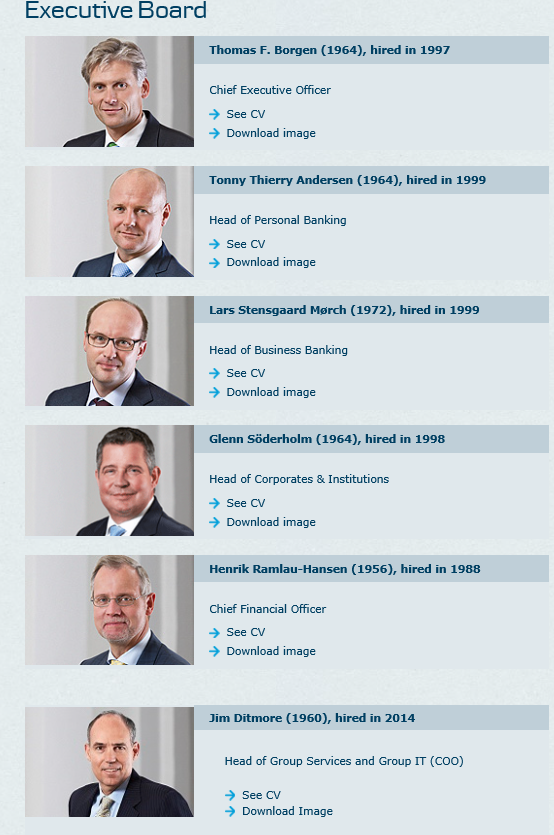
Danske Bank: Perhaps it's fitting that the tenth most sustainable company in the world rounds off this sorry state of women's affairs with a big ZERO women in the management Executive Board.


However, Danske Bank does make a commitment - one of the few that does:

This is not entirely out of the blue. This is what prompted Danske Bank to get more women-action-oriented: 

"In 2012, the Danish Parliament adopted legislation to ensure equal rights for men and women in private organisations. The law requires Danish companies to set specific targets for the number of women on the Board of Directors and to develop policies to increase the number of women in leadership positions. In their annual reporting, companies must also report on the progress made towards these targets and on the implementation of a diversity policy. We have already come a long way in developing a diversified and inclusive workforce, but we recognise that we still have some work ahead of us.

12.5% women on the Executive Board  of six members adds up to 0.75 women. I wonder which 0.25 part they are planning to leave out? Nonetheless, appointing three quarters of a woman executive by 2017 (four years from the 2013 report publication) is some sort of commitment, but forgive me if I am not falling off my seat. Today the score is:
0%


Well, all that was rather disappointing. I confess to being a little surprised that companies that are named as "most sustainable" are so unwilling to promote women. I am sure none of them will admit to discrimination among their ranks. But look at the numbers. Draw your own conclusions. It will take more than an International Women's Day to fix this. In fact, several Days haven't. Let's move on from a Day to Every Day.  


elaine cohen, CSR consultant, Sustainability Reporter, HR Professional, Ice Cream Addict. Author of Understanding G4: the Concise Guide to Next Generation Sustainability Reporting  AND  Sustainability Reporting for SMEs: Competitive Advantage Through Transparency AND CSR for HR: A necessary partnership for advancing responsible business practices . Contact me via Twitter (@elainecohen)  or via my business website www.b-yond.biz   (Beyond Business Ltd, an inspired CSR consulting and Sustainability Reporting firm).  Need help writing YOUR Sustainability Report? Contact elaine: info@b-yond.biz   

Saturday, July 19, 2014

How to grow revenues by connecting women

I am often asked, by clients or people I meet in the course of my work: What is the difference between embedding CSR into business decisions and doing business that improves sales and profits, provided its ethical? When you talk about embedding CSR into business decisions, its hard to know where business stops and CSR sets in. After all, both should lead to better business results. How can you know when a business decision has integrated CSR principles, or if it was based solely on goals of delivering income and profit growth? Doing "good" business, beyond philanthropy and community investment, is just doing good business. Or is it? 

I often answer this question rather simply, in a way that more or less aligns with the direction described in the Big Idea of Porter and Kramer, who explain: 

"The solution lies in the principle of shared value, which involves creating economic value in a way that also creates value for society by addressing its needs and challenges. Businesses must reconnect company success with social progress. Shared value is not social responsibility, philanthropy, or even sustainability, but a new way to achieve economic success. It is not on the margin of what companies do but at the center."

My answer, then, is about the considerations involved in developing new business initiatives or products. If it's about selling more to create economic growth (which is, in general, a good thing if business is done ethically), then this is hardly embedded CSR. Economic growth alone, as we have seen, does not always produce equitable social benefit and even risks perpetuating many of the global divides - poverty, malnutrition, access to medicine etc - that society faces today. Embedded CSR means approaching business development in a different way, that includes an assessment of the social and environmental impacts of potential decisions, and the social and environmental imperatives in the markets where a company operates. In making such decisions, then, economic considerations as well as social and environmental considerations share valuable weight in the decision-making process. The outcomes are measurable benefits to business, to the economy and also equitable social advancement. 

So far, I suspect, there's not much new here for the rather enlightened readers of this blog. Most of you already will already be familiar with shared value and integrating CSR type concepts. So let's get to the point. It's this. Vodafone. Mobile Technology. Economic Empowerment. Measurable Outcomes. Connected Women.

Earlier this year, Vodafone published one of the most fascinating reports I have read in a long while about the effects of mobile technology on women's empowerment and improvement in the quality of life. It's called: Connected Women. This actually missed my radar a few months back when it was launched, in March, at a Vodafone Connected Women Summit. Better late than never, I guess, and what's more, it's still relevant, of course. I learnt about it this week via an item from IndiaCSR, reporting the launch of the Connected Women report in India by Cherie Blair. 


The report is the summary of research for the Vodafone Foundation conducted by Accenture Sustainability Services. In addition to assessing the impact of increasing mobile ownership among women, Accenture modeled the potential social, economic and commercial impact of five services in the areas of education, health, safety, work and loneliness in 2020. These services are: 

1. mobile learning for adult literacy 
2. Text to Treatment: using mobile payments to cover travel costs to receive maternal healthcare 
3. an alert system for women at high risk of domestic violence 
4. a mobile inventory management system for rural female retailers 
5. new services to connect elderly people to their family, friends and carers.
The research ran in 27 markets around the world where Vodafone does business.

Conclusions are summarized in this infographic below, with the overriding message that the services Vodafone provides in the markets where it does business could enable 8.7 million women to improve their lives. Around the world an estimated 300 million fewer women than men own a mobile phone.  


I guess we all know that mobile technology can support education, health, safety and work so it is clear that improving access in these areas will have social benefits. The Vodafone reports looks at each of these issues in detail, and in relation to the special opportunities that women could enjoy, providing perspectives, data and impacts. There are some very compelling examples. The thing that I found most eye-opening is the issue related to loneliness. I guess, at some level, we know that phone and internet can help older people feel connected. We have all heard the stories of delighted grandparents who sent their first email to their grand-kids. But loneliness as a social issue is perhaps more real and more extensive than we imagined. In Spain, for example, 38% of people over 65 that live alone or have limited mobility report feeling lonely, the research shows.

"Loneliness and social isolation in old age can lead to sadness and anxiety and can even affect physical health. It is particularly a problem for women, since they are more likely to live longer and to live alone in old age."

Vodafone's initiatives in this area meet such real social needs - perhaps even ones that haven't yet been fully articulated - and open up opportunities for great business. Vodafone cites a potential $1.7 billion annual economic benefit to society in 2020 through reduced healthcare costs and informal carers being able to return to work. This translates into a potential $450 million cumulative revenue for Vodafone through 2020. Just by helping older women feel more connected.  

One of the neatest things in this report is the summary of findings and impacts. 


In each area, there is a clear benefit for society and a clear revenue opportunity for Vodafone as a result of empowering women through technology. The report closes with four recommendations, that place focus on doing business differently, engaging in partnerships and considering new business models.

Focus on women’s needs and preferences: Only by understanding their different needs as well as user preferences in each market, can operators provide the tailored services that will be valued by women customers. 

Local implementation with relevant partnerships:  Operators will need to work in partnership with NGOs, partners and funders to launch programmes at scale. Working with local partners will enable operators to leverage their expertise and networks to reach more women more effectively. 

Explore new models and funding options: Different economic models would be required to deliver the different services at scale. An estimated $900 million in donor funding would be required to achieve wide uptake of the modelled services in health, work and education in emerging markets. The mobile learning and Text to Treatment services are likely to require ongoing, large-scale donor or public sector funding. Nominal fees for services to recover development costs and public sector investments could contribute to these costs in some circumstances. Other services, such as those focused on work, safety and loneliness, have the potential to be self financing or revenue generating. 

Use local infrastructure and existing technologies: Combining projects with existing services, for example the M-Pesa mobile money transfer system, or infrastructure, such as local healthcare networks, will significantly improve reach and effectiveness.

Back to the question of how to define embedded CSR / shared value, it seems to me that this is an example of exactly that. It seems to me that Vodafone is quietly pioneering new business models and innovative ways of combining social needs with business development. 

It just so happens that I am currently reading Alice Korngold's excellent book, entitled: A Better World, Inc. In this book, Alice focuses on many of the ways that companies (including examples from Vodafone) are engaging in this new economy and achieving success through addressing social needs. In fact, Alice makes the point that "only global corporations have the resources, global reach and self-interest to build a better world". She says: 


In combination with a fundamentally RATS approach (responsibility, accountability, sustainability, transparency), corporations have the potential to change our lives for the better. This Vodafone example shows how. 


elaine cohen, CSR consultant, Sustainability Reporter, HR Professional, Ice Cream Addict. Author of Understanding G4: the Concise guide to Next Generation Sustainability Reporting  AND  Sustainability Reporting for SMEs: Competitive Advantage Through Transparency AND CSR for HR: A necessary partnership for advancing responsible business practices . Contact me via www.twitter.com/elainecohen   or via my business website www.b-yond.biz   (Beyond Business Ltd, an inspired CSR consulting and Sustainability Reporting firm

Thursday, April 5, 2012

Five insights on Accenture and Women

Let me start at the end. After reviewing Accenture's global 2010-2011 Corporate Citizenship Report, recently released, I have been encouraged by Accenture's performance in gender diversity and advancing women. In many ways, I now believe that Accenture is showing leadership in providing a working environment which repects women's leadership and encourages women to advance.

But that's the end. The beginning is that I wasn't fully convinced of this after reading the Accenture Corporate Citizenship Report. Fortunately, I didn't stop at reading the report. I talked to Accenture. And this is the story. From the beginning.

I didn't have time to study Accenture's report in full (it's online and available as a download) but I  can never resist having a quick look at new report releases, so I did, just in passing, in-between things. Kinda by auto-pilot, my screen navigated to the page entitled "An inclusive, diverse environment".

 What stood out for me on this page is this:


My first reaction was this:

I was disappointed. For the past 5 years, female intake has been static at 34-36 percent. And the number of women senior executives has been static at 16-17 percent of the  senior executive workforce. Accenture has a Diversity Council and a Diversity Advisory Forum. There are leadership courses for women and a Women's Network. Accenture celebrates International Women's Day and in 2010, senior women participated in events in 146 locations across 35 countries, and in 2011,  events took place in  162 locations across 40 countries. Accenture conducts research every year on women in business, and has Women's Mentoring Programs which pair women with senior executives. Yet only 17 percent of the senior executives are women.

Accenture writes: "Increasing the representation of women and minorities among our leadership and welcoming all diverse employees will remain ongoing priorities for us." For the past 5 years, there appears to have been almost no increase of women representation in the senior executive ranks, despite this having been, apparently, a priority during these years.

It therefore seemed to me that, whatever Accenture has been doing for the past five years, it hadn't worked. Whatever Accenture plans to do for the next five years, has to be different. As I have said in the past, down with womenwashing!. "Fixing" women through leadership programs and women's networks doesn't create space for women to move into leadership positions.

Admittedly, Accenture has three women on the Board of Directors (out of a total of 10 non-management Directors) and 26% (5 out of 19) of its global Executive Leadership Team are women, which stacks up pretty well against most large companies and other companies in this sector. However, this just made me wonder why more women do not achieve senior executive status, and, apart from continuing the current initiatives, what Accenture plans to do differently to ensure that 17% could become more than 17% in the next few years.
  
But then......

I contacted Stacey Jones, who is Accenture's reporting contact point for Corporate Citizenship to see if there is perhaps an explanation that I am missing. I was totally impressed that Stacey came back to me immediately and we chatted by phone about what Accenture is doing to advance women. This is fabulous responsiveness, way beyond that which I experience from most companies (and I write to many!).

And then ......

From our conversation I understood that the "senior executives" is actually quite a small proportion of the overall management population at Accenture, as 17% is based on a group of some thousand within the company’s population of nearly 250,00 employees. The percentage of women overall in all management positions is much higher.

I also saw that the total workforce increased by 40% in the same 5 years, so the female workforce in 2007 was 61,200, while in 2011, it was over 80,000. This means that absolute numbers of women in senior positions has increased, even if the percentage figure does not reflect this. Maintaining this level, then, actually represents an achievement.

In addition, Stacey talked with passion about the programs to advance women at Accenture, especially the Diversity Council. "Diversity Council membership includes representation of our most senior male and female executives who have key leadership positions within the business. They play important roles in succession planning and sponsoring women to be groomed for leadership positions and ensuring they have the opportunity to advance. I have been here for 18 years, and I personally observe the investment of time and energy that goes into creating an inclusive culture that works for women."

All this was enough to convince me that there is genuine openness and encouragement for women's advancement at Accenture.

And so .....

I changed this post from what have been a rather critical post to one which highlights the value of stakeholder engagement. Here are my five insights:

Number Uno: As stakeholders, take the time to give feedback and ask questions.
Had I not fed back my observations to Accenture, I would have written an overly critical piece. Knowing what I do now, this would have been unjustified. I like being critical :), but I prefer to be fair.

Numero Two: As corporations, listen and be responsive to stakeholders.
My conversation with Accenture provided them with some value. Through my feedback, they were able to gain some new perspectives about how to present their performance in the Corporate Citizenship Report and a couple of insights into aspects of diversity management.

Number Trois: Things are not always what they seem.
It's always worth checking the facts and hearing the other side of the story. It's easy to jump to conclusions, and be judgmental, especially when the numbers seem straightforward. But just asking a simple question led to a great conversation and a much fuller understanding of the situation on my part. It's easy to be critical of companies. It's less easy to take the time and consider a more balanced view. 

Nombre Four: Transparency builds trust.
This is the whole point of Sustainability Reporting. Transparency opens you up to scrutiny. It exposes you to criticism and external interventions. As a result, I now have a much higher level of trust in Accenture's reporting, and corporate integrity, and Accenture has avoided what might have been some rather unpleasant publicity, and has gained new insights about their reporting.

Nummer Cinq: Make sure your Sustainability Report has an accessible contact point.
If the whole point of Sustainability Reporting is to engage stakeholders, make sure you publish an accessible contact point. It's so frustrating when you send an email and it ends up in a black hole. Accenture's timely and friendly response is a best practice example of stakeholder engagement and deserves a CSR Reporting Blog Double Cone Award.


The End.


elaine cohen, CSR consultant, Sustainability Reporter, HR Professional, Ice Cream Addict. Author of CSR for HR: A necessary partnership for advancing responsible business practices  Contact me via www.twitter.com/elainecohen on Twitter or via my business website www.b-yond.biz/en  (Beyond Business, an inspired CSR consulting and Sustainability Reporting firm)

Tuesday, December 20, 2011

18 Examples of (Not-So) Integrated Sustainability Reports

Last week, I dutifully submitted my feedback to the International Integrated Reporting Committee on their discussion paper. It was an interesting exercise. Here are a few of my responses:

Do you believe that action is needed to help improve how organizations represent their value‑creation process?
Me: I believe companies need to take responsibility and be held accountable for their impacts on society. Action is needed to improve the number of companies who do this and the way in which they do it. This includes value companies create for society, but it is also about negative impacts on society and accounting for them.

Do you support the development of an International Integrated Reporting Framework?
Me: In principle yes, but on page 8, the Discussion Paper says that the IR framework will provide "high-level" guidance - I think it should provide very detailed guidance. Similarly, the approach states that it is focused on the needs of investors in the initial stages. I believe this is absolutely wrong. Integrated Reporting should AT THE VERY OUTSET focus on the needs of all stakeholders, otherwise it misses the point. Clearly, financial stakeholders are looking for tools to quantify the social/environmental risks and impacts in terms of shareholder value, but if this is the prime direction of Integrated Reporting, we are back to Square One, where sustainability is relegated to almost no influence on financial decisions and shareholder considerations. Once the framework has been developed for investors, there will be zero motivation to change or enhance it for all stakeholders.

Do you agree that Integrated Reporting will drive the disclosure of information that is useful for integrated analysis (from the perspective of investors)?
Me: Yes. In fact, that's pretty much all it will do. I don't think that's enough.

So, as I am having an integrated thinking week, I thought I would take a look at what's really happening out there and scan the 18 Integrated Reports that are contestants in the largest online annual Corporate Responsibility Reporting Awards - CRRA12.

Ultimately, a truly integrated report would show connectivity between the sustainability parts and the financial parts. Ultimately, a truly integrated report would make linkages between business strategy and sustainability strategy and define financial and social/environmental impacts of both in a seamless way. As I review the 18 reports entered in the Best Integrated Category, this is primarily what I am looking for. Connectivity. Linkage. Causality. Integration.

The IIRC discussion paper contains a couple of examples, including this one from Akzo Nobel:
Here we can an example of demonstrating financial value generated through response to global (green) market drivers. 

As you will discover, in most reports, I don't find this degree of linkage. Most integrated reports today are  a juxtapositioning of two separate reports. In the better cases, some of the narrative is blended so that business strategy appears to take financial, social and environmental aspects into account. Finding a report that actually considers the financial implications of sustainability actions is more difficult, though in some cases, the opportunities of sustainability strategy are discussed - sometimes using the Porter Creation of Shared Value Concept as inspiration.

One thing that puzzles me, for example, is why the cost of energy or other environmental or social factors are not considered. Only one company in this Integrated Reporting Category reports the cost impact of energy - all others report only the KWH consumed and the GHG's emitted. Surely, energy conservation is both a sustainability and a financial risk/opportunity? Why would companies not wish to understand (and disclose) the financial impacts of their energy practices? This seems obvious to me but no-one does it. Yet.

Here are the 18 reports in the Best Integrated Report category (in alpha order):

Alma Media Oy, Annual Review 2010, Finland, 43 pages, GRI B

This is the first integrated report of Alma Media Oy, "the voice of sustainable media", a company whose reporting I have always loved, and this integrated version is great. It looks and feels like a Sustainability Report while ensuring the financials are included and well presented. There is a good deal of contextual information about markets and sustainability considerations. While it doesn't go quite as far as to truly integrate CSR issues into financial and business strategy, and lacks a materiality analysis (though it does include top subjects raised by stakeholders), this report is so well written that it almost make me want to read newspapers again!


Altron - Allied Electronics Corporation, Integrated Annual Report 2011, South Africa, 259 pages, GRI B+


This is Altron Group's second integrated report prepared in line with the King Report on Governance for South Africa (King III). It's a very official looking sort of report, not something you would want to enjoy reading, though it does provide a good range of data. The Company has identified 11 Strategic Themes and a set of Material Issues which are analyzed in the report in detail. There is a clear financial flavor to this report - although consolidated financials start only on page 143, in the early part of the report, much space is devoted to financial impacts and market reviews, including a CFO review and results highlights. 

 A material issue for Altron, energy consumption, shows a massive increase, from a total of 113,000 Mkwh to 218,000 Mkwh in one year, more than double:


In fairness, there is some discussion of this in the report, and Altron is committing to improving measurement procedures and initiatives to reduce the Group's carbon footprint. However, I couldn't help wondering what the financial impact of this single environmental indicator had on Altron's overall budgets and exactly what Altron is planning to do to to make a change, and how this will impact operations and people.

Cebu Holdings Incorporated Integrated Annual and Sustainability Report 2010, Philippines, 174 pages, GRI B

This real estate company in the Philippines has been an integrated reporter now for 4 years, and although the Chairman's review opens with Dear Stockholders (and not Stakeholders), the company has a nice sustainability framework and the report is quite a pleasant read. Sustainability issues are dealt with well, and include external stakeholder commentaries. The Financial part of this report begins officially on page 123.

One of the things this company integrates alongside financial, social and environmental performance is its core values - Cebu is one of the only companies I have seen whose core values include the Love of God. I wonder if this is a condition of hiring?


Cermaq ASA Annual Report,  Norway, 131 pages, GRI B+

This is a fascinating report about a company who makes a living from salmon farming and making salmon feed. Did you know that 70% more salmon was consumed in Norway in 2010 versus 2009? Rising salmon eating trends is due to more sushi and sashimi consumption by younger people in the West, emulating Japanese fish eating habits. As salmon demand increases and supply falls behind, salmon is getting much more expensive. This is good news for Cermaq who made more profits than ever before in 2010. Another fascinating aspect of fish farming is the monitoring of salmon stress levels. Did you know that salmon could be in stress? Did you ever think about how much that salmon fillet you ate for dinner last week was stressed-out during its lifetime? Cermaq is able to identify stress levels in salmon and in 2010, was able to reduce stress levels by 60%. Wow. (Perhaps they could do the same for Sustainability Consultants?) Another fun fact is that Cermaq have 46 million fish in the sea as part of their farming effort and not one managed to escape. Hey, I bet prison services around the globe would be interested in Cermaq's methodologies.  

Cermaq's Integrated Report is really a joined Sustainability Report and an Annual (Financial) Report. The Sustainability part takes up the first 55 pages and pages 61-131 are in the form of a traditional Annual Report. There are separate Auditor's Reviews for the Sustainability content and the Financial content. The Sustainability part contains a nice Materiality Matrix:

Cermaq - nice Materiality Matrix presentation

Cermaq have even created customized indicators for reporting on their own kind of sustainable aquaculture:
Cermaq's propietary reporting indicators


Deloitte LLP USA Fiscal Corporate Responsibility Report, 50 pages, GRI B

Oops! What' this doing here? This is a CSR Report and not an Integrated Report. How come it snuck into the Integrated Reporting category:). If this report wins, the IIRC will go a little crazy, I suspect :)

Clearly Deloitte are a little confused :). Perhaps their involvement in the IIRC Pilot program may help.

NOTE: UPDATE 23 December:  Following my comments above, Deloitte has now confirmed that this report entry in the Integrated Category was an error and it has now been removed. However, Deloitte's report is still in the running in the Best Creativity Category. Clearly, Deloitte is not confused. Just a small error. These things happen. Thanks, Deloitte, for the clarification. 

Flughafen Muenchen Sustainability and Annual Report 2010, Germany, 194 pages, GRI A+

The Munich Airport Sustainability and Annual Report is a fascinating look at the full scope of sustainability issues which are relevant to airport operations which are complex and cover a wide range of social and environmental impacts. This report nicely discloses on workplace, climate change and environment activities, community engagement and stakeholder interests, and includes a full Materiality Matrix. The consolidated management report, beginning on page 130, contains financials as well as sustainability risks. As far as integration goes, it does a good job, though as with all other reports in the integrated category, financial impacts and sustainability impacts are handled as separate entities and the connectivity between them is not clearly articulated. 


Hyundai Engigeering & Construction Co, Korea, Sustainability Report, 88 pages, GRI A+

The Hyundai Report also seems to be misplaced in this category. There are two pages of headline economic or financial data in a total report of 88 pages. Hardly an Annual Report and hardly an integrated one. Hyundai should have read the fine print more carefully!

The report does include an explanation of the difference between a Triple Bottom Line Report and an Integrated Report and includes economic impact discussion and targets, though there is no direct linkage between these and other ESG performance areas.


The Hyundai Report includes a thoughtful Materiality Matrix which shows how issues have moved between one year to the next. This is a nice touch which most companies fail to consider.

The Hyundai report also features several external stakeholders and their responses to business and sustainability issues which are important to them as they consider their relationship with Hyundai. Overall, this is a great Sustainability Report showing consideration of social and environmental performance. The fact that some economic factors are mentioned and discussed does not make this a truly integrated report.

Indra Sistemas SA Annual Report 2010, Spain, 148 pages, GRI A+

Indra Sistemas offer a report which provides me with an opportunity to check out how much Spanish I don't know. I did try to use Google Translate, but when it converted a piece in Spanish to "The accountability that is presented below was carried out following the guidelines of the G3.1 Global Reporting Initiative application level A + and as AA1000 APS (2008), Accountability, including our behavior on the Global Compact principles with which we compromised ...", I decided to give up and let the Spanish speakers among us analyze the degree of integration of this report. (The GRI Index is in Spanish and English).  I did discover the Indra Sustainability website which is in English with an online report which is rather pleasant, including a "Sustainability Balanced Scorecard" which presents all sustainability data in great detail for a six year period. However, the website was not entered in the CRRA '12 competition so it is not really fair to comment on that.

Korea Railroad Corporation 2010 Sustainability Report, Korea, 105 pages, GRI A+

This report is called a Sustainability Report and follows a classic structure of sustainability reporting, with economic performance, social performance and environmental performance making up the core sections of the report. The economic section includes 7 pages of business descriptions and profiles, but not a full set of financials and there is no reference to any other report which does include the full financial data. Here again, this report doesn't fit the bill for what I believe constitutes an Integrated Report, even using the "light" definition which may indicate a "combined" report.  


MOL Group 2010 Hungary, Annual Report, 251 pages, GRI A+

This mammoth report  by MOL Group oil and gas producer in Hungary, Slovakia and Croatia, includes a separate section on Sustainability non-financial performance which starts at page 175 and runs through to page 210 - 14% of the total report. More if you include the separate governance section which is a further 23 pages - bringing total sustainabiilty and governance content to 22%. One of the disturbing things about this report is the title of the sustainability section - "non-financial performance". Surely, in an integrated world, social and environmental performance can no longer be solely non-financial? MOL is not the only Integrated Reporter which uses this terminology which I think is misleading and not representative of integrated thinking.  Aside from a mention of MOL's position in the Dow Jones Sustainability Index, sustainability issues are conspicuously absent from all discussion of MOL's business strategy and market performance. Sustainability data is assured separately from financial data.

The MOL sustainability component is very detailed and covers all transparency bases very well. However, the narrative is dry and factual and certainly not appealing to anybody other than those specifically searching for data and facts. In fact, MOL understands this, stating "While the Annual Report’s main audience is assumed to be our shareholders, investors and sustainability analysts, our webpage is tailored to answering the information needs of all stakeholders." The website is a little more friendly for us non-financial people - it has a few more photos and the language is a little friendlier, though the pages are long and very detailed.

One thing I have never seen before in a published report is a draft GRI Application Level Check statement!
MOL - getting ahead of themselves - confident of the GRI check!
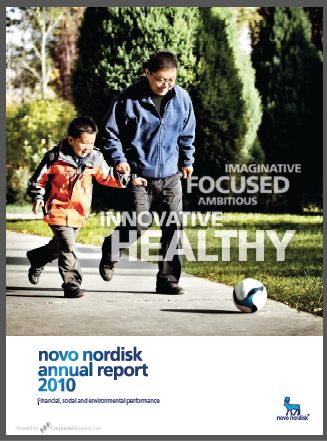
Novo Nordisk Annual Report 2010, Denmark, 115 pages, GRI A+

Novo Nordisk is often held up as the go-to-company for Integrated Reporting excellence, and has been a winner of the Best Integrated Report category in CRRA several times. Certainly, Novo has been doing this a lot longer than most companies (since 2004), so one might expect them to have developed a methodology which works for the company and for all stakeholders, not just financial stakeholders.

Novo says about their own report: "We believe Novo Nordisk creates value in ways that are not captured on a balance sheet or income statement and this is one of the reasons we publish an integrated report. Managing a business sustainably involves looking at risks holistically and taking a long-term perspective. In our 2010 Annual Report we exemplify this in a number of ways: comparing our sales growth with CO2, emissions, water usage and waste to better reflect relative performance and setting and reporting on long-term targets for diversity and engaging corporate culture."

De-coupling business growth from environmental impacts, is excellent, though Novo Nordisk continues to refer to non-financial targets and does not make the direct linkage between business and sustainability issues.

At the risk of becoming repetitive (yawn, zzzzzzzzzzzzzz), how can employee turnover, energy consumption, water consumption etc, not include an element of financial impact? Since 2007, Novo has achieved big reductions in water and energy consumption (37% and 28%) - I am sure this has made a significant financial contribution which is not specifically identified in Novo Nordisk's integrated reporting.

However, perhaps there is light at the end of the tunnel. I noted in an interview with Lise Kingo of Novo Nordisk, included in the report, that she says: "Together with experts and with inputs from stakeholders we have developed a methodology that enables us to value the contribution of our Triple Bottom Line approach in a profit and loss perspective. We have called this initiative our Blueprint for Change programme, and we have conducted Triple Bottom Line reviews looking at our climate action strategy and our business approach in China." I found more about this Blueprint for Change in China on the Novo Nordisk website - this is indeed an excellent document showing how Novo built business while creating very positive social and environmental impact. Again, I miss seeing an assessment of the impact of significant environmental benefits on the profitability and affordability of diabetes healthcare as part of this initiative, but this report does go further than most in identifying economic, social and environmental impacts for value creation as an integrated strategy.  

The consolidated financial and non-financial statements start in the Novo report at page 57, though both financial and "non-financial" figures remain separate, with 7 pages out of around 58 referring to social and environmental impacts.

Solar World AG Annual Group  Report 2010, Germany, 327 pages, GRI A+

This report is very long - at 327 pages, it weighs in as the second longest report in the entire competition. The report structure goes from corporate background and profiles (often quite technical) and then to consolidated financial statements, followed by a sustainability section which is made up of the GRI Index, the UNGC Index and the KPI's of EFFAS, all of which take up a further 16 pages  and is followed by some more detailed disclosures against performance indicators. There is little in the form of sustainability narrative - mainly data and while this is a business all about sustainability, I didn't detect too much overall integration in between financial and sustainability performance. It's quite a techy impersonal report in simple b/w design, making for a not terribly entertaining reading experience.  


There is one page of economic narrative in this Sustainability Report. It's a Sustainability Report. Do Sustainability and Integrated sound so alike?

In fact, this report only barely qualifies as a Sustainability Report. It is so light on sustainability data that it would not make a GRI C Application Level. It's more of a marketing-oriented brochure that reflects Siveco's business performance with a couple of CSR themes thrown in for good measure.

While I commend Siveco for being one of the few Romanian sustainability reporters, and the only Romanian report entered in the entire CRRA competition, the Company needs to develop its understanding of what CSR and Sustainability really mean, and how this can be presented more effectively and transparently.


Syngenta International Annual Review 2010, Switzerland, 58 pages, GRI A+

Hah! This is the only report in this entire category which makes a connection between environmental impacts and financial results. Syngenta says: "We monitor energy use to identify opportunities to improve efficiency. Our energy strategy encourages local teams to select the best ways to reduce energy at local sites. By 2012, we aim to decrease global greenhouse gas emissions by 40 percent relative to EBIT from the 2006 baseline."

Energy consumption, GHG  and other air emissions and water consumption all carry a $ value and are measured in terms of their impact on financial results as well as environmental sustainability.


The nature of Syngenta's business, developing seeds for more sustainable agriculture, advancing food security, lends itself well to a blended business and sustainability discussion, which makes the narrative in this report readable, informative and quite enjoyable. (Check out also Syngenta's Grow More from Less website).The people section is light, and I would have welcomed more discussion about responsible workplace practices and a similar assessment and measurement of sustainable people practices in relation to cost efficiencies. Much of this can be quantified, and it would be an interesting next step for Syngenta to incorporate measurable people impacts in their next report.

In the meantime, given that Syngenta is the only report in this category which has made the connection I was looking for, as well as providing an integrated view of the business in a readable and accessible manner, without too much financial geek jargon and headaches, this report has my vote as the category winner!

(At this point, I will overlook the fact that this is a self-declared GRI A+ level report, and that several core indicators are not fully reported, which to me seems to fall below the A level threshold.)

Takeda Pharmaceutical Company Annual Report 2011, Japan, 150 pages, GRI A+

Takeda is a 230-old corporation so I guess they must be doing something right that supports their sustainability as an organization, although 2010 marks the first year of "Transformation into a New Takeda" strategy, driven by innovation, culture and growth. The reports looks and feels  more like a Sustainability Report than an Annual Report, and includes extensive interviews with company people, and a thorough explanation of a significant acquisition, Nycomed, including aspects of culture and management style. (Most company reports do not examine in detail the basis for and impacts of acquisitions - this is a nice approach).

Financial results and discussion takes up 41 pages (27%) of this report, and some of the business and market disclosures in the body of the report are rather too detailed for the lay stakeholder to read and engage with, but overall, the report hangs together nicely, even though, as with other integrated reports, I could not find and direct connectivity between environmental or social performance and business results.

Takeda has adopted the seven core subjects of ISO26000 as a basis for CSR policy and reporting and structures disclosures around these themes. Takeda also publishes a CSR Data Book which replicates all the information in the Annual Report and adds some, and also includes the GRI Index. So if you are looking for a more traditional standalone CSR Report, this is the one to view.

As with most Japanese reports, many messages are formulated into charts and diagrams. I liked this one which explains Takeda-ism and Takeda stakeholders.


Vancouver City Credit Savings Union (Vancity) 2010 Annual Report, Canada, 94 pages, GRI A+

Vancity is a member-owned, community-based credit union seeking to develop member and community value through everything it does. Vancity is Canada’s largest credit union, with $14.5 billion in assets, more than 417,000 members and 59 branches. Vancity calls this report "their first truly integrated Annual Report", and in my view, they have done a good job. Vancity's report gives a reasonably integrated business overview, with a financials taking up only 28 pages. One of the few integrated reports which has less bespoke financial content - and one of the few which is actually quite pleasant to read, with many nice visuals and a good storyline in the narrative. If you are wondering how Vancity manages to do this - I suspect I know why :)  Take a look at the following shot of the Chair of the Board and the CEO! Women power is obviously the key!

Vancity's reporting on Materiality is interesting. In fact, they produce a whole separate report about it - it's 4 pages long, and defines the materiality process undertaken and the specific priority responses received by stakeholders from different forms of engagement with them, and how these issues have been addressed in the Annual Report. While this is excellent practice and transparency, I do wonder about the decision to omit this, beyond a mention and referral to the separate report, from the Annual Report main document. Materiality process is so core to reporting, particularly integrated reporting - why push it out of the main document? Another nice touch I have always liked about Vancity's reporting is the way their targets are clearly laid out and the specific accountability for achieving each target is noted- once upon a time, Vancity included actual names of people but today, it's just the job title, such as VP Human Resources, CFO or other. Still, it's good to know who in the organization is accountable for what.

Wilderness Holdings Ltd, Integrated Annual Report, South Africa,
153 pages, GRI Undeclared level


Wow. You have to look at this report, just to see the spectacularly breathtaking photography! It's just too beautiful for words. The second reason you need to look at this report is to learn about the intricate details of cultural and sustainable tourism - the high level of detail this report provides is also breathtaking - some might say overkill - but it has a certain authenticity and charm which makes you want to read more. The report includes a list of issues raised by stakeholders and Wilderness's response to them.

Consolidated financial statements begin on page 108, however, so that is where I stopped :)


Wyndham Worldwide Corporation Sustainability Report 2009-2010, USA, 56 pages, GRI C

Oops! Another Sustainability Report. Not integrated. No vote in this category. It does include 2 pages about business performance and revenues, but this hardly constitutes a full set of financials. This report belongs in the Best First Time Report category. Phew! It's there. And also in the Best Carbon Disclosure Category. So that's alright then.

I couldn't resist taking a little peek, though! Two things caught my eye. First, is the Wyndham has a website dedicated entirely to women travelers. I will have to see what that offers the next time I am off somewhere. I wonder if they supply people to pack and unpack my bags. That's by far the worst part of travelling.

The second thing I noticed is Wyndham's Sustainability structure, which seems highly slanted towards Environmental Sustainability.
  
Wyndham - green is it

Overall, the Report is a lightweight GRI level C report, responding to just 11 performance indicators in full. But a nice first time effort, all the same. Hmm. Wonder how it got into that Integrated Category, though!

And to round it all off...if you got this far ....

Of the 18 Reports entered in the Best Integrated Report category, there are five which I believe cannot be classified by any stretch of the imagination as integrated. Reporting companies should be more careful about how they define their entries in CRRA in future years. Also, some more specific guidance from CRRA might be helpful.

Of the remaining 13 reports, all go some way to presenting financial information blended, to a greater or lesser degree, with social and environmental impacts. However, very few manage to make a connection between business strategy and sustainability material issues in a way which shows how value is created or destroyed in both financial and sustainability terms. This shows the true nature of the leap that Integrated Reporting needs to drive. It is more than developing green products or delivering new drugs. It's about truly connecting all aspects of all business initiatives in which the sustainability impacts of business are represented in financial terms (where possible) and the business impacts of sustainability are represented in social and environmental terms (where possible). I fully recognize that 100% integration may be hard to achieve, but, based on my review of the Integrated Reports that are showcased here, even some first tentative steps would be significant.

Oh, and by the way, my own company Sustainability Report, which is not integrated (phew!) is entered in the Best Report, Best First Report, Best SME Report and Best Creativity categories in CRRA 12. I would be delighted if you would consider voting for Beyond Business Sustainability Report. Check out the CRRA 12 Awards here. PLEASE vote for your fave Integrated Reports AND for the Beyond Business report :))


elaine cohen, CSR consultant, Sustainability Reporter, HR Professional, Ice Cream Addict. Author of CSR for HR: A necessary partnership for advancing responsible business practices  Contact me via www.twitter.com/elainecohen  on Twitter or via my business website www.b-yond.biz/en  (BeyondBusiness, an inspired CSR consulting and Sustainability Reporting firm)
Related Posts with Thumbnails