Showing posts with label beyond business. Show all posts

Sunday, January 25, 2015

Our second Sustainability Report - hot off the press


DRUMROLLLLLLLLL


Announcing the Beyond Business 
2014 Sustainability Report


Yes, we finally made it to our second report. Just a little behind schedule. But there is something entirely uplifting about completing a Sustainability Report so for us, it was worth the effort. This report tells the story of our little company that has been making a BIG impact over the past few years and the roller-coaster journey we have been on since our last report covering 2010. 

Of course, our report is in accordance with the GRI G4 Reporting Guidelines. Of course, because we have come out strongly in support of the G4 framework and have encouraged our clients to adopt G4 where possible. Therefore, believing it is right to practice what we preach, we had no other reasonable choice. Having said this, the G4 framework worked well for us. It helped us define what's most important in a concise way, leading us to focus on the top six impacts, after having started with a much longer list. And this helped us keep our report short and focused. 


We also pioneered the new GRI Content Index Service - a check by GRI that all the disclosures and performance indicators that we included in our content index are actually present  and correctly located in the report. This was a useful exercise, and we did correct a few details in order to receive the coveted icon. We felt it was important for us to experience this check so that we know how it works if/when we recommend it to clients. Happily, for us as GRI Organizational Stakeholders, the check was free of charge. 

It's clear that our small business is not especially complex - we don't have a supply chain to speak of and governance isn't really in our lexicon. In terms of direct impacts, there is not much to speak of either. Even our commitment to addressing climate change by being carbon neutral since 2009 is unlikely to make a big dent in the global temperature rise. Recycling all our electronics and printing both sides in our minute quantities is hardly going to save the world. Where a company like ours can shine, however, is in the contribution we make to helping our clients advance along their sustainability journey and in helping the conversation around sustainability evolve in general. That's something we cannot measure in a direct way, but the confirmation we receive from our clients and the position of respect we (modestly) hold in the sustainability community indicates that, overall, our impact is positive. 

Of course, as with our last report, we included a page of failures - yes, we had some of those as well - recognizing that people only believe the good things if they also read the bad things. 

On a more philosophical level, our reporting demonstrates that SMEs can do it, that G4 can work for SMEs and that there is value in the process. We have long advocated that SMEs should report - both for the benefits it brings to their business directly and for the supply chains they are part of. I believe that SMEs have important stories to tell, and reporting is within reach. And it can be done on a modest budget. We did not need external assistance to prepare our report so that was not a budget line for us, but we did save (again!) by not having our report professionally designed, preferring to make it look as nice as we could using our own resources. Hopefully it's reasonably legible.  As part of our commitment to supporting SMEs in adopting a sustainable approach and transparency, we are holding a free workshop for SMEs in early March in our home market, to teach them the essentials and hopefully get them into the transparency habit on a low budget in a way that adds value for them. 

Finally, our report reflects our approach to reporting, which is that reporting is serious but also fun. We hope you will think so too. 

We'd love to hear your feedback!

Thank you.  


elaine cohen, CSR consultant, Sustainability Reporter, HR Professional, Ice Cream Addict. Author of Understanding G4: the Concise Guide to Next Generation Sustainability Reporting  AND  Sustainability Reporting for SMEs: Competitive Advantage Through Transparency AND CSR for HR: A necessary partnership for advancing responsible business practices . Contact me via Twitter (@elainecohen)  or via my business website www.b-yond.biz   (Beyond Business Ltd, an inspired CSR consulting and Sustainability Reporting firm).  Need help writing YOUR Sustainability Report in 2015? Contact elaine: info@b-yond.biz   

Tuesday, December 30, 2014

Our Year in 2014

2014 was a super-fun-busy year for my company, Beyond Business. We supported 9 clients in the development of GRI-based sustainability reports: 7 are G4-core reports, one is G3 and one is not GRI based. In some cases, this included more extensive stakeholder engagement and/or strategic development work with these great clients, the results of which you can see in some of the reports.


We also continued to support the different and varied requirements of other new and long-standing clients including bench-marking reports, reports analysis, strategy preparation and lectures and training sessions for management and in-house sustainability teams. 

In 2014, Elaine lectured or facilitated in sustainability events in 5 countries in addition to our home base and also participated in an online debate about stakeholder engagement. Elaine contributed chapters to two sustainability educational books published in 2014. We continued to write frank sustainability report reviews that are published in Ethical Corporation magazine - 6 reviews in 2014. 

We have had an active year too on the CSR Reporting Blog with 66 posts excluding this one (that's an average of 5.5 per month) covering hundreds of sustainability reports, events, and general views on the transparency landscape. That brings the total CSR Reporting Blog posts to 511. The most popular posts of all continue to be the annual Top Ten Sustainability Report picks. 

We have responded to numerous requests for advice and assistance from students of sustainability or even fellow professionals or those aspiring to be. Through it all we have tweeted far and wide, mostly about #sustainability, #CSR and #reports, bringing our total tweets to 16,448 to 12,407 followers, at the time of writing. 

Our community involvement primarily took the form of cash donations to non-profit organizations in the areas of women's empowerment and food-waste rescue, and our team of four took a day in July to help pack food parcels that we purchased for needy families. We remain an environmentally conscious company, recycling pretty much everything and being carbon neutral since 2009, covering our modest GHG emissions through purchasing offsets. 

Alison, Gal and Iris of the Beyond Business team in 2014


Also in 2014, we created, with a little (lot of) help from design professionals, our first sustainability video featuring Dr. Sustainability, and we launched our spanking brand new website, detailing the range of services we offer and the support we can provide to corporate clients, large and small. I'd love you to check it out! You never know, maybe there is something we might be able to assist you with in 2015! If so, I'd love to hear from you!

In the meantime, we are looking forward to 2015 and another fun-packed reporting year. We hope you are too! 

Happy New Year!


elaine cohen, CSR consultant, Sustainability Reporter, HR Professional, Ice Cream Addict. Author of Understanding G4: the Concise guide to Next Generation Sustainability Reporting  AND  Sustainability Reporting for SMEs: Competitive Advantage Through Transparency AND CSR for HR: A necessary partnership for advancing responsible business practices . Contact me via Twitter (@elainecohen)  or via my business website www.b-yond.biz   (Beyond Business Ltd, an inspired CSR consulting and Sustainability Reporting firm).  Need help writing YOUR Top Ten Report in 2015? Contact Elaine: info@b-yond.biz   


Tuesday, December 2, 2014

4 reporting tips from Dr. Sustainability

Dr. Sustainability has made a short (3 minute) video all about sustainability reporting.


Dr. Sustainability, as you may know, is a regular guest expert on the CSR Reporting Blog. This time, she agreed to share some reporting tips and help a reporting geek (me) and Beyond Business (my company) spread our message about creating great Sustainability Reports. This is part of our preparation for our brand new Beyond Business website which is in the final stages of preparation. For the time being, I am happy to share our short, fun, reportingy geeky vid.

The video was created by Alexandre (Alex) Magnin and narrated by Juno Rinaldi. Alex is a skilled illustrator with a passion for sustainability. You can see more of his work and a range of fun-educational sustainability videos on the Sustainability Illustrated site.  

Check out our new vid:


elaine cohen, CSR consultant, Sustainability Reporter, HR Professional, Ice Cream Addict. Author of Understanding G4: the Concise guide to Next Generation Sustainability Reporting  AND  Sustainability Reporting for SMEs: Competitive Advantage Through Transparency AND CSR for HR: A necessary partnership for advancing responsible business practices . Contact me via Twitter (@elainecohen)  or via my business website www.b-yond.biz   (Beyond Business Ltd, an inspired CSR consulting and Sustainability Reporting firm).  Check out our G4 Report Expert Analysis Service - for published G4 reports or pre-publication - write to Elaine at info@b-yond.biz to help make your G4 reporting  even better. 

Tuesday, September 2, 2014

Strauss Group: a special 7th report

I am always delighted to showcase reports we have worked on for our clients, and this month, Strauss Group published its seventh annual Sustainability Report.

Strauss Group is an international corporation with a portfolio of five companies in the food and beverage sector, headquartered in Israel, active in 24 countries and generating $2.35 billion in consolidated sales in 2013. The Group directly employs over 13,500 people.  


7 is a very special number in many ways. It's the lowest natural number that cannot be represented as the sum of the squares of three integers. is the aliquot sum of one number, the cubic number 8 and is the base of the 7-aliquot tree. 7 is the only dimension, besides the familiar 3, in which a vector cross product can be defined. 7 is the lowest dimension of a known exotic sphere. Of course, if you understood all of that, you are way more intelligent than I am. Or probably than anyone I know. I copy-pasted these 7-facts from Wikipedia. Impressive, right? In the Jewish religion, 7 is special in different ways. More copy-paste - here we come: 7 is one of the greatest power numbers in Judaism, representing Creation, good fortune, and blessing. The Bible is replete with things grouped in 7. Besides the Sabbath, the 7th day, there are 7 laws of Noah and 7 Patriarchs and Matriarchs. Several Jewish holidays are 7 days long, and priestly ordination takes 7 days. The Land of Israel was allowed to lie fallow one year in 7. The menorah in the Temple has 7 branches. There's more from the Rabbi ... check it out here. In numerology, the number 7 is the seeker, the thinker, the searcher of Truth. The 7 doesn't take anything at face value - it is always trying to understand the underlying, hidden truths. The 7 knows that nothing is exactly as it seems and that reality is often hidden behind illusions. More for numerologists here. In gambling, number 7 is really lucky. According to the Psychic Library website, on July 7, 2007, the casinos were full up as hopefuls tried to beat the lucky date 07/07/07 (maybe they also went at 07:07 in the morning!) Someone even wrote a book about the magical, amazing and popular number 7. 

So, having established that 7 is special, we might then expect something special from Strauss Group's 7th Sustainability Report. Here are 7 special things about Strauss Group's 7th Sustainability Report.

First, it's prepared in accordance with GRI G4 (core), a first for Strauss. So far, worldwide, just a few hundred companies have ventured into G4 territory. Actually, the stretch was not overly significant for Strauss, as a deep materiality review had been conducted in 2012 and presented in Strauss's 2012 report. In 2013, in preparation for this report, further consultation with stakeholders was conducted and resulted in a revised focus on six core material issues. The main narrative of the report is aligned with these six material themes. 


Second, each materiality-based chapter presents the core issues, aligned strategic goals, GRI G4 material Aspects and reported Performance Indicators. As you will know if you have read my G4-Game-changer series, this is a critical element of a G4 report. There must be an audit trail from strategy to materiality to performance. The Strauss Group report ensures this is as clear as you can get. 


Third, this report presents Strauss Groups's 2020 Sustainability Strategy. Strauss Group has been assimilating sustainability practices into its operations for many years. This is the first time the Group has worked across company-boundaries and created a global corporate multi-year strategy with measurable targets. The strategy has two elements: impact and performance. Each has three dimensions.


In the Impact element, the three dimensions relate to the direct connection of stakeholders to the company. Colleagues (employees) are the first degree of impact. They are the first to experience the way the company behaves toward them, and they are also the ambassadors of the company and define the way the company impacts other stakeholders. Consumers are a much larger group, of course, and they are directly impacted by the product quality, choice, availability, access and messaging of Strauss Group. The way Strauss impacts consumers has a direct result on the quality of their lives and the way they connect to the company's products. Finally, the Citizenship dimension represents Strauss Group's impacts on society, the environment and all relevant stakeholders. By improving impacts in a spirit of citizenship, ethical behavior, efficient resource management and transparency, Strauss Group continues to make a positive impact as a good corporate citizen. 


In each dimension, the 2020 Sustainability Strategy defines 3 levels of performance - meet, exceed and lead. Meet refers to meeting the basic performance expectations of society and all stakeholders in relation to commonly accepted standards of responsible behavior including governance, compliance and ethics. Exceed represents continuous improvement, exceeding prior performance in certain strategically defined performance areas. Lead refers to a smaller number of performance areas where Strauss aspires to make significant progress and achieve levels of impact that can be considered leading performance at a global level. In this way, the Sustainability Strategy defines the scope and scale and degree of impact improvement that Strauss Group plans to achieve in the next few years. 

Fourth, Aron Cramer, CEO of BSR and one of the leading thinkers and opinion-leaders in sustainability today, reviewed Strauss's material issues and strategic direction and provided guidance. "Strauss should be focused on real issues that are driven by core products. These could include enhancing consumer choice, helping consumers understand the health implications of consumption habits, through product labeling and other means, and sustainable sourcing." His full commentary can be found in the report.  


Fifth, the people. Strauss people appear on many pages of this report and they are the ones that make it all happen. Working with Strauss Group, we are privileged to meet many employees in the course of our varied interactions with Strauss around the world, and we can testify to the Strauss spirit and values that motivate and inspire employees to do great things. Employee engagement at Strauss reaches 92% in parts of the Group, based on employee surveys, and that's what makes this 7th report (and all previous ones) special. 


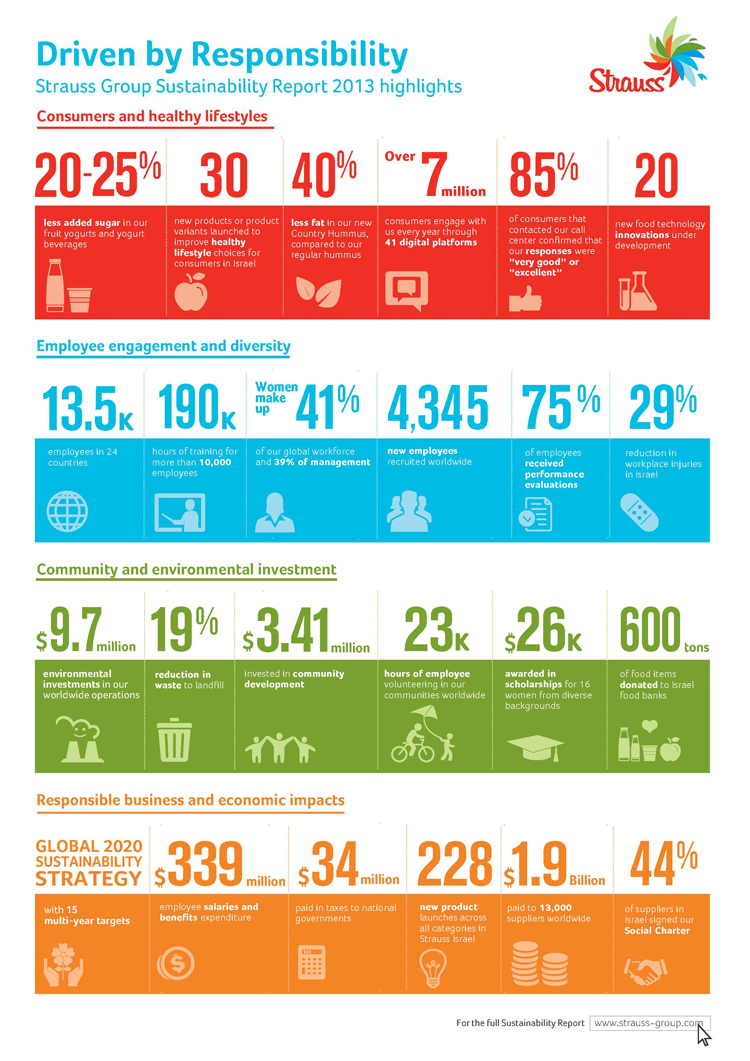
Sixth, the infographic. It's always good to get the report highlights all in one place. If you are a numbers person, this is the page for you.


7th, is the fact that it's the 7th. Delivering a sustainability report year after year is no easy task. Strauss Group is the only Israel-based company to date that has published  7 reports, year after year, since 2008, demonstrating not only a commitment to transparency and continuous improvement, but also a commitment to local leadership and best practice. 

For us at Beyond Business, supporting clients such as Strauss, as we do around the world, is a privilege and we are delighted to have been able to help create this 7th report. 

Oh and by the way, I should also mention that the number 7 is very relevant to the world of ice cream too. I happened to come across, in my search for all things 7, this announcement by Perry's Ice Cream of 7 new flavors for 2014.  They all sound delicious. As 2014 is nearly over, I had better start tasting.....


elaine cohen, CSR consultant, Sustainability Reporter, HR Professional, Ice Cream Addict. Author of Understanding G4: the Concise guide to Next Generation Sustainability Reporting  AND  Sustainability Reporting for SMEs: Competitive Advantage Through Transparency AND CSR for HR: A necessary partnership for advancing responsible business practices . Contact me via www.twitter.com/elainecohen   or via my business website www.b-yond.biz   (Beyond Business Ltd, an inspired CSR consulting and Sustainability Reporting firm)

Friday, July 27, 2012

Sustainability: What the Numbers Tell You

Sustainability is not only about numbers. When all is said and done, sustainability is about people, community, society, collective responsibility and action, stories and interventions. But, sometimes, the numbers form a picture, and pictures can help us develop new insights and change our paradigms. And this can lead to new action. So,  when the The Conference Board, a non-profit organization which creates and disseminates knowledge about management and the marketplace to help executives make the right strategic decisions,  published a deep-dive study - perhaps the most comprehensive study available - of Sustainability Practices of thousands of companies around the world, containing more numbers about Sustainability Practices than I suspect you have ever seen in one place, you have to sit up and take notice. Ready?

The study is called Sustainability Practices 2012 Edition and is a 176 page epic, containing more data than anyone can absorb in one sitting and a wealth of relevant information for anyone interested in sustainability numbers, trends, areas of focus by sector and by subject, and opportunities to make a difference. The report was prepared in collaboration with Bloomberg, who runs one of the most extensive real-time financial and non-financial information networks to hundreds of thousands of subscribers, and with the GRI - no introduction necessary.


Sustainability Practices 2012 Edition is based on a global sample of 3000 business organizations tracked by Bloomberg's Environmental, Social, and Governance (ESG) database and covers 72 environmental and social practices including: atmospheric emissions, water consumption, biodiversity policies, labor standards, human rights practices, and charitable and political contributions. For benchmarking purposes, Bloomberg ESG data is compared with the S&P 500 (large capitalization U.S. companies) and the Russell 1000 (market cap-weighted index of U.S. companies), and further analyzed across 11 business sectors, using the CIGS code, and four revenue groups (under $1 billion, $10 billion, $100 billion and over $100 billion). The findings of the report are split into three broad areas: Disclosure Practices, Environment Practices and Social Practices.

Now for the numbers. Sitting up and taking notice?

19%
This is the overall social and environmental disclosure rate for companies in the global Bloomberg ESG 3000 Index, which is made up of largely non-U.S. companies. Does that surprise you? Only 574 companies out of a total 3,000 disclose on the full spectrum of 72 sustainability practices analyzed. This compares with 15% in the S&P 500 and 10% in the Russell 1000, showing that U.S. companies are lagging when it comes to overall sustainability disclosure. Match this with the next number:

25%
This is the number of companies in the Bloomberg ESG 3000 Index which released Sustainability Reports - 747 companies. More companies are reporting than disclosing. What does that tell us? That Sustainability Reporting is not delivering full transparency. In other words, just because it's called a Sustainability Report doesn't mean that it's transparent. By comparison, in the U.S., 45%  of the S&P 500 and 24% of the Russell 1000 publish reports. However, these indices are smaller and include large-cap, often global, companies, headquartered in the U.S., versus the Bloomberg Index which includes only 510 U.S. companies, 17% of the total 3000 sample. Overall the Bloomberg 3000 is weighted towards Japanese companies who have 27% of the sample, and with strong representation from India, China and the UK, and a host of other countries.  So Sustainability Reporting is more widespread globally than it is in the U.S. But that's not news. Match this with this next number:

80%
This is the rate of Sustainability Reporting for companies with more than $100 billion in annual revenues. Not surprising, perhaps, that this is a high figure. The larger the company, the greater its impacts, the more extensive its resources, the greater its risk exposure, the higher the expectations from stakeholders. However, 20% of these mega-corps are still resisting the reporting opportunity. The rate of Sustainability Reporting drops to 63% for companies over $10 billion, 25% for companies below $10 billion and only 4% for companies below $1 billion. $1 billion is still a heck of a company size and has potential for some serious impact. Who is chasing the other 96%? Match this with this next number:

46%
This is the rate of companies in the telecommunications services sector which publish Sustainability Reports. This is the highest reporting sector in the Bloomberg 3000. Contrary to the long-held view (and data) that financial services companies and energy companies have been leading the fray in sustainability reporting, only 20% and 25% respectively in these two sectors are publishing reports at a global level.


 Great work by telcos. What's driving this industry's reporting prowess? Match that with this number:

48%
This is the rate of telcos which use the GRI guidelines to report. Again, this is the highest rate of all sectors, with an overall average being 30%, generally lower than the hype would suggest. Consumer Discretionary and Information Technology companies have the lowest uptake rate of the GRI guidelines, at 27%.  Again, we find that the highest revenue companies are more likely to use GRI guidelines (66% - 23 companies) versus the lowest revenue companies (10% - 109 companies). The picture in the telecommunications sector is both of high disclosure and high use of the GRI guidelines. Telcos also have the highest rate of report verification and assurance at 26% (versus an overall average of 13%).  Match that with this number:

24%
telcos. No wonder it's so expensive to connect.  But take a look at these numbers:

54% - 43%
The numbers of women employed in the workforce and the numbers of women in management in the telco sector. Hah! One of my favorite indicators.  Not so rosy in the IT sector, where women make up 13% of the workforce and only 9% of management. Across all sectors, the lowest revenue group of companies has the highest proportion of women in management - 24%. Telcos stand out for positive diversity in other respects too - with 26% disabled employees, and 7% of minorities in management. Apparently, if you are a disabled woman from a minority group,  you stand the best chances of advancing your career in a telco. If you are a man, the materials sector is for you. A median 86% of managers are male, and 85% of the total workforce. Match that with this number:

7%
This is the proportion of companies reporting employee fatalities in the Bloomberg 3000. Only 197 companies out of 3000 disclose this figure (even less in the U.S. large company Russell 1000, where only 36 companies disclose). The average rate of fatalities across all those companies reporting is 2, but the Information Technology Sector inflates this average with a total of 6 fatalities. Conclusion: don't go into IT if you value your life. Match that with this number:

59%
This is the proportion of companies that disclose their Health and Safety Policy. This includes 58% of Information Technology companies where six people died. Just think how things might improve if 100% of companies had a Health and Safety Policy. Would things get worse, or better? Match that with this number:

1,367
This is the average number of workforce accidents reported by the 12% (364) companies who disclose this information. I calculate this to be a total of  almost half a million accidents in this small sample. Only 5% of companies report how many lost workhours result from these accidents, reporting an average 56,111 lost hours across only 137 companies, but this is much higher than the average in large U.S. companies, which report an average of 36,121 hours (13 companies) in the Russell 1000. This might indicate that it is safer to work in the U.S.  Or that you have your accident, and get back to work pronto. Even so, the Russell 1000 indicates the lost-time equivalent of 18 employees per year per company that do not come to work as a result of an accident. Rather shocking, don't you think? The impact on families and communities of such safety issues can be quite significant. Match that with this number:

36%
This is the proportion of companies which disclose their charitable giving. I would have expected this number to be higher. Companies like to tell their good news. Match that with this number:

$161,522,597
This is the average community spending reported in the energy sector in the Bloomberg 3000. This is by far the highest rate of charitable giving, comparing with an average across all companies which disclosed of almost $28 million. The healthcare sector is the second largest giver with an average of $98 million reported by 47 companies. Industrial sector companies have not been bitten by the bug to this extent, apparently, with the giving average at a mere $10 million reported by 232 companies. Match that with this number:

$66,800,000
This is the median total corporate giving reported for 21 companies with in the highest revenue group - over $100 billion. If ya got it, share it. Seems to work for them. Companies with under $1 billion revenues give a median of $88,552. Yes, that's thousands, not millions. Match that with this number:

$1,000,353
This is the average utilities sector spend on political lobbying, more than double that of any other sector in this study. Overall, in the Bloomberg 3000, the average amount spent on lobbying is $226,065 per company (though only 14% of companies disclose this information). Interestingly, in the U.S. alone, the amount spent is three times that much. The politicization of business in the U.S. is quite some investment, it seems, if you are a utilities company. Wonder if it's worth it?

I am going to stop here for now, while I continue to study this report. You can read a great review of key findings and  broader conclusions of this report  in the Conference Board's Press Release. Or you can wait for my next post, as I will definitely have more to say about this in the coming week, after getting to the rest of the numbers that I have not looked at yet in detail. 

In the meantime, you might now like a little light relief, by watching the Sustainability Practices 2012 Edition authors, Matteo Tonello, Director of Corporate Leadership at the Conference Board and  Thomas Singer, Conference Board Research Associate, talk about the importance and relevance of this study and what this means. It's short and to the point and contains no numbers.


Thomas Singer rounds off with this perspective: "To a large extent, sustainability is about long-term risk management. It's about making sure that, if you are a company that is dependent on finite resources, you make sure that those resources are available, that they are clean and that you have access to them in the long haul. However there is a very important second part to sustainability which is ensuring innovation and new products, new markets. It is those companies that actually go beyond seeing sustainability as a risk strategy and more of an innovation strategy, those are the companies that really become sustainability leaders in the long term"

Final Tip: ice cream is a great remedy, if your eyes are getting a little fatigued from figures and percentages. Any flavor will do.

elaine cohen, CSR consultant, winning (CRRA'12) Sustainability Reporter, HR Professional, Ice Cream Addict. Author of CSR for HR: A necessary partnership for advancing responsible business practices Contact me via www.twitter.com/elainecohen   on Twitter or via my business website www.b-yond.biz  (Beyond Business Ltd, an inspired CSR consulting and Sustainability Reporting firm)

Friday, June 15, 2012

Dr Sustainability is at Rio+20!

Dr Sustainability is enjoying the sunshine in Rio, where the Big Event of the sustainability calendar is taking place - the 2012 United Nations Conference on Sustainable Development. She just gave me a call, offering to answer readers' questions about what's going on at this important event. Here are the questions that Dr. Sustainability received and, of course, her frank and unflappable answers:

Dear Dr. Sustainability: Do I need a visa to attend the Rio+ conference?
Dear Traveler: Not unless you plan on spending a lot of money. (think about it)

Dear Dr. Sustainability: Do you expect Rio+20 to result in concrete outcomes ?
Dear Construction Worker: The concrete outcomes have already been achieved. Four new hotels were built to house the Heads of State, Heads of Companies and Head Waiters at the Rio+20 event. That's a heckuvalotta concrete.

Dear Dr. Sustainability: Will the world become more sustainable after Rio+20?
Dear Naive: Yes. Of course. Why else would they go to all this trouble?

Dear Dr Sustainability: I hear that the sustainability reporting agenda is a key negotiating point at Rio+20. Will there be a commitment by governments to mandatory reporting by all companies everywhere, as Teresa Fogelberg hopes to see?
Dear Reporter: Yes, there will. It will probably be worded something like this: "We, the governments of the enlightened world, believe that sustainability reporting has value and we would like to require incentivize recommend promote encourage suggest beg plead with companies around the globe to include think about including sustainability disclosures in their annual corporate reporting to all stakeholders."

Dear Dr Sustainability: There are some that say it would be much easier if we gave up on cooperation and watched the planet burn. I read that in a post on Treehugger. What's your view on that? Have you heard anyone suggesting we should give up on Rio+20?
Dear Firecracker: Well, everyone that I have met here believes this is a very important conference and that the momentum is building to have a coherent discussion on the future of our planet. Of course, we have been having coherent discussions for quite some time now. Momentum is a great thing, but sooner or later, it has to result in something. Otherwise, instead of sustainability, we just get momentum.

Dear Dr. Sustainability: I understand the theme of Rio+20 is called "The Future we Want". Is it all about the future? What about the present?
Dear Nitpicker: Yes, Rio+20 is focused on commitments to future action. The future starts in the present. The problem is, the future was yesterday and there are some who are getting impatient. By the time it's tomorrow, the future will already be the past and then it will be too late for collaboration. In the meantime, which I think is the present, it is probably fair to say that the future is at least as important as the past and Rio+20 needs to deliver a decisive commitment so that the past of our future will be more sustainable than the future of our past, which is now. It makes a lot of sense when you stop to think about it. Now. In the present. Before the future.

Dear Dr. Sustainability: How many people are there at Rio+20? Are they all tweeting?
Dear Tweet: There are about 50,000 people here. About 25 are tweeting at #Rio20. A few more are live-blogging. About 49,800 are networking. The rest are walking out of the negotiations.

Dear Dr. Sustainability: I have heard that the developing nations want the developed nations to pay them to be sustainable. Do you think that will work?
Dear Money-Grabber: This is technically not correct. The Developing Economies want the Developed Economies to invest money to help them do their part in creating the Future the Developed Economies Want. The Developed Economies want a future in which the Developing Economies will not interfere. In other words, they want the Developing Economies to stay Developing. But it's more complex than that. The Developing Economies want to become Developed. They want to add to the mess that the Developed Economies got us all into. They want the Developed Economies to invest in them not making a bigger mess. The Developed Economies say: He who createth the bigger mess must footeth the bigger bill. In classical literature, this is called a lose-lose situation. In business, it's called unsustainable development.

Dear Dr. Sustainability: I read that a recent poll by Globescan showed that nearly eight in ten (78%) sustainability experts believe the current economic system must be substantially overhauled and a similar percentage (77%) say that major catastrophes will need to occur before governments will act on sustainability. Are you one of the 78% of sustainability experts?
Dear Wiseguy: I did not participate in the poll. It must have gone into my spam. However, I concur with the fact that the current economic system must be overhauled. Where I am undecided is exactly what it must be hauled over. Over the heads of Prime Ministers and Presidents, I suppose. I agree about major catastrophes. A good catastrophe is always a catalyst for action. Hurray for catastrophes. What would we do without them? Apart from save on Xanax expenses. 

Dear Dr. Sustainability: After Rio+20, will I be able to sleep any easier at night ?
Dear Insomniac: Oh sure. If you destroy your neighbors' kids BoomBox. But more importantly, your great-great grandchildren will be able to sleep a  lot too. In fact, the planet will be so sustainable, they'll be bored out of their minds.


elaine cohen, CSR consultant, winning (CRRA'12) Sustainability Reporter, HR Professional, Ice Cream Addict. Author of CSR for HR: A necessary partnership for advancing responsible business practices Contact me via www.twitter.com/elainecohen   on Twitter or via my business website www.b-yond.biz  (Beyond Business Ltd, an inspired CSR consulting and Sustainability Reporting firm)

Wednesday, April 25, 2012

Thank you for voting!

I am delighted that Beyond Business Ltd, my consulting company, has won first place in the Best SME Report in the CRRA '12 Reporting Awards :)

This is what report viewers said about the Beyond Business report:

“They know their stuff. They know what they have achieved. Material aspects are included. It is an honest report. They tell what they haven't achieved (although the organization is small and hardly anybody would hold them accountable for any failures). The content makes the readers believe in the organization.”
NGO & Charity, Germany

“It is clear that a lot of effort went into producing this report alongside a heavy workload. The content and style is original and engaging.”
CSR Consultant, UK

“Corporate reports are mostly self-serving. But here comes a company that's started small but thinks big by sharing its ideas which could have been kept for private profit.”
Corporate CSR Professional, Philippines

There is also a really nice comment on the report page on the CorporporateRegister.com website, from "chenying":

"This is really the most interesting CSR report I have ever read up until now. I laughed while reading. It is full of jokes; it easily gets the message across and remains professional. It is such a pleasure to read it. The "Quick facts" is well done! The "Case Study" offers concrete examples. Though it looks quite lengthy but I didn´t feel it. It is very informative. If I were a potential client, you´ve won me!"

This captures the essence of what we were trying to do with this report - deliver a professional document while making it easy to read and a little fun. That's how sustainability should be!

The Beyond Business report also achieved fourth place in the Best First Time Report category and eighth place in the Creativity in Communications Category . We are proud to have delivered a winning report !! And this is the time to thank each and every one of the CRRA '12 voters who nudged our report into first place. Admittedly, this was the smallest category with only five reports in total, but overall, the category got more votes per report than any other category.

THANK YOU EVERYONE!!!

We believe that any business, no matter how small, can report and can gain benefit from reporting. We also believe that it is important for sustainability consultants to issue reports as a way of demonstrating our personal commitment to sustainability and showing clients that we know how to do it as least as well or better than other firms. "Practice what your preach" goes the old adage. We practice a lot and we preach a lot. And what's more, it's good for business.

Congrats also to the runners up in the SME category, Banarra from Australia and Guelph Hydro Inc from Canada, both of whom delivered great reports.

elaine cohen, CSR consultant, Sustainability Reporter, HR Professional, Ice Cream Addict. Author of CSR for HR: A necessary partnership for advancing responsible business practices . Contact me via www.twitter.com/elainecohen   on Twitter or via my business website www.b-yond.biz/en  (BeyondBusiness, an inspired CSR consulting and Sustainability Reporting firm)

Saturday, March 3, 2012

Transparency is an asset

Transparency is an asset. That's what we believe here at Beyond Business and at the CSR-Reporting Blog. That's why, back in 2009, we developed the Transparency Index of leading publicly traded companies, analyzing the quality of sustainability transparency on their corporate websites. In 2009, 2010 and 2011, we analyzed the top 100 companies in our home market, Israel. However, the Transparency Index is a globally applicable index, which is equally valid for all companies in all sectors, providing complete comparability on what matters equally as much as what companies are doing to advance their own sustainability and that of the planet: how effectively their corporate websites make this information available and accessible to their local and global stakeholders. Therefore, in 2011, we formed a partnership with the Center for CSR Development in Ukraine, and, after updating the methodology to include some modifications reflecting our experience of performing the analyses over several years, we have started to analyze the leading companies in several additional countries around the globe. We are on our way to developing the first truly Global Transparency Index.

In 2011, we published The Transparency Index for the largest publicly traded companies in South Africa and in the UK. This year, 2012, after slightly modifying the methodology to reflect an improved balance of the Transparency Index four dimensions (reporting, content, navigation, accessibility), we have published a Transparency Index for the largest publicly traded companies in two countries: Denmark and the U.S.

In Denmark, Novo Nordisk takes the trophy with a leading 92% transparency, reflecting top level reporting on sustainability issues and great performance in the other three transparency dimensions on the Novo Nordisk website.  A Twitter stream, with a clearly explained policy, video content and even sustainability games in business ethics, climate change and economics and health. Novo Nordisk is way ahead of the average transparency of the top 25 companies in Denmark which ranks at 57.3%.

Here is how the top ten in Denmark looks:


In the U.S. our findings are that companies are a little more transparent. Average transparency for the top 25 in the U.S. is 69% . Intel takes the trophy here with 91.5% transparency, reflecting sustainability reporting, a highly informative sustainability website, video content, a great  CSR at Intel blog , a report builder and an online feedback form.

Here is the top ten in the U.S.:


The full methodology is transparently (!) described in each report.

While it is true that transparency is only half the picture - it's an important half of the picture. Transparency does not substitute for good performance, but it is necessary as a tool to inform about performance. Transparency is a public statement of commitment to sustainability, encapsulating both a declaration and a promise, a demonstration of serious intent and most importantly, an invitation to stakeholders to read, review and react. As the world embraces digital formats and interactions,  web-based sustainability transparency has an important place in the shaping of sustainability practices.

Watch this space for more countries  to follow in the Global Transparency Index  (and for news of the launch of our new GTI website) and for further analyses as the more countries are added to the mix.


elaine cohen, CSR consultant, Sustainability Reporter, HR Professional, Ice Cream Addict. Author of CSR for HR: A necessary partnership for advancing responsible business practices  Contact me via www.twitter.com/elainecohen   on Twitter or via my business website www.b-yond.biz/en  (Beyond Business, an inspired CSR consulting and Sustainability Reporting firm)

Friday, December 9, 2011

Sustainability for Breakfast

This morning, we had the pleasure and privilege of hosting the Deputy CEO of the GRI, Teresa Fogelberg, in Tel Aviv. It is a rare treat to have someone of such stature come and share insights and experience with a group of local CSR practitioners. Today, over breakfast, that's what happened.

Sustainability for Breakfast in Tel Aviv
The meeting was hosted by the Embassy of the Netherlands in Israel, at the initiative of the Head of the Economic Section, Wendela Haringhuizen. The Embassy is no stranger to sustainability and has held several local conferences in recent years to raise awareness for sustainability issues such as green building, water conservation, waste and air quality, introducing Dutch technologies and offering practical advice. In general, the Government of the Netherlands is one of the more progressive on sustainability matters, as one might expect of the host government to the Global Reporting Initiative, based in Amsterdam. One interesting practice of the Netherlands Ministry of Economic Affairs, Agriculture and Innovation is the Transparency Benchmark, which analyzes in detail the quality of Dutch Sustainability Reports and awards prizes for the best quality reports.

Wendela Haringhuizen opens the meeting in the spirit of Netherlands' Sustainability
Following Wendela's welcoming remarks, and overview of the Embassy activities in Israel, I gave a review of the state of sustainability reporting in Israel. While reporting is always positive, and we should acknowledge some progress in recent years, the fact remains that only 25 reports were published by 23 companies during 2010-2011 in Israel. This is a very low count, given the size and state of development of our market. The reporting companies include local subsidiaries of global companies such as Motorola and Intel, large Israeli global companies such as Teva Pharmaceuticals, Delta Galil, Strauss Group and Elbit Systems, as well as local companies such as the leading banks and telecoms companies.

Of these 25 reports published, 14 were in accordance with the GRI Framework (with three being externally verified), all at Level A or B, demonstrating a certain competitiveness among local players who, it seems, perceive a higher GRI Application Level to be more important than the quality of the report itself. When analyzing the quality of the reports, we found wide variations. We analyzed section by section the disclosures against GRI-based performance indicators and without exception, found that there were serious omissions in the way companies reported on indicators they had declared to have fully reported against. For example, EC1 is the most reported economic performance indicator of all the Israeli GRI-based reports.


However, when drilling down to look at exactly how companies had reported on EC1, we found a different picture - i.e. that one company hadn't reported it at all, and four companies disclosed only partially. So, out of 13 reports declaring this indicator as fully reported - only nine (69%) made the grade.


Another interesting insight was the use of the famous N/A. How many indicators are truly Not Applicable to companies? One of the GRI-based B-level reports we examined noted in their GRI Index that 49 (out of a total 79 performance indicators) were not applicable. This included indicators such as EC7 - procedures for local hiring and LA7 - rates of injury and absenteeism. The company may not wish to disclose against these indicators, but stating that they are Not Applicable detracts from the report's credibility.

Concluding this presentation with the acknowledgement that sustainability reporting in Israel is both weak in quantity and patchy in quality, we recognized the massive opportunity that this represents for Israeli companies (gotta stay optimistic, right?).

This led nicely into the presentation of Teresa Fogelberg.
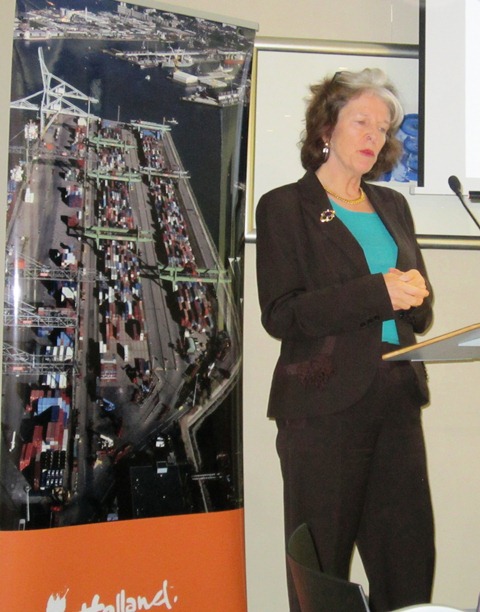
Teresa Fogelberg explains the global imperative of sustainability reporting
Teresa focused on the global imperative of sustainability reporting and talked about the advances being made all around the world to incorporate reporting into regulation, such as in the case of Denmark, where the Report or Explain approach appears to have had significant results. The Report on CSR and Reporting in Denmark which summarizes the Impact of the second year subject to the legal requirements for reporting on CSR in the Danish Financial Statements Act  informs us that 87% of the top 1,100 Danish companies now report, and that: "There has been a significant improvement in the businesses’ ability to translate policies into actions and to describe the achieved results. In the 2010 financial statements, more businesses report on policies at 71% (69%); on actions at 66% (60%); and on achieved results at 49% (37%)." Teresa also quoted additional studies which prove the value of mandatory reporting. But even without regulation, the reporting climate has changed, moving from "why should you produce a report?" to "why are you not producing a report?".


Finally, Teresa didn't fail to issue a wake-up call to the Israeli business community by reminding us that, of the 34 countries analyzed by the recent KPMG International Survey of Corporate Responsibility Reporting Report, Israel was at the bottom of the list. (and when you are at the bottom, the only way to go is up, right ?)

You can download Teresa's full presentation HERE.

Eli Abramov, CEO of Baran Group, committed to transparency
Finally, Elhanan (Eli) Abramov, the CEO of Baran Group, one of Israel's few pioneering GRI-based Sustainability Reporting companies, provided his perspectives on how, as a CEO, he understands the value of sustainability practice and of transparency in business. In particular, Eli reinforced the necessity of personal leadership in sustainability issues and confirmed that: "Reporting is a participatory and interactive management process which teaches us much about ourselves and the way we do business, and reinforces the accountability of all Baran employees."

You can download Eli's full presentation HERE.

Finally, we were delighted to be joined by H.E. Mr. Caspar Veldkamp, Ambassador of the Kingdom of the Netherlands in Israel.

L>R:
Wendela Haringhuizen, Sohail Wahedi , Ambassador Veldkamp, Teresa Fogelberg, Elaine Cohen
To round off the morning, taking us from breakfast to lunch, we continued our discussion in the comme il faut restaurant in Tel Aviv port, housed in the newly reconstructed Bait Banamal, the socially-responsible, alternative consumerism, pro-women hub of creativity, inspiration and pretty good food!

Sustainability for Lunch
Participants at our morning conference included representatives from a wide range of companies including Teva Pharmaceuticals, Ormat Technologies, Israel Chemicals, Alon Holdings, Microsoft R&D in Israel, Intel Israel, Motorola Israel, Amdocs, Bank Leumi and more.

All in all, a worthwhile morning. I hope that Teresa comes back soon, as she threw down a challenge to Israeli business that by the time she returns, we should have triple the number of reports in Israel.


elaine cohen, CSR consultant, Sustainability Reporter, HR Professional, Ice Cream Addict. Author of CSR for HR: A necessary partnership for advancing responsible business practices Contact me via www.twitter.com/elainecohen  on Twitter or via my business website www.b-yond.biz/en  (BeyondBusiness, an inspired CSR consulting and Sustainability Reporting firm)
Related Posts with Thumbnails