Showing posts with label IIRC. Show all posts

Friday, April 1, 2016

Common principles of materiality: April Fool!!!!

So, apologies for a few weeks of radio silence on the CSR Reporting Blog... sometimes that little thing called life just takes over .... but this April Fool's Day joke was too good to miss. It's the publication of the Statement of Common Principles of Materiality of the Corporate Reporting Dialogue in March 2016 which I just noticed yesterday via a Facebook post from eRevalue. 

The Corporate Reporting Dialogue is the consortium of the biggies or wannabe biggies in corporate disclosure:
  • CDP
  • Climate Disclosure Standards Board
  • Global Reporting Initiative
  • International Accounting Standards Board
  • International Integrated Reporting Council
  • International Organization for Standardization
  • Sustainability Accounting Standards Board 
It was established in June 2014 as "an initiative designed to respond to market calls for greater coherence, consistency and comparability between corporate reporting frameworks, standards and related requirements".

So, after almost two years of dialogue, where, we might be inclined to ask, is the greater coherence, consistency and comparability? Aside from more and more connections and linkages and principles and frameworks and standards and indicators and pseudo-dialogue... there is little evidence of coherence, consistency and comparability.. on the contrary, there is more evidence of three different c's: confusion, complexity and conflict. And just to make life fun, yet another document on materiality that looks like more of an April Fool's Day joke than an intelligent response to the needs of reporters and their stakeholder communities appears proudly on our screens. 

The document is billed as responding to "market demand" in "clarifying reporting concepts". It starts with a full page introduction to Materiality... which, when boiled down into a couple of sentences, essentially tells us what we already know: what's material is different depending on who you are talking to, and, what is only a bit material now maybe a lot material in the future. Therefore, no-one has a "one-size fits-all" (sic.) definition of materiality but there is a "foundational principle" which is: "material information is any information which is reasonably capable of making a difference to the conclusions reasonable stakeholders may draw when reviewing the related information."

Note here that the reference is to "reasonable" stakeholders. Later this is explained as excluding from the reporting focus a "single or atypical stakeholder or one who is behaving unreasonably or irrationally". I wonder what this means? I know all stakeholders weren't created equal, but surely there is some element of stakeholder inclusion that suggests that by definition, a stakeholder (group or individual)  is affected by and affects the business of a corporation and therefore has the right to hear and be heard? Who judges what behavior is unreasonable or irrational enough to merit exclusion from the playing ground? GRI's definition of stakeholders does not exclude unreasonable or irrational stakeholders:

So, apart from the fact that companies are encouraged to play nice with nice stakeholders, there's nothing new in this introduction and it kinda reinforces what most of us have already known for a long time - that materiality without due process is subjective, self-serving and manipulable and no-one really wants the inconvenience of proving otherwise.  This document makes no reference to the process by which materiality is determined... only what materiality is or should be. As fundamental as materiality is to all things sustainable and reporting, we might have expected that the most invested minds in reporting thought-leadership today might have been able to come up with something more substantive.

Moving quickly onto the document's presentation of the principles. Oops. No principles... just (another) Introduction, Concepts and Application.

Six concepts are presented. I can distill five of them down to the following from the mumbo-jumbo technobabble of this coherent, consistent and comparable (not) document:
  • Report materiality to your most important stakeholders (only) and assume they understand
  • Leave out stuff which is not material
  • Every company will have to decide how much detail to add in or leave out
  • It's OK to include stuff which is not material, as long as it doesn't hide what's material
  • Materiality is relative - depends on the context
  • Even if a new standard defines something as material, if the reporting company's stakeholders don't think its material, it's OK to ignore it 
I challenge you to read the six concepts in full original technobabble and see if you can distill them down to even fewer words, or even, identify anything ANYTHING that is remotely different, new, enlightening or helpful in all of this.

Then there's the application. There are five points of guidance which I have distilled down into English:
  • Materiality requires qualitative judgment, but if it's law, the law prevails
  • Managers decide what's material but should take primary stakeholder (investor) input into account  
  • Relevance of materiality changes over time, so if you've said it once, you can probably ease off in the future
  • If you are making estimates when reporting material impacts, take into account the views of your reasonable stakeholders
  • When disclosing material information, if you can't measure it, it doesn't count 
Then there are 4 pages of comparison of materiality definitions and approaches by Corporate Reporting Dialogue participants - a sort of copy-paste-plus of what's already out there.

So, I am wondering, apart from wanting us to have a laugh on April Fool's Day, what earthly purpose does this document fulfil and what are corporate reporters supposed to do with it? More importantly, if it takes two years of meetings, lunches and open dialogue to deliver this, frankly I think everyone should go back to their own corner and campaign for fragmentation, differentiation and splendid isolation. Unless the lunches are unbeatable.


elaine cohen, CSR consultant, Sustainability Reporter, HR Professional, Ice Cream Addict. Author of Understanding G4: the Concise Guide to Next Generation Sustainability Reporting  AND  Sustainability Reporting for SMEs: Competitive Advantage Through Transparency AND CSR for HR: A necessary partnership for advancing responsible business practices . Contact me via Twitter (@elainecohen)  or via my business website www.b-yond.biz   (Beyond Business Ltd, an inspired CSR consulting and Sustainability Reporting firm).  Need help writing your first / next Sustainability Report? Contact elaine: info@b-yond.biz  

Thursday, July 3, 2014

GRI: the standard setter

It may have skimmed under your radar, but GRI is proposing what could be one of the most significant changes in the history of the organization. No, it's not G5. Yet. It's the way we use the GRI guidelines. That means, instead of the GRI framework being a set of guidance documents, it could become a formal standard. GRI is setting itself up to be recognized as a "public reporting standard setter". Doing so, it is proposed, will involve a complete overhaul of GRI's governance structures, and include new things like a firewall, an IAC, a DPOC, an SRSB, and wow, total transparency. As with all GRI big-news changes, there is a Public Comment Period. We are asked to read a 12 page explanatory document, and four other documents that contain the terms of reference for the new governance bodies and due process. I just did all of that, and it took me quite a long time to trawl through the usual GRI techno-babble and actually understand what's being proposed, how it will work and what it means for me, a teeny-weeny stakeholder.  

In plain English, then, this is how I see it. It's time for GRI to take control of the dissonance that is caused when, on the one hand, the GRI framework is clearly the leading framework for sustainability reporting, but on the other hand, GRI no longer shows up as the sole leading voice in sustainability disclosure. Events of the past couple of years have catapulted other organizations into leadership discourse for sustainability disclosure and they have claims to fame that go beyond diverse multi-stakeholder backing. With the IIRC having the clout of the world's money, and SASB having the backbone of an official certified standards body (ANSI) and two new financial powerhouses at its helm,  the UNGC having Ban Ki Moon and Co, and even CDP claiming the support of $92 trillion in assets represented by institutional investors, GRI's voice risks getting lost in the cacophony. What could change that? Officialdom. Become a standard, not a framework. In order to do this, GRI needs to get itself ready for standardness. This means removing potential areas for organizational conflict of interest, institutionalizing due process in everything that affects the way standards are set, ensuring funding is correctly appropriated and ultimately, shattering any potential glimmer or doubt that GRI Sustainability Reporting Standards might not be created with integrity, relevant consultation and in order to serve the Public Interest. 

Perhaps being a recognized standard setter will put GRI on a better footing as it participates with other recognized standard setters in yet another fuzzy initiative to get people talking to each other, called the Corporate Reporting Dialogue, launched this month by the IIRC. Its aims are more-of-the-same more-of-the-lame communicate zzzzzzzzzz, identify ways to improve zzzzzzzzzzzz and share information zzzzsnorezzzzzz. You couldn't give a new collaborative initiative less teeth if you were a dental technician who ran out of bridges. Come on folks, ever heard of a SMART target? Will the CRD actually help achieve alignment and convergence of reporting frameworks and standards?  Or is this another nail in the coffin of complemetarity dressed up as good intentions? But membership of the club apparently requires being standardful. 

  
In its new proposals, the GRI Board states its objectives as:
  • To ensure that GRI is globally accepted as a public reporting standard setter in all relevant forums. 
  • To demonstrate that GRI meets all the requirements and responsibilities expected of a publicly referenced standard setter.
So what are the proposed measures? In a nutshell, the key features:
  • Separation of standard setting activities (formerly overseen by the Technical Advisory Committee) and all other activities in the organization (that will continue to be run by the Secretariat), resulting into two distinct organizational pillars.
  • A new Sustainability Reporting Standards Board (SRSB), a Due Process Oversight Committee (DPOC), and an Independent Appointments Committee (IAC).
  • The establishment of an independent public funding base for standard setting activities.
  • Transparency of all standard development processes including open SRSB meetings, published protocols and an annual report to the general public on progress made. 
This is how the new structure will look:


Is this a good thing? Do we want a sort of ISO G4? Is G4 tight enough to become a standard? And what do the implications of being a standard setter mean for companies using the framework? Will the new output of the proposed GRI Sustainability Reporting Standards Board (SRSB) be certifiable standards? The public comment we are asked to provide doesn't relate to any of these questions, it ask us only if we think the measures proposed will help GRI strengthen its reputation and voice as a "recognized standard setter". 

My response to the question in the Public comment questionnaire: "Does the proposed governance structure meet the criteria you / your organization/government would expect a public reporting standard setter to apply? was as follows: 

"I am no expert in standards and what is required of standard setters. However, I would have thought that a standard is only as good as adherence to it. This structural proposal does not refer to the measures that will be undertaken as part of the establishment of the GRI Framework as a standard to ensure greater quality in adherence to the standard. While GRI has had great success in disseminating and encouraging the use of the Sustainability Reporting framework, it has always completely disregarded the way it is used. As such, there has been a great framework but its use has often been abused for different reasons. I see nothing in these proposals that suggest anything will be different in the future".

So, apart from having three great new acronyms to add to my list, SRSB, DPOC and IAC, to help me mystify my clients so they will think I am really intelligent, I am a little ambivalent about whether this structural change is going to help us get higher quality sustainability disclosure. However, if it helps keep GRI at the table, recognizing GRI's de facto leadership in sustainability disclosure today, even if the perception is clouded by bells and whistles in a competitive landscape, it may have some advantage. 

The public consultation period is open through July 9, 2014. Links here to all you need to have your say:

All the documents that form part of the proposal: GRI website page
The position paper: "Intended changes to GRI’s governance in order to achieve its role as a standard setter in sustainability reporting, and its suitability for official reference in public policy."
Questions asked in the consultation platform: Questions document
Comments: Consultation Platform


elaine cohen, CSR consultant, Sustainability Reporter, HR Professional, Ice Cream Addict. Author of Understanding G4: the Concise guide to Next Generation Sustainability Reporting  AND  Sustainability Reporting for SMEs: Competitive Advantage Through Transparency AND CSR for HR: A necessary partnership for advancing responsible business practices . Contact me via www.twitter.com/elainecohen   or via my business website www.b-yond.biz   (Beyond Business Ltd, an inspired CSR consulting and Sustainability Reporting firm


Tuesday, January 21, 2014

GRI vs IIRC vs SASB: Round Nine. All lose.

We are witnessing a leadership battle for ownership of sustainability transparency and it's not a good thing. Instead of playing to everyone's strengths, we are risking moving the needle back to only one strength. The state of everyone's bank account. The battle is being played out on the respective turfs of the IIRC, SASB and the GRI, where IIRC and SASB are focused on what investors want to know in order to make more money and GRI is focused on what companies are doing to the world that makes it more or less sustainable. If I were a publicly listed corporation, I would probably find myself rather confused, amused or bemused.

Creating a harmonized corporate transparency pathway which enables consistent and non-overlapping disclosure frameworks does not need to be a lost cause, although it looks that way at present. Even the definition of a core concept such as materiality is not consistent across these three leading organizations, as explained eloquently by Dunstan Alliston-Hope and Guy Morgan of BSR in a great article to which I have referred in the past.

As I was considering this fascinating state of affairs, I noticed that a few other accomplished experts have also discussed what Dwayne Baraka calls the disconnect in ESG reporting. In an article which outlines the strengths and weaknesses of the IIRC, SASB and GRI frameworks, Dwayne concludes that "each of the approaches will add something to various types of investors, and dialogue might increase, but companies and investors need to be involved if CEOs and responsible investors are to have a meeting of minds on the state of ESG reporting." Another article, by Cornis van der Lugt, an independent consultant and researcher with a sharp mind, was published back in May 2013, just after G4 was revealed, entitled "Time to align forces". This was his first message of caution: "Used in combination, IR1 [Integrated Reporting Framework version 1] and G4 can have significant impact on measurement and disclosure by companies world-wide. Yet used non-aligned, and perceived to be competing, years of work on non-financial reporting and corporate sustainability may be lost."  Cornis goes on to present a fabulous evaluation of the IIRC and G4 frameworks and even offers his updated comparative analysis of both freely to all those who are interested. 

However, even before the pronouncements on the state of affairs post-G4, the chronology of this leadership battle for corporate sustainability transparency was already apparent. These are my observations from afar and some, possibly irreverent and highly subjective assumptions about what's been going on. 

Integrated Reporting is in the air. The May 2010 GRI conference ended up with CEO Ernst Ligteringen making a bold if not rather surprising declaration to 1,200 participants from over 70 countries. Two goals for the GRI.

(1) By 2015, all large and medium-size companies in OECD countries and large emerging economies should be required to report on their Environmental, Social and Governance (ESG) performance and, if they do not do so, to explain why.
(2) By 2020, there should be a generally accepted and applied international standard which will effectively integrate financial and ESG reporting by all organizations.

This second element, the surprising one, was clearly an expectation that GRI would become an integral part of the fabric of anything the IIRC would eventually come up with. It was also a clear expectation that it was going to take quite some time - ten years to develop an international standard for integrated reporting. 

This was the twilight period. Everyone was optimistic that we could have it all. Eventually.


There was a big buzz of excitement and anticipation when the IIRC was formed in 2010, called at the time the International Integrated Reporting Committee, with a lot of support from Prince Charles, who was moving full steam ahead with the Accounting for Sustainability Project at the time. IIRC (renamed in 2012 to Council rather than Committee) was chaired by Professor Mervyn E. King, the then Chair of GRI. Was this a conflict of interest? Apparently not at the time, when, to all onlookers, GRI and IIRC were completely full of themselves and of each other, and travelling along apparently parallel paths, euphorically optimistic that the solution to all the world's ills had been found in Integrated Reporting of the kind that would be jointly owned and nurtured by GRI with the IIRC filling in the gaps and making the connection to investors. 

Soon the landscape would look rather different. However, three GRI places were on the original steering committee and working group of IIRC, and the shared objective to create a globally accepted standard for accounting for sustainability was the glue that stuck everyone together. (Apart from money of course. Let's not forget that the original IIRC governance bodies were composed of 53 members of whom 31 (58%) represented financial services institutions or associations or the financial function of corporations in one way or another. Contrast this with the governance bodies of the Global Reporting Initiative which has always been a collection of elected representatives from corporations, NGOs, labor institutions, academic institutions, consulting firms and individual experts, representing all corners of the sustainability spectrum including human rights, environmental protection, labor standards, economic development and more. IIRC and SASB are squarely focusing on an investor audience and therefore target publicly traded companies, while GRI is focusing on any and all audiences, and therefore targets all organizations, including government agencies, SMEs, non-profits and trade associations who are not required to deliver Annual Reports, integrated or otherwise).  

The creation of IIRC was not entirely out of the blue. It followed the publication of the campaign book, One Report, by Eccles and Krusz, a heroic, if not a little rose-colored, effort to extol the benefits of integrated reporting, and the announcement of the South African Stock Exchange in June 2010, that listed companies would be required to deliver an integrated report if they wanted to stay listed, a coup-de-grace for non-reporting companies, masterminded by Mervyn King, the leading light in creating a pre-global South African Integrated Reporting Committee. The fact that King would ultimately find his home at the helm of the IIRC was probably not yet entirely predictable as, at this point, all seemed hunky-dory on the reporting horizon.  

In the GRI 2010-2011 Year in Review, the optimistic intertwining of IIRC and GRI is evident: "GRI’s Reporting Guidelines offer comprehensive and trusted guidance for sustainability reporting, and are an excellent tool for progressing towards integrated reports. GRI also aims for its Guidelines to be a provider of robust content for the forthcoming integrated reporting framework. GRI is present in the IIRC’s Secretariat and Committee, and in its content Working Groups and task forces."


Leaving the GRI to go dedicated at the IIRC, Mervyn King signals where he sees the future. Optimistic nevertheless that this is a shared future, GRI makes King an Honorary Chairman and says: "Professor Mervyn King has been an outstanding Chairman for the Global Reporting Initiative, pushing the sustainability reporting agenda forwards in pursuit of a sustainable global economy. GRI congratulates Professor King on his new appointment and as an active member of the International Integrated Reporting Committee the GRI is looking forward to continue to work closely with Professor King in the important endeavor of promoting the development of Integrated Reporting."  Nonetheless, this divorce, amicable though it may be, sends a message to the aspiring Integrated Reporters of the world: Investors are King. (No pun intended). The Chief Exec of GRI, Ernst Ligteringen, however, remains in the loop as a Board Member of IIRC with its reorganization in late 2011.

During the period up to the publication of the Integrated Reporting Framework in December 2013, IIRC is generating quick wins and momentum for integrated reporting. It gets the concept on the agenda at Rio, and a declaration (the famous Paragraph 47) which talks of "integrating" sustainability information in to the reporting cycle", publishes a draft integrated reporting framework for public comment and a consultation draft and establishes alliances and memorandums and a pilot program and more. Driving forward relentlessly, IIRC pretty well overlooks, it seems, a similar major reporting event which is taking place at the same time. The new-improved GRI Reporting Framework. 

Round Four:  Mid 2012 Enter SASB

In October 2012, the newly-formed full-of-promise Sustainability Accounting Standards Board put out a press release claiming that "SASB will be the U.S. voice for material non-financial issues and how to recognize and account for them as part of corporate reporting." With bold plans to create a Materiality Map and a series of sector-based standards that identify material non-financial issues that should be included in mandatory reporting by publicly traded companies, SASB starts to shake up the mix. Notably at this point, SASB maintains a distance both from GRI and from IIRC, carving a place for itself on the reporting landscape which will rather disturb the status quo and leave corporations even more challenged and possibly, amused, bemused or confused.

Round Five: February 2013 IIRC and GRI agree to agree

Just as both GRI and IIRC are developing their respective frameworks, an MOU is signed between the two organizations, declaring that both parties will proactively engage with each other by sharing information and striving for "complementarity" in their respective frameworks. Shame they didn't agree to agree on a definition of materiality. That would have been an MOU with teeth. Instead, GRI made some more tangible resource commitments to IIRC. IIRC made rather fewer to GRI.


Round Six : May 2013 GRI good news

May 2013 was alive with the sound of eager applause at the GRI conference in Amsterdam, hailing the new G4 as the superhero way forward for sustainability reporting, with a materiality focus, and a shorter, sharper, cleaner, quicker way to relevant corporate transparency. Although ditching comparability, the process-oriented G4 framework was seen by (almost) all as a massive improvement on previous GRI reporting framework iterations and would substantively change sustainability reporting for the better. Oops. Just one thing missing. Despite the stated objective of creating a sort of plug-and-play sustainability element which would fit snugly into integrated reports, by "offering guidance on how to link the sustainability reporting process to the preparation of an Integrated Report aligned with the guidance to be developed by the International Integrated Reporting Council (IIRC)" the G4 framework excluded all serious mention and reference to integrated reporting and all guidance relating to the process linkage. Why? Well, the IIRC was powering up full steam ahead with its own framework, and apparently didn't have the time to stop to think about how G4 could work to its advantage. Or it thought that G4 wouldn't work to its advantage. The official line was that the timelines for these two developments were different.  


In 2013, GRI also demonstrated an interest in the progress of integrated reporting and led a piece of research which examined the sustainability perspectives of existing integrated reporters and other experts. One of the key conclusions placed G4 squarely into the round integrated reporting peg, describing GRI as "a compass of sustainability" saying that "Some of them [reporters] want to see GRI hone key performance indicators specifically from the perspective of integrated reporters. Others appreciate how GRI ‘opens their eyes’ to the breadth of potential sustainability concerns for their business, and find the GRI reporting process a good reference point as they construct an integrated report. As one pioneer put it: ‘GRI guidelines helped us right from the start to answer the question: what does it take to be a sustainable company?’"

Round Seven:  December 2013 IIRC Framework Publication

Hot on the heels of the publication of the G4 Framework came the IIRC Framework, in December 2013, announcing that the framework marks "an important milestone in the market-led evolution of corporate reporting." The definition of the Integrated Report, in the framework is: "a concise communication about how an organization’s strategy, governance, performance and prospects, in the context of its external environment, lead to the creation of value over the short, medium and long term." And we are left in no doubt about who the Integrated Report is designed to communicate this to: "The primary purpose of an integrated report is to explain to providers of financial capital how an organization creates value over time. It therefore contains relevant information, both financial and other."   Conspicuous by its omission in the < IR > Framework is any mention whatsoever of GRI. The word "sustainability" appears only twice. There can be no mistake that Integrated Reporting is not about sustainability impacts. It's about helping investors make financial decisions. If it happens that a sustainability impact is so unquestioningly obviously financially material, then it will merit inclusion in the integrated thinking and writing of the Integrated Report. Regrettably, or otherwise, that may exclude most of what is included in sustainability reporting. 

The < IR > framework ignores GRI, MOU or otherwise. GRI believes that sustainability reporting is a prerequisite for integrated reporting but in fact, it's not. Because nowhere in GRI - or in G4 - is the link explicitly made between sustainability issues and business profitability or shareholder return. And nowhere in < IR > is the link explicitly made between sustainability impacts and financial outcomes. Perhaps it's time we stopped thinking of Integrated Reporting as an evolution of both Annual and Sustainability Reporting and accept that reality is different. Integrated Reporting plays an important role in filling in the gap between top line and bottom line, and ensuring that the value-creation radar screen is not too narrow. Sustainability Reporting plays an important role in ensuring companies account for their impacts on all stakeholders. These are two purposes, two roles and despite the existence of a compelling connection between the two, no organization has successfully delivered a framework which encompasses both in a substantive way. 


And still, the MOU game continues. This month saw the signing of an MOU between the IIRC and SASB "to more closely collaborate to advance the evolution of corporate disclosure and communicate value to investors...... Among other measures, SASB and the IIRC agree to strive for complementarity and compatibility in the ongoing development of their respective frameworks, guidelines and standards, and take proactive measures to share the work of the other organization." There's that complementarity thing again. If only we could save the world by signing MOUs and preaching complementarity, we would all be able to sit back and take a long rest by now.

Round Nine: Here we are. All Lose

So far, in eight rounds, no single framework has emerged a clear winner. Sustainability Reporting is firmly entrenched and G4 is looking promising with uptake starting to emerge. The token number, growing though it may be, of integrated reports, some of which are evidence of integrated thinking and some of which are evidence of little thinking, is unlikely to increase substantially unless we see that investors are not only demanding, but using, these wonderful new documents. SASB is a great concept and has made fabulous progress in practice, but we have yet to see the detailed SASB standards being widely applied in any sector. In short, the fragmentation and apparently competitive battle for sustainability transparency leadership has not yet favored any of the protagonists in an outright way, which might suggest that time and energies might be more productively used in working together rather than working apart.

Perhaps it is time that the leadership of the IIRC, GRI, SASB and even the UNGC - there's room in the corner - meet together at a Complementarity Retreat (no MOU necessary) and emerge with a set of agreed action items:

(1) Recognize that G4, < IR > Framework and SASB Standards CAN each deliver unique and equally valuable elements of corporate transparency and accountability.
(2) Harmonize the definition of sustainable business materiality and other key definitions across all frameworks.
(3) Agree that < IR > is the standard for Integrated Reporting and that, as such, it must include a reporting against a set of common core sustainability material issues relevant to all businesses with linkage to business outcomes and financials, with harmonized performance indicators and methodologies to measure these.
(4) Agree that G4 is the standard for sustainability reporting and that the material issues identified through the sustainability process must reference business outcomes, irrespective of where they occur in the value chain. Companies producing only one (integrated) report would be advised to include core material issues as identified in (3) above, and a set of sustainability material issues as required by G4.
(5) Agree that SASB have got the sector materiality process nailed, and encourage the adoption, with perhaps some adaptation for non-U.S. non-publicly traded entities, of SASB standards in integrated and sustainability reporting without duplicating all that's being done in separate processes.
(7) Agree to do things once and not three times, where reasonably possible.
(8) Agree to be inclusive and not competitive, while retaining focus, where reasonably possible. 
(6) Have a celebratory ice cream, and get to work. 


elaine cohen, CSR consultant, winning (CRRA'12) Sustainability Reporter, HR Professional, Ice Cream Addict. Author of Understanding G4: the Concise guide to Next Generation Sustainability Reporting  AND  Sustainability Reporting for SMEs: Competitive Advantage Through Transparency AND CSR for HR: A necessary partnership for advancing responsible business practices . Contact me at www.twitter.com/elainecohen   or via my business website www.b-yond.biz   (Beyond Business Ltd, an inspired CSR consulting and Sustainability Reporting firm)

Monday, December 9, 2013

A Crown among Reports

I am already getting excited about the third annual Smarter Sustainability Reporting Conference, which will take place in London on 25th February 2014. This year, we have a fabulous line-up of speakers and a great agenda addressing the critical issues influencing the Sustainability Reporting landscape, ranging from the emerging regulatory frameworks to the global versus local reporting, to reflecting material issues and more. There's going to be a BIG RUSH for places, so better book early :) (Contact me for a registration discount code.)

Each year, I try to engage with some of the key speakers prior to the conference, and also check out what they have been doing in the sustainability space. First up this year is Mark Gough. 

Mark is the Head of Sustainability at The Crown Estate, and is responsible for developing, delivering and driving innovative ways of embedding sustainability into the business. He is on the Natural Capital Committee (Landowners Group) and is a Sustainability Champion of the Scottish Public Sector Climate Leaders Forum (PSCLF). Previously he was the Global Environmental Manager at Reed Elsevier and has sat on a number of national and international sustainability committees, including the steering committee of the United Nations CEO Water Mandate, the Board of the Alliance for Water Stewardship and has chaired the publishing sector's Environmental Action Group.


The Crown Estate is a fascinating organization - not a typical publicly traded type of corporation. It is a diverse property business with a capital value of £8.6 billion, and a total property value of £8.1 billion. The property managed by the Crown Estate is owned by the Crown but is not the private property of the monarch. The Crown Estate is governed by an Act of Parliament and works supportively with government in Westminster, Scotland, Wales, Northern Ireland and at a local level. In 2012/13, a net surplus (profit) of £252.6 million went to the Treasury for the benefit of the nation.

The Crown Estate employs approximately 460 staff, at ten different locations throughout the United Kingdom. The Crown Estate is formally accredited as an Investor in People (IiP) - a national quality standard which sets the level of good practice for improving an organisation's performance through its people. IiP recognises an increased focus on training, employee involvement in the business and communications throughout the organisation.

In 2013, The Crown Estate published its first Integrated Report. Prior to that, the Crown Estate had already integrated much of its thinking about sustainable business in alignment with the concept of Total Contribution. The Crown Estate published a first Total Contribution Report for 2011/2012 together with a detailed methodology description. This seems to me to be a great kind of SROI type of approach which looks at impacts and outcomes, rather than just activities. I recommend you all take a look! Here are some of the key findings:


The 2013 Integrated Report of the Crown Estate is one of the most interesting I have come across. Everyone knows I have not been a fan of Integrated Reporting, mainly because I have felt it focuses too much on the financial stakeholders and leaves all the rest behind. This report by the Crown Estate is a little more accessible to the non-financial genius, and creates many links between sustainability aspects of performance and financial outcomes both for the company and for society.


The report contains a description of how The Crown Estate creates value and a list of 14 material issues described in some detail. For example, the material issue of Attracting Talent is described as follows, and the narrative and data supporting the defined issue is located later in the report.


The material issues include elements relating to business performance, organisation and people, environmental impacts and customer relationships and more.

By the way, the 2013 Integrated Report of The Crown Estate is shortlisted in this years online CRRA '14 awards, in the Integrated Reporting category, so it you take a look, and think it's great, please vote!

Here is my interview with Mark Gough, a key member of the team behind the report. 

Tell us about your professional background and how you came to be Head of Sustainability at The Crown Estate. 

I started out in sustainability, as many people do, by noticing something was not working and trying to fix it. I was doing some part time work for a publisher while looking for a change in career. At the end of the working day, there was a big pile of paper and no recycle bin, so I took it home. The next week I noticed that every desk had a big pile of paper on it, so I put them into a white sack and carried them home. The next week I came in and the police were waiting for me. Some computers had been stolen and when they had checked the CTV they saw me leaving the office with this big white sack. They did not arrest me as I explained I was recycling. But I was told ‘you are a temp, we are not interested, and stop doing it’! 

After that, with some other like-minded colleagues, we set up a Green Team and found recycling solutions that the company could implement and started helping to develop a sustainability strategy. I started going to night-school to learn more about it. I continued to work for the publishing company, moving up to advise the head office and then the global head office where I became Global Environmental Manager. I stayed there for 13 years, working on several other projects including with the UN on the CEO Water Mandate and chairing the publishing industry Environmental Action Group. 

What specific experience prepared you for this role? 

In terms of the property industry, specifically, we had a very big global estate in my previous role, so I had spent 13 years working on improving assets. The magazine I was working on at the beginning was a leading property magazine, so I was familiar with the key issues relating to sustainability in property. But, I don't think it's about the product that a company deals in that makes you a good or bad Head of Sustainability. It is about helping develop a strategic direction, being able to identify trends, risks and opportunities and helping the company to become successful long into the future. 

You were appointed in early 2012. What have been your priorities in the first 18 months in the job? And looking toward the next few years? 

The first thing we did was to rip up our previous sustainability strategy. We have since been working to develop one single business strategy that has sustainability at its heart. Sustainability should not be a bolt-on but at the centre of decision making and we are clear that by doing this we will be more successful. 

So what is our approach? To have only one strategy with sustainability at its heart, to develop the tools to embed sustainability into decision making and to pass responsibility for delivery to employees rather than committee and experts like me. We are very clear that our ambition should be to fully integrate sustainability by the time our ten year vision concludes. 

How does the unique position of the Crown Estate lend itself to the sustainability agenda? And where are the conflicts? 

The Crown Estate is unique. We are an independent property company set up under an Act of Parliament. We hold some great assets. We also have a very clear commercial mandate, so like many companies we have to make commercial returns. The way we do this though can be different. We take a long term approach, recognising that making a positive impact in all material areas of our business is fully aligned with our commercial ambitions. We are keen to ensure that we create greater opportunities, not less, for a shared future with our partner, customers and our broader stakeholders. We have been looking at how we can measure the broader value we create through a process we call Total Contribution and this is helping us to redefine our approach. We are not allowed to borrow money so this raises some interesting challenges and has meant that we have had to work collaboratively on joint ventures with partners who share our values. Also, helping people to understand that we have this commercial remit to return all of our net revenue to the Treasury each year is something we are continually trying to get across. Proving then that sustainability increases this revenue is really important. 

This year you delivered an integrated report. In what ways did the development of the integrated reporting movement influenced your thinking? What have been the benefits for you in this approach? 

It has been great to be able to share ideas and thoughts with other brave companies who are attempting to grapple with integrated reporting. Being part of the pilot programme, testing out some of the ideas and helping to contributing to the framework has been an essential to our success. We also have worked with an excellent design company (Radley Yeldar) and a critical friend (EY) to make the principles of IR relevant to us. 

What are the most significant challenges for you in the reporting process? How do you ensure all sustainability issues are reflected in a balanced way? 

In the past we focused on reflecting all sustainability issues in a balanced way, but this created a homogenized approach where everything has the same value, which is just not true. One of the most important steps we took through working on an integrated thinking approach was to focus on what is material. For example already 98% of our waste is diverted from landfill, a great sustainability result from lots of hard work, but this is not material to our business, so you will not find this in our annual integrated report. You can though go online and find out more about it. It is after all integrated reporting and not just an integrated report so it should run through all of the communications. 

Who do you expect to be the main audience for your integrated report? How do you ensure that your report gets noticed? 

Integrated Reporting was set up with investors as the main audience. We don’t have investors in the same way as other publicly traded companies, but it is important for us to explain our license to operate to all of our stakeholders. Integrated reporting is a much better way of doing this. Let’s face it, very few people actually read our sustainability reports. The best compliment we have had is "I really enjoyed reading your integrated report".

Thanks, Mark!

So, don't delay, sign up RIGHT NOW for the Smarter Sustainability Reporting conference and come and hear more from the Crown Estate and many more fascinating companies. 


elaine cohen, CSR consultant, winning (CRRA'12) Sustainability Reporter, HR Professional, Ice Cream Addict. Author of Understanding G4: the Concise guide to Next Generation Sustainability Reporting  AND  Sustainability Reporting for SMEs: Competitive Advantage Through Transparency AND CSR for HR: A necessary partnership for advancing responsible business practices . Contact me at www.twitter.com/elainecohen   or via my business website www.b-yond.biz   (Beyond Business Ltd, an inspired CSR consulting and Sustainability Reporting firm)

Monday, July 30, 2012

Is Integrated Reporting truly Integrated?

Right on the heels of the GRI G4 Exposure Draft, which rightly avoided getting into any discussion of Integrated Reporting, despite an original intent to create a seamless harmony between these two streams, it looks as though the GRI and the IIRC are having a bit of a language problem. That is, neither is speaking the same one. GRI is talking material impacts. IIRC is talking value creation.

The IIRC recently published a Draft Framework Outline  which is written, I think, in English. This follows the IIRC Discussion Paper which was published in September 2011 and elicited over 200 responses. A summary of the responses can be downloaded here, or you can do as I did, and take a look at all the individual responses submitted by people and organizations here (including mine here). It's worth taking a peek at these. They are very interesting. And sometimes rather amusing!

The purpose of the Integrated Reporting Draft Framework is to keep stakeholders informed. The Draft for Public Consultation will not be issued until 2013, with a Version 1.0 for implementation by end 2013.

The Integrated Reporting Draft Framework describes the elements that the Framework is expected to contain when it is actually a Framework and not a Draft. It has two parts: the concepts that are likely to be included in the Integrated Reporting approach,  and the expected elements contained in the route to preparing one.

The Draft framework refers to a "principles-based approach rather than focusing on specific KPIs or rules for measurement or disclosure of individual matters". While the IIRC threatens to issue KPI's or rules for disclosure (in GRI language: Performance Indicators and Profile Disclosures) at some future date, the emphasis is clearly on companies using their own judgment to sort out what's important and what to measure. In this way, the Draft Framework does have some similarity to the elective elements contained in the new G4 Exposure Draft which proposes a more rigorous process to define material issues and disclosures relating to those issues only.

Creating and Preserving Value is a key theme in Integrated Reporting. While one might argue that value is determined by considering all stakeholders, the focus on value rather than impacts moves Integrated Reporting further away from the accountability focus that has been, in my view, a pivotal factor in the development of sustainability reporting.  I think this positioning - value creation versus accountability - is one of the basic differences in perception between financial reporting and sustainability reporting.  The Draft Framework expects to include a definition of value, just to make it clear for everyone - and the implication is that by using the capitals system (see below), the definition of value will be broadened to include value for all stakeholders rather than purely financial value for shareholders. But what I am not sure about is whether there is a loophole that assumes you can create value without being accountable? If Integrated Reporting focuses on value creation, who focuses on accountability?  
 
The IIRC calls resources and relationships "capitals" of which there are six: financial, manufactured, human, intellectual, natural and social. I don't really identify with this. Why call them capitals when they are actually resources? Almost any definition of capital you look at makes the connection between capital and creating money. If all that the new approach to Integrated Reporting is doing is changing the words we use to refer to creating money, I am not sure we haven't lost the plot.

The Framework is likely to include a set of  guiding principles which should be used to prepare the report.
  • Strategic focus
  • Connectivity of information
  • Future orientation
  • Responsiveness and stakeholder inclusiveness
  • Conciseness, reliability and materiality.
These principles make sense, as I have said before. The aspects of connectivity and future orientation are often very lacking in our current forms of sustainability reports.

The Framework  is likely to prescribe six content elements relating to business model, operating context, strategic objectives, governance, performance, and future outlook. So far, so good. These are the elements that were introduced in the Discussion Paper that was published last year and seem to be the right sort of questions that a company should address.

To what extent this Draft Outline Framework actually moves us further down the track of Integrated Reporting. What exactly is integrated here?
 
Claudia Kruse writes on the IIRC Blog: "There is still much confusion about the distinction between sustainability reporting and integrated reporting. From an investors’ perspective it is absolutely critical that integrated reporting is positioned firmly within the realm of value creation and in a manner that speaks to the boards and financial (reporting) departments of companies". How integrated is that? I understand the need for investors to seek ESG information. I understand that the financial community is looking for another way to safeguard their cash. So what is this distinction that Claudia Kruse refers to? If all we are doing is moving from Financial Reporting to Value Reporting by adding in a few more ESG context-related content areas, then there is no new distinction. There will be Integrated Reporting and Sustainability Reporting. Just like now. Annual Reporting and Sustainability Reporting.

The state-owned energy Company from South Africa, Eskom, has delivered an Integrated Report which, for the first time, claims to align with the principles of the IIRC Discussion paper, stating,
"Eskom has combined sustainability and financial reporting for a number of years, but this is the first integrated report that aligns with the principles contained in discussion papers published by the International Integrated Report Council and the Integrated Reporting Committee of South Africa. Integrated reporting is a new international initiative that has emerged in response to the shortcomings of traditional reporting, which emphasises financial results without taking account of the broader context in which companies operate, and fails to weave together different reporting strands. Integrated reporting allows for reporting on financial results, governance, sustainability and other material factors in an interdependent manner. It addresses the challenges that companies face, the advantages they enjoy, the external factors that influence them and the way they in turn influence the external environment."

The report appears to present both financial and sustainability information in a comprehensive way. There is a degree of integration in the narrative of social and environmental context.  Eskom lists a set of material issues throughout the value chain. These are typically the sort of issues we might see in a Materiality Matrix of the type that many companies include in Sustainability Reports today. It is certainly a good thing to see this in an Integrated Report and Eskom has made a great pioneering attempt to present a full view of the organization in this 166 page report (of which around 60 pages are pure financials).  

Using Eskom as my test-case, I was interested to see how the principles of connectivity of information and future orientation are reflected in this report. I looked at the material issue Becoming a High Performance Organization which relates to safety as a key issue.  

25 people were killed in the course of duty in Eskom in 2011. The same number as 2010. Eight more people than in 2009. Despite declarations of the unacceptability of this safety record, and several programs in place to improve safety awareness, the fact remains that for three years, the situation has not improved, it has worsened. According to the new report, Sustainability Practices 2012 Edition, the average total annual fatalities in the Bloomberg 3000 for companies in the energy sector globally is 3. Eskom is about 8 times worse.

While Eskom expresses regret, and names the employees who died individually and sympathizes with the families, which shows respect and concern, as an investor, I would be interested to know a few more things:
  • What impact does this level of fatalities have on  business continuity?
  • What is the cost of this safety record (insurance premiums, employee morale, litigation, recruitment potential, work delays etc)?
  • What level of investment is required to improve employee practices?
  • What are the implications for creating and preserving value?  
In the context of future orientation, I would be interested to know more precisely what Eskom will be doing differently to prevent 25 more people being killed in 2012. Eskom describes activities and general frameworks relating to safety management, but a very detailed action plan to prevent fatalities is not included.

In a typical Financial Report, I would not necessarily expect to see these analyses.
In a Sustainability Report, I would expect to see what Eskom has included in this current report - details of the issue, an expression of sympathy and an intent (with a plan) to improve.  
In an Integrated Report, I would expect to see an analysis of the financial (as well as social) impact of this material issue and its connectivity to business performance, continuity and value, together with a detailed future plan (not just a target).

I think the Integrated Reporting discussion still has a long way to go. If it is to be something just more than a Financial Report which contains ESG information, the entire quality of thinking needs to change. If it is to be a tool for investors, then companies need to get better about understanding, measuring and reporting on the impacts of sustainability performance in financial terms. Otherwise, how will investment analysts be able to use this additional information to inform their decisions and calculate long-term risk? If the Integrated Report is to satisfy non-financial stakeholders, it needs to ensure that social and environmental impacts, not just value creation, are transparently disclosed, demonstrating accountability. Finally, if the Integrated Report is to become a document which is of any use to anyone, it needs to be more .. well.. integrated.

 
elaine cohen, CSR consultant, winning (CRRA'12) Sustainability Reporter, HR Professional, Ice Cream Addict. Author of CSR for HR: A necessary partnership for advancing responsible business practices  Contact me via www.twitter.com/elainecohen   on Twitter or via my business website www.b-yond.biz  (Beyond Business Ltd, an inspired CSR consulting and Sustainability Reporting firm)

Wednesday, February 22, 2012

45 reasons to attend the Smart Sustainabilty Reporting Conference

One-Day Conference
15th May 2012, 76 Portland Place, London

And here are the reasons to attend...

45: You can get a discount from the CSR-Reporting Blog. email me for discount code.
44: You don't have any other plans for the 15th of May, 2012.
43: You might learn something.
42: You might teach something.
41: You will hear great speakers.
40: You can heckle great speakers.
39: You get to give the Conference Chair a hard time (ahem, I can take it)
38: You will be able to ask sustainability reporting experts loads of questions.
37: You get to hear about the "most read sustainability report". Which is that? Oh, Marks and Spencer. Read it yet?
36: You will at long last understand everything there is to understand about Sustainability Reporting.
35: Attendance will count as 16 credit points in the CSR Reporting Blog Sustainability Reporting Study Program.
34: You can do lots of networking in the breaks. Or lots of breaking in the networks.
33: You get to hear how ArcelorMittal increases transparency and drives performance.
32: You will learn about strategic communication at the Royal Bank of Scotland.
31. You will be able to avoid the stress of real work for a full day.
30: You will be able to impress all your friends with acronyms such as the IIRC, DEFRA, GRI and more.
29: You will never think about your own Sustainability Report in the same way again.
28: You will hear me answer the question: Is Integrated Reporting really the Holy Grail? Hint: Err.
27: You will learn all about segmented data sets at the BBC.
26: You will be able to hear John Elkington, the guru of sustainability.
25: You will find out where integrated reporting is likely to go from Paul Druckman of the IIRC.
24: You will hear Paul Scott of CorporateRegister.com debating where companies should draw the line on transparency.
23: You will be able to do some shopping in London after the conference.
22: You will hear from the most sustainable company in the world about pioneering integrated reporting. Guessed who? Novo Nordisk.
21: You will learn how to account for indirect ecological impacts in a complex supply chain. From Danisco.
20: You will be able to do some shopping in London before the conference.
19: You will be able to impress the Twitter CSR community with live tweets from the conference.
18: You will be able to list 45 reasons you attended the conference.
17: You will be able to slip out in the lunch break and do some shopping in London.
16: You will be able to compare this conference with the next Smart Sustainability Reporting Conference.
15: You will be able to answer the question: Is Sustainability Reporting Smart?
14: You will be able to brief your in-house reporting team on all the ways they can improve your company's Sustainability Report.
13:  You will be able to check out 76 Portland Place as a conference venue. 
12:  You will be able to post a picture of yourself at the conference on your Facebook page.
11: This line is intentionally left blank.
10: This line is unintentionally left blank.
9:   You will be able to make intelligent comments about Sustainability Reporting.
8:   You will be able to hear about the role of sustainability reporting in building a green economy.
7:   You will be able to hear how Wyndham created their first integrated report.
6:   Dare I leave another line blank?
5:   You will be able to enjoy the conference refreshments (hope they have ice cream).
4:   You will meet lots of people interested in Sustainability Reporting. Doesn't that sound like fun?
3:   You will enhance your reputation as a Sustainability Reporting Conference Go-er.
2:   I will be able to meet you.
1:   I want you to attend.

So, if that's not enough, here's a bonus reason for attending: you will not regret it.


elaine cohen, CSR consultant, Sustainabiliity Reporter, HR Professional, Ice Cream Addict. Author of CSR for HR: A necessary partnership for advancing responsible business practices  Contact me via www.twitter.com/elainecohen   on Twitter or via my business website www.b-yond.biz/en  (BeyondBusiness, an inspired CSR consulting and Sustainability Reporting firm)

Tuesday, December 20, 2011

18 Examples of (Not-So) Integrated Sustainability Reports

Last week, I dutifully submitted my feedback to the International Integrated Reporting Committee on their discussion paper. It was an interesting exercise. Here are a few of my responses:

Do you believe that action is needed to help improve how organizations represent their value‑creation process?
Me: I believe companies need to take responsibility and be held accountable for their impacts on society. Action is needed to improve the number of companies who do this and the way in which they do it. This includes value companies create for society, but it is also about negative impacts on society and accounting for them.

Do you support the development of an International Integrated Reporting Framework?
Me: In principle yes, but on page 8, the Discussion Paper says that the IR framework will provide "high-level" guidance - I think it should provide very detailed guidance. Similarly, the approach states that it is focused on the needs of investors in the initial stages. I believe this is absolutely wrong. Integrated Reporting should AT THE VERY OUTSET focus on the needs of all stakeholders, otherwise it misses the point. Clearly, financial stakeholders are looking for tools to quantify the social/environmental risks and impacts in terms of shareholder value, but if this is the prime direction of Integrated Reporting, we are back to Square One, where sustainability is relegated to almost no influence on financial decisions and shareholder considerations. Once the framework has been developed for investors, there will be zero motivation to change or enhance it for all stakeholders.

Do you agree that Integrated Reporting will drive the disclosure of information that is useful for integrated analysis (from the perspective of investors)?
Me: Yes. In fact, that's pretty much all it will do. I don't think that's enough.

So, as I am having an integrated thinking week, I thought I would take a look at what's really happening out there and scan the 18 Integrated Reports that are contestants in the largest online annual Corporate Responsibility Reporting Awards - CRRA12.

Ultimately, a truly integrated report would show connectivity between the sustainability parts and the financial parts. Ultimately, a truly integrated report would make linkages between business strategy and sustainability strategy and define financial and social/environmental impacts of both in a seamless way. As I review the 18 reports entered in the Best Integrated Category, this is primarily what I am looking for. Connectivity. Linkage. Causality. Integration.

The IIRC discussion paper contains a couple of examples, including this one from Akzo Nobel:
Here we can an example of demonstrating financial value generated through response to global (green) market drivers. 

As you will discover, in most reports, I don't find this degree of linkage. Most integrated reports today are  a juxtapositioning of two separate reports. In the better cases, some of the narrative is blended so that business strategy appears to take financial, social and environmental aspects into account. Finding a report that actually considers the financial implications of sustainability actions is more difficult, though in some cases, the opportunities of sustainability strategy are discussed - sometimes using the Porter Creation of Shared Value Concept as inspiration.

One thing that puzzles me, for example, is why the cost of energy or other environmental or social factors are not considered. Only one company in this Integrated Reporting Category reports the cost impact of energy - all others report only the KWH consumed and the GHG's emitted. Surely, energy conservation is both a sustainability and a financial risk/opportunity? Why would companies not wish to understand (and disclose) the financial impacts of their energy practices? This seems obvious to me but no-one does it. Yet.

Here are the 18 reports in the Best Integrated Report category (in alpha order):

Alma Media Oy, Annual Review 2010, Finland, 43 pages, GRI B

This is the first integrated report of Alma Media Oy, "the voice of sustainable media", a company whose reporting I have always loved, and this integrated version is great. It looks and feels like a Sustainability Report while ensuring the financials are included and well presented. There is a good deal of contextual information about markets and sustainability considerations. While it doesn't go quite as far as to truly integrate CSR issues into financial and business strategy, and lacks a materiality analysis (though it does include top subjects raised by stakeholders), this report is so well written that it almost make me want to read newspapers again!


Altron - Allied Electronics Corporation, Integrated Annual Report 2011, South Africa, 259 pages, GRI B+


This is Altron Group's second integrated report prepared in line with the King Report on Governance for South Africa (King III). It's a very official looking sort of report, not something you would want to enjoy reading, though it does provide a good range of data. The Company has identified 11 Strategic Themes and a set of Material Issues which are analyzed in the report in detail. There is a clear financial flavor to this report - although consolidated financials start only on page 143, in the early part of the report, much space is devoted to financial impacts and market reviews, including a CFO review and results highlights. 

 A material issue for Altron, energy consumption, shows a massive increase, from a total of 113,000 Mkwh to 218,000 Mkwh in one year, more than double:


In fairness, there is some discussion of this in the report, and Altron is committing to improving measurement procedures and initiatives to reduce the Group's carbon footprint. However, I couldn't help wondering what the financial impact of this single environmental indicator had on Altron's overall budgets and exactly what Altron is planning to do to to make a change, and how this will impact operations and people.

Cebu Holdings Incorporated Integrated Annual and Sustainability Report 2010, Philippines, 174 pages, GRI B

This real estate company in the Philippines has been an integrated reporter now for 4 years, and although the Chairman's review opens with Dear Stockholders (and not Stakeholders), the company has a nice sustainability framework and the report is quite a pleasant read. Sustainability issues are dealt with well, and include external stakeholder commentaries. The Financial part of this report begins officially on page 123.

One of the things this company integrates alongside financial, social and environmental performance is its core values - Cebu is one of the only companies I have seen whose core values include the Love of God. I wonder if this is a condition of hiring?


Cermaq ASA Annual Report,  Norway, 131 pages, GRI B+

This is a fascinating report about a company who makes a living from salmon farming and making salmon feed. Did you know that 70% more salmon was consumed in Norway in 2010 versus 2009? Rising salmon eating trends is due to more sushi and sashimi consumption by younger people in the West, emulating Japanese fish eating habits. As salmon demand increases and supply falls behind, salmon is getting much more expensive. This is good news for Cermaq who made more profits than ever before in 2010. Another fascinating aspect of fish farming is the monitoring of salmon stress levels. Did you know that salmon could be in stress? Did you ever think about how much that salmon fillet you ate for dinner last week was stressed-out during its lifetime? Cermaq is able to identify stress levels in salmon and in 2010, was able to reduce stress levels by 60%. Wow. (Perhaps they could do the same for Sustainability Consultants?) Another fun fact is that Cermaq have 46 million fish in the sea as part of their farming effort and not one managed to escape. Hey, I bet prison services around the globe would be interested in Cermaq's methodologies.  

Cermaq's Integrated Report is really a joined Sustainability Report and an Annual (Financial) Report. The Sustainability part takes up the first 55 pages and pages 61-131 are in the form of a traditional Annual Report. There are separate Auditor's Reviews for the Sustainability content and the Financial content. The Sustainability part contains a nice Materiality Matrix:

Cermaq - nice Materiality Matrix presentation

Cermaq have even created customized indicators for reporting on their own kind of sustainable aquaculture:
Cermaq's propietary reporting indicators


Deloitte LLP USA Fiscal Corporate Responsibility Report, 50 pages, GRI B

Oops! What' this doing here? This is a CSR Report and not an Integrated Report. How come it snuck into the Integrated Reporting category:). If this report wins, the IIRC will go a little crazy, I suspect :)

Clearly Deloitte are a little confused :). Perhaps their involvement in the IIRC Pilot program may help.

NOTE: UPDATE 23 December:  Following my comments above, Deloitte has now confirmed that this report entry in the Integrated Category was an error and it has now been removed. However, Deloitte's report is still in the running in the Best Creativity Category. Clearly, Deloitte is not confused. Just a small error. These things happen. Thanks, Deloitte, for the clarification. 

Flughafen Muenchen Sustainability and Annual Report 2010, Germany, 194 pages, GRI A+

The Munich Airport Sustainability and Annual Report is a fascinating look at the full scope of sustainability issues which are relevant to airport operations which are complex and cover a wide range of social and environmental impacts. This report nicely discloses on workplace, climate change and environment activities, community engagement and stakeholder interests, and includes a full Materiality Matrix. The consolidated management report, beginning on page 130, contains financials as well as sustainability risks. As far as integration goes, it does a good job, though as with all other reports in the integrated category, financial impacts and sustainability impacts are handled as separate entities and the connectivity between them is not clearly articulated. 


Hyundai Engigeering & Construction Co, Korea, Sustainability Report, 88 pages, GRI A+

The Hyundai Report also seems to be misplaced in this category. There are two pages of headline economic or financial data in a total report of 88 pages. Hardly an Annual Report and hardly an integrated one. Hyundai should have read the fine print more carefully!

The report does include an explanation of the difference between a Triple Bottom Line Report and an Integrated Report and includes economic impact discussion and targets, though there is no direct linkage between these and other ESG performance areas.


The Hyundai Report includes a thoughtful Materiality Matrix which shows how issues have moved between one year to the next. This is a nice touch which most companies fail to consider.

The Hyundai report also features several external stakeholders and their responses to business and sustainability issues which are important to them as they consider their relationship with Hyundai. Overall, this is a great Sustainability Report showing consideration of social and environmental performance. The fact that some economic factors are mentioned and discussed does not make this a truly integrated report.

Indra Sistemas SA Annual Report 2010, Spain, 148 pages, GRI A+

Indra Sistemas offer a report which provides me with an opportunity to check out how much Spanish I don't know. I did try to use Google Translate, but when it converted a piece in Spanish to "The accountability that is presented below was carried out following the guidelines of the G3.1 Global Reporting Initiative application level A + and as AA1000 APS (2008), Accountability, including our behavior on the Global Compact principles with which we compromised ...", I decided to give up and let the Spanish speakers among us analyze the degree of integration of this report. (The GRI Index is in Spanish and English).  I did discover the Indra Sustainability website which is in English with an online report which is rather pleasant, including a "Sustainability Balanced Scorecard" which presents all sustainability data in great detail for a six year period. However, the website was not entered in the CRRA '12 competition so it is not really fair to comment on that.

Korea Railroad Corporation 2010 Sustainability Report, Korea, 105 pages, GRI A+

This report is called a Sustainability Report and follows a classic structure of sustainability reporting, with economic performance, social performance and environmental performance making up the core sections of the report. The economic section includes 7 pages of business descriptions and profiles, but not a full set of financials and there is no reference to any other report which does include the full financial data. Here again, this report doesn't fit the bill for what I believe constitutes an Integrated Report, even using the "light" definition which may indicate a "combined" report.  


MOL Group 2010 Hungary, Annual Report, 251 pages, GRI A+

This mammoth report  by MOL Group oil and gas producer in Hungary, Slovakia and Croatia, includes a separate section on Sustainability non-financial performance which starts at page 175 and runs through to page 210 - 14% of the total report. More if you include the separate governance section which is a further 23 pages - bringing total sustainabiilty and governance content to 22%. One of the disturbing things about this report is the title of the sustainability section - "non-financial performance". Surely, in an integrated world, social and environmental performance can no longer be solely non-financial? MOL is not the only Integrated Reporter which uses this terminology which I think is misleading and not representative of integrated thinking.  Aside from a mention of MOL's position in the Dow Jones Sustainability Index, sustainability issues are conspicuously absent from all discussion of MOL's business strategy and market performance. Sustainability data is assured separately from financial data.

The MOL sustainability component is very detailed and covers all transparency bases very well. However, the narrative is dry and factual and certainly not appealing to anybody other than those specifically searching for data and facts. In fact, MOL understands this, stating "While the Annual Report’s main audience is assumed to be our shareholders, investors and sustainability analysts, our webpage is tailored to answering the information needs of all stakeholders." The website is a little more friendly for us non-financial people - it has a few more photos and the language is a little friendlier, though the pages are long and very detailed.

One thing I have never seen before in a published report is a draft GRI Application Level Check statement!
MOL - getting ahead of themselves - confident of the GRI check!
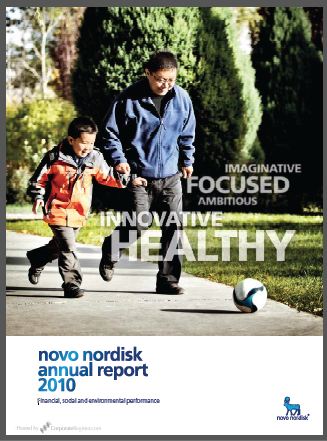
Novo Nordisk Annual Report 2010, Denmark, 115 pages, GRI A+

Novo Nordisk is often held up as the go-to-company for Integrated Reporting excellence, and has been a winner of the Best Integrated Report category in CRRA several times. Certainly, Novo has been doing this a lot longer than most companies (since 2004), so one might expect them to have developed a methodology which works for the company and for all stakeholders, not just financial stakeholders.

Novo says about their own report: "We believe Novo Nordisk creates value in ways that are not captured on a balance sheet or income statement and this is one of the reasons we publish an integrated report. Managing a business sustainably involves looking at risks holistically and taking a long-term perspective. In our 2010 Annual Report we exemplify this in a number of ways: comparing our sales growth with CO2, emissions, water usage and waste to better reflect relative performance and setting and reporting on long-term targets for diversity and engaging corporate culture."

De-coupling business growth from environmental impacts, is excellent, though Novo Nordisk continues to refer to non-financial targets and does not make the direct linkage between business and sustainability issues.

At the risk of becoming repetitive (yawn, zzzzzzzzzzzzzz), how can employee turnover, energy consumption, water consumption etc, not include an element of financial impact? Since 2007, Novo has achieved big reductions in water and energy consumption (37% and 28%) - I am sure this has made a significant financial contribution which is not specifically identified in Novo Nordisk's integrated reporting.

However, perhaps there is light at the end of the tunnel. I noted in an interview with Lise Kingo of Novo Nordisk, included in the report, that she says: "Together with experts and with inputs from stakeholders we have developed a methodology that enables us to value the contribution of our Triple Bottom Line approach in a profit and loss perspective. We have called this initiative our Blueprint for Change programme, and we have conducted Triple Bottom Line reviews looking at our climate action strategy and our business approach in China." I found more about this Blueprint for Change in China on the Novo Nordisk website - this is indeed an excellent document showing how Novo built business while creating very positive social and environmental impact. Again, I miss seeing an assessment of the impact of significant environmental benefits on the profitability and affordability of diabetes healthcare as part of this initiative, but this report does go further than most in identifying economic, social and environmental impacts for value creation as an integrated strategy.  

The consolidated financial and non-financial statements start in the Novo report at page 57, though both financial and "non-financial" figures remain separate, with 7 pages out of around 58 referring to social and environmental impacts.

Solar World AG Annual Group  Report 2010, Germany, 327 pages, GRI A+

This report is very long - at 327 pages, it weighs in as the second longest report in the entire competition. The report structure goes from corporate background and profiles (often quite technical) and then to consolidated financial statements, followed by a sustainability section which is made up of the GRI Index, the UNGC Index and the KPI's of EFFAS, all of which take up a further 16 pages  and is followed by some more detailed disclosures against performance indicators. There is little in the form of sustainability narrative - mainly data and while this is a business all about sustainability, I didn't detect too much overall integration in between financial and sustainability performance. It's quite a techy impersonal report in simple b/w design, making for a not terribly entertaining reading experience.  


There is one page of economic narrative in this Sustainability Report. It's a Sustainability Report. Do Sustainability and Integrated sound so alike?

In fact, this report only barely qualifies as a Sustainability Report. It is so light on sustainability data that it would not make a GRI C Application Level. It's more of a marketing-oriented brochure that reflects Siveco's business performance with a couple of CSR themes thrown in for good measure.

While I commend Siveco for being one of the few Romanian sustainability reporters, and the only Romanian report entered in the entire CRRA competition, the Company needs to develop its understanding of what CSR and Sustainability really mean, and how this can be presented more effectively and transparently.


Syngenta International Annual Review 2010, Switzerland, 58 pages, GRI A+

Hah! This is the only report in this entire category which makes a connection between environmental impacts and financial results. Syngenta says: "We monitor energy use to identify opportunities to improve efficiency. Our energy strategy encourages local teams to select the best ways to reduce energy at local sites. By 2012, we aim to decrease global greenhouse gas emissions by 40 percent relative to EBIT from the 2006 baseline."

Energy consumption, GHG  and other air emissions and water consumption all carry a $ value and are measured in terms of their impact on financial results as well as environmental sustainability.


The nature of Syngenta's business, developing seeds for more sustainable agriculture, advancing food security, lends itself well to a blended business and sustainability discussion, which makes the narrative in this report readable, informative and quite enjoyable. (Check out also Syngenta's Grow More from Less website).The people section is light, and I would have welcomed more discussion about responsible workplace practices and a similar assessment and measurement of sustainable people practices in relation to cost efficiencies. Much of this can be quantified, and it would be an interesting next step for Syngenta to incorporate measurable people impacts in their next report.

In the meantime, given that Syngenta is the only report in this category which has made the connection I was looking for, as well as providing an integrated view of the business in a readable and accessible manner, without too much financial geek jargon and headaches, this report has my vote as the category winner!

(At this point, I will overlook the fact that this is a self-declared GRI A+ level report, and that several core indicators are not fully reported, which to me seems to fall below the A level threshold.)

Takeda Pharmaceutical Company Annual Report 2011, Japan, 150 pages, GRI A+

Takeda is a 230-old corporation so I guess they must be doing something right that supports their sustainability as an organization, although 2010 marks the first year of "Transformation into a New Takeda" strategy, driven by innovation, culture and growth. The reports looks and feels  more like a Sustainability Report than an Annual Report, and includes extensive interviews with company people, and a thorough explanation of a significant acquisition, Nycomed, including aspects of culture and management style. (Most company reports do not examine in detail the basis for and impacts of acquisitions - this is a nice approach).

Financial results and discussion takes up 41 pages (27%) of this report, and some of the business and market disclosures in the body of the report are rather too detailed for the lay stakeholder to read and engage with, but overall, the report hangs together nicely, even though, as with other integrated reports, I could not find and direct connectivity between environmental or social performance and business results.

Takeda has adopted the seven core subjects of ISO26000 as a basis for CSR policy and reporting and structures disclosures around these themes. Takeda also publishes a CSR Data Book which replicates all the information in the Annual Report and adds some, and also includes the GRI Index. So if you are looking for a more traditional standalone CSR Report, this is the one to view.

As with most Japanese reports, many messages are formulated into charts and diagrams. I liked this one which explains Takeda-ism and Takeda stakeholders.


Vancouver City Credit Savings Union (Vancity) 2010 Annual Report, Canada, 94 pages, GRI A+

Vancity is a member-owned, community-based credit union seeking to develop member and community value through everything it does. Vancity is Canada’s largest credit union, with $14.5 billion in assets, more than 417,000 members and 59 branches. Vancity calls this report "their first truly integrated Annual Report", and in my view, they have done a good job. Vancity's report gives a reasonably integrated business overview, with a financials taking up only 28 pages. One of the few integrated reports which has less bespoke financial content - and one of the few which is actually quite pleasant to read, with many nice visuals and a good storyline in the narrative. If you are wondering how Vancity manages to do this - I suspect I know why :)  Take a look at the following shot of the Chair of the Board and the CEO! Women power is obviously the key!

Vancity's reporting on Materiality is interesting. In fact, they produce a whole separate report about it - it's 4 pages long, and defines the materiality process undertaken and the specific priority responses received by stakeholders from different forms of engagement with them, and how these issues have been addressed in the Annual Report. While this is excellent practice and transparency, I do wonder about the decision to omit this, beyond a mention and referral to the separate report, from the Annual Report main document. Materiality process is so core to reporting, particularly integrated reporting - why push it out of the main document? Another nice touch I have always liked about Vancity's reporting is the way their targets are clearly laid out and the specific accountability for achieving each target is noted- once upon a time, Vancity included actual names of people but today, it's just the job title, such as VP Human Resources, CFO or other. Still, it's good to know who in the organization is accountable for what.

Wilderness Holdings Ltd, Integrated Annual Report, South Africa,
153 pages, GRI Undeclared level


Wow. You have to look at this report, just to see the spectacularly breathtaking photography! It's just too beautiful for words. The second reason you need to look at this report is to learn about the intricate details of cultural and sustainable tourism - the high level of detail this report provides is also breathtaking - some might say overkill - but it has a certain authenticity and charm which makes you want to read more. The report includes a list of issues raised by stakeholders and Wilderness's response to them.

Consolidated financial statements begin on page 108, however, so that is where I stopped :)


Wyndham Worldwide Corporation Sustainability Report 2009-2010, USA, 56 pages, GRI C

Oops! Another Sustainability Report. Not integrated. No vote in this category. It does include 2 pages about business performance and revenues, but this hardly constitutes a full set of financials. This report belongs in the Best First Time Report category. Phew! It's there. And also in the Best Carbon Disclosure Category. So that's alright then.

I couldn't resist taking a little peek, though! Two things caught my eye. First, is the Wyndham has a website dedicated entirely to women travelers. I will have to see what that offers the next time I am off somewhere. I wonder if they supply people to pack and unpack my bags. That's by far the worst part of travelling.

The second thing I noticed is Wyndham's Sustainability structure, which seems highly slanted towards Environmental Sustainability.
  
Wyndham - green is it

Overall, the Report is a lightweight GRI level C report, responding to just 11 performance indicators in full. But a nice first time effort, all the same. Hmm. Wonder how it got into that Integrated Category, though!

And to round it all off...if you got this far ....

Of the 18 Reports entered in the Best Integrated Report category, there are five which I believe cannot be classified by any stretch of the imagination as integrated. Reporting companies should be more careful about how they define their entries in CRRA in future years. Also, some more specific guidance from CRRA might be helpful.

Of the remaining 13 reports, all go some way to presenting financial information blended, to a greater or lesser degree, with social and environmental impacts. However, very few manage to make a connection between business strategy and sustainability material issues in a way which shows how value is created or destroyed in both financial and sustainability terms. This shows the true nature of the leap that Integrated Reporting needs to drive. It is more than developing green products or delivering new drugs. It's about truly connecting all aspects of all business initiatives in which the sustainability impacts of business are represented in financial terms (where possible) and the business impacts of sustainability are represented in social and environmental terms (where possible). I fully recognize that 100% integration may be hard to achieve, but, based on my review of the Integrated Reports that are showcased here, even some first tentative steps would be significant.

Oh, and by the way, my own company Sustainability Report, which is not integrated (phew!) is entered in the Best Report, Best First Report, Best SME Report and Best Creativity categories in CRRA 12. I would be delighted if you would consider voting for Beyond Business Sustainability Report. Check out the CRRA 12 Awards here. PLEASE vote for your fave Integrated Reports AND for the Beyond Business report :))


elaine cohen, CSR consultant, Sustainability Reporter, HR Professional, Ice Cream Addict. Author of CSR for HR: A necessary partnership for advancing responsible business practices  Contact me via www.twitter.com/elainecohen  on Twitter or via my business website www.b-yond.biz/en  (BeyondBusiness, an inspired CSR consulting and Sustainability Reporting firm)
Related Posts with Thumbnails