Showing posts with label transparency index. Show all posts

Thursday, December 22, 2011

A COP can be a good thing

Some people think of the UN Global Compact Communication on Progress (COP) as a lightweight entry into the world of transparency. In some cases, they would be right. To submit an Active level COP, all you need to do is describe how you uphold the 10 Principles of the UNGC, describe the positive things your company is doing and sit back and wait for next year's deadline. However, in November 2011, 106 companies were delisted for not communicating, bringing the total delistings to 2,953 companies, so maybe it's a little more challenging.

Last year, the UNGC made a change to the COP structure, introducing what the UNGC calls the "Differentiation Programme". This gives companies two choices: Active Level and Advanced Level. Basically, "Active" means the old-style COP, in which companies do the Good News thing, saying how good they have been in advancing the 10 Principles. This could be compared to an Application Level C Report using the GRI Framework, though it doesn't quite require the same degree of rigor in terms of Management Disclosures. "Advanced" is another affair, requiring companies to report on how they meet 24 criteria of responsible and sustainable business practice, grouped in 5 broad categories:
  • strategy, governance and engagement
  • UN goals and issues
  • implementation of Global Compact principles
  • value chain implementation
  • verification and disclosure
Essentially, anyone aiming for an Advanced level COP is working at the level of a GRI Application Level A Report. But, as anyone who has ever written an A Level report knows, this is no small task. If you have the capability of producing an Advanced Level COP, in practice, you are capable of writing a Sustainability Report and posting it on the UNGC Website, thereby also fulfilling the UNGC COP requirements. The Sustainability Report will include a reconfirmation of the CEO commitment to the UNGC and a cross-reference index of UNGC principles to GRI Indicators.  In practice, this is what most companies who report at GRI B or A Level do.

For companies which are not quite ready to report at this advanced level, an Active COP could be a positive alternative. It provides an opportunity for transparency in a globally recognized context and allows some flexibility regarding what to disclose.  In some cases, companies invest quite a significant amount of effort to deliver an Active Level COP.

Take a look at this (Active Level) COP by (my client) , ECI Telecom.


ECI Telecom is a global provider of telecommunications networking solutions and this is the Company's second COP. Beyond confirming the Company's commitment to the 10 principles of the UNGC, ECI discloses how the company makes a Green Impact with ICT Technology. If you don't know your DSL from your VDSL, ADSL and HDSL, or the environmental significance of Vectoring, you can learn a lot from reading ECI's COP. ECI is a champion in low-power applications and E-band technologies. If this is all gibberish to you, don't worry. It was to me until I started to learn what it all means. It's actually surprisingly simple, once you get the letters in the right place, and confirms that ICT is one of the most significant opportunities for companies to provide services which improve their environmental footprint and those of consumers.


Additionally, ECI makes many environmental disclosures relating to  its own environmental impacts. With an E-TASC (Electronic Tool for Accountable Supply Chains) score of 96%, the company's best to date, ECI demonstrates a commitment to managing, measuring and reporting. The company achieved a 20% reduction in paper consumption in 2010, a 20% reduction in electricity consumption per employee, a 12% reduction in water consumption and a 9.75% reduction in waste. Great progress.

However, my favorite part of this COP is the description of the Green Camera project that ECI Telecom's CSR Manager, Eynat Rotfeld, organized in 2010. Employees were invited to submit their "green" photographs and the three winning photos were selected from around the ECI globe. The photos were breathtaking. Here are the winning photos:

My Green Life in Huangzhou by Tony Xu (China)
Tony Xu said about this photo: "Bicycle is a green, healthy and convenient choice for me. In Hangzhou, the government purchased a mass of bicycles and offer free use for residents in order to improve the condition of traffic and reduce the usage of cars. You can borrow near the home and return at your destination. It is very convenient, saves money and good for health for everyone. That is my reason for choosing this picture."


Harvesting the power of nature by Glenn Leis (ECI Philippines)
Glenn said about this photo: "I was amazed when I saw those windmills up-close and personal and wonder how the force of nature, which is the wind, drives those giants to produce electricity without any bi-products / pollutants. I’ve been to some power plants during my college day field trips and I have compared it to those diesel-fed engines that are very dependent in oil in which we do not have here (yet) in our country. The power of nature is everywhere, we just need to harvest it in a way we do not destroy it in the end because it's FREE...."
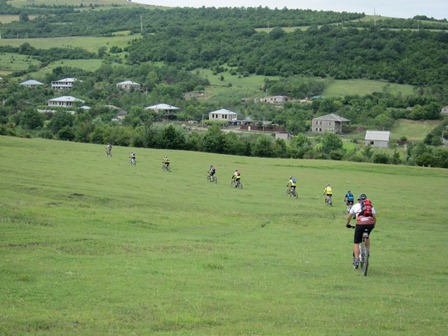
The ECI Biking Team in Georgia by Amit Singer (Israel)
Amit said about this photo: "This picture was taken during our "green" sporting activity, an ECI team bike ride, which doesn’t cause any form of pollution. The team also gets involved in a lot of volunteering activity, including making donations to hospitals, supporting underprivileged children and more. The photo itself represents the spirit of the group – riding in an atmosphere of calmness and blending with the green of nature."

ECI Telecom's 2011 COP is a comprehensive document of 65 pages covering a wide range of social and environmental disclosures, demonstrating year on year progress in advancing sustainable practices. Not a lightweight entry by any means.


elaine cohen, CSR consultant, Sustainability Reporter, HR Professional, Ice Cream Addict. Author of CSR for HR: A necessary partnership for advancing responsible business practices Contact me via www.twitter.com/elainecohen  on Twitter or via my business website www.b-yond.biz/en  (BeyondBusiness, an inspired CSR consulting and Sustainability Reporting firm)

Friday, December 9, 2011

Sustainability for Breakfast

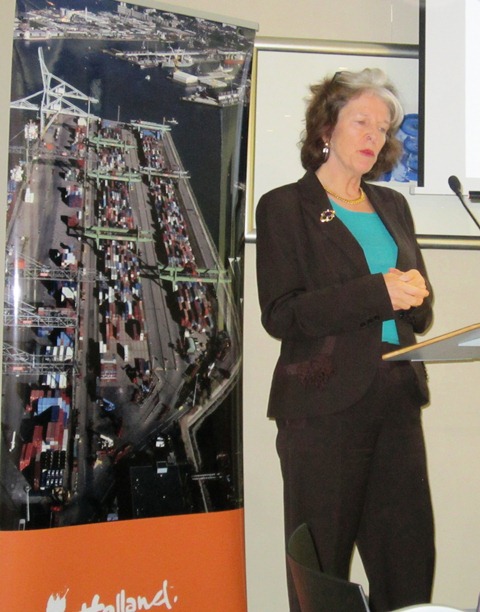
This morning, we had the pleasure and privilege of hosting the Deputy CEO of the GRI, Teresa Fogelberg, in Tel Aviv. It is a rare treat to have someone of such stature come and share insights and experience with a group of local CSR practitioners. Today, over breakfast, that's what happened.

Sustainability for Breakfast in Tel Aviv
The meeting was hosted by the Embassy of the Netherlands in Israel, at the initiative of the Head of the Economic Section, Wendela Haringhuizen. The Embassy is no stranger to sustainability and has held several local conferences in recent years to raise awareness for sustainability issues such as green building, water conservation, waste and air quality, introducing Dutch technologies and offering practical advice. In general, the Government of the Netherlands is one of the more progressive on sustainability matters, as one might expect of the host government to the Global Reporting Initiative, based in Amsterdam. One interesting practice of the Netherlands Ministry of Economic Affairs, Agriculture and Innovation is the Transparency Benchmark, which analyzes in detail the quality of Dutch Sustainability Reports and awards prizes for the best quality reports.

Wendela Haringhuizen opens the meeting in the spirit of Netherlands' Sustainability
Following Wendela's welcoming remarks, and overview of the Embassy activities in Israel, I gave a review of the state of sustainability reporting in Israel. While reporting is always positive, and we should acknowledge some progress in recent years, the fact remains that only 25 reports were published by 23 companies during 2010-2011 in Israel. This is a very low count, given the size and state of development of our market. The reporting companies include local subsidiaries of global companies such as Motorola and Intel, large Israeli global companies such as Teva Pharmaceuticals, Delta Galil, Strauss Group and Elbit Systems, as well as local companies such as the leading banks and telecoms companies.

Of these 25 reports published, 14 were in accordance with the GRI Framework (with three being externally verified), all at Level A or B, demonstrating a certain competitiveness among local players who, it seems, perceive a higher GRI Application Level to be more important than the quality of the report itself. When analyzing the quality of the reports, we found wide variations. We analyzed section by section the disclosures against GRI-based performance indicators and without exception, found that there were serious omissions in the way companies reported on indicators they had declared to have fully reported against. For example, EC1 is the most reported economic performance indicator of all the Israeli GRI-based reports.


However, when drilling down to look at exactly how companies had reported on EC1, we found a different picture - i.e. that one company hadn't reported it at all, and four companies disclosed only partially. So, out of 13 reports declaring this indicator as fully reported - only nine (69%) made the grade.


Another interesting insight was the use of the famous N/A. How many indicators are truly Not Applicable to companies? One of the GRI-based B-level reports we examined noted in their GRI Index that 49 (out of a total 79 performance indicators) were not applicable. This included indicators such as EC7 - procedures for local hiring and LA7 - rates of injury and absenteeism. The company may not wish to disclose against these indicators, but stating that they are Not Applicable detracts from the report's credibility.

Concluding this presentation with the acknowledgement that sustainability reporting in Israel is both weak in quantity and patchy in quality, we recognized the massive opportunity that this represents for Israeli companies (gotta stay optimistic, right?).

This led nicely into the presentation of Teresa Fogelberg.
Teresa Fogelberg explains the global imperative of sustainability reporting
Teresa focused on the global imperative of sustainability reporting and talked about the advances being made all around the world to incorporate reporting into regulation, such as in the case of Denmark, where the Report or Explain approach appears to have had significant results. The Report on CSR and Reporting in Denmark which summarizes the Impact of the second year subject to the legal requirements for reporting on CSR in the Danish Financial Statements Act  informs us that 87% of the top 1,100 Danish companies now report, and that: "There has been a significant improvement in the businesses’ ability to translate policies into actions and to describe the achieved results. In the 2010 financial statements, more businesses report on policies at 71% (69%); on actions at 66% (60%); and on achieved results at 49% (37%)." Teresa also quoted additional studies which prove the value of mandatory reporting. But even without regulation, the reporting climate has changed, moving from "why should you produce a report?" to "why are you not producing a report?".


Finally, Teresa didn't fail to issue a wake-up call to the Israeli business community by reminding us that, of the 34 countries analyzed by the recent KPMG International Survey of Corporate Responsibility Reporting Report, Israel was at the bottom of the list. (and when you are at the bottom, the only way to go is up, right ?)

You can download Teresa's full presentation HERE.

Eli Abramov, CEO of Baran Group, committed to transparency
Finally, Elhanan (Eli) Abramov, the CEO of Baran Group, one of Israel's few pioneering GRI-based Sustainability Reporting companies, provided his perspectives on how, as a CEO, he understands the value of sustainability practice and of transparency in business. In particular, Eli reinforced the necessity of personal leadership in sustainability issues and confirmed that: "Reporting is a participatory and interactive management process which teaches us much about ourselves and the way we do business, and reinforces the accountability of all Baran employees."

You can download Eli's full presentation HERE.

Finally, we were delighted to be joined by H.E. Mr. Caspar Veldkamp, Ambassador of the Kingdom of the Netherlands in Israel.

L>R:
Wendela Haringhuizen, Sohail Wahedi , Ambassador Veldkamp, Teresa Fogelberg, Elaine Cohen
To round off the morning, taking us from breakfast to lunch, we continued our discussion in the comme il faut restaurant in Tel Aviv port, housed in the newly reconstructed Bait Banamal, the socially-responsible, alternative consumerism, pro-women hub of creativity, inspiration and pretty good food!

Sustainability for Lunch
Participants at our morning conference included representatives from a wide range of companies including Teva Pharmaceuticals, Ormat Technologies, Israel Chemicals, Alon Holdings, Microsoft R&D in Israel, Intel Israel, Motorola Israel, Amdocs, Bank Leumi and more.

All in all, a worthwhile morning. I hope that Teresa comes back soon, as she threw down a challenge to Israeli business that by the time she returns, we should have triple the number of reports in Israel.


elaine cohen, CSR consultant, Sustainability Reporter, HR Professional, Ice Cream Addict. Author of CSR for HR: A necessary partnership for advancing responsible business practices Contact me via www.twitter.com/elainecohen  on Twitter or via my business website www.b-yond.biz/en  (BeyondBusiness, an inspired CSR consulting and Sustainability Reporting firm)

Thursday, September 22, 2011

Transparency is the key to Sustainability

You can't underrate transparency. It is the catalyst for driving sustainability performance. This is why sustainability reporting is so critical. Once a company makes a commitment to transparency, the rest must follow. The commitment to publish carbon emissions, employee turnover, community impacts and more leads a company to ask itself searching questions about its performance. This is why I have made made it my mission to drive awareness of the importance of corporate transparency and spend most of my time involved in activities which are connected with advancing transparency in one way or another. One of these activities is our investment in the development and publication of the Transparency Index which is now becoming a truly global comparative ranking.

We developed the Transparency Index methodology three years ago as a way of assessing the sustainability transparency level of publicly traded corporations via their corporate websites. We tested the methodology for three years in my home-base market, Israel, and have now broadened our scope to include additional countries.

The Transparency Index follows a rigorous methodology which, once determined, leaves almost no scope for judgment - the methodology defines what should sustainability information should be present on a corporation's website, following, broadly, the Global Reporting Initiative reporting framework. This includes information relating to all the sustainability dimensions that would normally be included in sustainability performance reporting. If the information or website feature is present, the company gains points. If it is not, it doesn't. That means that we can be sure of delivering a neutral, unbiased view of corporate transparency as we perform our analyses.  


Transparency Index Scoring Table

Our analysis covers four dimensions: Reporting, Content, Navigation and Accessibility. The Reporting dimension provides half the total points available. An Application Level A report, for example, earns 100 out of a total 200 points. The web-site analysis can then deliver up to an additional 100 points. The final score is an overall transparency percentage. Clearly, we make no judgment about the quality of an organization's sustainability performance - we focus on the quality of its transparency. This is because we believe that transparency is the key to improving sustainability performance. Oops, did I say that already?

Of course, you may take issue with the methodology and believe that points should be allocated with different weightings. You may even believe that the reporting element is overstated. If a company has all of  its sustainability performance on its website, why should it only get half the points? Well, we believe that the process and discipline of working towards a Sustainability Report way outweighs the publication of performance data on a website. A Sustainability Report (of good quality) ensures a comprehensive view of the entire sustainability impacts of a company, reported for one period, in one place, in a structured way. A company which produces a sustainability report and ensures that all sustainability information is easily accessible and navigable on the corporate website (without having to download the sustainability report) achieves optimum transparency in our view. As it stands, I believe The Transparency Index is the only ranking of corporate sustainability-performance website transparency in the world which is completely applicable across sectors, industries and geographies, enabling a true comparison of corporate commitment to transparency.

After having published the Transparency Index for three consecutive years in Israel (2009-2011), covering the top 100 publicly traded companies on the Tel Aviv Stock exchange, we have become expert in analyzing corporate websites and have amassed quite some data about transparency performance. In Israel, leading companies now approach us for details of our analysis of their websites and ask for advice on where to focus in order to improve transparency,  as well as publishing their transparency ranking in their own Sustainability Reports.

You can  download all the three year Israel reports from our website here.

South Africa sets a benchmark

This month we published the Transparency Index of the largest publicly traded companies in South Africa. See the full report here and the Press Release here. 

These large South African companies set a new benchmark in transparency, achieving an average of 78% (versus an average of 48% for the top 25 companies in Israel). The highest ranking was AngloGold Ashanti Ltd with 95% (though the highest ranking in Israel was Bank Hapoalim with 99%).

Ukraine joins the Transparency Index

We have been delighted to welcome the initiative of the dynamic Center for CSR Development in Ukraine to apply the Transparency Index methodology and measure the transparency level of the largest companies in Ukraine.  See the Press Release here. (a full report will follow).

The average level of transparency of the top 106 companies in Ukraine was 21% (35% for the top 100 in Israel), demonstrating that there is much work to do in both countries. DTEK, a large Ukraine energy company, achieved the highest ranking in Ukraine at 80% sustainability transparency.

Transparency Index Global Comparison

In addition to our work in Israel and South Africa, our friends in Ukraine performed a comparative analysis of thirty additional companies - ten from Russia and twenty leading global corporations.

Using the Ukraine analysis and our own analyses, we can come up with a semi-global league table which presents the top 20 companies out of the 260 + company sites analyzed:


In this top 20 so far, we have 9 South African companies, 5 global companies, 4 from Israel and one from Russia and one from Ukraine. The overall average of these leading companies for Sustainability Transparency is 88%, a very respectable benchmark for other companies to aspire to.

In the coming months, we will be adding UK, USA, Canada, India and other countries. As we grow our global transparency database, we will perform industry and sector analyses, as well as analyses relating to the sustainability content which is most widely published on websites and that which is not. At present, this information is only provided in country level reports.

Transparency is key to sustainability. Watch as the Transparency Index grows in scope and use it to influence companies toward greater transparency.


elaine cohen, CSR consultant, Sustainability Reporter, HR Professional, Ice Cream Addict. Author of CSR for HR: A necessary partnership for advancing responsible business practices Contact me via www.twitter.com/elainecohen  on Twitter or via my business website www.b-yond.biz/en  (BeyondBusiness, an inspired CSR consulting and Sustainability Reporting firm)
Related Posts with Thumbnails