Showing posts with label csr. Show all posts

Monday, January 23, 2017

People powering trust

As a consultant, my work is most often behind the scenes of business and most of my job satisfaction derives from helping others make a difference. One of my favorite things about my work is when clients tell me they gained a new insight, or when I see the contribution I have made creating ripples in an organization or helping empower people. And in the field of CSR and Sustainability, pretty much everything I work on supports a mission of  advancing positive-impact, ethical, values-driven business which I believe is a key stepping stone to a sustainable society and planet. 

Transparency is the cornerstone of responsible business, and my geeky fascination with and love of Sustainability Reporting has become a purposeful occupation, a hobby and a vocation all rolled into one. I couldn't have imagined that this is what I'd end up doing when I started out 30+ years ago as a Distribution Manager with Procter and Gamble in England, and today, I can't imagine doing anything else. As a consultant, I think we are wired not to seek recognition for ourselves, but for our clients. As consultants, we take pride in our professional work, but we are more proud of what our clients achieve. As consultants, our success is possible because of the trust our clients place in us. And trust is what brings me to share these non-typical personal ramblings on what is usually a fairly on-topic blog. 

In the Winter 2017 Issue of Trust! Magazine,  I am quoted on the topic of trust.  


"Trust defines relationships – personal and professional. It’s the most basic currency of our interactions. When trust exists, relationships thrive and positive outcomes are possible. When trust is eroded, relationships are eroded too. In a business context, the value of trust is often underestimated. Because we can’t count trust in the same way as we can count money, products and other tangible outputs of business, we are often unappreciative of the role trust plays in making it all possible. But we must never forget that business is built on relationships… we may think business is about profit but it’s really about people… so when trust is present, relationships work and business has a good chance of success. As an optimist, I believe, we are predisposed to trust. Retaining trust is the longer-term challenge and that is done by consistently demonstrating integrity, empathy and openness (in business, that includes transparency)."

But you may notice that the Magazine cover carries a special announcement - it's from Trust Across America - Trust Around the World (TAA-TAW) honoring  global leaders in organizational trust. The TAA-TAW awards program, now in its 7th year, celebrates professionals who are transforming the way organizations do business. This year a diverse group of 84 global professionals from different backgrounds operating in different countries and sectors are honored. This list includes seven honorees who have  maintained Top Thought Leader status for five years and are presented with a Lifetime Achievement Award. The Press Release from TAA-TAW notes: "We congratulate all of our honorees whose work is shining a spotlight on the importance of trust and providing a roadmap for others to follow. They inspire organizations to look more closely at their higher purpose…to create greater value for, and trust from all of their stakeholders, and understand trust is a “hard currency” with real returns."

So it's not by accident that I am writing about all of this here. I am genuinely humbled and delighted to be among the 2017 Lifetime Achievement Award honorees. More humbled, I guess, as the list of Top Thought Leaders in Trust (which you can view in the Winter Issue of Trust! Magazine) includes so many accomplished individuals that inspire me with all they have done to change the world and the world of business.


With this post, I applaud each and every one of the Top Thought Leaders in Trust 👏👏👏👏
I encourage you to notice and appreciate the difference they make and recognize them, as I do, as a source of inspiration and optimism. This recognition by TAA-TAW is a breath of fresh air in a world in which trust is evidently more necessary than it ever has been. 

Trust Across America - Trust Around the World (TAA-TAW) is the product of the vision and focused action of Barbara Brooks Kimmel, the CEO and Cofounder of Trust Across America-Trust Around the World, whose mission is to help organizations build trust. Now in its seventh year, the program's proprietary FACTS® Framework ranks and measures the trustworthiness of over 1,500 US public companies on five quantitative indicators of trust. Barbara also runs the world largest global Trust Alliance, and is the editor of the award winning TRUST INC. book series and a Managing Member at FACTS® Asset Management, a NJ registered investment advisor. Barbara has made trust her agenda in quite a unique way. I was keen to find out why and learn more about her work: 

Me: When was your a-ha moment that trust was a pivotal factor for healthy business and society?
Barbara: That moment came at the height of the financial crisis in 2008 when CEOs would announce on a Friday that their balance sheets were strong and then declare bankruptcy over the weekend. I started thinking about what trust meant at the organizational level and started searching the internet for resources. I quickly realized that there was no central "clearinghouse" or website where one could go to find information on organizational trust and trustworthiness. Inherently I knew that trust played a very large role in the health of business and society, but frankly, was unaware at the time just how large that role was.

Me: What are the key challenges facing organizations that are trying to build trust ? 
Barbara: Most of the work we do at TAA-TAW focuses on public companies, although all organizations regardless of the type, tend to have similar issues. The biggest challenge is leadership. Trust is usually taken for granted. It's certainly not something that proactively comes up in meetings of Boards of Directors or CEOs, unless they are faced with a crisis, and there is certainly no budget. Trust is built over time and in incremental steps. There are so many competing forces in public companies- quarterly earnings, analysts expectations, CEO compensation and tenure, etc. That's why we have focused on building the Business Case for Trust via our FACTS® Framework. FACTS is a holistic quantitative measurement of the trustworthiness of public companies, compiled from independent third party data providers. In other words, companies do not know they are being evaluated nor do they pay us any fee. With 8 years of data, we see strong correlations between the most trustworthy public companies and long-term profitability. My message to Boards and CEOs is that without organizational trust decisions take longer, employee turnover is high, innovation slows and profits erode. Place trust on your agenda. Start meeting the needs of all your stakeholders, not just your shareholders, and your profits will increase.

Me: What was your prime motivation in developing the Top Thought Leaders in Trust Awards program?
Barbara: There are people who have devoted their entire careers to building organizational trust across every functional area of an organization. These same people should be hailed as heroes and be celebrated. Seven years ago there was no mechanism for doing this. Now there is. Perhaps the recognition opens doors for these folks to make a greater impact.

Me: Tell us a little more about the Trust Alliance? What does the Alliance achieve? 
Barbara: I started the Alliance 5 years ago to bring like minded professionals together to build tools and resources that would enhance both our website and society at large. Very little existed before the Alliance was formed. Now when visitors come to our website, there is an almost endless supply of organizational trust resources and tools. I love to connect members that have complimentary interests and watch new relationships flourish that already have a head start on trust. Understanding that trust is both holistic and global, so is our membership. We don't actively solicit new members but welcome them when they find us. It's a global group.

Me: What's top of your agenda in advancing trust in the coming year or two?
Barbara: Within the next several months we will have the ability to issue "flash reports" to public companies who have an interest in elevating organizational trustworthiness but don't know where to start. The reports will provide a good overview of where the company stands in relation to its peers. These will be driven by our FACTS ® data and provide a mechanism to get companies on the right road, at least those that want to be there! Imagine if every company published their FACTS score in their annual report! With so many years of data there is also quite a bit of interest building both in and outside the financial community. We are discussing licensing with many organizations. This is good for business and for society over the long term and will remain our focus over the next few years.


Thank you Barbara for making trust your thing and for your contribution to making trust our thing. Thank you to all the Top Thought Leaders in Trust for making our world better. 


elaine cohen, CSR consultant, Sustainability Reporter, HR Professional, Trust Across America 2017 Lifetime Achievement Award honoree, Ice Cream Addict, Author of Understanding G4: the Concise Guide to Next Generation Sustainability Reporting  AND  Sustainability Reporting for SMEs: Competitive Advantage Through Transparency AND CSR for HR: A necessary partnership for advancing responsible business practices . Contact me via Twitter (@elainecohen)  or via my business website www.b-yond.biz   (Beyond Business Ltd, an inspired CSR consulting and Sustainability Reporting firm).  Need help writing your first / next Sustainability Report? Contact elaine: info@b-yond.biz 

Friday, November 25, 2016

The missing piece of the materiality puzzle

Earlier this year, I had quite a lot of fun as a GRI-appointed Quality Control Officer, whose role is to attend GRI training courses as an observer and report back to GRI if certified GRI training is being conducted professionally, competently and in line with GRI standards. This is fascinating for me, mainly because it's so interesting to hear what training delegates ask about and comment on during the course. In one session, a delegate asked the ultimate G4 (now GRI Standards) question - the very same one that I asked GRI Standards leading architect Bastian Buck of GRI, three years back:

Is it OK to write a G4 report with just one material issue? 

The answer of course is Yes and No.

Yes, because technically, if you have determined that your organization has only one material impact, then disclosing this and using GRI to report it does actually tick the box.

No, because, I believe, no organization can be so simple that its impact is entirely mono-dimensional. Even micro-businesses operate across more than one dimension. No business has just one stakeholder.

Behind this ultimate question, then, is the deeper consideration of how organizations define their most material impacts for the purpose of strategy development and reporting. It's not so much about whether you can ride the framework with one material issue; it's about the value you derive from understanding what's material for your business. 

Materiality and Strategy 
One of the positive developments following the introduction of G4 was the elevation of materiality from dormant to active in the minds of companies and reporters. Transitioning to G4 has generally appeared to cause companies to engage in some level of thinking about what's material and how to define it. In some cases, this has been a meaningful exercise where materiality is the result of insightful stakeholder dialogue and the precursor to a multi-year sustainability strategy and basis for reporting. In other cases, we are still seeing the disconnect - where companies have, on the one hand, a sustainability strategy and, on the other hand, a list of material issues that bears no resemblance to the strategy and a report which covers everything except what is deemed material. The next stage in materiality maturity is helping companies to see that this all plays out on the same playground. Sustainability strategy has to be the result of materiality analysis. Materiality can never be in a vacuum.

Materiality and Impacts
Which brings me to another interesting and highly geeky thing I did this week. I listened in on the GRI Global Sustainability Standards Board (GSSB) meeting (for the second time). It's fascinating to be a fly on the wall as the GSSB debates the different aspects of developing GRI Standards. I have to commend GRI and GSSB on full transparency here - all the meeting documents are available and the meeting itself is audio live-streamed (shame about the video!) - and it's a truly illuminating discussion... if you are a reporting geek like me.

One of the topics that came up this time around was the definition of materiality and the clarification of this in the new GRI Standards. GRI maintains that to date, people have "misinterpreted" the definition of materiality, and that the new terminology in GRI Standards makes this much clearer. GRI Standards 100:1.3 states: "Relevant topics, which potentially merit inclusion in the report, are those that can reasonably be considered important for reflecting the organization’s economic, environmental, and social impacts, or influencing the decisions of stakeholders. In this context, ‘impact’ refers to the effect an organization has on the economy, the environment, and/or society (positive or negative)."


In G4, material impacts were defined as follows:
In the GRI 100 Glossary of the GRI Standards, it is now clarified as follows:
A Sustainability Report should therefore report impacts OF the business and ON the decisions of stakeholders. It is not about the impacts of sustainability on the business. The guidance matrix in the GRI Standards remains the same in the GRI Standards is it was in G4 (though the colors have changed a little 😌) (NB: I remind you that a matrix is NOT necessary for GRI Reporting - a list of priority issues is perfectly adequate.)

This the application of this matrix - or specifically, the focus of each of the axes -  has commonly been misused in G4 reporting.

3M's 2016 Sustainability Report, for example, uses reputation on the Y axis and stakeholders on the X axis:

The Fedex 2016 Global Citizenship Report uses stakeholders and business success:


Both these approaches do not reflect the actual intention of the GRI framework. The GRI approach is designed to create a report that reflects impacts on the economy, people and planet. The shape and size of the impact of your specific business is key to defining your positive (or negative) contribution to society. The primary focus in sustainability reporting should be the size and nature of the impacts OF your business and how your business affects our lives. In the GRI Standards, that should now be crystal clear. The outcomes of the way your business addresses mitigating negative impacts or enhancing positive impacts is reflected in your reputation, business success and value creation.

In the conversation at the GSSB, where I was a fly, a concern was raised that some companies have spent fortunes on materiality assessments that include this measure of "importance to business success". "What should they do now?", was the question. Well, it's not the end of the world. There is some overlap. Quite often, these issues will naturally coincide. Almost always, in fact. But in the next review of material impacts, there's an opportunity to better align with the letter and spirit of the reporting standard (and stakeholder expectations).

Which brings me to the more important question: How do you prioritize material impacts?

Materiality and Prioritization
The big weakness in the GRI Standards is the lack of robust guidance for defining the process for prioritizing material impacts. GRI could have been prescriptive in this area. The GRI Standards omit the guidance that was contained in G4 around the stages of defining material impacts: identification, prioritization, validation and review. However, even that guidance did not prescribe a robust process for getting from the universe of many impacts to the fewer most material impacts.  Few companies, if any, actually report this process in a way that help us understand the voices that counted in prioritizing specific impacts.

It's easy enough to define the landscape of relevant issues. But the prioritization has often been reduced to a number-crunching exercise, where different groups give scores to different topics, the numbers are added up and voila - you have a matrix. The outcome of this process can vary widely depending on which voices you count, what weight you give to each voice, how each voice assesses the value of each impact and the weighting factors you use to roll that up into one coherent list of issues. These details are rarely disclosed by companies. The entire basis upon which material impact reporting rests is therefore not transparent and possibly, not robust.

Lloyds Bank publishes a Materiality Report.


The bank describes its process for defining material impacts:

This looks like an invested process. A universe of 50 issues was established. Representatives of six stakeholder groups (including employees as one group) took part in an online survey to rank the issues in order of importance. The online input was supplemented by the opinions of Lloyds external Stakeholder Advisory Group who provided "proxy representation on behalf of some of these groups". The responses were weighted according to "stakeholder group sample and data quality with priority given to direct feedback and Stakeholder Advisory Panel feedback". Then it was all rolled up into a set of 14 issues in 5 categories that appear to have equal priority as the most material impacts.


The issues look to be a reasonable mix of what we might expect a large banking group to prioritize at a general level. But they could also be the issues of any bank anywhere in any country. Trust in business, job creation, access to products and services, customer satisfaction - this tells me nothing about Lloyds Banking Group that is specific to that company. This begs the questions: How detailed was the initial universe of material issues? How was the weighting of stakeholder responses constructed?

Another bank, for example, presents a more company-sector specific picture. Westpac Australia's materiality matrix includes impacts such as positive impact finance, financial capability and empowerment, digital product and service transformation (an issue which is sweeping the banking industry worldwide for obvious reasons) and macroeconomic and demographic trends that are current in the materiality assessment period.

Westpac's matrix refers to impacts that are important to stakeholder and important to the business, but, despite this bank's detailed disclosure of stakeholder issues and responses, we are still left in the dark about the process used to assign prioritization to these top 18 material impacts. What influenced the positioning of the dots on this matrix? How were the different stakeholder inputs evaluated?

Next week, I will be presenting the findings of an analysis I performed on behalf of BSI, the UK's national standards body, of sustainability performance and reporting standards that are used predominantly today. The presentation will serve as a basis for dialogue at an event hosted by BSI to consider where standardization or additional focused guidance may assist companies in advancing sustainability performance and reporting. 

If materiality is central to reporting, does the process of defining materiality not merit greater structure and transparency? Good process, good outcome. But what is the process for determining materiality? Every company uses its own logic to develop a process that delivers a result. But if the process is flawed, then the result is flawed. How can we know that companies are reporting the most material issues? If the process is different in every case, the outcomes are not comparable. One of the recommendations I am tabling for discussion next week is that there should be robust process standards for the determination of material impacts. What do you think? I'd welcome your thoughts as we consider this fundamental question that goes to the heart of relevant corporate transparency. The actual event is fully booked with a long waiting list, so if you have a strong view, write to me here or comment on this blog. I am very interested to hear your views.

In the meantime, the good news is that companies are making efforts to define material impacts. Even an imperfect, undisclosed process is a start. As I often say, 80% of something is better than 100% of nothing.
 

elaine cohen, CSR consultant, Sustainability Reporter, HR Professional, Ice Cream Addict. Author of Understanding G4: the Concise Guide to Next Generation Sustainability Reporting  AND  Sustainability Reporting for SMEs: Competitive Advantage Through Transparency AND CSR for HR: A necessary partnership for advancing responsible business practices . Contact me via Twitter (@elainecohen)  or via my business website www.b-yond.biz   (Beyond Business Ltd, an inspired CSR consulting and Sustainability Reporting firm).  Need help writing your first / next Sustainability Report? Contact elaine: info@b-yond.biz   

Wednesday, October 26, 2016

Trump versus Clinton or SASB versus GRI

Topical as ever on the CSR Reporting Blog, although usually not party-political, I was struck by some of the similarities in the current U.S. Presidential Election and the sustainability standards reporting landscape. In fact, we might liken the Trump-Clinton adversarial position to the SASB-GRI position, where the stakes have just been raised with the official publication of the GRI Standards.  

GRI was created as the voice of the people in 1999 to support the inevitable need of wide groups of stakeholders for increasing transparency about business practices and corporate accountability. Over the years, GRI has remained steadfastly true to its multi-stakeholder process (sometimes, sadly, at the expense of speed and flexibility) and continues to deliver the only broad set of globally applicable standards for sustainability reporting available today. With the vast majority of reporting companies using GRI guidelines, and, I expect, an equally vast majority planning to transition to the GRI Standards in the next reporting cycle, GRI's voice has been a dominant one on the sustainability landscape for many years. Unfazed by the absence of a CEO in this current period, the mission goes beyond individual interests, and the Standards promise to elevate GRI's position in the global debate - especially in the political arena where governments make decisions and regulators earn their bread. The voice of GRI is the voice of how business affects us. Often, the actions of business affect our bank accounts, but for most of us, they affect the quality of our environment, the values we hold dear and the way we live happy, productive lives. (Cue: violins).

SASB was created in 2011 with a different purpose. Distilled into one sentence, that purpose (as I interpret it) is to help people who have more money make more money with sustainability in mind. SASB states its vision and mission as: "The Sustainability Accounting Standards Board sets industry-specific standards for corporate sustainability disclosure, with a view towards ensuring that disclosure is material, comparable, and decision-useful for investors." This is how it's portrayed in a video screenshot on the SASB website:


Helping investors make more money in itself is nothing to be ashamed of. SASB's approach has been to split the business of corporations into different sectors, and develop a comprehensive range of standards, focusing on the mostly sector-specific sustainability-related issues that affect the financial valuations of companies for investors. SASB has had an amazing crazy-busy time, consulting with corporations and investors and pulling together sustainability accounting standards across 79 industries in 10 sectors. The full set was published in March 2016. It's been a mammoth job and the outputs are very clear.

At the center of SASB's raison d'être has always been that existing sustainability reporting is rubbish for investors. Sure, I don't recall SASB ever using the word rubbish, but that's how I understand it. For example, in a letter from SASB to the United States Securities and Exchange Commission in July 2016, SASB refers to Sustainability Reports as "glossy, attractive publications, often developed in consultation with a company’s marketing department or a public relations firm that describe a company’s achievements with respect to environmental, social, governance, and related matters" and "sustainability reports generally include information that is immaterial for purposes of investment decision-making. These reports tended to make the reporting company look as good as possible to stakeholders other than investors" and "Standalone sustainability reports are often prepared by corporate communications departments or public relations firms. They tend to be positively biased and do not provide investors with a true and fair representation of performance on material risks....This practice of producing a glowing sustainability report is known as “greenwashing”." No doubt then, that investors don't think much of sustainability reporting, according to SASB.

SASB goes further in its public comments to GRI during the Exposure Draft Period of the GRI Standards, submitting a 4-page letter, which includes the paragraph:


"Perhaps GRI is better placed in providing a forum for stakeholders to voice their concerns and ideas"? Seriously? After 17 years of driving the sustainability conversation by creating reporting frameworks that have been adopted and recognized as best practice by thousands of organizations globally, the suggestion is that GRI backs off and runs a chat-club while SASB's largely untried and untested Standards become the SEC endorsed/mandated reporting tool for a small pool of U.S. public corporations? That’s a bit off in my book. It made me think of the adversarial positions we are currently witnessing in the U.S. Presidential Election. In politics, for you to win, someone has to lose.

Portraying GRI as a virtually useless initiative that's encouraging companies to greenwash, and the thousands of sustainability reporters around the world as creators of imbalanced marketing blurb to make them look good is a distortion. SASB wants to be the recognized standard that the U.S. SEC endorses.  The above-mentioned letter to the SEC concludes: "Because of SASB’s approach, with its emphasis on due process and adherence to U.S. securities law, we believe it would be appropriate for the SEC to acknowledge SASB standards, once they become final, as an acceptable framework for companies to use in their mandatory filings to comply with Regulation S-K in a cost-effective and decision-useful manner." Now that GRI is a formal Standard, and not just a framework, SASB has real competition. 

Even before the GRI Standards were published, the GRI reporting guidelines (specifically G4) were used widely in both non-financial AND financial reporting. For example, using CaspianTM powered by DatamaranTM , eRevalue's brilliant corporate disclosure research tool, covering more than 44,000 corporate reports, it took me just a split second to discover that GRI was referenced 733 times in 2016 in financial reports and SEC filings, whereas, in this same period SASB was referenced just 18 times. That's in addition to the >800 non-financial (sustainability) reports that reference GRI, versus 51 non-financial reports that reference SASB. (Interestingly, SASB may be becoming a tool that's used more in non-financial reporting than for financial reporting. Oops!)  Of the 18 financial reports published in 2016 that reference SASB, only one actually reports against the sector indicators according to the relevant SASB Standard. All the others mention SASB once - in reference to the frameworks and guidance used in the preparation of a materiality matrix. Of these 18 financial reports, 14 include a full GRI G4 report with a Content Index, or refer to a standalone G4 report in addition to the financial report. The remaining four companies mention GRI as a guidance framework for the materiality assessment.  

Now, let's be clear. SASB has a very legitimate and useful agenda. Make sustainability disclosure more relevant and useful for the U.S. financial markets. Address the very specific information needs of investors. Help the financial markets enhance value creation. Efficiency. Comparability. Clarity. Focus. Sector-specific. It's all good. But as good as SASB is, SASB is not better by telling GRI to go and sulk in a corner because GRI has a different definition of materiality or because proper use of the GRI framework is evolving rather than perfect.

Sure, GRI-based reporting is fraught with issues of quality, good news rather than balanced news, and omissions. I have been a constant voice of the reporting quality mantra. It's true that some Sustainability Reports are glossy brochures. That's not to say the framework doesn't add value. GRI has been used tens of thousands of times over tens of years in hundreds of countries. How many times have the SASB standards been used in practice? How is the quality of adherence to the SASB Standards assessed? How many investors used SASB based disclosures and found them to be relevant to their investment decisions? What's the prognosis about how investors will actually use the information reported according to SASB Standards, if they are ever used by more than a couple of corporations?


In my work of more than 10 years as a sustainability reporting consultant, I know first-hand the tough deliberations that go into sustainability reporting and the processes companies go through to make quality and meaningful disclosure. I witness a genuine intent to present good and relevant information for stakeholders. I believe the reports of today are much more balanced than those of some years ago. But there is obviously still some way to go.

Marjella Alma, CEO and co-Founder of eRevalue, developer of a groundbreaking analytics platform for emerging ESG, regulatory and reputational risk assessment, is very much at home in this space. Marjella says: "The collective push for disclosure on sustainability issues is impressive. Irrespective of the specific framework, there is growing evidence that companies are including non-financial issues into all kinds of reports, including 10-K’s and Annual Reports. If you look at the issues, rather than the frameworks, you can see companies embracing the thought leadership and this push to more meaningful disclosure. GRI's work of the past 20 years is incredible; the global uptake including emerging markets, not just large multinationals, has made a big difference. The sector-specificity of SASB is a helpful addition. Ultimately, it's about helping companies understand 1. what issues are out there 2. manage them properly and 3. use the right metrics that reflect their business model. At eRevalue, we are making it much easier and much more efficient for companies to know what’s on the radar and do something about it."


What alarms me about the sustainability reporting landscape is this lack of respect and collaborative spirit. It may be that investors have different needs than non-financial stakeholders. It may be that materiality in sustainability reporting is used differently than materiality in a U.S. regulatory framework. But that doesn't mean that respectful, collaborative, constructive coexistence of these two approaches for maximum benefit would not be advantageous for financial markets. Both GRI and SASB organizations together are spending around $15 million per year to advance this - our - agenda. Perhaps that money could be used more efficiently with a greater degree of synergy. Instead of telling GRI to back off, maybe there should be a serious discussion about how to jointly provide guidance that meets the needs of SEC regulatory filings, investors and other stakeholders. I am sure this is possible. SASB has done amazing work in articulating sustainability priorities by sector. This is GRI's Achilles Heel. GRI has done amazing work in creating a strong framework that has put disclosure on the map around the world. There is surely something SASB can learn from that. Do we, as stakeholders, need to live with either/or? Can't we have both, in good spirit?

Which brings me back to the election. Only one candidate will win. One wins, one loses. It doesn’t have to be that way in sustainability. But then, I never was a politician but will always be an optimist.


elaine cohen, CSR consultant, Sustainability Reporter, HR Professional, Ice Cream Addict. Author of Understanding G4: the Concise Guide to Next Generation Sustainability Reporting  AND  Sustainability Reporting for SMEs: Competitive Advantage Through Transparency AND CSR for HR: A necessary partnership for advancing responsible business practices . Contact me via Twitter (@elainecohen)  or via my business website www.b-yond.biz   (Beyond Business Ltd, an inspired CSR consulting and Sustainability Reporting firm).  Need help writing your first / next Sustainability Report? Contact elaine: info@b-yond.biz 

Tuesday, August 30, 2016

10 ways to have CSR fun in Berlin in September

Planning go to Berlin on 14-16 September 2016? Could possibly get there on 14-16 September 2016? There anyway? Let me help you decide how to have some fun on those days.

1. Go to one of the best Ice Cream Shops in Berlin and try out at least 5 flavors.

2. Attend the opening session of the 7th International Conference on Corporate Sustainability and Responsibility at Humboldt University. The conference theme is "CSR in an age of digitization".


At 08:45 precisely on Wednesday 14th September, Joachim Schwalbach will take the stage to open  up three days of spectacular debate, as he has done for the International CSR Conference Series since its inception in 2004. Joachim is Professor emeritus of International Management at Berlin's Humboldt University, and a prominent expert in CSR and related topics with a distinguished academic career to date. 

I asked Joachim about his hopes for the upcoming conference.
Joachim Shwalbach: "Based on the take-out of the conference in 2014, my hope is that we find ways for technological innovations to empower individuals and organizations to contribute to society's well-being. The last conference concentrated on the connection between innovation and sustainability. There were many insights resulting from that conference, but I will mention only three: First, given the challenge to global sustainability, incremental improvements are not enough. Instead, sustainability driven innovations increase the likelihood to improve value creation by companies and in society. Second, the conference brought two camps, innovation and sustainability, together. These disciplines do not normally pay attention to each other in companies as well as in academia. Third, digitization may help to speed up the process so that innovation and sustainability will be present in all elements of the value chain in companies. The 2016 conference will be a natural extension of our thinking in 2014."  

Well, there you are, and we are only at number two thing to do. If you are not convinced, read on for 8 more fun things to do. 

3. Attend the first plenary at 0900 on Wednesday 14th September at the 7th International Conference on Corporate Sustainability and Responsibility at Humboldt University. Join Timotheus Höttges, CEO of Deutsche Telekom, Georg Kell, Vice Chairman of Arabesque Partners, an asset management firm for sustainable investing and the founding Executive Director of the United Nations Global Compact until recently and David Kiron, executive editor of MIT Sloan Management Review's Big Ideas initiatives. They'll present their thoughts on CSR and Digitization. Surely that's fun enough to convince you to participate in this session. But if not, read on..

4. Come and have a drink with me at the Hotel de Rome. At the heart of everything that happens in Berlin, the Hotel de Rome is a great startpoint for your Berlin sightseeing. Unfortunately, I won't be doing much of that.. see points 5., 7., and 8.

5. Join me for a plenary panel that I will chair  with a formidable group of experts at 14:00 on Wednesday 14th September on the subject of Digital Accountability. How is the digital world affecting communications with stakeholders? What is digitization doing to reporting and do we like it? Come and ask the tough questions!


6. Enjoy fresh the Berlin air in the Campus Mitte around Humboldt University's main building, at the boulevard "Unter den Linden", between Brandenburg Gate and the Dome of Berlin. While you are there, pop in to one of the rich, informative and educational sessions at the 7th International Conference on Corporate Sustainability and Responsibility.

7. Join me for another plenary panel that I will chair with another formidable group of experts at 09:00 on Thursday 15th September on the subject of Innovations in Sustainable Development with a focus on Human Rights. What are the practical steps being taken by companies to protect human rights? What outcomes can be identified? What innovations are we seeing? What are the minimum disclosure standards we should expect from corporations relating to human rights? How are we seeing the evolution of such disclosures today? What are the gaps? More on this .. but only if you show up. It's ok - you can bring ice cream.


8. Join me for yet another plenary panel that I will chair with yet another formidable group of experts at 14:00 on Thursday 15th September on the subject of Innovative Philanthropy and Impact Investing. What are the similarities and differences, and how can you tell? What contributes most to sustainable development? What's driving what? Don't worry, there won't be a call for financial contributions.

9. Join me for a massage at the Spa in the Hotel de Rome. After chairing all these plenary panels, even ice cream may not be enough to keep me cool and collected. The spa is located in what was once a vault for gold and jewellery. (The Hotel was built to house the headquarters of the Dresdner Bank in 1887). Maybe they didn't clean it out properly and we might find a few diamond tiaras and a ruby or two.

10. Go to one of the best Ice Cream Shops in Berlin and try out all the flavors you didn't already try. Joachim Schwalbach's favorite flavor is Cookies and Cream, so don't gorge yourself on that, so there is some left for him.

I could have continued with at least another 45 fun things to do in Berlin on 14-16 September (most of them associated with the CSR Conference). However, these are the Top Ten. If you allocate your time well, and screen your calls, you can probably manage to do all of them. Wow, that's a whole lot of fun in Berlin in three days. See you there?

I'll leave you with another thought from Joachim Schwalbach: "CSR or sustainability departments in companies have reached a cross-roads: Either they improve their competence as a valuable partner for the companies' top management to show that CSR aspects are key success factors, or they do business as usual and remain in their niche, not recognized as one of the most important drivers of business success." Yes, that's something else we'll be talking about in Berlin. Now you HAVE to come.


elaine cohen, CSR consultant, Sustainability Reporter, HR Professional, Ice Cream Addict. Author of Understanding G4: the Concise Guide to Next Generation Sustainability Reporting AND Sustainability Reporting for SMEs: Competitive Advantage Through Transparency AND CSR for HR: A necessary partnership for advancing responsible business practices . Contact me via Twitter (@elainecohen) or via my business website www.b-yond.biz (Beyond Business Ltd, an inspired CSR consulting and Sustainability Reporting firm). Need help writing your first / next Sustainability Report? Contact elaine: info@b-yond.biz

Monday, August 29, 2016

First Reports -Ten Trust Factors

It's almost Q4 and you know what that means. It's almost the start of the reporting season.

YAY! 

In the final quarter of the year, many companies are starting to plan their next report, or even their first report. There is a certain seasonality to reporting, by and large: Q4 planning, Q1 preparing, Q2 publishing, Q3 recovering. Of course, not every company is on that cycle.. but about now is usually the calm before the storm.

As we anticipate the next reporting season, we can expect a flurry of fabulous new first-time Sustainability Reports that will be published in 2017. It's not that I am especially optimistic about the impact of the EU Directive that will require 6,000 companies who do not currently report to start thinking about what they will write in their Sustainability Reports for 2017. Each year brings a flurry of new reports, with or without the Directive. And that means that each year, more companies have thought just a little more about the impact they have on our lives and are taking the first steps to be held to account.

Let's face it. Reporting is a little bit of a risky business. Take for instance, Dollar Tree Inc., a Fortune 500 American chain of discount variety stores that sells items for $1 or less in 13,600 stores around the country. Dollar Tree just published its 2016 Sustainability Report . Full marks for effort but this 14-pager 7-minute read is a list of environmental and social practices with barely any meaningful performance data. Not surprising then, perhaps, that there has been some backlash.

In a press release published in PR Newswire,  angry activists representing the Campaign for Healthier Solutions  berate the company for not addressing their concerns relating to chemical toxicity in the company's products after laboratory testing has found "potentially dangerous levels of lead, phthalates, and other toxic chemicals" in Dollar Tree's products. Comparing the current report to prior reports, these stakeholders find that there is almost no difference. So, although the folks at Dollar Tree have taken some steps along the transparency journey, they still have to find the path of accountability. Reporting is risky. Arguably, the fact that Dollar Tree has made efforts to publish a Sustainability Report has added fuel to the frustration of stakeholders. But, in fact, the Campaign for Healthier Solutions is doing Dollar Tree a favor. It's creating pressure that will ultimately lead to a safer planet, a safer society and a stronger business. If Dollar Tree embraces its critics, and takes responsible action, next year's headline may well be: "Dollar Tree's Sustainability Report reflects significant progress."  Reporting, whatever your motivation, even if it's just to tick a box, sooner or later becomes part of a greater whole relating to a company's role in society. Sooner or later, Dollar Tree will change. And it will benefit from that change.

So, even with some risk, reporting adds value and first-time reports hold a special significance for reporters, report users and me. I love first-timers. There is something about the special efforts necessary to deliver a first-time report and starting to flex those transparency muscles. I believe this starts to transform the internal conversation in any company, and eventually transforms the external dialogue too (as it has done at Dollar Tree Inc.). So many first-time decisions challenge any company that's reporting for the first time that it's a bit like navigating a minefield. And almost as risky.

As you all know by now, I generally tend to be a little critical when looking at reports so here's my upfront disclaimer. Every first report is a commendable venture into accountability and transparency and the start of what is hopefully a meaningful reporting journey for any company and its stakeholders. As a reporting consultant for hundreds of years now working with many companies, I can testify to the fact that no report is easy and every first report double-proves it. Before we go any further, I say: CONGRATS to ALL first-time reporters ever - you all deserve a triple scoop. Good luck to all those first-timers planning to break through the transparency barrier in 2017. (Remember, help is at hand - you don't need to go it alone :-)).

In looking at any report, including first-timers, it's important to consider that the overarching purpose of any Sustainability Report is to build trust. If it doesn't do that, heck, you're wasting your time. I've been taking a look at first-timers - it's always fun - to see how this is working. There are probably a thousand ways in which reports build trust, but, in order to help me apply a consistent approach when looking at first-timers from around the world, I  selected ten basic aspects of a first-time Sustainability Report that, for me, help build trust. These aspects do not carry equal weighting and they are far from scientific. These elements contribute to building any report's TF (Trust Factor) in my personal and subjective view. In sharing my thoughts, as always, my goal is to encourage reporting, in the hope that first timers will become second and third timers. My intention is not to be overly critical, but in some cases, forgive me if I can't help myself!

Here are the ten TF (Trust Factor) elements I  consider in my series of first-timer report reviews:
  • The CEO Statement: Must be meaningful, relevant and authentic, not just some generic any-company rhetoric about "how proud we are of what we have achieved but there is more to be done". 
  • Material focus: Must state the most important sustainability impacts and provide relevant disclosures. Oh, and that doesn't mean a list of material topics somewhere at the beginning of  the report, and no further reference to materiality. It means using materiality to frame the content of the report.
  • Adherence to GRI: Yes, a GRI compliant report gains a point in my book. While there are many fantastic and genuinely impressive non-GRI reports, using GRI implies for me a predisposition to align with the most widely-used global reporting framework that relies on general stakeholder expectations of rigor in reporting content and quality. 
  • Transparency maturity: This means  providing a critical mass of relevant sustainability performance data, not just declarations of approach and positions. No numbers, no good.
  • Challenges: No company has no challenges. Authentic reports discuss challenges. 
  • Examples of practice: Yes, I believe case studies build trust. They also help make the report more interesting and reduce yawn-time. 
  • Stakeholder voices: I think reports that contain direct opinions from stakeholders tend to show that the reporting company has good relationships, a collaborative culture and appreciates stakeholder involvement. Including stakeholder voices - and faces - bring a report to life. 
  • Contact person: I like reports that provide a person to contact, not an anonymous email dump-box. If you are proud of your report, put your name on it.
  • Clarity of presentation: We have to be able to understand data and charts quickly and read the narrative with ease. Too much technobabble drives me crazy. If I have to pore over a chart for more than 35 seconds to understand what it's telling me, it's a bad chart, no matter how creative the designers have been. 
  • Design and format friendliness: While design is not necessarily a trust-builder, good, clean, compatible design makes reading easier and shows the reporting company considers not only how to get the message across but how to get it through. Easy navigability is a plus. (I don't read eBook reports, so first-timer non-downloadable eBooks don't get my time.)  I don't like online-only which ties me to the speed and reliability of my internet connection wherever I am in order to navigate. I love PDFs. When I download a PDF, I can read it quickly wherever and whenever I want, search, highlight and make notes. Online formats undoubtedly offer interactivity advantages, but for me, they slow me down.
In upcoming posts over the next few weeks, in the run-up to Q4, I will review first reports that were published over the past couple of years against my TF (Trust Factor) framework. Watch out for posts with a First -Time Trust Factor title.

Let me know if you have recently published a first report.
Or even better - let me know if you'd like some help in preparing your first report. I would totally love that.


elaine cohen, CSR consultant, Sustainability Reporter, HR Professional, Ice Cream Addict. Author of Understanding G4: the Concise Guide to Next Generation Sustainability Reporting  AND  Sustainability Reporting for SMEs: Competitive Advantage Through Transparency AND CSR for HR: A necessary partnership for advancing responsible business practices . Contact me via Twitter (@elainecohen)  or via my business website www.b-yond.biz   (Beyond Business Ltd, an inspired CSR consulting and Sustainability Reporting firm).  Need help writing your first / next Sustainability Report? Contact elaine: info@b-yond.biz  

Thursday, August 25, 2016

Are you ready for the future?

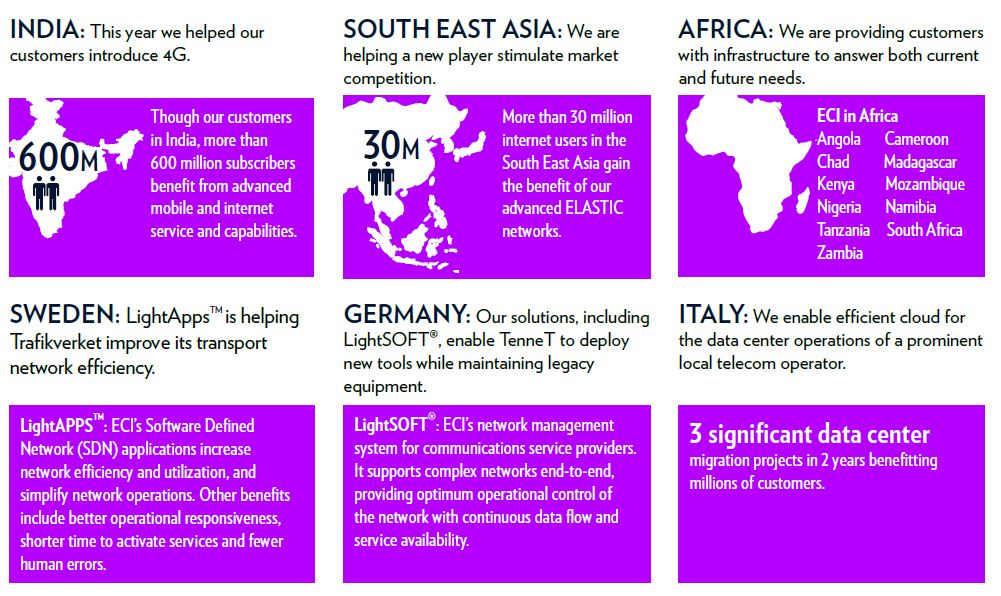
Getting future-fit is both a business strategy and a sustainability strategy.  This year, ECI's Sustainability Report, the fifth annual report, and the third GRI G4-based report, places the focus squarely on how the company has been transforming itself to become future-fit and help its stakeholders become future-fit. So many Sustainability Reports are full of gloom and doom, and the impending collapse of humanity as we know it. While no-one questions the need to transform the way our economies work and the way corporations behave, getting future-fit can be inspiring and positive. ECI's 2015 Sustainability Report reflects ECI's optimistic approach to getting ready for the future. Are you ready? 


ECI is a global provider of ELASTIC network solutions to Communications Service Providers (CSPs), critical infrastructures and data center operators. ECI provides packet-optical transport, SDN/NFV applications, end-to-end network management, a comprehensive cyber security solution, and a range of professional services.

At its core, ECI's future-fit strategy is based on an ELASTIC approach to business. ELASTIC means flexible, open, adaptable, customizable, controllable and resource-efficient. Much of this may sound like mumbo-jumbo technobabble to you.

Think about it this way. You live in Mumbai and wants to call a friend who lives in a remote area in Southern India. As you may know, fixed-telephone-line coverage in India is not comprehensive, so mobile is the most practical way to reach remote communities. According to Wikipedia, India had 24.81 million fixed line telephone subscribers in 2016, and more than one billion wireless subscribers. ECI has a strong presence in the Indian telecoms market and supports 4 leading mobile service providers, helping develop and upgrade their mobile and internet coverage and speed. The chances are that when you call your friend, the call will be transported over ECI's equipment.  

Or perhaps you live in Africa. As a result of the work of ECI in 11 countries in Africa, supporting local providers with efficient, state-of-the-art communications and internet infrastructures, people living in these countries are now able to gain access to advanced mobile and internet services.

Millions of people in the many countries that ECI serves have a similar experience. These individuals can achieve an enhanced quality of life because local providers develop and expand the quality, reach and choice of their mobile and internet services to their customers through the use of ECI's ELASTIC solutions that provide advanced, efficient, reliable, secure, future-fit technology, building on legacy installations for speed-to-market and affordable incremental costs. 

This is ECIs positive impact on society and the environment. In the 2015 Sustainability Report, ECI describes its work in developed and emerging markets, and the way new ELASTIC solutions are transforming lives for so many. 


All of this is aligned with ECI's material focus and specifically with five of the UN 2030 Sustainable Development Goals:


The 2015 Sustainability Report, in addition to all of this, describes the progress ECI has made across a range of social and environmental topics. This includes a first in 2015 for ECI -  a stakeholder round table attended by participants from civil society, ECI's supplier network, academic and business subject experts who engaged in a frank discussion about the expectations of ECI as a company and offered suggestions about the way ECI could improve its impacts. Environmental performance has continued to improve at ECI with, in 2015, further reductions in energy, emissions, water and waste.

ECI continues to promote women in technology, achieving a level of 24% of managers who are women in 2015, from 19% in 2014 (and 16% in 2011).

As a privately-owned company, ECI's commitment to transparency is part of a leading-edge approach to everything the company does. Future-fitting business is sustainability at its best. With optimism and inspiring ELASTICITY, ECI's report is worth a look.
  
It's not by chance that I write (again) about ECI's reporting. It has been my honor and pleasure to support this report, and every prior ECI report. I'd also like to call-out Eynat Rotfeld, ECI's CSR Manager who has driven reporting with a passion over the years and has slowly but surely engaged the entire ECI organization from the Chairman of the Board, through the CEO and all senior management and divisional management teams. Eynat is a CSR change-maker and an example of how trusting, collaborative relationships, consistent communication and gentle encouragement are ingredients that work in embedding a culture of CSR in an organization.


As always, take a look at the report. Give feedback!


elaine cohen, CSR consultant, Sustainability Reporter, HR Professional, Ice Cream Addict. Author of Understanding G4: the Concise Guide to Next Generation Sustainability Reporting AND Sustainability Reporting for SMEs: Competitive Advantage Through Transparency AND CSR for HR: A necessary partnership for advancing responsible business practices . Contact me via Twitter (@elainecohen) or via my business website www.b-yond.biz (Beyond Business Ltd, an inspired CSR consulting and Sustainability Reporting firm). Need help writing your first / next Sustainability Report? Contact elaine: info@b-yond.biz

Monday, May 23, 2016

Comrades. It's all about jobs.

One of the most memorable moments in the 5th Global GRI Conference last week was when the Minister of State for International Development (United Kingdom), The Rt Hon Desmond Swayne TD MP took to the stage and opened with the greeting: Comrades! It's all about jobs. 


That woke us all up. Minister Swain continued to elaborate, loudly, deliberately and perhaps even a little flamboyantly, in the following way, more or less. (Apologies, I may have missed a sentence or two in my transcript below)

"Let me give you my take on the Sustainable Development Goals.. or as we must now learn to call them, the Global Goals. Fundamentally these will, of course, deliver the disappearance of absolute poverty by 2030, and in doing so, will have created a more prosperous more stable and safer world. But ultimately, these goals come down to one thing: It's all about jobs. It's all about jobs in the end. A livelihood, a job - being able to put a roof over your head, putting food on the table, educating children, providing healthcare, generating the tax revenue which governments require to provide social services - it's all about jobs and if you look at the world, you will see that people are going to enormous lengths to secure a livelihood, a job or a better job. 40,000 people a day are going to the extraordinary lengths of leaving everything they are familiar with, everything they know, leaving their homes in pursuit of a job. Even if we take those who are being driven primarily by conflict, just look at that behaviour.


"Let's take Zaatari, on the verge of becoming the world's largest refugee camp, look at the conditions - they're much better than in many cities around the world with security, safety, reasonable accommodation, sanitation, clean water, food which the World Food Program provides, UNICEF will educate the children. But these people will nevertheless leave because the one thing that it cannot offer is a job opportunity. For a job, these people will risk absolutely every penny they have. It's all about jobs in the end. The world needs 600 million new jobs over the next decade if we are going to avoid a growing army of frustrated, despairing and angry young people who are unemployed or underemployed - exactly the sort of raw material, the circumstances, that generate conflict and instability which is the enemy of any kind of employment. So it's all about jobs.

"Now, I confess as a young economic student to having been enthralled with a right-wing economics professor in my University and his catchphrase was: Well, after all, there's only one thing worse than being exploited by capitalists and that's not being exploited by capitalists. HaHa. He reinforced his ignorance with another of his catchphrases: After all, surely any job has to be better than the alternative, which is daytime television! showing his clear ignorance of circumstances in the real world. If only it were so. So it is not any job, comrades. What if your job literally enslaves as many jobs do in all sorts of different forms? What if your job is breaking your health, poisoning the air or water or the land in which your community lives? What if your job literally costs you your life?It's not any job. We require inclusive growth - those kinds of jobs are actually job destroyers because what they do is generate the very sense of grievance or injustice which is the raw material for conflict which is utterly destructive of any prospect of employment.


"So we need inclusive growth. From where is it going to come? Well, my ideological prejudice will tell you that it certainly won't come from governments. Governments create the circumstances in which there can be inclusive economic growth - by providing a relatively benign investment environment, the rule of law, contract law, light-touch regulation - all those things that are essential to Global Goal number 16 and the targets that underpin it. Equally, the greatest enemy of employment can be a government where there is no rule of law, where there is arbitrary and unpredictable taxation, where there is no creation of successful enterprise, where people get jobs because they are somebody's cousin rather than because they are efficient. Any number of things, I assure you, governments can screw up and drive jobs away.

"I only know of one engine that can release initiative, enterprise and hard work of ordinary people to generate jobs and that is private-sector-led investment - the only sustainable engine of inclusive economic growth. But how do we ensure that those enterprises spend as much time addressing the impact of their enterprise as they do maximizing profit? That is where organizations such as GRI come into being. I think it's a huge compliment, a huge achievement, that just recently the Japanese Stock Exchange has made the GRI standard a mandatory requirement of membership. A huge leap forward in this vitally important set of guidelines for promoting transparency and collaboration. That's why the Department of International Development is so passionate in our support for this kind of initiative.

"May I make three suggestions for ways that we can drive this agenda forward. Firstly, with respect to new technology - let us harness new technology to make those reporting standards ever more up-to-date, ever more relevant and drive that agenda forward. Secondly, let's find ways of ensuring that this agenda - the environment, human rights and these proper concerns of enterprise are brought into the main effort, the mainstream, the core of the enterprise and not tucked away in a compliance department or in a department that ticks the boxes to show that the enterprise is meeting all its requirements. Finally, and most importantly, how do we address and engage those who are not already in this room? The reality is I'm preaching to the converted, otherwise you wouldn't have come to this conference in the first place. How do we engage those enterprises and draw them into this initiative so they too can be transparent and accountable? I know our best brains are working on it."


The message is clear. It's all about jobs. Creating and maintaining jobs, I believe Minister Swain was saying, is the core of a corporation's social impact and therefore accountability. In G4, soon to be reborn as a standard, job creation is not identified as a core material Aspect. There are references to inclusive hiring - but that's about diversity (G4-LA1). There is a reference to jobs supported in the supply chain as part of an organization's indirect economic impacts (G4-EC8). But there is nothing about creating jobs, sustainable jobs, as a core objective for corporations. Should there be? Job creation is often the outcome of successful business, rather than the driver. Companies will tell you they do not do business to employ people but that they employ people to do business. There is nothing about layoffs in the GRI framework and most companies do not tend to report layoffs. Should this be a new performance indicator? In the U.S. in 2015, Forbes reports almost half a million job cuts. I recently heard a talk on a webinar by a Manager at social enterprise Greyston Bakery, whose mission is: "Greyston is a force for personal transformation and community economic renewal. We operate a profitable business, baking high quality products with a commitment to customer satisfaction. Grounded in a philosophy that we call PathMaking, we create jobs and provide integrated programs for individuals and their families to move forward on their path to self-sufficiency." Job creation is as central to Greyston's mission as baking cookies is central to their operation. 


In any event, I thought Minister Swain got his point across very effectively, while demonstrating a sound knowledge of the issues at stake and the global environment in which we live and work. Is it all about jobs? Maybe it is, and maybe it isn't. But I could add that it's not only all about jobs. It's also about an ecosystem that enables people to get to the jobs, develop and thrive, and, ultimately, enjoy an ice cream here and there. I'd like to thank Minister Swain for one of the most powerful speeches at the GRI Conference. IMHO.


elaine cohen, CSR consultant, Sustainability Reporter, HR Professional, Ice Cream Addict. Author of Understanding G4: the Concise Guide to Next Generation Sustainability Reporting  AND  Sustainability Reporting for SMEs: Competitive Advantage Through Transparency AND CSR for HR: A necessary partnership for advancing responsible business practices . Contact me via Twitter (@elainecohen)  or via my business website www.b-yond.biz   (Beyond Business Ltd, an inspired CSR consulting and Sustainability Reporting firm).  Need help writing your first / next Sustainability Report? Contact elaine: info@b-yond.biz  
Related Posts with Thumbnails