Showing posts with label future. Show all posts

Thursday, August 25, 2016

Are you ready for the future?

Getting future-fit is both a business strategy and a sustainability strategy.  This year, ECI's Sustainability Report, the fifth annual report, and the third GRI G4-based report, places the focus squarely on how the company has been transforming itself to become future-fit and help its stakeholders become future-fit. So many Sustainability Reports are full of gloom and doom, and the impending collapse of humanity as we know it. While no-one questions the need to transform the way our economies work and the way corporations behave, getting future-fit can be inspiring and positive. ECI's 2015 Sustainability Report reflects ECI's optimistic approach to getting ready for the future. Are you ready? 


ECI is a global provider of ELASTIC network solutions to Communications Service Providers (CSPs), critical infrastructures and data center operators. ECI provides packet-optical transport, SDN/NFV applications, end-to-end network management, a comprehensive cyber security solution, and a range of professional services.

At its core, ECI's future-fit strategy is based on an ELASTIC approach to business. ELASTIC means flexible, open, adaptable, customizable, controllable and resource-efficient. Much of this may sound like mumbo-jumbo technobabble to you.

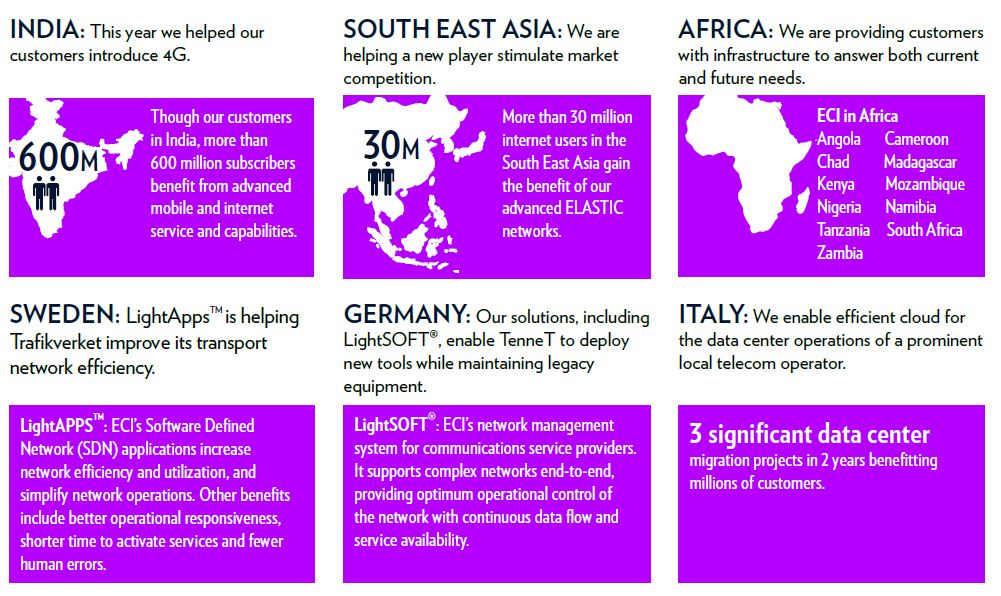
Think about it this way. You live in Mumbai and wants to call a friend who lives in a remote area in Southern India. As you may know, fixed-telephone-line coverage in India is not comprehensive, so mobile is the most practical way to reach remote communities. According to Wikipedia, India had 24.81 million fixed line telephone subscribers in 2016, and more than one billion wireless subscribers. ECI has a strong presence in the Indian telecoms market and supports 4 leading mobile service providers, helping develop and upgrade their mobile and internet coverage and speed. The chances are that when you call your friend, the call will be transported over ECI's equipment.  

Or perhaps you live in Africa. As a result of the work of ECI in 11 countries in Africa, supporting local providers with efficient, state-of-the-art communications and internet infrastructures, people living in these countries are now able to gain access to advanced mobile and internet services.

Millions of people in the many countries that ECI serves have a similar experience. These individuals can achieve an enhanced quality of life because local providers develop and expand the quality, reach and choice of their mobile and internet services to their customers through the use of ECI's ELASTIC solutions that provide advanced, efficient, reliable, secure, future-fit technology, building on legacy installations for speed-to-market and affordable incremental costs. 

This is ECIs positive impact on society and the environment. In the 2015 Sustainability Report, ECI describes its work in developed and emerging markets, and the way new ELASTIC solutions are transforming lives for so many. 

All of this is aligned with ECI's material focus and specifically with five of the UN 2030 Sustainable Development Goals:


The 2015 Sustainability Report, in addition to all of this, describes the progress ECI has made across a range of social and environmental topics. This includes a first in 2015 for ECI -  a stakeholder round table attended by participants from civil society, ECI's supplier network, academic and business subject experts who engaged in a frank discussion about the expectations of ECI as a company and offered suggestions about the way ECI could improve its impacts. Environmental performance has continued to improve at ECI with, in 2015, further reductions in energy, emissions, water and waste.

ECI continues to promote women in technology, achieving a level of 24% of managers who are women in 2015, from 19% in 2014 (and 16% in 2011).

As a privately-owned company, ECI's commitment to transparency is part of a leading-edge approach to everything the company does. Future-fitting business is sustainability at its best. With optimism and inspiring ELASTICITY, ECI's report is worth a look.
  
It's not by chance that I write (again) about ECI's reporting. It has been my honor and pleasure to support this report, and every prior ECI report. I'd also like to call-out Eynat Rotfeld, ECI's CSR Manager who has driven reporting with a passion over the years and has slowly but surely engaged the entire ECI organization from the Chairman of the Board, through the CEO and all senior management and divisional management teams. Eynat is a CSR change-maker and an example of how trusting, collaborative relationships, consistent communication and gentle encouragement are ingredients that work in embedding a culture of CSR in an organization.


As always, take a look at the report. Give feedback!


elaine cohen, CSR consultant, Sustainability Reporter, HR Professional, Ice Cream Addict. Author of Understanding G4: the Concise Guide to Next Generation Sustainability Reporting AND Sustainability Reporting for SMEs: Competitive Advantage Through Transparency AND CSR for HR: A necessary partnership for advancing responsible business practices . Contact me via Twitter (@elainecohen) or via my business website www.b-yond.biz (Beyond Business Ltd, an inspired CSR consulting and Sustainability Reporting firm). Need help writing your first / next Sustainability Report? Contact elaine: info@b-yond.biz

Thursday, August 18, 2016

Beyond Reports - 11 insights

The GRI Conference has come and gone, and I have been so busy working on so many client reports that I have barely come up for air, let alone come up to post on the blog. More about some of the reports I have been working on in recent and upcoming posts.

Lots of water under the bridge since the GRI Conference in May 2016... including the not-so-surprising-to-many-of-us departure of Michael Meehan, the GRI CEO since 2014. A new era of collaboration and innovation will now be replaced with a new era of searching for a new CEO. The hunt is on... though, as is often the case, organizations look further than they need to.

Someone  I believe is eminently qualified to lead GRI into a new era of better and more impactful reporting is GRI's current Deputy Executive, Teresa Fogelberg. Teresa has been a reporting advocate for longer than most of us have been reporting, and has advanced the positioning of reporting around the world through her work with governments and advocacy organizations more than anyone else on the landscape. As a veteran GRIer, she's well positioned to put GRI back on course. Continuity at GRI is critical in this period to avoid onging over-commercialization of the GRI services and focus on advancing the true value of reporting as a process, an output and an impact on the way business gets done and the way economies are run. Just as we might hope for the USA in the forthcoming elections,  a woman (the right woman) at the helm of GRI will be a new era of not only collaboration and innovation, but also, getting things done.

But I digress.

This post is about podcasts. You may or may not have noticed, but GRI has been putting out a series of short podcast called Beyond Reports for some time now. In fact, there are 6 in the series to date. The podcasts include a brief update of reporting news over the past month, and an interview with a reporting personality from the GRI network.


It was fun for me to be one of the six podcasters so far. At the GRI Conference, GRI's charming Media Relations Manager Davion Ford asked me lots of questions about my favorite subject: reporting. and this was the result:


Five insights:
"A challenge that is significant for companies is about reporting impacts and outcomes rather than a whole shopping list of everything they have ever done. A report is not an activity agenda - it should be a focused material account of how companies are making a difference in our lives. Companies find it difficult to report how they are making a difference rather than simply what they did."

"The biggest thing that companies have a challenge with is: bad news. No-on wants to put bad news in a Sustainability Report. I always advise my clients to include good-bad news, which means that you should disclose a challenge or particular difficulty, but you can position that in a good way by describing what to have done to address that challenge or prevent recurrence of a problem."

"Legislation is always a great motivator but often it motivates to the minimum common denominator.....two drivers that will change the motivation of companies to report are large companies and CEOs. Large companies - the biggest multinationals - are more or less getting it. If they are able to drive reporting through their supply chain, that's a real motivator for their suppliers. The second thing is, if you want to motivate a business, convince the CEO. If the CEO is convinced that reporting adds value to the business, she will make it happen!"

"Your first sustainability report is not the absolute best report you could ever produce. It will take several years of perfecting your process in order to get a better quality report."

"A limitation of reporting today is that there tends to be bits of information presented in a fragmented way, which doesn't necessarily reflect a consistency of approach year on year. If I am reviewing the report of a company, for example, I always look at one or more prior reports. You can't take a single report in isolation. Our expectation is that we can read a report, and that's it. The big challenge is for companies is to develop consistency over time in reporting."


The first podcast in the series was with Nikki McKean Wood who heads up Corporate and Stakeholder Relations at GRI. Nikki talked about the new GRI GOLD community.

Three insights:
"The GOLD community members are really our core supporters so we strive to put them at the heart of GRIs network, shaping the future of sustainability reporting."

"We hope to achieve an active, engaged and diverse [GOLD] community."

"This is a new era of sustainability... we see business taking action towards a more sustainable world, but there's a lot to do and a transformational effort is required by all to unlock the real value of sustainability data."     

The most recent podcast in the series is an interview with Christina Burmeister of Deutsche Bank:


Three insights:
"The reporting process is relevant as much for management decisions as it is for investors."

"The Financial Services Sector has experienced a major shift in the last decade.. sustainability is becoming more and more of a strategic imperative."

"One can always improve the quality of reporting and the fact that a defined set of information will be mandatory [from the EU CSR Directive]  in the near future onwards will help that case.. there are sill some challenges ahead of us and we will take this opportunity to strengthen our internal process and get the adequate information."


I encourage you to have a listen to the Beyond Reports Podcast series of GRI  and pick up loads more insights from people who live and breath Sustainability Reporting every day. Of course, listening to podcasts with ice cream helps our brain understand all those wonderful insights.


elaine cohen, CSR consultant, Sustainability Reporter, HR Professional, Ice Cream Addict. Author of Understanding G4: the Concise Guide to Next Generation Sustainability Reporting AND Sustainability Reporting for SMEs: Competitive Advantage Through Transparency AND CSR for HR: A necessary partnership for advancing responsible business practices . Contact me via Twitter (@elainecohen) or via my business website www.b-yond.biz (Beyond Business Ltd, an inspired CSR consulting and Sustainability Reporting firm). Need help writing your first / next Sustainability Report? Contact elaine: info@b-yond.biz

Thursday, December 4, 2014

Stakeholder engagement is here to stay

Stakeholder 1: I love being a stakeholder. It's so engaging.
Stakeholder 2: Yes, I agree. I love to engage.
Stakeholder 1: So, who are you engaging with these days then?
Stakeholder 2: Well, anyone who asks, really. I'm not that fussy.
Stakeholder 1: Yes, me too. I am a pro-engagement stakeholder.
Stakeholder 3: Hi guys. How's the stakeholder engagement thing going these days? I am making a killing.
Stakeholder 1: What do you mean?
Stakeholder 3: Well, I am getting invited to offer my expert opinion for a range of companies and they pay me loads of money just to tell them what I think. That's what they call engagement these days. It doesn't matter if  I use their products or services. They just want me to reply to their questions.
Stakeholder 2: But how do you give an opinion if you don't use their products?
Stakeholder 3: That's easy. I just tell them what they want to hear.
Stakeholder 1:  How do you know that?
Stakeholder 3: It's what everyone says, you know, climate change is important, treating employees well is important, ethics and integrity is important, human rights are super-important. It's not rocket science, you know. I say the same things to every company.
Stakeholder 2: But why do they ask you? I have been around far longer than you and hardly anyone asks me.
Stakeholder 3: Well, maybe you told them the truth.
Stakeholder 1:  You also have to remember that all stakeholders were not created equal. Stakeholder 3 is a real thought-leader. He has written a book. He speaks at conferences. People think he knows about companies even if he doesn't. They think it's good to have his name in the Sustainability Report.
Stakeholder 3: (blushing) Yes, not all stakeholders are equal. I admit that I enjoy all the fuss and attention. My kids stopped listening to me a long time ago. Now at least, someone is asking what I think.
Stakeholder 2: Well, I don't agree with this. I think companies shouldn't pick and choose their stakeholders. They should engage with ALL stakeholders and not discriminate.
Stakeholder 1:  And how exactly do you propose that a company does that? Some companies have millions of stakeholders.
Stakeholder 2: SurveyMonkey.
Stakeholder 3: Oh dear. If everyone starts using SurveyMonkey, I'll need to go back to teaching at the university in order to make a living.
Stakeholder 1: Oh, I am sure it's not that bad. There will always companies be that prefer to have big names in lights.
Stakeholder 3:  (blushing again) Maybe you are right. I love the lights.
Stakeholder 2:  I am thinking of sectorizing myself. You know, adding Sector Expect Stakeholder to my resume. So that companies that want a sector expert will know to come to me.
Stakeholder 1: Which sector?
Stakeholder 2: All sectors. It doesn't really matter.
Stakeholder 3: That's a great plan.
Stakeholder 1: But what if there are companies that really want to know the truth? You know, really want an honest informed opinion about their material issues to inform their sustainability strategy?
Stakeholder 3: Hahahahahahhahaha now you really made me laugh.
Stakeholder 2: Hahahahahahahahaha, me too. Not in our lifetime, buddy.
Stakeholder 1: OK, OK, I was just kidding. Stakeholder engagement is here to stay. Just like we love it.

How real is stakeholder engagement? Who is actually a stakeholder? How do companies engage with stakeholders? Whats on the cards for stakeholder engagement? Is it here to stay? And if so, what does it look like?

More on this in what promises to be a kick-ass discussion live online, hosted by 2degrees on Tuesday December 9th (next week) at 15:00 GMT. Tune in to hear and engage.. yes, engage.... with Rowland Hill (Marks and Spencer Sustainability Reporting Manager), Rachel Depree, (Sky, Senior Engagement Manager), Peter Collins (RSA Insurance Group, Group Head of Corporate Responsibility) and Oliver Hurrey of 2degrees, and myself. Check it out here and register. No powerpoints. No scripts. No pressure. Just a genuine discussion and sharing of insights and opinions on what stakeholder engagement has become, what it should be and where it's going. Approximately. It should be fun. Especially if we all disagree :-)


elaine cohen, CSR consultant, Sustainability Reporter, HR Professional, Ice Cream Addict. Author of Understanding G4: the Concise guide to Next Generation Sustainability Reporting  AND  Sustainability Reporting for SMEs: Competitive Advantage Through Transparency AND CSR for HR: A necessary partnership for advancing responsible business practices . Contact me via Twitter (@elainecohen)  or via my business website www.b-yond.biz   (Beyond Business Ltd, an inspired CSR consulting and Sustainability Reporting firm).  Check out our G4 Report Expert Analysis Service - for published G4 reports or pre-publication - write to Elaine at info@b-yond.biz to help make your G4 reporting  even better. 
Related Posts with Thumbnails