Another year-end, another excruciating task picking out my Top Ten Sustainability Reports for 2014. It's excruciating because narrowing my selection down to ten is probably the hardest thing I do on the CSR Reporting Blog each year. I am always tempted to go to 15, or 20, or 25... but then I think that tradition has its advantages and I have been picking Top Tens now for several years...
2010,
2011,
2012 and
2013. These are always the most popular posts of the year and get thousands and thousands of views. So why change a winning formula? Nevertheless, this year was particularly tough. There really are some great reports out there.
My selection is always based on reports that cross my radar throughout the year, not a scientific or strict methodical evaluation of the report quality. Some of them have already featured in different blog posts. I try to select a cross-section of companies, sectors and countries, rather than selecting the big names in reporting that generally pick up reporting awards around the world. However, as I have done for the past few years, I use the AIM MODEL as I consider the reports that I find worthy of mention. Each report adds value in its own way, and each report is evidence of progress. Therefore, in mentioning a mere ten reports of the thousands that were published in 2014, I continue to do reporting somewhat of an injustice. On the other hand, highlighting these ten reports and their unique elements may provide insights and inspiration for new reporters, or potentially better reporters. In any event, this is always a post I find both challenging and fun all at the same time.
Here is a quick reminder of my
AIM MODEL:
Authenticity: I look for whether the company has reported in an honest way, using stakeholder voices to supplement performance data. Authenticity for me includes balance, accuracy and completeness. I look for targets and progress against stated targets.
Materiality: I look for whether the company has clearly defined the most important issues for the company and its stakeholders and described the way in which those issues have been identified and prioritized. Reporting materiality should also include a certain amount of contextual information which can assist us in understanding the issues and why they are material.
Impacts: I look for whether the company identified impacts rather than just presenting a shopping list of activities. This means discussing the outcomes of what was achieved. The outcomes are the achievements (impacts), not the activities. This is by far the most difficult thing for companies to address and very few do it well.
And, in alpha order by company name, my Top Ten pick for 2014 includes larger and smaller companies, companies reporting for the first time, companies using the GRI framework at G3 or G4, and companies not using any framework, from all corners of the world and from a range of business sectors.
And now for the detail:
GRI G3.1, Application Level B+, 7th report
There's something about the consistency and intelligence of ArcelorMittal's reporting that makes it a reporting winner for me this year. ArcelorMittal's global sustainability report is no design extravaganza and you won't find any spectacular graphic elements or sweet photos of kids holding up the world on steel girders. But you will find a carefully crafted, well-written and balanced account of the company's impacts across its value chain, supported by clearly presented performance against targets and future plans, with considered material focus. A selection of short case studies supplement the narrative.
One of the things that has always impressed me about this company is its commitment, not only to global reporting, but also to local engagement. This year, the company published 15 local reports in different markets, each a report in its own right and not a copy-paste translation of the global report (although there is a shared overall strategy framework).
In fact, ArcelorMittal is deepening its local stakeholder engagement efforts, with a plan for engagement at "each and every" ArcelorMittal site. There is a compact stakeholder overview in the global report.
The global report follows a familiar structure framed around ArcelorMittal's strategy covering: investing in people, making steel more sustainable, enriching communities and transparent governance. In each section, progress is noted and relevant context is provided in each area. This aligns with the material focus of ArcelorMittal.
The material issues were developed in a process involving internal and external stakeholders. The top six issues are all direct impacts of ArcelorMittal's operations.
I wonder if the broader issues relating to the contribution of steel to society and the way steel consumption over time is changing may be equally important. This is addressed by ArcelorMittal in its reporting - I wonder if the materiality process employed was broad enough to include the full value chain impacts of steel-making as well as a focus on the operational impacts of the company. Something for ArcelorMittal to consider in future. However, this does not detract from the fact that this report is well done and fits the aspirational AIM model very well.
.
Not GRI, 44 pages, 1st report

This is DS Smith's first report and it is swimming against the tide a little (in a way that I find encouraging!). The company says: "
We have previously included a section on corporate
responsibility within our Annual Report, which was aimed primarily
at the financial community, but as our company continues to grow,
we now want to broaden our reporting and reach a wider audience." Well, now, it's broadened. I have never noticed any of DS Smith's annual reports but I have noticed this Sustainability Report, and now, you have too!
DS Smith employs more than 21,500 people worldwide, in over 250 facilities across four continents, supplying four main products and services: packaging solutions, containerboard papers for the packaging industry, recycling operations and supply of flexible packaging and dispensing products.
There are several things I like about DH Smith's first report:
First, although it is not a GRI-base report, DH Smith has followed a materiality assessment process, defined material issues and clearly linked the report content to what's material.
The company explains its targets in different sustainability performance areas and links them to corporate values in an innovative presentation.
DS Smith's report includes case studies demonstrating performance and a statement of outcome. This is unlike many case studies in most of the reports that I read that simply describe a nice activity without telling us what kind of a difference it made.
DH Smith's report also includes external stakeholder voices and insights throughout the report, demonstrating a level of engagement in practice and an outward focus on stakeholders.
All in all, a very readable, interesting and
AIM-worthy first report.
GRI G4 core, 49 pages, 3rd report
Reports from Latin America are generally quite colorful and this one from Globant in Argentina is characterized by bright design that makes reading this report fun. Sustainability is serious but it's also optimistic, energizing, aspirational and more. So many Sustainability Reports are soooooooooooooo serious, sooooooooooooooo tedious and sooooooooooooooooooooo straight-laced that it's no surprise that people moan and groan about how boring they are. Fun reports reflect a fun state-of-mind and it's catching. Globant's report combines this with good transparency and narrative in this G4 core report.


Globant's business is about developing innovative software solutions for global audiences, headquartered in Argentina with offices around the world, employing more than 3,200 peopple. WPP, the large communication service group, acquired 20% of Globant at the end of 2012.
Globant's material issues, although appearing right at the end of the report, are clearly (and colorfully) stated. Globant reports on 16 material Aspects and 21 performance indicators, demonstrating considered selection and focus of disclosure.
Each report section follows a similar structure : approach, management and performance narrative, supported by performance indicators and case studies as relevant. Globant provides data for three years, which is good practice.
Although this report does not contain any external stakeholder voices, much of the narrative is outward looking, referring to impacts on stakeholders and impacts in markets and communities, with stakeholder engagement key players and headlines of their input. In future, it might be nice to see some (colorful) commentary from Globant's stakeholders. In the meantime, a respectable, credible and fun AIM-type report from Buenos Aires.
GRI G4 referenced, 68 pages, 7th report
By now, if you are a regular CSR Reporting Blog follower, you are probably thinking that I take a commission or something from Impahla, as the Impahla report has featured in my top ten in all but one year, and that was probably only because in 2011, I decided not to pick the same companies as 2010. However, Impahla's reporting is so consistently outstanding that it's not right to discount them because they already reached the top. No, I don't get a commission, kickback or reward of any sort from Impahla. I just think the company is great, with inspiring leadership and totally triple-ice-cream-worthy reporting. Even before we look at the content of this report of this SME company with around 400 employees, just look at the way employees are honored in this report (there are three pages, I show just one of them below):
Of course, not every global company with hundreds of thousands of employees can included a thumbnail of every single employee .... but more than the pictures themselves, this tribute to employees is a rare demonstration of the true appreciation this privately-owned, forward-thinking award-winning sports apparel company has for every individual. Including all employees in Impahla's annual report has become something of a signature style for this company. That's part of the reason that Impahla is special. The other part is the founder-leader, William Hughes, a modest Kenyan-born businessman whose visionary insight and trust-based actions have shaped Impahla into a successful and sustainable business. William writes in his introduction to this 2014 report that it is written as much "for ourselves" as for external stakeholders, which I believe would be a good approach for many companies to adopt.
The report is neatly put together, smacks of professionalism and attention to detail, and is a true celebration of employees throughout the narrative. Material issues are described over a couple of pages, and page references guide you to the detailed disclosures.
Results are shared with no holes barred - both the good and the challenging.
A case study here or there adds a little color.
If there is one suggestion I might make to Impahla for future reporting, it would be to give some external stakeholders a voice. Impahla is a business rooted in the local community, a dedicated supplier to the great PUMA, a significant local employer .... while Impahla tells its story extremely well, the affirmation of external voices would help amplify and reinforce the credibility of Impahla's reporting. However, in my view, Impahla's reporting has been consistently AIMful over several years and I believe, will continue to be so.
GRI G4 core, 63 pages, 3rd report
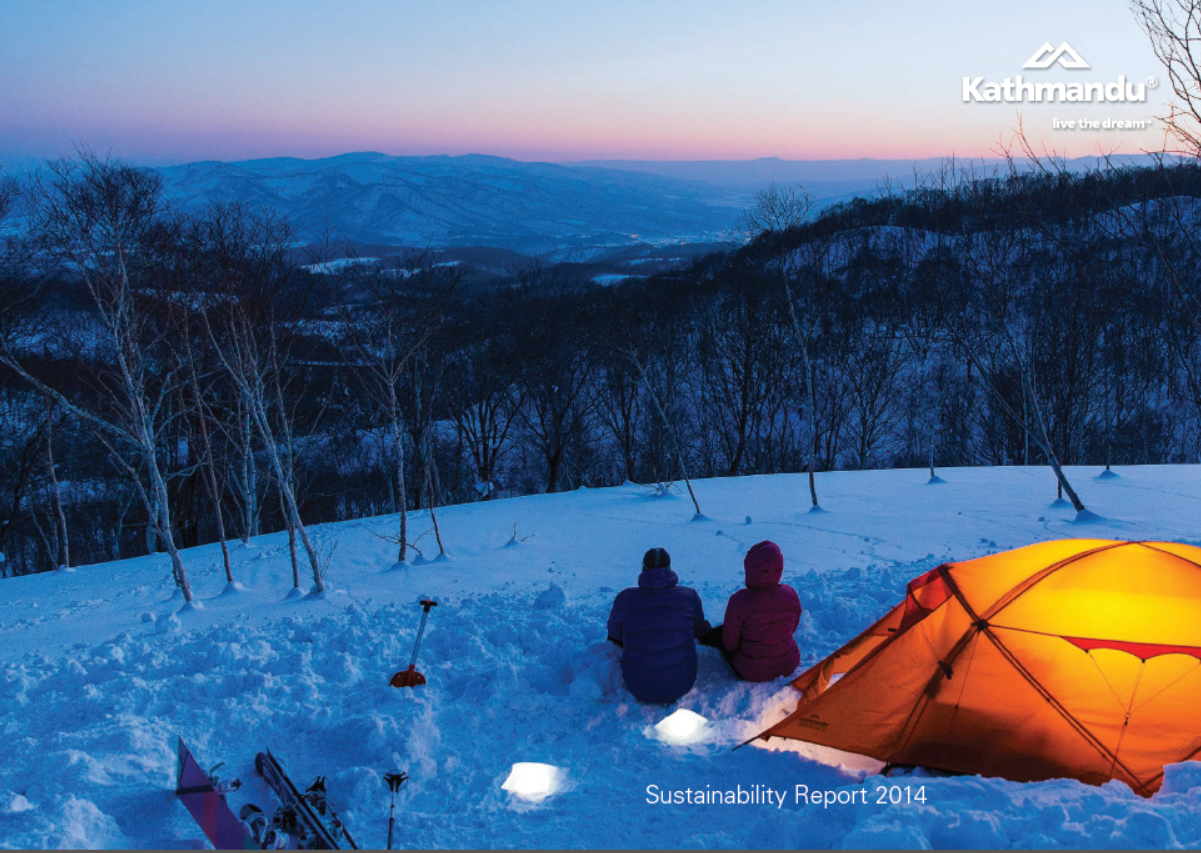
They say you should never judge a book by its cover. I say you should never judge a Sustainability Report by its photos. But some reports have photos that are just too great to pass over without comment. So it is with Kathmandu. Kathmandu is a leading retailer of outdoor clothing and equipment with 146 stores in Australia and New Zealand and 4 in the UK. The company employs just over 2,000 people. This is Kathmandu's third report. Here are some of the photos.
Although I would have like to have seen a slightly more direct link between material issues and performance indicators reported, Kathmandu works well with the GRI G4 framework in a focused 32 page report, covering its stated material issues.

An overarching issue for any apparel manufacturer is always supply chain management. Kathmandu deals with this well, with full description of the company's approach and strong relationship with a key supplier, while admitting that, at the other end of the spectrum,"we acknowledge that we have suppliers who are not achieving high standards and we are striving to increase awareness and assist them to build capacity." The challenges are by no means simple and Kathmandu transparently related an incidence of child labor in a new proposed factory as a young girl aged 15 had falsified her age and an older relative had provided verification. Kathmandu details its approach to instances of this nature - things, I suspect, that plague every manufacture using outsourced operations. Kathmandu's report also provides short case studies and outcomes of environmental activities in a way that is easy for us to understand.


As short, focused, materially relevant reports go, Kathmandu is definitely on the AIM scale.
GRI G3.1, Application Level C, 58 pages, 7th report
Olam International is a leading agri-business operating from seed to shelf in 65 countries, supplying food and industrial raw materials to over 13,800 customers worldwide with a team of 23,000 employees. Key raw materials supplied include cocoa, coffee, cashew, rice and cotton. Olam apparently means "transcending boundaries" - though I am not sure in which language - and this theme comes through in Olam's reporting. Taking a landscape view of the overall value chain is a good place to start.
Olam's 2014 report is a simple GRI G3 Application Level C affair. Or so it seems. In reality, it's an exceptionally cleverly written and designed, compact account of how Olam is making a difference in 7 key sustainability focus areas, presented as case studies in the report and exemplifying Olam's holistic sustainability approach.
In each section, we are provoded with relevant context, Olam's actions, connections to other parts of the value chain and outcomes.
The narrative is short but the message gets through. Definitely Olam has
AIMed for an impressive report, demonstrating equally impressive performance.
GRI G4 core, 55 pages, 1st report
Simple Green is the brand of Sunshine Makers, a privately-owned family company founded over 39 ago by the father of Bruce FaBrizio who runs the company today. The company developed a biodegradable, not-toxic, non-flammable, non-abrasive cleaning formula and now sells environmentally friendly cleaning products in 41 countries, manufactured in 11 facilities worldwide. Sunshine Makers employs 59 people directly and works with a network of partners for distribution. Sunshine Makers also founded EGBAR (“Everything’s Gonna Be All Right”), a non-profit foundation for environmental education and community improvement projects. I reviewed Simple Green's inaugural 2014 report on
my recent post about U.S. first-time G4 reporters.
Simple Green does a nice job of reporting for the first time and using the G4 framework, two achievements rolled into one. As the name of the brand, so the report. It's simple, and it's green. The report takes a value chain approach and uses material issues to drive the reporting content.
The company covers its key sustainability risks in a transparent way over several pages of the report.
External stakeholder voices are represented also throughout the report.
A very greenly
AIMified report.
GRI G4 comprehensive, 92 pages, 12th report
Telekom Austria is the largest telecommunications company in Austria serving many countries in central and eastern Europe with products and services including voice telephony, broadband internet, multimedia services, data and IT solutions. The total group has more than 16,000 employees serving around 23 million customers.
I reviewed Telekom Austria's Sustainability Report earlier this year in a post on the CSR Reporting Blog. As I mentioned in that post, Telekom Austria has a history of consistently fascinating and creative reports that reflect an authentic consideration of sustainability issues that are embedded in the way the company does business. As a G4 comprehensive report, this 2013 edition covers a lot of ground in its 92 pages. Materiality drives this report:
An interesting thing about Telekom Austrian's report, as I wrote earlier this year, is the use of external insights to raise critical reporting questions and perspectives. This is a report that you read to help you think about issues, not just learn about the performance of a specific company.
Telekom Austria also presents performance in a clear way, showing both continuity and intent.
Overall, AIMworthy performance and reporting from Telekom Austria.
GRI G4 core, 55 pages, 4th report
Tiffany's report is as elegant in narrative style as it is in design. The story of diamonds is well told, with responsible mining, as you might have guessed, being the number one issue that is addressed comprehensively in this report. Tiffany has adopted a leadership approach in its own operations and in the sector over many years.
What I like about Tiffany's reporting is the detail provided regarding sourcing of different raw materials, many of which have been controversial at some point and/or remain so today. Tiffany explains its sourcing, auditing and traceability processes, and its corporate position for each.
A full set of focus areas is included in the report - following a materiality assessment - although it is not clear to what extent specific engagement with stakeholders shaped this approach, or whether it was the result of internal analysis of trends, issues and analysis.
Tiffany's 2013 report is, I believe, an
AIM-driven report.
Not GRI (GRI referenced), 6th report, online with 106 page download

Wipro Limited is a global leader in providing IT Services, Outsourced R&D, Infrastructure Services, Business Process Services and Business Consulting. Wipro has a workforce of over 140,000 employees and serves over 950 clients across 57 countries.
Wipro's 2012-2013 Sustainability Report is not just a report, it's an entire education. Telling the story of the migration patterns of butterflies on journeys which includes Wipro's biodiversity-friendly designed campus in Bangalore, Wipro likens the path of sustainability to their butterfllies' journey - transformation, tenacity and endurance. "The sustainability journey is similar and progress happens in small and often invisible steps. We think that every such step, every movement forward is important . Eventually the actions and thoughts of the many will add up to a critical gestalt, a point of significant inflection. The butterfly’s journey symbolizes a spirit of commitment to its future generations in the face of severe odds. It is to this spirit that our sustainability report this year is dedicated." That's probably the most inspiring sustainability report opener that I have seen this year, or even ever. It's a fabulous story, not plucked only out of Wipro's imagination, but an example of a sort of miraclulous and uplifting event that touched the hearts of the Wipro folks. It's really nice. You should read the butterflies' story.
But that's not all. Wipro's sustainability report is also a reading list. It seeks not only to inform but to educate, commemorate and inspire.
With excerpts from classics that represent the landmarks of the sustainability movement, beautifully designed, this report is an entire Environmental Sustainability Education Program.
But don't get distracted by Wipro's creativity and respect for the great sustainability thinkers of our time. Wipro apparently has some sustainability thinkers of its own. The report is well constructed, referencing, not conforming, to GRI, but nonetheless, applying a material core. Not one, but two. Wipro splits its materiality analysis into two - actually, this is an interesting approach - and present smaterial issues for both econo-environmental and social aspects.
Wipro's report contains an overview of business and sustainability megaforces that provides important context and perspective. This is under the theme of the Sustainability Mobius.
I am not sure if I should be embarrassed to admit that I had no idea what a mobius is. How many people know that? Anyway, now I know that it's something that usually looks like this:
And I also know why it's relevant: "..... complex, interrelated issues and our fragmented and siloed societal structures have
largely been incapable of responding to these with a greater sense of urgency. The lines are
blurring between all the stakeholders, their interests and business – with no clear start
and end points much like the mobius strip."
Wipro presents achievements in the reporting year and objectives for the future - mainly qualitative but some quantitative targets. It's all very clear and very orderly and very meticulously done. If there were to be one suggestion I would make to Wipro for future reporting, it would be to raise the bar a little beyond operational activities in favor of greater emphasis on external impacts and contribution through core business accounting for the transformational change the company drives in society at different levels. Even so, this report has AIMed for much more than a report, and it's an absolutely deserving member of the 2014 Top Ten club.
***************
I hope you enjoyed this overview and that you have met some reports that you hadn't seen before. I hope these reports bring inspiration for other reporters. Using these reporting ideas is never quite as simple as copy-pasting, because every company has a unique message, style and tone. However, some of the Top Ten reports may help you look at things in a different way as you undertake your first, or next, reporting cycle in 2015. Good luck!
Happy Reporting in 2015, everyone!
Here's to the next Top Ten.
elaine cohen, CSR consultant, Sustainability Reporter, HR Professional, Ice Cream Addict. Author of Understanding G4: the Concise guide to Next Generation Sustainability Reporting AND Sustainability Reporting for SMEs: Competitive Advantage Through Transparency AND CSR for HR: A necessary partnership for advancing responsible business practices . Contact me via Twitter (@elainecohen) or via my business website www.b-yond.biz (Beyond Business Ltd, an inspired CSR consulting and Sustainability Reporting firm). Need help writing YOUR Top Ten Report in 2015? Contact Elaine: info@b-yond.biz









 Posts
Posts

