Showing posts with label marks and spencer. Show all posts

Monday, August 12, 2019

AIMing for Best in Class Reporting

I was recently asked by a client to prepare an overview of Best In Class Sustainability Reports. 

Now, I read, review and judge hundreds of sustainability reports each year, and also write several. I find reporting fascinating in all its forms, and there is no sustainability report that is not a source of insight, inspiration or interest for me. Sustainability reports are as diverse as the companies that publish them, and I find it hard to find an overall measure that represents Best in Class. In many of the awards programs in which I participate as a judge, the ultimate selection often becomes the report that achieved an aggregated highest score across a range of criteria - is that the definition of Best in Class? 

Best In Class is defined by the Business Dictionary is: The highest current performance level in an industry, used as a standard or benchmark to be equaled or exceeded.

But sustainability reports can be assessed across so many dimensions that it's not so simple to select a single report that can be used as a standard to be equaled or exceeded. Sustainability reporting is so unique and specific to each company that, while it is possible to compare use of selected reporting frameworks, or the scale of disclosure, or the length, or the colors of the design, creating a single Best in Class standard for reports is misleading. It's possible to compare certain types of disclosure across reports - such as how a company discloses carbon performance or employee engagement - so maybe it's possible to identify Best in Class reporting on certain topics. But overall Best in Class? Is Class every single sustainability report that's published? Or Best in Class for certain types of company, company size or industry sector?

The impossibility of the Best in Class assessment is why I prefer a threshold approach to evaluating the effectiveness of reporting. Framework-agnostic, metrics-agnostic and generally-agnostic, I use a simple model to the evaluate reports I come across every day. It's called the AIM Model. I developed this model for the publication of my annual list of the Top Ten  Sustainability Reports of the year in 2011. Either a report broadly meets the expectations for AIM reporting, or it doesn't. It's not about a score or a leader-board - it's about doing the job or not doing the job.

The AIM (Authenticity, Impacts, Materiality) Model goes like this:
Authenticity stands for: credible reporting that appears balanced and complete; it links reporting to purpose; it uses stakeholder voices to supplement internal narrative; it demonstrates consistency with prior reporting and shows evidence of long-term commitment with a strategy through targets and reported progress against targets; it includes a clear set of policies and positions on important topics and a CEO statement that you believe the CEO has actually read
Impacts stands for: How has the company made a difference, and how it measures that difference; not just a shopping list of activities; measurable outcomes; focused storytelling that supports describing impacts in specific cases.
Materiality stands for: clear materiality process that connects to the materiality topics identified and selected; description of the stakeholder interactions that have influenced the selection of material topics; contextual information that helps us understand the material topics and their relevance and explicit deep-dive reporting on the material topics selected.

Now, some reporters do a great job year after year in delivering reports that meet the AIM Model criteria - generally I know even before I look at the report that these companies will deliver reports that I will find inspiring. Here are three reporters that deserve a recurring 🎯 AIM Award 🎯 for their consistent reporting effectiveness. In random order. 

Marks and Spencer
Marks and Spencer plc is one of the strongest, most consistent, most comprehensive reporters that never fails to impress me with the scale of its programs and the meticulous nature of its planning, target setting and disclosing. The iconic Plan A (that has now become Plan A 2025) is a masterpiece of branding, engagement and evolution of leading sustainability practice. The 2019 Plan A Update is a fairly nuts and bolts 18-page document, no fancy design and no stories, but covers all the Plan A news in brief. Enough so that we know what M&S has been getting up to in the past year.

The prior Plan A Report for 2018 was a fuller update, more colorful (though not much more) and much more detailed.


It includes for example, as well as the individual updates against Plan A's 2025 pillars across all 100 commitments, details of how the company creates value and several pages with the governance structure for Plan A and named individuals responsible for each piece fitting into place. There are also commentaries from external stakeholders.


The Plan A overarching goals are all about Impacts - supporting customers in sustainable living, helping people live happier and healthier lives, transforming communities, science-based carbon targets and more - M&S's goals have been developed from the outside in, understanding global priorities and driving change through the business and its engagement with customers and communities.
The Material focus of Plan A is clearly described and the stakeholder input used to help define and assess material topics is explained. I find it a little odd that M&S does not publish the specific results of the materiality assessment, which they claim to have performed, in an overt way. Rather, the claim is that the most material topics, around 40 of the 100 commitments, are independently assured and a couple of asterisks denote these throughout the report. So, if you have an hour or so to spare, you can compile this list, though it's a little fidgety. Bottom line, however, it that Materiality is defined and there is a lot of supporting information as to how it was done.
And finally, Authenticity. I cannot imagine a company maintaining this scale, scope and pace of achievement and reporting year after year since the launch of Plan A in 2007 (was it that long ago?!) and reporting more generally on sustainability prior to that, without a large measure of Authenticity. Many elements support this including the transparent Plan A governance structure, the clear reporting on performance whether positive or less positive and the detailed methodology of selecting the Plan A components. Definitely worthy of an  🎯AIM Award 🎯

Kingfisher
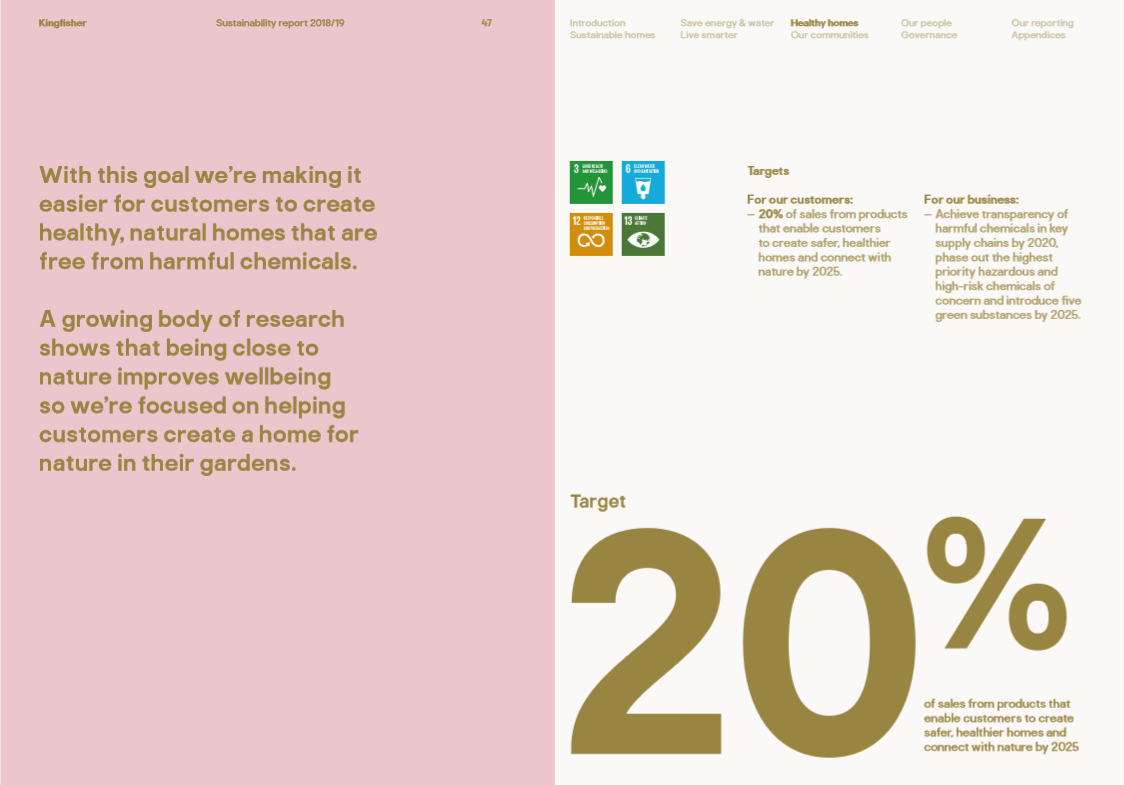
Kingfisher's reporting is bold, creative, inspiring, coherent and absolutely in line with the AIM model. I have been following Kingfisher's reporting over the years, and even selected Kingfisher's Net Positive 2012-2013 Report as one of my Top Ten CSR Reports of 2013. Kingfisher has the knack of distilling its sustainability vision, mission, program and performance into eye-level, easy-to-follow messages that get through to our minds and hearts. It's reporting for everyone: Kingfisher's 2018-2019 Sustainability Report shows meticulous transparency with on-point metrics across a range of targets alongside well-flowing narrative supported by big bold highlighter pages that anyone can understand.

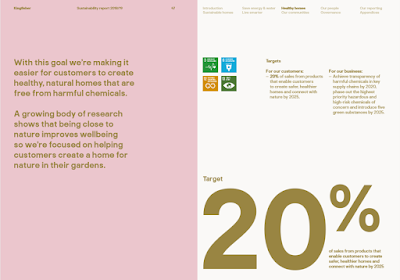


In terms of Authenticity, Kingfisher publishes performance - successes and challenges - clearly against annual and long-term targets. An external commentary from a sustainability expert and a case study from the community build in external stakeholder voices. A seemingly genuine message from the CEO, Véronique Laury (Yes, it's a woman CEO. YAY!!) expresses both the positioning, the positives and the challenges of Kingfisher's sustainability journey: "In several areas our progress has been slower than we would have liked and challenges with our data systems mean we cannot report this year on two important KPIs relating to timber sourcing and sustainable home products. We know how important these issues are and we are addressing these challenges as a priority."   
Progress against 2018/2019 targets en route to 2050 are set out with clarity:


Kingfisher's entire sustainability strategy is about its overall Impact on the world. Like Marks and Spencer above, it's an outside-in strategy with four net-positive aspirations to 2050 that focus on how Kingfisher makes a difference in the way people live their lives. Kingfisher has guidelines for customers so they can make sustainable choices and measures the proportion of sales that these choices represent. 


Outside-in strategies tend to be closely aligned with the Sustainable Development Goals. Kingfisher goes a step beyond most companies by aligning its Impacts with specific SDG targets.


As for Materiality, yes, that's in there too, supported by a description of the process used to create and revise this list annually, including a specific materiality assessment in 2018 on 25 raw materials used in Kingfisher's products, assessed for human rights and environmental practices, that will be integrated into the overall materiality assessment.


While this report does not follow the In Accordance level of GRI guidelines, an online GRI Content Index is provided.
The CSR Reporting Blog hereby grants an 🎯AIM Award🎯 to Kingfisher for consistently impressive and meaningful sustainability reporting.

Baoviet
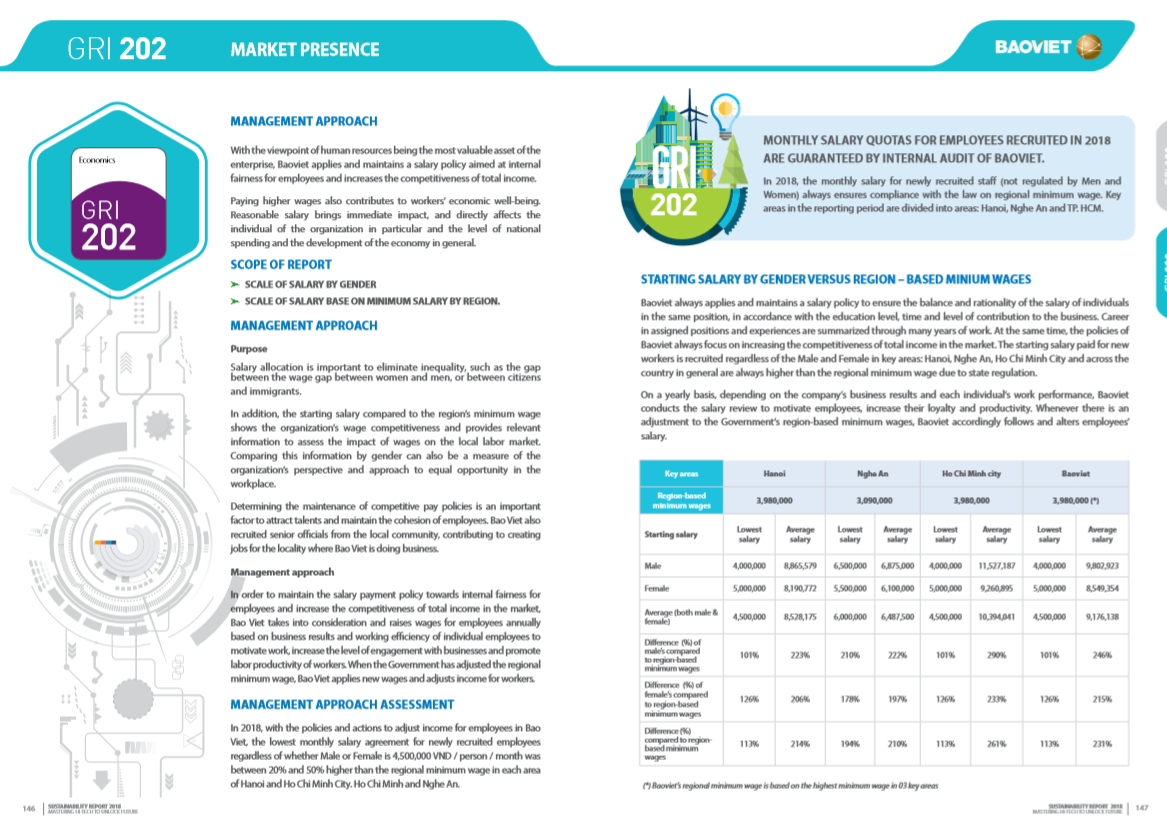
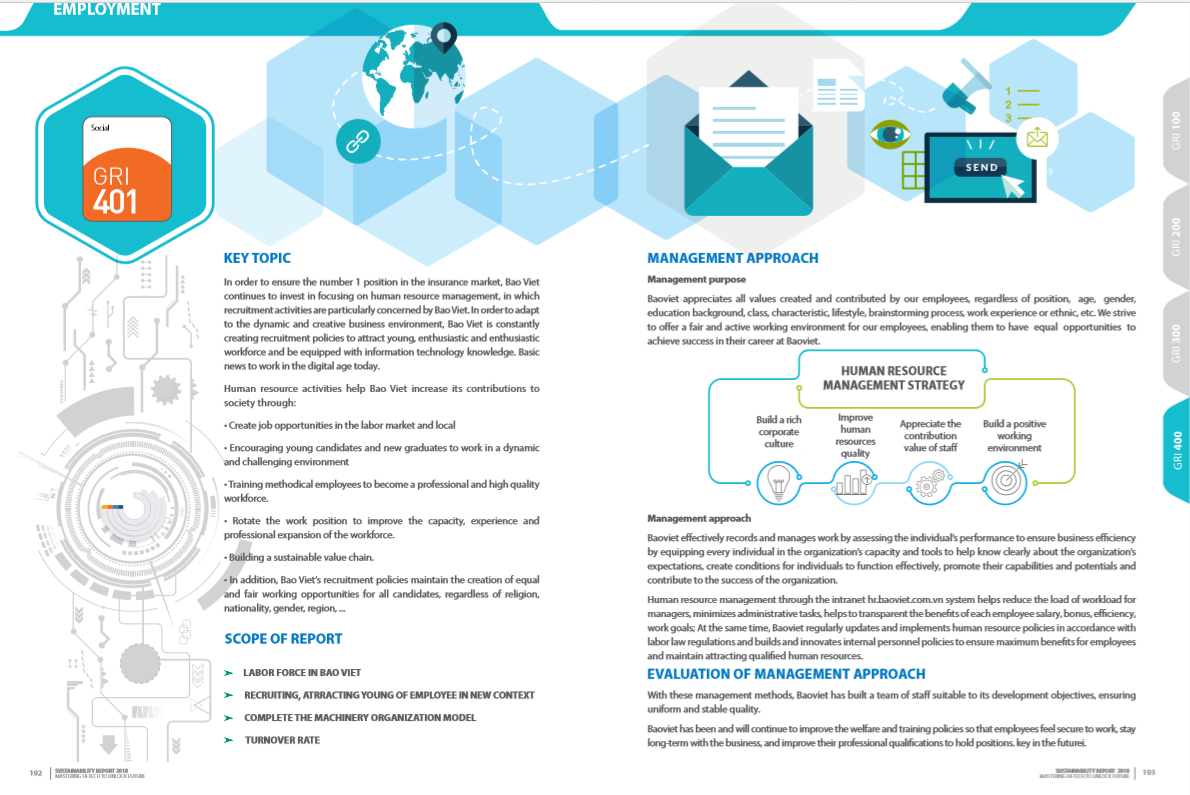
Baoviet is one of the leading financial-insurance groups in Vietnam. As a judge in the annual Asia Sustainability Reporting Awards (ASRA), I have been reading Baoviet's reports each year for the past few years and have always been impressed with the way this company pulls its report together with diligence and scrupulous attention to detail. Always rather (too?) long (the 2018 report is 257 pages!), Baoviet presents its comprehensive GRI Standards-based disclosure in a logical and lucid way. As previous reports, Baoviet's 2018 Sustainability Report, Mastering Hi-tech to unlock Sustainable Future, also shows how Baoviet masters disclosure, and not just sustainable insurance.


The report is laid out using the GRI Standards framework, addressing the disclosures in order of the 100, 200, 300 and 400 Standards sets. This is not my personal favorite way of presenting content, but it's a very respectable way of reporting, and has some advantages in terms of easy navigation to each group of topic-connected disclosures. In the case of Baoviet, this is done quite neatly, with a symmetrical order to each page, following the GRI prescribed content for disclosure of Management Approach and associated data.


Wholly AIM, this report covers Authenticity, Impacts and Materiality exhaustively. A deep-dive into risks, opportunities and context supporting the selection of Material topics helps us understand the sustainability challenges of Baoviet.


A strategic approach aligned to the Sustainable Development Goals shows that Baoviet has invested Authentic thought into its planning and sustainable development direction.


Impacts are presented in a specific section describing "indirect economic impacts" (GRI's Standard 203) summarizing Baoviet's overarching contributions to a more sustainable society, with some case studies later on in the report in the section on community involvement (GRI 413).  Definitely deserving of an 🎯AIM Award 🎯, Baoviet could also do this with a shorter report! I'd recommend trimming some of the evergreen detail from this report in future, giving greater focus to the reporting year achievements.

********


So, coming back to my opening thought, would I consider these reports Best in Class?  The highest current performance level in an industry, used as a standard or benchmark to be equaled or exceeded?

I certainly consider these reports that I find inspiring and can learn from. It's possible they might win awards (and all of these companies have won sustainability reporting awards over the years) when pitched against a limited number of entrants in an awards program (and I admit to making these choices as a judge in different awards programs each year.) In the end, I circumvented the question my client posed to me by providing a selection of reporting elements from different companies and reports, a sort of pick'n'mix showing what can be done to achieve AIM reporting, and in some cases, with a little added creativity.  So I think my message here is about delivering the best report you can, wherever you are on your sustainability journey, targeting to meet the needs of your stakeholders.

If your report does this well, some may consider it to be Best in Class.
I'll probably say that it's worth an ðŸŽ¯AIM Award🎯 !


elaine cohen, CSR consultant, Sustainability Reporter, HR Professional, Ice Cream Addict. Owner/Manager of Beyond Business Ltd, an inspired Sustainability Strategy and Reporting firm having supported 100 client reports to date; author of three books and several chapters on Sustainability Reporting and the Human Resources connection to CSR; frequent chair and speaker at sustainability events and judge in several sustainability awards programs each year. Contact me via Twitter , LinkedIn or via Beyond Business  


Thursday, December 27, 2018

Target targets for 2019

Sustainability reporting used to be about activities and actions whereas today it is more about impacts and intentions. Substantiated intentions, that is, by which I mean T-A-R-G-E-T-S. Yes, that awful, threatening, potentially blood-pressure-raising concept of actually making a public commitment to making a difference. One of the things I find most frustrating about many sustainability reports is the extreme lengths companies go to in order to describe their mission, vision, what's important to them, what's important to stakeholders, what's important to the world and why it's ALL so important ("Sustainability is in our DNA" and "The world is about to end") .... but when it comes to saying what they plan to do about it: radio silence. Vague intentions, aspirations, declaratory blurb - it's all very nice but, well, no teeth. 

Andrew Wilson, expert advisor on sustainability, author of Green to Gold and The Big Pivot, has done leading-edge work in this area. He's even quite positive in his views of how targets have progressed and become embedded in the way most large companies report on sustainability. You can gain some comfort from his article from December 2017 here. He concludes that 94% of the largest 200 companies in the world include targets in their Sustainability Reports. 


You can check out Andrew's Pivot Goals database, containing 3,923 goals that have been publicly disclosed by (large) companies in their sustainability communications over the past few years (the database contains some duplication with both original goals and those that have been superseded or replaced). While this is apparent progress, it's by no means close to critical mass for all the thousands of companies that report on sustainability. Also, as you might expect, the distribution of targets is uneven - in the Pivot Goal database, for example, in the pharma sector, I counted 13 companies with targets, ranging from one company that has 62 targets and one that discloses just one target. 

Other aspects of target setting are coverage and quality. Coverage is the extent to which a company discloses targets for all material sustainability aspects versus targets that are limited to one area, say, environmental impacts which is the most popular. Quality is the extent to which targets are SMART. You know what SMART means. SMART is not: "Continue to improve our environmental impacts". Just sayin.  

Many of the reports I view and review are GRI-based and claim to be in accordance with GRI Standards at core or comprehensive level. Now, GRI has made reporting of goals and targets mandatory in the Management Approach Disclosures. Disclosure 103-2 requires (the organization SHALL report) disclosure of goals and targets. Well, sort of. The mandatory part is diluted by the addition of some small print: if the management approach includes that component.  


Additional guidance suggests including context, time-frame, reference to legislation if relevant and more. 


So, according to GRI, for GRI compliance, reporting of targets is mandatory if you have them. If you don't, no problem. Well, no problem is exactly how most reporters approach the Approach. It's so easy to say "we are committed to", "we place great importance upon", "we are passionate about" and all those other gloriously positive affirmations, but when it comes to the crunch, it's apparently more convenient to ignore the bits that bolt those commitments down in the organization and give stakeholders something to believe in. I believe disclosing targets should be a mandatory element of material topic reporting. Every single GRI Topic-specific Standard should include a requirement to disclose SMART targets - not IF they exist, but BECAUSE they should exist. And if they do not exist, conformance to GRI Standards should not either.

Some (random) examples of how companies commit in sustainability reports:

Arguably the best-of-the-best expression of public commitments and consistent reporting of progress is Marks and Spencer, whose Plan A, when it was created in 2007, immediately set M&S apart from the crowd with a bag of 100 commitments representing the most far-reaching and comprehensive set of targets by any company at that time (as far as I know).  Although Plan A's tagline was "Because there is no Plan B", Plan A has continued to reinvent itself and currently goes under the name of Plan A 2025. Behind the scenes of Plan A is a strong commitment to sustainable business, and business that positively impacts people and planet, and the pace has been maintained even at times when the company's financial results have been a bit wobbly. Marks  and Spencer's 2018 Plan A Report includes a detailed account of progress against all targets across the four Plan A pillars in a way reflects the M&S brand: quality, detail and tailored to meet a range of needs. 


Walmart's 2018 Sustainability Report includes a range of specific commitments at the start of its 230-page report. The targets are SMART enough and cover all areas of sustainability priorities - a comprehensive approach.


At the end of the report, Walmart discloses how it is doing against these commitments:


While it's possible to correlate progress reported to the commitments made upfront, it takes a little detective work to sort it all out as the language used is different in both cases. However, Walmart's (mostly) specific time-bound targets and progress statements are enough to quench my thirst for target-juice in this report. 

CVS Health also does a great job in its 2017 Corporate Social Responsibility Report with multi-year targets and reporting of progress in the reporting year. Across four pages, CVS demonstrates a mature view of its role in society with targets that reflect its impacts on society (help create a tobacco-free generation by acting to reduce youth smoking) as well as targeting improvements it its own operations. The targets are also in line with the material impacts CVS Health defines in its report. 


A super presentation of targets is from Sinyi Realty Group, one of Taiwan's leading real estate agencies in its 2017 Corporate Sustainability Report. For key strategic areas, the company sets long-range goals, medium term targets to 2025 and short-term targets for the coming year. Sinyi transparently reflects performance against the short-term targets set in the reporting year. No room for misinterpretation or detective work required here: it all hangs together very credibly.


Google's 2018 Environment Report includes a set of targets and progress made against these. It's a clear enough presentation and scoreboard markers give you a quick overview of progress. However, while this is totally fantastic, the targets are a mixed bag, for example, two of the targets are: set targets and others are either not time-bound or relevant for the single reported year - which in sustainability terms is no time at all. All targets relate to the direct environmental impacts of Google's own operations, for example, achieving zero net operational carbon emissions, which Google has impressively done for at least the past five years.


Of course, I couldn't write a post about targets without looking at Target Corporation. I mean, if your name is Target, you have to have targets, right? Well, Target doesn't disappoint, though, oddly enough, Target's targets are called goals 😂😂😂 But, whatever they are called, they are extensive and are presented across 7 pages in Target's 2018 Corporate Responsibility Report, followed by a couple of pages of upcoming goals (or targets) in areas not measured to date or not the subject of goals so far.  


There is no doubt in my mind that the inclusion of public commitments is both a way to reinforce trust with stakeholders and a tool to catalyze performance improvements. Several leading companies are doing this really well, and I tend to agree with the analysis above that more are doing so these days than in the past. However, the leading companies across the world represent only a small fraction of the entire population of reporting companies, and many (I might even say, most) of them do not even hint at targets or commitments.

So, let's be clear: If you want stakeholders to believe you are serious about sustainability, or whatever you call it in your organization, make SMART public commitments in key areas of impact and report your progress against these year on year. 

Of course, a great addition to any Sustainability Report would be the inclusion of a target to provide a lifetime supply of free ice cream to anyone who blogs about your targets on the CSR Reporting Blog. 

Happy Holiday Season and Happy 2019 to all CSR Reporting Blog readers!


Thursday, December 4, 2014

Stakeholder engagement is here to stay

Stakeholder 1: I love being a stakeholder. It's so engaging.
Stakeholder 2: Yes, I agree. I love to engage.
Stakeholder 1: So, who are you engaging with these days then?
Stakeholder 2: Well, anyone who asks, really. I'm not that fussy.
Stakeholder 1: Yes, me too. I am a pro-engagement stakeholder.
Stakeholder 3: Hi guys. How's the stakeholder engagement thing going these days? I am making a killing.
Stakeholder 1: What do you mean?
Stakeholder 3: Well, I am getting invited to offer my expert opinion for a range of companies and they pay me loads of money just to tell them what I think. That's what they call engagement these days. It doesn't matter if  I use their products or services. They just want me to reply to their questions.
Stakeholder 2: But how do you give an opinion if you don't use their products?
Stakeholder 3: That's easy. I just tell them what they want to hear.
Stakeholder 1:  How do you know that?
Stakeholder 3: It's what everyone says, you know, climate change is important, treating employees well is important, ethics and integrity is important, human rights are super-important. It's not rocket science, you know. I say the same things to every company.
Stakeholder 2: But why do they ask you? I have been around far longer than you and hardly anyone asks me.
Stakeholder 3: Well, maybe you told them the truth.
Stakeholder 1:  You also have to remember that all stakeholders were not created equal. Stakeholder 3 is a real thought-leader. He has written a book. He speaks at conferences. People think he knows about companies even if he doesn't. They think it's good to have his name in the Sustainability Report.
Stakeholder 3: (blushing) Yes, not all stakeholders are equal. I admit that I enjoy all the fuss and attention. My kids stopped listening to me a long time ago. Now at least, someone is asking what I think.
Stakeholder 2: Well, I don't agree with this. I think companies shouldn't pick and choose their stakeholders. They should engage with ALL stakeholders and not discriminate.
Stakeholder 1:  And how exactly do you propose that a company does that? Some companies have millions of stakeholders.
Stakeholder 2: SurveyMonkey.
Stakeholder 3: Oh dear. If everyone starts using SurveyMonkey, I'll need to go back to teaching at the university in order to make a living.
Stakeholder 1: Oh, I am sure it's not that bad. There will always companies be that prefer to have big names in lights.
Stakeholder 3:  (blushing again) Maybe you are right. I love the lights.
Stakeholder 2:  I am thinking of sectorizing myself. You know, adding Sector Expect Stakeholder to my resume. So that companies that want a sector expert will know to come to me.
Stakeholder 1: Which sector?
Stakeholder 2: All sectors. It doesn't really matter.
Stakeholder 3: That's a great plan.
Stakeholder 1: But what if there are companies that really want to know the truth? You know, really want an honest informed opinion about their material issues to inform their sustainability strategy?
Stakeholder 3: Hahahahahahhahaha now you really made me laugh.
Stakeholder 2: Hahahahahahahahaha, me too. Not in our lifetime, buddy.
Stakeholder 1: OK, OK, I was just kidding. Stakeholder engagement is here to stay. Just like we love it.

How real is stakeholder engagement? Who is actually a stakeholder? How do companies engage with stakeholders? Whats on the cards for stakeholder engagement? Is it here to stay? And if so, what does it look like?

More on this in what promises to be a kick-ass discussion live online, hosted by 2degrees on Tuesday December 9th (next week) at 15:00 GMT. Tune in to hear and engage.. yes, engage.... with Rowland Hill (Marks and Spencer Sustainability Reporting Manager), Rachel Depree, (Sky, Senior Engagement Manager), Peter Collins (RSA Insurance Group, Group Head of Corporate Responsibility) and Oliver Hurrey of 2degrees, and myself. Check it out here and register. No powerpoints. No scripts. No pressure. Just a genuine discussion and sharing of insights and opinions on what stakeholder engagement has become, what it should be and where it's going. Approximately. It should be fun. Especially if we all disagree :-)


elaine cohen, CSR consultant, Sustainability Reporter, HR Professional, Ice Cream Addict. Author of Understanding G4: the Concise guide to Next Generation Sustainability Reporting  AND  Sustainability Reporting for SMEs: Competitive Advantage Through Transparency AND CSR for HR: A necessary partnership for advancing responsible business practices . Contact me via Twitter (@elainecohen)  or via my business website www.b-yond.biz   (Beyond Business Ltd, an inspired CSR consulting and Sustainability Reporting firm).  Check out our G4 Report Expert Analysis Service - for published G4 reports or pre-publication - write to Elaine at info@b-yond.biz to help make your G4 reporting  even better. 

Friday, March 11, 2011

Is Marks and Spencer's ladder standing against the right wall?

I am often approached by students to provide assistance with their studies on sustainability. This time, an MSc student from the UK challenged me with several questions about the Marks and Spencer 2010 report. Whilst I don't manage to response to everyone in such great technicolor detail, I used this student's questions as a great opportunity to study the M&S report and blog about the iconic Plan A, all the while assisting with the study of sustainability.

Here are the questions in red with my answers in boring old black:

What is the GRI Application Level sought by the last report by M&S 2010? I have read that it is C, but looking at the GRI index at the end, it is not clear. How do I get this information?

Yes, it's true, some reports don't clearly state the Application Level of their report in a very visible and accessible way. The M&S Report notes on page 40: "To provide a common point of reference, the Global Reporting Initiatives’s (GRI) third generation G3 framework has been used as a checklist. As the Report is mainly based around our Plan A commitments it has been prepared in accordance with the level C". I interpret this to mean that they have not rigorously applied the C framework but have more or less, in a roundabout way, generally speaking, rather, somewhat, glanced at the GRI C framework. In actual fact, after a quick review I can see that one of the mandatory disclosures, 4.15 (basis for identification and selection of stakeholders with whom to engage) is not reported. You can look at the GRI Application Levels table on the GRI website to know what indicators need to be reported at each level.

M&S doesn't explain how they selected their core of stakeholders (4.15). However, although there is lot of literature on M&S, I never found a stakeholder unhappy to be left out. Most of the NGOs and Think Tanks commentators are positive about M&S's report (and therefore M&S's way of selecting stakeholders). Here is the contradiction: apparently they haven't reported properly (4.15) but nobody is complaining as if they have done well practically. Is this correct?

Actually, the  Stakeholder Dialog section in the M&S report (pages 42 and 43) is quite impressive and certainly has more breadth and depth than most of the reports I read. Stakeholder dialog is one of the most important parts of a sustainability report and most don't do it well, mainly because they don't have a structured approach to stakeholder engagement and therefore revert to reporting about general conversations with customer and suppliers and mentioning a few industry associations they are affiliated with. True stakeholder dialog is the fundamental basis for legitimacy any organization can seek, and representing it well in the Sustainability Report one of the strongest pillars of credibility. M&S report on how they engaged an external party, Ernst and Young to gather "impartial feedback" from a range of organizations, which the report lists. All of these organizations are NGO's which focus on different aspects of sustainability. The broad stakeholder responses gained from this exercise are listed and are quite enlightening being not simply complimentary but offering good suggestions for M&S's sustainability direction. M&S's responses to the responses are also listed. In addition, M&S reports the channels for stakeholder interaction with other stakeholder groups. 


This is a good overall representation of stakeholder engagement. We might of course ask how the stakeholder groups were selected, how many stakeholders from each NGO consulted provided feedback, and why they elected to use an external party to facilitate dialog rather than create a direct route for discussion involving M&S people. We might ask for more information about the true nature of stakeholder dialog with employees, suppliers, customers and regulators, some of which is only briefly referred to in the body of the report. We also might wonder how much stakeholder feedback and input influenced the selection of Plan A commitments (and we may need to go back to January 2007, when Plan A was launched, to find out) or the new 80 commitments launched in March 2010. In response to the point about no-one complaining because M&S did not disclose against 4.15, I would say that, first of all, we don't know who complained and if so, because M&S does not disclose this. In general, however, M&S does do well with a strongly branded and well-communicated Plan A, and a very detailed report against the commitments they have made, so I doubt there will be a stakeholder lobby about a gap against profile disclosure 4.15.

They said that they reported on 4.17 (what the stakeholders have to say). However, they reported only what the stakeholders said on the issues that M&S selected. So, we don't know whether the stakeholders presented other issues as material or not. Again, I never read practical criticisms of materiality on regard of M&S report 2010. I only read your comments to the report of 2008, on regard of the lack of transparency of what happened when employees were made redundant. So, am I right that 2010 report still lacks of transparency on materiality but that, at the same time, the public seems happy with it?

This is a good point. M&S have not published a materiality matrix. We are left to assume that the 100+ commitments reflect the most material issues. We don't know from the way M&S reports anything about the relative intensity of the feedback the company has received from different stakeholders, nor do we know how these issues tie into M&S's core business strategy, aside from some obvious assumptions relating to growth and cost savings. The plan A commitments range from aiming to make all  UK and Republic of Ireland operations (stores, offices, warehouses, business travel and logistics) carbon neutral by 2012  (no. 1), to maintaining a non GM food policy (no. 53), to introducing a range of recycling services for customers including a project for used clothing (no. 44) to providing improved health and lifestyle information to employees (no. 100) and a whole lot more in between.  Which of these are material?  Which are more material ? Which are most material? And why? M&S did not meet commitment no. 49, to triple sales of organic food by 2010. In fact, 2009/10 sales were below 2005/6 levels. Is this of any material significance? Will the general health of consumers be seriously affected by avoidance of organic foods? Will M&S's share price take a hit because of this? Will fertilizer and pesticide volumes used in M&S products be increased as they sell less organic food? 
M&S have a checklist of performance indicators, their own kind of GRI, and they work through this. The difference between Plan A and the GRI framework is that the GRI framework, imperfect though it may be, is a multi-stakeholder consensus driven platform which is now widely accepted as leading practice. The M&S Plan A is a unilaterally developed performance program. It's a bit like the ladder against the wall analogy. M&S are outstanding ladder-climbers, but is the ladder standing against the right wall? And how do we know?
In response to the point as to whether the public are happy with it, it seems they are. M&S enjoys much participation from consumers and gains much kudos from thought leaders in this space. The company deserves great credit. They are doing far more, and doing it far better, than many. Perhaps that is the limit of their stakeholder aspirations (and perhaps they know that).  

  
I have the feeling (from many readings, but I can't point to any specific one) that the supply chain issue is better covered by other competitors, such as Sainsbury. However, M&S is famous for being very demanding with its supply chain, being mostly the only big retailer that is sending auditors everywhere. So, could M&S be weak on reporting on supply chain, but strong in practice? Why would it be so?

I think part of the response to this is the format M&S uses for its reporting. Rather than describe policies, goals, objectives, case studies, and provide a platform for stakeholder voices in the report, the Sustainability Report is a list of commitments and status statements against Plan A. This makes for a very disjointed view of the M&S performance. We only know about anything insofar as it is encompassed in one of M&S's commitments. Reporters who weave goals and objectives into a body of narrative which flows logically may well give an impression of more comprehensive reporting when in fact they may be doing less than M&S.

Marks and Spencer report is a C Level but why is it self-declared and C only (not C+) given that it was externally certified by Ernst and Young ?

The assurance statement by Ernst and Young could qualify for the GRI "+". However, as mentioned earlier, M&S are very hedgy about their claim to Application Level C. They have not really declared and Application Level but merely assessed their level of disclosure to be in adherence with Level C guidelines. They could have said C+ guidelines just as easily. However, the assurance statement did not assess the M&S report against the GRI guidelines requirements, which I would expect it to do if assuring a true GRI report. Perhaps it was just easier all round to leave this point rather fuzzy.  


So, that was, for me, an interesting review of the Marks and Spencer report, based on an even more interesting set of questions from our London student. I think that definitely deserves a Chunky Monkey next time I am in London, don't you ?


elaine cohen, CSR consultant, Sustainabilty Reporter, HR Professional, Ice Cream Addict. Author of CSR for HR: A necessary partnership for advancing responsible business practices Contact me via www.twitter.com/elainecohen  on Twitter or via my business website www.b-yond.biz/en  (BeyondBusiness, an inspired CSR consulting and Sustainability Reporting firm)

Tuesday, November 30, 2010

What they said at the CSR conference

Here I am back from the Ethical Corporation Reporting and Communications Summit held in London on 25th and 26th November. Promising to provide answers to whether one-way CR Reporting is dead, what integrated reporting means in real life, whether stakeholder engagement adds value, what good CR practice looks like online and more, this conference presented an array of CSR practitioners from the best of companies such as Vodafone, M&S; JS Sainsbury, Sony and more. Below is the conference in quotes which I have tried to reflect fairly and not take out of context (much). These are things that I wrote down. There were many more insights to be gained from listening to the entire presentations and debates, but this should give you a bird's eye view. Background on the speakers and companies can be found at the conference link in the first line of this blop.

Andy Wales of SABMiller
"Sustainable development is part of everything we do"
"For every job we create in Uganda, 100 additional jobs are created"
"I remain unconvinced that analysts are looking at the long term issues "
"Less than 10% of people [visiting our site] download the [CR] report"
"People have a completely bizarre view of how our bisiness works"

Chris Burgess of Vodafone
"It's very difficult not to report these days"
"The main value of sustainable reporting is more of an internal one"
"We're not really clear who reads our reports"

Rowland Hill of M&S
"The best reports are considered to have a compelling story to them"
"A report should be the tip of an overall communications iceberg"
"A report has done 90% of its job by the time you've got it signed off"
"Our employees have never been as engaged as they are now.. but when we gave the [sustainability] report to our employees, it hit the recycling bin faster than we could say something short."
"Key external opinion formers are the target of our reporting"
"An Ipsos Mori survey in September 2010 showed that when asked "Which sustainability reports have you read?", 40 respondents from the NGO and CR expert community responded M&S (68%), Tesco (65%), Coop (65%) Sainsbury (55%), Next (8%) Debenhams (8%) " (actually this was more of a slide than a quote but it's close enough:)
"Integrated reporting is an interesting thing"

Marcelo Esquivel of Anglo American, Chile
"The first challenge [of writing reports] is to make sure they are read"
"I definitely believe integrated reporting is the immediate fture"
"We are proud of the net positive impact we generate in communities"

Simon Braaksma of Phillips
"Sustainability is part of our company strategy"
"Our report is not written by one person, it's a military operation"
"[Our report] helps employees understand the business strategy"

Judith Moore of the World Bank
"Stakeholder engagement and feedback [on our report] is disappointing"
"[Reporting] has actually made our job a lot easier  - it creates a lot less dissonance in our work and makes it easier to raise money in capital markets"

Louise Tyson of BP
"You get caught up in a discussion about share price and environmental issues - but is important to remember that 11 people died"
"Most crises are much shorter .. this one lasted several months"
"Targets we set for the next BP report are transparency (using accessible language), balance (not being defensive), commitent to the Gulf of Mexico and a roadmap for BP and the way forward"
"The big challenge is who's going to read our report "

Chris Harrop of Marshalls
"The UNGC is a very good roadmap to organise our own sustainability actions"
"We use the UNGC framework to fame our discussions with stakeholders"
"Our CR report is easy to write"

Toby Webb of Ethical Corporation
"cutting edge" "authentic" "genuine"  (talking about the Patagonia CSR website)
"Timberland talks about issues they don't know how to solve"

Marjolein Baghuis of the GRI
"Stakeholders need to see results from their inputs"

Emily Nicholl of Sony
"First forget social media .. this is about being social..."
"We have to shift from smiley baby reports to development and data-heavy and rigorous reports"

Jeffrey Oathan of Centrica
"Reporting can be prety boring"

Revital Bitan of Intel
"Our localised CSR reports create a link between Intel and national issues"
"A CSR report is like a reference guide"
"Think integration not subsitution"
"Be prepared to engage"
"Employees are trained in blogging but blogs are not censored"

EDF Energy (marketing slogan) (I love this)

If we save today, we can save tomorrow. 

Finally, the only thing I was hoping to hear but unfortunately was not articulated even once during this informative and  thought-provoking two day conference was:

"And now it's time for an ice cream break - free Chunky Monkey for everyone!" 


elaine cohen, CSR consultant, Sustainabilty Reporter, HR Professional, Ice Cream Addict. Author of CSR for HR: A necessary partnership for advancing responsible business practices Contact me via www.twitter.com/elainecohen  on Twitter or via my business website www.b-yond.biz/en  (BeyondBusiness, CSR consulting and Sustainability Reporting firm)

Friday, November 12, 2010

Is one-way CR reporting dead?

I like Ethical Corporation conferences. I have attended several over the years and have never been disappointed. I go to conferences to learn from practitioners and hear the latest thinking on different aspects of CSR and reporting. I feel it has been worth my time when I come away with new information and ideas and an up-to-date feel for what is going on in the CSR space. (Meeting people is fun too, of course!) I have always come away from Ethical Corp conferences with added value. (haha, at one conference,  when Cadbury's had a stand presenting their CSR Report, I also came away with about 3 kg of Dairy Milk chocolate). So later this month I am off to the Ethical Corporation Annual CSR Reporting and Communications Summit.  In fact, I have also been asked to speak at one of the conference plenaries. (I am not showing up yet on the speaker list so I will keep you in suspense as to which session I am speaking in :)  

In the opening plenary, which I am not speaking in, (well, except for a little heckling from the stalls, maybe) SABMiller, Vodafone and Marks and Spencer will be debating whether one-way CR reporting is dead. Of course, we know the answer to that. It's not. By far the majority of companies are still pushing out their CR reports in standard PDF format, and not providng platforms which engage stakeholders in a participatory dialogue.

SABMiller have a nice online sustainable development site which includes detailed performance charting in a special metrics portal, and downloadable reports including prior years reports from way back when. The Company produces several sustainability-related reports each year. One is their full annual Sustainability Report, but others are issue or region specific.This report, for example, called "Working for South Africa - the contribution of SABMiller to the South African economy" , is a thorough, transparent and fascinating look at the beer and liquor industry in South Africa, the direct and indirect impacts SABMiller is reponsible for and the multiplier effects of SAB activities in the local economy. However, getting back to the opening plenary, and one-way communciations, SABMiller are doing it two ways, with the "Views and Debates" section, in which you can find the SABMiller sustainability blog whch has been on air with a spurt since June 2010, slowing down a little in recent months, with the most recent post being from Andy Wales, head of SABMiller Sustainable Development sharing his experiences from the BSR conference.  Despite the fact that all the recent posts I looked at do not appear to have generated any engagement in the form of comments, and provided that the SABMiller blogging team can keep up the pace, this is a good platform for dialogue. It does, however, show how tough it is to maintain this kind of platform  and generate some interaction.. Anyway, I left a comment, haha, couldn't resist.

Vodafone is a master reporter having changed the game with the "We said, We have, We will" motto which has been emulated by many in various forms. Vodafone's reports are always clear, carefully crafted and focussed well on material issues. The Vodafone website doesn't have much that is  any other way than one-way, though. All their reports, including several local country reports, are available for download as PDF's. The thing that appears to come closest to interactiveness is the page on their CSR website called CR Dialogues.  Actually, though, these aren't dialogues, they are monologues - posts by non-Vodafone people expressing their opinions, with no room to comment, despite Vodafone saying they want our views.  

Marks and Spencer Plan A (Doing the Right Thing) website is nicely branded. See how they talk CSR without even mentioning the word ? Most of this site is the one-way version with nice presentation of all M&S  sustainability ... errr...oops... Plan A initiatives. However, the M&S two-way comes in the form of getting people to make promises... pledges...  so that M&S can turn customers into Plan A customers through involvement in social, personal and environmental initiatives. Each of the possible pledges are explained in an easy style, advising readers what they can do and what a difference it makes. It's good. The website shows 18,580 people have signed up with their own individual pledges. That's quite a number. Wonder how many people have kept their pledge? However, aside from pledging, there doesn't seem to be much opportunity for interactive dialogue on the M&S site.

So, there we have it. Three speakers... two with no dialogue and one possible dialogue .. talking about whether one-way reporting is dead.. Should be an interesting session .... or a very short one. Haha. However, all three companies do maintain outstanding CSR programs and consistently report  well, and I am sure what they have to say will be fascinating. I  will be interested to hear how these companies do spark dialogue around their CR initiatives in forums which are not necessarily on their online reporting site, and how they see their own company's reporting evolving. I will be interested to hear what they have tried in terms of communication with different stakeholder groups and what has worked or not. The other interesting aspect which is often debated is to what extent the CR report itself is a vehicle  for communications. Maybe the CR report is the catalyst but the communications (read: dialogue) of necessity must take place elsewhere.

If you plan to be at the Ethical Corp Annual Reporting and Communications Summit on 25th and 26th November in London UK, do let me know or come up and say hi during the conference.  I wonder if this time they will serve Chunky Monkey during the breaks :)


elaine cohen, CSR consultant, Sustainabilty Reporter, HR Professional, Ice Cream Addict. Author of CSR for HR: A necessary partnership for advancing responsible business practices  Contact me via www.twitter.com/elainecohen  on Twitter or via my business website www.b-yond.biz/en  (BeyondBusiness,  CSR consulting and Sustainability Reporting firm)

Monday, August 9, 2010

19 textile sector companies sustainability profiles

Alongside the very worthwhile Sustainability Initiatives study benchmarking of 100 top-notch Companies and what they are doing to save the planet and us, Sustainable Life Media also released at the end of last month another fascinating report entitled: "Exporting Textiles: March to Sustainability. Preview of the coming decade: Textile Supply chain Sustainability Plans by Brands and Retailers." And as if that title weren't long enough, it has a subtitle: "Getting Manufacturers to Create Business Value through GHG (Energy), Water and Waste Conservation". The report was produced by cKinetics, and supported by SLM and Nitra. Anyway, now we know what it's all about, let's take a look.

We start off with a bit of context taken from the intro-page: "The 1990s was about the march towards manufacturing quality as the textile industry worldwide raced to adopt lean manufacturing and ISO driven quality practices. The 2000s were about ensuring ethical sourcing and labour practices. The coming decade is going to be about sustainability and optimally using natural resources to generate value in the textile supply chain. This report previews activities already underway that are harbingers of this coming movement." The report examines aspects of sustainability which concern the textile supply chain from the raw material (natural fiber or man made fiber) to the point that it is converted to finished product. The focus in the report is primarily on energy efficiency, greenhouse gas emissions, water and chemcial footprints and logistics. This is important as, the report says, the textile industry is the number one fresh water polluter on the planet, and is high in carbon intensity. In India, for example, 10% of the country's energy is consumed by the textile industry. 10% . Think about that for a minute................ OK. Stop. Move on.

The report provides detailed profiles of brands and their supply chain sustainability initiatives of 19 leading textile sector companies. Those that have programs under way are: Adidas, Carrefour, Gap Inc, H&M, Ikea, Levi Strauss, Marks and Spencer, Nike, Otto, Walmart, Continental Clothing. Those companies whose (supply chain environmentl) initiatives are at the planning stage are: Phillips-van-Heusen, Timberland, Inditex, Grupo Cortefiel, John Lewis Partnership,  Primark, Lindex and Tesco.  None of the Companies studies are in the unfortunate position of not having anything in progress or in the pipeline, which is a good thing, I suppose.

A few interesting initiatives: Gap are extending their environmental footprinting assessment right throughout the supply chain , including the mills that convert cotton into fabrics. This is great. Marks and Spencer are going big on Fairtrade cotton with a target of 20 million garments by 2012. Levi Strauss have extended Global Effluent Emissions guidelines to second tier suppliers. And more and more .....

The report profiles each of these manufacturers using the following parameters:

*  Overall approach and key initiatives
*  Aspects of supply chain sustainability the Company measures (eg energy, water, emissions etc)
*  Standards and Frameworks used (eg GRI, GHG PRotocol, Oeko-Tex or proprietary framework)
*  Sustainability intiatives relative to the Company's suppliers.

Some Company reports are highly detailed, with some, such as Primark and Lindex, did not fill a page.

(NB: The report does not analyse reported data or benchmark or rank Company performance; it describes what the Company is doing and which processes it has adopted). (Sorry, I know you all like rankings, but this report doesn't go there. Hah! Gotcha!)

In addition, the report summarizes the provisions of the key standards and certifications for sustainability (environmental) initiatives in the textile supply chain and ends up with some predictions. The report's key conclusion is that "evidence pointing to a new wave of sustainability is quite clear". The report predicts that (environmental) sustainability intiatives in the textile supply chain will be adopted by all major players, and will become a differentiating factor in supplier selection.

I might add a couple of predictions myself:

First, the word "traceability" will necessarily be on the lips of every manufacturer sourcing textiles and suppliers will need to be able to operate systems which give total supply chain transparency and accountability.

Second, manufacturers will need to change their own internal procedures. It will not be enough to require suppliers to be more environmentally friendly. Manufacturers will need to review the way they manage consumer demand and production planning which in turn affects the way suppliers can respond, and impacts the production, waste and logistics activities. Whether or not the 18 companies benchmarked will succumb to the pressures of slow fashion remains to be seen, but even if they continue fast fast fast fashion, they will have to start doing it a little differently to generate greater total supply chain effiiencies.

Third, as a result of all these brilliant supply chain efficiencies, manufacturers will pay their suppliers a fair wage and also share their supply chain savings with consumers, and we will all be able to afford a new wardrobe about six times a year. Oops. You don't believe that, do you ? Just kidding. :) Only 5 times a year.

The big advantage of this report is the ability to review 19 of the top players in the sector side by side and gain an overall  insight into what is driving environmental sustainability initatives in this sector. The textile sector is fascinating and contains many lessons for different industries. The challenges of environmental sustainability in the massively complex textile supply chains are incredible. This report is a useful addition to our body of knowledge and hopefully will serve to accelerate progress.

By the way, most of  the data provided in this report was sourced from Corporate Responsibility Reports. YEAH!  I told you CSR reports were good for something!


elaine cohen, CSR consultant, Sustainabilty Reporter, HR Professional, Ice Cream Addict. Contact me via www.twitter.com/elainecohen  on Twitter or via my business website www.b-yond.biz/en  (BeyondBusiness, an inspired CSR consulting and Sustainability Reporting firm)
Related Posts with Thumbnails