Showing posts with label material issues. Show all posts

Sunday, September 9, 2018

Cosmetic materiality

This week, a Press Release announcing the publication of AS MADARA Cosmetics ESG Report for 2017 caught my eye for several reasons. (1) Madara is a Latvian company - not too many of those publish reports - the GRI Database lists just 5 reports in 2017/2018 from Latvia. (2) It's a FIRST report - and you know how much I 💗 first reports. (3) It highlighted a CEO pay ratio of 1.68:1 and (4) It follows the NASDAQ ESG Reporting Guidefor Nordic and Baltic Markets.

Now, as some of you may recall, I wrote about this guide a while back in a post entitled: Materiality: from meaningless to differentiating. The thing about materiality is that so many companies today use it as a box to tick rather than a considered strategic framework for sustainable development and reporting. The low-level thinking on materiality where people, society and the environment are material to every company has rendered materiality fairly meaningless as all companies, no matter what sectors, are driven to report on the same thing. Advanced materiality thinking is differentiating; it identifies those unique impacts where a company has the power to change lives and society for the better. So, a broadscale, unimaginative, limiting approach to materiality doesn't serve to advance sustainable development, it simply serves the purpose of transparency and accountability, albeit that is also a worthy and necessary purpose. I call this operational materiality, and it is reflected in the NASDAQ reporting indicators for all companies, all sectors, all sizes.


Thirty-three basic measures of the ESG performance of the business provide a positive overview of how a company performs from a sustainability standpoint. 

Madara Cosmetics is a woman-led Latvian-based natural cosmetics firm traded on NASDAQ. The Madara report uses this framework, responding to all NASDAQ indicators (most are labelled - five are not labelled but the disclosures are present). Thus, in a refreshingly clean and attractively designed 50-page report, Madara covers off the bases using a compact set of universal indicators in a coherent way. 


However, the brand has gone beyond a simple response to a set of measures. It tells a story.


And it takes a stand.


Part One of the report is an education on organic and/or natural ingredients and the different certifications and standards that govern claims that cosmetics companies make on their labels. While intuitively, anything labelled natural or organic sounds environmentally friendly and healthy, this may not always be the case. 

It is clear where Madara stands here. A new ISO Standard 16128 for natural beauty products permits petrochemical and GMO-based ingredients, according to Madara, and is in general an inadequate and inappropriate standard for natural cosmetic products. Madara also attacks new EU regulation governing claims that can be made on cosmetic products, commenting that the new regulation compromises the rights of consumers to information about products they use and the ability to prefer products that do not contain certain ingredients. This is getting a bit messy according to Madara and may encourage greenwashing rather than science-based true and accurate product labelling.

A bold move. In this first report, Madara has chosen to take a strong and well-articulated stand against market regulatory developments that influence how consumers perceive natural cosmetics and influence competition for natural and organic share. This is a good use of the Sustainability Report. It helps us get to know the company and what it stands for. It places the company operations in a market context that showcases how Madara positions its brand and stands out from the crowd. This is part of the brand identity and a clear element of the way Madara impacts lives. Had the company developed a differentiating set of materiality topics, "accurate natural product labelling" and "influencing regulation governing natural cosmetics for the benefit of consumers" might well have appeared on the list.  

What I am missing, however, are the rest of these broader impacts. After the regulatory and ingredient-type discussions, the report continues in three sections - environment, social and governance - using the NASDAQ guidelines as a (mainly chronological) basis to report. However, beyond product formulations, I am wondering how the company reaches and impacts the lives of consumers. "Deeper than skin" is the company motto. I would like to understand why Madara's products are so transformational for consumers and what a difference they really make. What consumer needs are Madara products responding to and how successful are they? These impacts are overlooked in this report. 

However, this first report is a good example of an activist company using reporting to amplify its message and differentiate itself while observing stakeholder expectations on transparency and disclosure. In fact, with a report such as this, you wonder - would using the GRI Standards have made any difference? Or would it have simply complicated the reporting process? 

I tend to think that identifying material impacts is a positive step and creates a clear focus that guides the reader. A materiality assessment, robustly developed and clearly presented is a good backbone for reporting and I would have appreciated this addition in the Madara report. On the other hand, there are interesting and important disclosures in the NASDAQ framework that I believe all companies should report, whether or not their materiality assessment picks them up (and we all know that processes for determining materiality are somewhat arbitrary in most cases). A GRI-compliant report would probably not have included these disclosures.

In my post of last year, then, I talked about operational and differentiating materiality. Those who read GRI's Annual Report for 2016-2017 will have noticed a similar presentation.


As you can see, this matrix is split into two parts: operational and mission effectiveness, which, coincidentally or otherwise (who knows!?) are pretty much how I was seeing it in August 2017, a little before the publication of the GRI Annual Report in May 2018. Operational issues are the ones GRI directly controls - transparency, advancing people, and partnerships. Mission effectiveness are the indirect impacts - the difference the organization makes in society as a result of its operational activities - driving better sustainability performance, reporting and harmonizing the sustainability landscape. The thing you notice about this is that the operational impacts could relate to any company. The mission effectiveness topics are differentiating and unique to GRI. 

(As an aside, not all indirect impacts are linked to mission effectiveness. An indirect impact of GRI, for example, might be job creation in the sustainability sector, as more reports means more reporters. But this is not the mission.)

I think we are at the point where we must elevate our approach to materiality so that it refers to real ways that companies affect our lives, and not just the things that companies do. We are lacking a robust process for determining materiality. Currently, each company individually defines the degree of stakeholder engagement required to define material topics and ranks the topics raised in unclear ways. The was the big fail of G4 (and now GRI Standards) when it first put materiality center-stage in 2013. It made materiality pivotal but did not provide the tools for companies to apply it adequately. If materiality is at the center of sustainability strategy and reporting, and not just a cosmetic addition, the process for defining the material topics should be more clearly prescribed and evidence-based.

Well done to Madara Cosmetics for reporting and for speaking out on issues that affect people's lives. Materiality or otherwise, this is an authentic and credible report. I give it three cones -  🍦🍦🍦 - including one for a first report. 


elaine cohen, CSR Consultant, Sustainability Reporter, former HR Professional, Trust Across America 2017 Lifetime Achievement Award honoree, Ice Cream Addict, Author of three totally groundbreaking books on sustainability (see About Me page). Contact me via Twitter (@elainecohen) or via my business website www.b-yond.biz (Beyond Business Ltd, an inspired CSR consulting and Sustainability Reporting firm). Need help writing your first / next Sustainability Report? Contact elaine: info@b-yond.biz 
Elaine will be co-chairing  the  
second annual Asia Sustainability Reporting Summit 2018 in Singapore on 2/3 OCtober. Join me there!

Saturday, December 24, 2016

Santa Claus Inc. 2016 Material Topics Report

With zero shopping days left before Christmas, the time is here once again to preview Santa's Sustainability Report. Reporting is a long Santa tradition. Check out Santa's prior reports: 


Santa Claus Inc. 2016 Material Topics Report 
 🎅 Leadership Message  🎅

Dear Stakeholders 

Oh, what a year 2016 has been. Ups and downs, downs and ups. Fortunately, profits have been up for the 346th successive year although almost everything else has been down. That includes Santa’s mood in the wake of startling turns of events in the political arena, mentioning no names Trump Brexit, corporate fraud mentioning no names Wells Fargo, devastating natural disasters in different corners of the globe, the spread of extremism and violence, the grim fate of populations under siege and civil war, increasing racism, sexism and terrorism and the rapidly deteriorating level of biodiversity on the planet which is destroying my reindeer population and favorite dodo egg breakfasts. 

Nevertheless, Santa is never down for long, as my mission to spread joy, goodwill and gifts throughout the holiday season is powerful enough to spur me on. In fact, my mission has such a motivating effect on me, taking away all the pain that I feel for the world’s gentle people, that I decided to recreate it in tablet form and market it as acetaminophen and hydrocodone which some of you might know as Vicodin. We call it SantaUpper. So far, we have sold several million units of SantaUpper and have noticed an interesting development. As people begin to feel greater joy and goodwill, they have become more generous of spirit and in cash. Donations to the Santa Claus Goodwill Fund have tripled and are on the way to achieving record levels by the New Year. You can help, whether or not you have ingested our SantaUppers. Send loads of money NOW to the Santa Goodwill Fund. 

Aside from this, we have received reports that some people are using far more SantaUppers than the stated dose. We understand that this drug is a little addictive. However, overdosing has given rise to another positive commercial opportunity for people and planet. The SantaUpperDowner. For those who have become critically addicted to SantaUppers, a few swigs of SantaUpperDowner (kale juice flavored with licorice, ginger and reindeer droppings) will soon bring the pain back. Sales are a little sluggish, mainly as we have not been able to maintain a steady supply of reindeer droppings because most them are used in biogas conversion to fuel Santa’s hybrid sleigh – our eco-friendly contribution to Goal 13 - so we are increasing the level of soluble fiber in our reindeer diet and expect to triple production in 2017. Reindeer are now enjoying dried figs and baked yams 3 times a day, in addition to their regular diet of Arctic char. 

Santa’s Materiality Matrix 
This year, we decided to refresh our Materiality Matrix to define the issues that matter most to our business and to our stakeholders. We consulted with many stakeholders including our teams of elves and reindeer, children around the world, parents, toy suppliers, sleigh manufacturers and sustainability experts. We asked all of these groups to suggest the issues that are of greatest importance to them and which affect their decisions about Santa Claus Inc. and rank them in order of priority. The results were not entirely surprising – especially after we massaged them a little to deliver the result we wanted. Here is Santa’s materiality matrix for 2016: 


New Hallmark Movie Series 
For years now, we have been standing idly by as Hallmark dominates the Holiday Season with Santa movies without paying any royalties to yours truly. Although the movies are often well made and star my fave performers such as Lori Loughlin, the fact remains that the holiday season belongs to Santa, not to Hallmark. However, generous as ever, we have now formed an agreement with Hallmark to produce a new Santa series that will replace Hallmark's 2016 Christmas line-up. Watch out on your big and little screens for the following New Movies: 

• Santa and the Science-Based Goals 
• Santa Brings Every Child an Eco-toy for Christmas 
• Love at the Christmas Compost Party 
• Santa Makes an SDG Wish for Christmas 
• The Sustainable Mistletoe Promise 
• My Christmas Citizenship Dream 
• A Perfect Positive Impact Christmas 
• A Heavenly Christmas Engaging Stakeholders 
• Santa and the Sustainability Reporting Mystery 

All of these full-length movies feature Santa in the starring role and they are guaranteed to bring a tear to your eye this holiday season. Lori Loughlin, Hallmark’s most proliferous and talented actress, also features in each of these movies, because she is Santa’s favorite. And she always solves the Garage Sale Mysteries which is an advantage in case there is any foul play on the set. Do let us know if you have enjoyed a Santa Hallmark movie this season. We are already working on sequels to all the above. 

New Santa Reality Series 
Santa never ceases to be amazed at the growth in popularity of reality TV and the interest that viewers have in following the personal lives of so many individuals for no particular reason. But, if the Kardashians can do it, if Mariah Carey can do it and heck, if the Amish can do it, then so can Santa. Apparently, reality TV reflects the thirst that the general population has for transparency. Santa believes that transparency could reinforce the trust and love that people everywhere have for Santa. Starting in 2017, a brand-new series of Santa Reality will air on prime time every day for a full year. In preparation for the show, we have kitted out our entire elf and reindeer population with personal microphones and we installed cameras throughout the North Pole. In order to achieve full transparency, we decided to hold nothing back. For some viewers, this may be a disturbing experience. Especially the parts where Santa is in the bathroom after the regular Wednesday breakfast curry, and one episode where overweight elves get stuck in a narrow chimney as they were preparing to help Santa deliver toys on Christmas Eve. Unfortunately, the only way to resolve this situation was to demolish the chimney or dismember the elves. We chose the latter because the chimney was Trump Tower chimney and therefore very high profile. After a gruesome episode in which we cut up several elves and shipped the parts to cannibals in Fiji, we subcontracted the Trump Tower toy delivery to Alex Baldwin who successfully navigated the chimney and was filmed doing so on Saturday Night Live

Santa on Mars 
A new venture we have undertaken in the past year is the fulfilment of our promise to bring toys to all the children of Mars, even if we still don’t know where they are. We believe that populating Mars is the solution to a sustainable planet Earth as the likelihood of achieving the recommendations of the IPCC sometime before we all reach the age of 243 is seriously close to zero. Therefore, we have accelerated our plans to support this initiative by being inclusive and spreading our joy and goodwill to territories unknown. Getting to Mars has been a bit of a problem, as our reindeer cannot survive in Mars’s atmosphere and we didn’t have enough oxygen tanks to support our team of elves. Therefore, instead of the sleigh, we chartered a Virgin Galactic satellite, specially customized for our elf population, and we kitted out a compact team of elves with Mars survival kits, including several cans of Red Bull in case they suffer a bout of low blood sugar. In our first trial mission, we deposited several toys for children of all sexes and ages in craters around the planet. We also left a few iPhone 7’s just in case they are Mars-proof as well as waterproof, so that the kids could give us a call if they wanted to replace any toys. To our delight, we received several calls from satisfied kids on Mars. We also received several complaints about the iPhone 7’s. Apparently, the battery life on Mars is even poorer than it is on Earth, and it’s impossible to use the earphones that were “in the box” while the iPhone is on constant charge. We addressed this by shipping out a batch of recalled Samsung Galaxy Note 7’s, but they all exploded before they could reach their galactic destination. 

Toy Developments 
As we do every year, we have continued to expand our range of toys and in 2016, we decided to focus on toys that support SDG 5 – gender equality – with a breakthrough innovation: A woman Santa. Yes, this is the first ever gender-balanced Santa doll in the history of Santakind. Santa Woman comes in 5 different editions, empowering women everywhere.

 • Santa Woman Housewife: Special edition of a doll that can cook, clean, shop, raise children, make the beds, run errands, look after elderly parents, perform conjugal duties, and even make home-made ice cream. She needs very little care and attention and never gets worn out. This Santa Woman is most popular with boys. 
• Santa Woman Executive: We only make around 5% of Santa Women Executives, representing the penetration of women in leading roles in business today. This edition is first in the office every day and last to leave, wears suit and a tie, goes for drinks after work and beats all the Santa Men Executives at almost every project. The good news is that Santa Woman Executives come at about 60% of the price of Santa Men Executives and they never need to be promoted. 
Santa Woman Miss World: This edition of Santa Woman is everyone’s favorite. Her mission is to achieve world peace and she loves animals. She looks as good in a bikini as in an evening dress, or even jeans. She has long shiny hair and doesn’t say very much other than how wonderful it would be to achieve world peace. She didn’t even speak out when unwelcome visitors stopped by the dressing room. 
Santa Disabled Woman: We took our cue from Lego on this one. This edition comes in several versions: one in a wheelchair, one with crutches, one with no arms and one who is deaf. Despite their disability, each of these Santa Women are big achievers. The box sets come with Para Olympic gold medals, academic degrees and awards for community service. Unfortunately, there are no business awards, as these Santa Women are typically excluded from the mainstream job market.
Santa Woman President of the United States: We had to cancel this edition due to tragic unforeseen circumstances. 

Elf Healf and Safety
Every year we provide an update on elf healf, one of our most material priorities. Our commitment is to ensure we do not kill any elves in the course of their work, thereby ensuring they retain their health. This year, in an attempt to encourage elves to accept greater accountability for their own wellbeing, we started a new scheme whereby all elves are required to take an Elf Healf survey relating to healthy lifestyles. The Survey quizzed elves about their personal health habits. Unfortunately, as our elves do not have any healthy habits, all surveys were returned blank. As a result, we decided to link elf healf to compensation and benefits. Simply put, the worse the health of the elf, the lower the compensation and benefits. Elves that are sick more than one day a year receive a 10% pay cut, more than 3 days per year, a 35% pay cut and elves that are sick more than 7 days a year actually have to pay Santa. This is quite convenient and the Santa Claus Bermuda Fund is now doing quite nicely. 

Protecting Reindeer Rights 
In line with the UK Modern Slavery Act, we revised all our reindeer contracts. We have committed, for the first time ever, to provide employment contracts where reindeer rights are explicitly detailed and grievance mechanisms are established. Since the introduction of these contracts, we have received 4 grievances. All of them were related to elf abuse. We discovered that certain elves are treating reindeer as their personal servants, and requiring them to bring them breakfast in bed, clean their living quarters and launder elf socks. After review, we determined that this is not an abuse of reindeer rights and we updated our reindeer contracts to reflect these new duties. This has resulted in a much happier elf population, very clean elf residences and far fewer smelly elf feet. 

Safeguarding against Dangerous Elf Merchandise
Over the years we have taken a strong stand against counterfeit Santa merchandise, ranging from Santa Farting Dolls, Santa apps, Santa toys and Santa movies. However, we have now turned our attention to a disturbing new trend relating to counterfeit elf merchandise. Many of you may know the book, Elf on the Shelf, by Carole Aebersold and Chanda Bell. Our elves did not object when this book was first published – what harm can a single book do? - but now, this appears to have gotten out of hand. The Elf on the Shelf website is packed with games and activities to entertain kids over Christmas in hundreds of ways. In fact, it’s so brilliant, we are annoyed we didn’t think of it first. The Elf Name Generator, for example, is extremely useful – we have already renamed several elves using the generator chart – Peppy Spiritson, Snickerdoodle Frostington, Bixby Winterville and Snowflake Candykirk are all newly named elves who are enjoying their new appellation. On the other hand, there have been reports that Elf on the Shelf is sweeping the UK and causing children to become paranoid. Believing that everything they do is scrutinized by Peppy and Snickerdoodle, children are becoming withdrawn and depressed. This created an opportunity for Santa to launch a child-dose version of SantaUpper which is already seeing sales growth. At the same time, we have decided to protect children everywhere by taking out an injunction against Elf on the Shelf for trademark infringement. By 2017, not only will elves not be on the shelves, the Santa Legal Fund will have benefited from a major influx of cash from fines paid.

Smart Distribution in Smart Cities 
In our increasingly connected world, we are finding that delivering toys has become much easier now that there are so many Smart Cities. We can now plan our delivery routes using GPS and smart mobility controls to ensure that we reach the right chimneys in the most efficient way. We also use smart parking facilities when we need to stop the sleigh to water the reindeer. The result is that we have reduced our environmental Santaprint by more than 43% in the last year alone. Not only this, we hooked in to a loophole in the smart city online infrastructures to ascertain the bank account numbers of all city dwellers. Demonstrating superior forward-thinking, we used these numbers to make generous donations to the Santa Retirement Fund, a worthy cause which we are sure all parents are happy to support, with or without their knowledge. Yes, Wells Fargo did us a BIG favor. 

Toy Quality 
As usual, we place great significance on toy quality as we aim to ensure our beneficiaries have a positive toy experience and do not become sick, or worse, dead. As a result, we took proactive steps when we discovered during routine tests that our life-size Santa Farting Doll emitted blasts with such a force that it propelled anyone in its way a distance of at least 27 meters. We therefore issued an immediate recall and recovered 23,400 dolls from 18 countries. The good news is we can now recycle these dolls, generating additional income for the Santa Retirement Fund. In future, we have decided to discontinue his line in favor of a Santa Augmented Reality Doll. All we need to distribute is a small Augmented Reality 3D viewer and our customers get the Santa Doll experience without any unpleasant consequences. 

Recognition from our Stakeholders 
As usual, this year, we received far more awards than we are able to mention in this report. Suffice it to say that the most welcome ones included a cash payment to the Santa Retirement Fund. 

Feedback on this Report 
We will be happy to receive your feedback on this report, as long as it's positive. For those of you who are unable to create your own feedback, you can use this short poll:

Please select the response you feel is most appropriate (multiple responses accepted)

Don't you just LOVE Santa's 2016 Material Topics Report ?

0 Yes
0 Yes
0 Yes


So, until we meet again.....

We Wish You and Everyone in the World a Happy Holiday Season and a Happy New Year 

🎄🎄🎄🎅🎅🎅🎅🎅🎅🎅🎅🎅🎅🎅🎄🎄🎄


elaine cohen, CSR consultant, Sustainability Reporter, HR Professional, Ice Cream Addict. Author of Understanding G4: the Concise Guide to Next Generation Sustainability Reporting  AND  Sustainability Reporting for SMEs: Competitive Advantage Through Transparency AND CSR for HR: A necessary partnership for advancing responsible business practices . Contact me via Twitter (@elainecohen)  or via my business website www.b-yond.biz   (Beyond Business Ltd, an inspired CSR consulting and Sustainability Reporting firm).  Need help writing your first / next Sustainability Report? Contact elaine: info@b-yond.biz 

Friday, April 1, 2016

Common principles of materiality: April Fool!!!!

So, apologies for a few weeks of radio silence on the CSR Reporting Blog... sometimes that little thing called life just takes over .... but this April Fool's Day joke was too good to miss. It's the publication of the Statement of Common Principles of Materiality of the Corporate Reporting Dialogue in March 2016 which I just noticed yesterday via a Facebook post from eRevalue

The Corporate Reporting Dialogue is the consortium of the biggies or wannabe biggies in corporate disclosure:
  • CDP
  • Climate Disclosure Standards Board
  • Global Reporting Initiative
  • International Accounting Standards Board
  • International Integrated Reporting Council
  • International Organization for Standardization
  • Sustainability Accounting Standards Board 
It was established in June 2014 as "an initiative designed to respond to market calls for greater coherence, consistency and comparability between corporate reporting frameworks, standards and related requirements".

So, after almost two years of dialogue, where, we might be inclined to ask, is the greater coherence, consistency and comparability? Aside from more and more connections and linkages and principles and frameworks and standards and indicators and pseudo-dialogue... there is little evidence of coherence, consistency and comparability.. on the contrary, there is more evidence of three different c's: confusion, complexity and conflict. And just to make life fun, yet another document on materiality that looks like more of an April Fool's Day joke than an intelligent response to the needs of reporters and their stakeholder communities appears proudly on our screens. 

The document is billed as responding to "market demand" in "clarifying reporting concepts". It starts with a full page introduction to Materiality... which, when boiled down into a couple of sentences, essentially tells us what we already know: what's material is different depending on who you are talking to, and, what is only a bit material now maybe a lot material in the future. Therefore, no-one has a "one-size fits-all" (sic.) definition of materiality but there is a "foundational principle" which is: "material information is any information which is reasonably capable of making a difference to the conclusions reasonable stakeholders may draw when reviewing the related information."

Note here that the reference is to "reasonable" stakeholders. Later this is explained as excluding from the reporting focus a "single or atypical stakeholder or one who is behaving unreasonably or irrationally". I wonder what this means? I know all stakeholders weren't created equal, but surely there is some element of stakeholder inclusion that suggests that by definition, a stakeholder (group or individual)  is affected by and affects the business of a corporation and therefore has the right to hear and be heard? Who judges what behavior is unreasonable or irrational enough to merit exclusion from the playing ground? GRI's definition of stakeholders does not exclude unreasonable or irrational stakeholders:

So, apart from the fact that companies are encouraged to play nice with nice stakeholders, there's nothing new in this introduction and it kinda reinforces what most of us have already known for a long time - that materiality without due process is subjective, self-serving and manipulable and no-one really wants the inconvenience of proving otherwise.  This document makes no reference to the process by which materiality is determined... only what materiality is or should be. As fundamental as materiality is to all things sustainable and reporting, we might have expected that the most invested minds in reporting thought-leadership today might have been able to come up with something more substantive.

Moving quickly onto the document's presentation of the principles. Oops. No principles... just (another) Introduction, Concepts and Application.

Six concepts are presented. I can distill five of them down to the following from the mumbo-jumbo technobabble of this coherent, consistent and comparable (not) document:
  • Report materiality to your most important stakeholders (only) and assume they understand
  • Leave out stuff which is not material
  • Every company will have to decide how much detail to add in or leave out
  • It's OK to include stuff which is not material, as long as it doesn't hide what's material
  • Materiality is relative - depends on the context
  • Even if a new standard defines something as material, if the reporting company's stakeholders don't think its material, it's OK to ignore it 
I challenge you to read the six concepts in full original technobabble and see if you can distill them down to even fewer words, or even, identify anything ANYTHING that is remotely different, new, enlightening or helpful in all of this.

Then there's the application. There are five points of guidance which I have distilled down into English:
  • Materiality requires qualitative judgment, but if it's law, the law prevails
  • Managers decide what's material but should take primary stakeholder (investor) input into account  
  • Relevance of materiality changes over time, so if you've said it once, you can probably ease off in the future
  • If you are making estimates when reporting material impacts, take into account the views of your reasonable stakeholders
  • When disclosing material information, if you can't measure it, it doesn't count 
Then there are 4 pages of comparison of materiality definitions and approaches by Corporate Reporting Dialogue participants - a sort of copy-paste-plus of what's already out there.

So, I am wondering, apart from wanting us to have a laugh on April Fool's Day, what earthly purpose does this document fulfil and what are corporate reporters supposed to do with it? More importantly, if it takes two years of meetings, lunches and open dialogue to deliver this, frankly I think everyone should go back to their own corner and campaign for fragmentation, differentiation and splendid isolation. Unless the lunches are unbeatable.


elaine cohen, CSR consultant, Sustainability Reporter, HR Professional, Ice Cream Addict. Author of Understanding G4: the Concise Guide to Next Generation Sustainability Reporting  AND  Sustainability Reporting for SMEs: Competitive Advantage Through Transparency AND CSR for HR: A necessary partnership for advancing responsible business practices . Contact me via Twitter (@elainecohen)  or via my business website www.b-yond.biz   (Beyond Business Ltd, an inspired CSR consulting and Sustainability Reporting firm).  Need help writing your first / next Sustainability Report? Contact elaine: info@b-yond.biz  

Thursday, August 27, 2015

The Sustainability Crystal Ball

Don't you wish you could have a crystal ball that would tell you what sustainability issues are coming up to hit you in the glabella? Or somewhere else even more painful? Wouldn't you like to know the issues before your stakeholders turn you into mush? Wouldn't you want to prepare your sustainability strategy knowing that you have covered all the angles and not left materiality to fortuity? Wouldn't you want a little materiality certainty rather than a lot of materiality perplexity? 

The answer to all your wishes just may have come true with a little big thing that calls itself the DatamaranTM. Yes, that's Datamaran, not catamaran. Catamarans are characterized by light weight, high stability, reduced drag and comfort that get you where you want to go. That's kind of what you want from technology too, so the selection of the name Datamaran for a dynamic, interactive, real-time personalizable database of sustainability issues is apparently not entirely coincidental.


Datamaran is the new little big thing for companies who want to be in control of their sustainability journey. With sustainability, there are so many variables that it's hard to stay in on top of what's most important. If you can't see the forest for the saplings, then you might need to cut through the undergrowth. (Am I mixing metaphors?)

Datamaran is the brainchild of startup eRevalue. Marjella Alma, founder of eRevalue, explained it to me: 

"Sustainability closes doors. People look at frameworks and numbers. We should take a step back, relax and then come back to see how the land lies. The frameworks that we use such as GRI or SASB should not be treated as forms you fill in and tick the sustainability “box”. Companies must first and foremost take responsibility for their impacts – “know your business” - regardless of the framework and their prescribed KPIs. But how do this when there’s many initiatives, various opinions, regulatory pressures… and you have a complex value chain?

We wanted to create a tool that would help companies understand and navigate the issues so that they can talk about what's really on the table, not reduce this important effort to “selecting from a set of generic givens”. We asked ourselves how we could put this in front of companies to help them identify emerging issues by country, by sector, by competitive landscape and by regulatory pressures. 

We wanted to help companies know what to talk about and how to establish the right kind of KPIs that are relevant for them, and early enough in the process so that companies are not caught unaware." 

HQ'd in London with a team of 25+ ESG experts, lawyers and data scientists and growing, eRevalue's Datamaran is set for a long and meaningful navigation through sustainaland.  

Marjella makes a lot of sense (She usually does. I've known her for quite a while!) We are being plied and prodded with more frameworks and regulations than we can ever imagine and more and more companies are asking, how can we cut through the clutter? More companies are looking to filter out the noise, as the folks at eRevalue say. Datamaran conjures up a set of emerging issues to be aware of as you assess what's material for your business and for your stakeholders. The issues are driven by what people are really talking about out there, as it happens. The conversations that suddenly explode into viral megaphones are caught at an early stage in the Datamaran clutches, letting you know who's doing the talking and how loud everybody else is shouting. Ultimately it becomes a real-time materiality funnel, shaping the relative force of the issues as the conversations on the radar vary in intensity.  

Datamaran works with complex search algorithms across a taxonomy of 6,000 search terms relating to 120 issues on the sustainability radar, hunting down references in corporate websites, Sustainability Reports, SEC filings, Annual Reports and increasingly, media and social media, starting with Twitter. There is also a regulatory platform where all the regulatory frameworks relative to a particular issue magically pop up, and even indicate emerging regulation that is on the radar. In short, all the things that your materiality analysis needs as you create it and as you revise it. 

For reporting, Datamaran helps you understand what's current right now. Suppose you are a company and you are about to prepare your next Sustainability Report. You have your overall strategy and materiality framework mapped out, but you are interested to know what is on the radar right now for your peer group. 

I couldn't resist having a little play around with Datamaran. (Fortunately it's not catamaran, as I am prone to seasickness). I imagined I was a large pharmaceutical company. I selected in my profile the issues that are currently on my radar and I benchmarked these against global and regional issues for my peer companies in relation to what they report in sustainability reports.


At a global level, I see that occupational health and safety, environmental issues and employee issues are picking up the most noise in terms of what pharma peer companies are reporting in their sustainability reports.    

Drilling down, I was able to get a view of how these issues play our in different regions and the relative noise created by each issue in the current landscape. When I separately benchmarked Europe, Americas and Asia, I got different rankings.

Europe


Americas
Asia
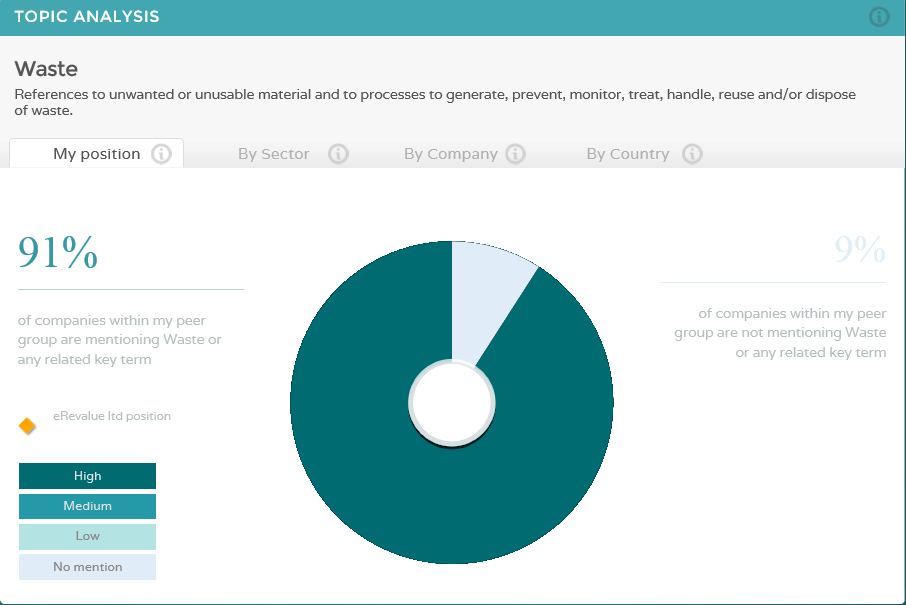
Globally, I can see that 91% of my peer companies mention waste in their sustainability reports - a sign that I had better ensure I'm on top of that too. 


Broadly speaking, the top 20 issues don't change significantly across regions - as I would not expect them to do - but in the Americas, waste comes out top; in Europe, occupational health and safety comes out top and in Asia, workforce diversity and inclusion tops the list. While these results might not be significant enough for me to entirely redraw my materiality matrix, it's certainly interesting enough for me to check out who's saying what in the different regions and why. On the subject of waste, for example, we can see the regulatory landscape of current and emerging legislation quite clearly and for each issue, Datamaran can take us back to the source legislation. 


There are a million other ways Datamaran can be useful.. I have only scratched the surface. In my chat with Marjella, I understand that the busy bees at eRevalue are technologizing away really really fast to expand the applicability and personalizability of the system to make it even more useful. This is apparently the only tool of its kind around to support sustainability material decision making and low-noise focus. 

As with any database, what comes out is only as good as what goes in, and the way the program functionality is constructed. So as long as Datamaran keeps its legs on dry land, it seems that it could be quite useful. I'll certainly keep this radar on my radar....  I always wanted a crystal ball.   


elaine cohen, CSR consultant, Sustainability Reporter, HR Professional, Ice Cream Addict. Author of Understanding G4: the Concise Guide to Next Generation Sustainability Reporting  AND  Sustainability Reporting for SMEs: Competitive Advantage Through Transparency AND CSR for HR: A necessary partnership for advancing responsible business practices . Contact me via Twitter (@elainecohen)  or via my business website www.b-yond.biz   (Beyond Business Ltd, an inspired CSR consulting and Sustainability Reporting firm).  Need help writing your first / next Sustainability Report? Contact elaine: info@b-yond.biz   

Sunday, January 25, 2015

Our second Sustainability Report - hot off the press


DRUMROLLLLLLLLL


Announcing the Beyond Business 
2014 Sustainability Report


Yes, we finally made it to our second report. Just a little behind schedule. But there is something entirely uplifting about completing a Sustainability Report so for us, it was worth the effort. This report tells the story of our little company that has been making a BIG impact over the past few years and the roller-coaster journey we have been on since our last report covering 2010. 

Of course, our report is in accordance with the GRI G4 Reporting Guidelines. Of course, because we have come out strongly in support of the G4 framework and have encouraged our clients to adopt G4 where possible. Therefore, believing it is right to practice what we preach, we had no other reasonable choice. Having said this, the G4 framework worked well for us. It helped us define what's most important in a concise way, leading us to focus on the top six impacts, after having started with a much longer list. And this helped us keep our report short and focused. 


We also pioneered the new GRI Content Index Service - a check by GRI that all the disclosures and performance indicators that we included in our content index are actually present  and correctly located in the report. This was a useful exercise, and we did correct a few details in order to receive the coveted icon. We felt it was important for us to experience this check so that we know how it works if/when we recommend it to clients. Happily, for us as GRI Organizational Stakeholders, the check was free of charge. 

It's clear that our small business is not especially complex - we don't have a supply chain to speak of and governance isn't really in our lexicon. In terms of direct impacts, there is not much to speak of either. Even our commitment to addressing climate change by being carbon neutral since 2009 is unlikely to make a big dent in the global temperature rise. Recycling all our electronics and printing both sides in our minute quantities is hardly going to save the world. Where a company like ours can shine, however, is in the contribution we make to helping our clients advance along their sustainability journey and in helping the conversation around sustainability evolve in general. That's something we cannot measure in a direct way, but the confirmation we receive from our clients and the position of respect we (modestly) hold in the sustainability community indicates that, overall, our impact is positive. 

Of course, as with our last report, we included a page of failures - yes, we had some of those as well - recognizing that people only believe the good things if they also read the bad things. 

On a more philosophical level, our reporting demonstrates that SMEs can do it, that G4 can work for SMEs and that there is value in the process. We have long advocated that SMEs should report - both for the benefits it brings to their business directly and for the supply chains they are part of. I believe that SMEs have important stories to tell, and reporting is within reach. And it can be done on a modest budget. We did not need external assistance to prepare our report so that was not a budget line for us, but we did save (again!) by not having our report professionally designed, preferring to make it look as nice as we could using our own resources. Hopefully it's reasonably legible.  As part of our commitment to supporting SMEs in adopting a sustainable approach and transparency, we are holding a free workshop for SMEs in early March in our home market, to teach them the essentials and hopefully get them into the transparency habit on a low budget in a way that adds value for them. 

Finally, our report reflects our approach to reporting, which is that reporting is serious but also fun. We hope you will think so too. 

We'd love to hear your feedback!

Thank you.  


elaine cohen, CSR consultant, Sustainability Reporter, HR Professional, Ice Cream Addict. Author of Understanding G4: the Concise Guide to Next Generation Sustainability Reporting  AND  Sustainability Reporting for SMEs: Competitive Advantage Through Transparency AND CSR for HR: A necessary partnership for advancing responsible business practices . Contact me via Twitter (@elainecohen)  or via my business website www.b-yond.biz   (Beyond Business Ltd, an inspired CSR consulting and Sustainability Reporting firm).  Need help writing YOUR Sustainability Report in 2015? Contact elaine: info@b-yond.biz   

Sunday, December 28, 2014

Why the materiality matrix is useless

2015 is a new year - Happy New Year to everyone! And as we close out 2014, I thought it would be a good time to shake things up a little and get just a touch provocative. (Totally out of character, haha). See, I have begun to be really irritated by useless materiality matrices.  I am looking forward to a year in 2015 where materiality drives strategy and reporting in a profound way, and where we stop playing around with dots on a matrix just because that's what seems to be the de rigeur of sustainability reporting.

One of the things that is going to have to get a whole lot better if companies are really going to gain best value from a strategic sustainability approach is the way materiality is considered, analyzed, developed and communicated, as well as, more importantly, used as a basis to drive action. In many cases, it's near impossible to relate what are stated as material issues to the way the company approaches its sustainability activities. The more G4 reports I read, the more materiality matrices I look at,  the more I come to the conclusion that, by and large, many companies are just missing the point

This is probably not entirely intentional. Maybe many companies actually think they are doing a good job of defining materiality. Spending time plotting little dots on a matrix and moving them up or down a millimeter may actually be someone's idea of meaningful strategic planning. Maybe people think that's how it's supposed to be done. Maybe companies look at their materiality matrices and give themselves a big slap on the back. 

But actually, it's not being done well. It's not hitting the right spots. It's not generating the leverage that is needed. Materiality, so far, as a concept, is not proving itself. It's a nice buzz word, makes everyone feel good, sound intelligent and provides creative license to draw pleasant graphs, charts and multicolor, even interactive, visuals, but it's not doing what it intended to do. This is clear from the disconnect we are still finding in sustainability reports between what's supposedly material (because the matrix says so) and what companies are actually doing (based on what's reported). 

The basis for my comments is my personal review of many of the 500+ GRI G4-based sustainability reports that have been published to date. I am referring to G4, because G4 places material impacts squarely at the center of the reporting approach. Not because it's right for reporting. Because it's right for business. This is how GRI G4 defines materiality: 


In G4 reporting, companies are required to list material aspects and provide disclosures that show how  an organization "identifies, analyzes, and responds to its actual and potential material economic, environmental and social impacts". Performance indicators supporting  material aspects are designed to reflect how a company measures its performance in relation to those stated material impacts. While I know that the G4 framework is not always 100% logical, and there is, in many cases, a rather unfathomable connection between certain material Aspects in the framework and the Performance Indicators that are designed to reflect those Aspects, the underlying issue is whether companies are approaching materiality in a meaningful way. (Perhaps someone might even be able to explain to me why G4 chose the very odd word Aspects and did not use the very clear word Impacts when making materiality the G4 engine driver). The metrics, or indicators, can be adapted or developed to meet the need. The material impacts should first drive what a company does or should do, and therefore measures, and therefore reports. Creating a materiality matrix after you have done everything else is not exactly going about things in the right way.

Let's think about what materiality really means in a sustainability context. It means the material impacts IMPACTS IMPACTS on stakeholders. 

These are things that material impacts are NOT (or not only):
  • what's going to help us make more profit
  • what our stakeholders mention in passing
  • how we perform
  • what we think is politically correct
  • what everybody else is saying
  • what's easiest to report
  • what shows us up best
  • what's in fashion
  • what the  lawyers tell us to say
  • what we've always said
  • what the assurers can count
  • things we have data for
  • an afterthought
  • an easy option
  • a buzz word
  • a box to tick
  • lip-service
  • a way to appear as though we wrote a G4 Sustainability Report

Material impacts are: 
  • the way our business activities affect the lives of our stakeholders and our long-term business viability
  • the basis for creating a sustainable business strategy with relevant targets
  • defined as the result of an analytical process that engages internal and external stakeholders about what affects them and how
  • the basis for creating sustainability communications including reporting
  • specific to a business, a sector, a geography, an issue
  • a catalyst for planning and action
  • connected to a business's core social mission
A few examples? Sure. Wizness recently published a free download benchmark of 50 materiality matrices across 5 industry sectors. Almost all of them have loads of little dots carefully plotted on creatively designed squares, blocks and circles. Some of them have so many dots you begin to wonder how on earth the company even recognizes the dots, let alone creates a strategy to manage them. Whoever is selling dots is making a killing. And the relativity between the dots is often just incomprehensible. Here are some examples from the ones presented by Wizness:

You may be able to see, just about, that this company has loads and loads of dots, with the top 16 prioritized as the most material issues/impacts, supported by a detailed stakeholder matrix of what affects whom. The top 9 issues all have the same degree of importance to stakeholders, yet they are all at different coordinates on the matrix. Compliance with laws and regulations is only mediumly important to the business and to stakeholders while compliance with laws concerning products and services hits the top right box in the matrix. I wonder how these nine issues were plotted. What makes anti-corruption so much more important than anti-competitive behavior? The report gives no clue to how these issues were placed in the matrix. Their placement suggests that they are not equally most material and that some are more most material than others. What does this differentiation actually mean? To me, it suggests that there is a focus on moving dots around a matrix and not on the underlying drivers of sustainability performance. Notwithstanding the fact that the very act of defining a set of material priorities is an important part of the process and should be encouraged.  

Here is another example:

Pan American Silver Sustainability Report 2013


Wow. The entire 46 G4 material Aspects and Sector Disclosure Aspects all carefully ticked or unticked and slotted into place on a matrix that it took me half an hour to work out what's where. I wonder how long the plotting exercise took and how the little letters on the matrix were locked into position. The color coding of the different categories makes it almost impossible to tell without detailed study what is actually most material for this company. It looks to me like the top three - turquoise "a" is "local communities" as the top issue,  purple "c" is "occupational health and safety" one of the two runners-up and blue "d" looks like child labor as the second runner up. Why are these issues more important, than, say, anti-corruption, which appears much lower on the list, or labor relations which is not material at all?

In Pan Silver's report, there is a large section devoted to the most material Aspect, local communities. It's about how Pan Silver, while doing its core business, is engaged with local community projects to support economic and social development. A really fine array of projects that I am sure are highly commendable and make a genuine difference to local quality of life. But why is engaging with local community development projects the most material impact of this company? What about the impacts generated through the company's core business? What about materials use and ecological limits? Pan Silver produced 26 million ounces of silver and 150 thousand ounces of gold in 2013. What about water use in the mining sector? Total water withdrawn for Pan Silver in 2013 was more than 42 million cubic meters, that's about 15,000 Olympic swimming pools. Not to mention water discharge with potential toxic chemicals. Pan Silver has addressed these issues in the report, but what makes them less important local community projects? Does the materiality matrix indicate priority in allocation of the company's resources required to address material impacts, suggesting that a higher priority received more attention, more resources, more commitment? What I would really like to know from Pan Silver is its most significant impacts on stakeholders. The top 5 or 10. I don't really care where they are on a matrix. I don't really care about the tenth of a millimeter of space between the little letters. Does anyone? I don't even believe it is possible to differentiate between the most important material impacts at this level of detail. I am sure the process of thinking about what is most important should have been beneficial. I suspect that the part where the dots on the matrix slotted into place is simply a total waste of time.  

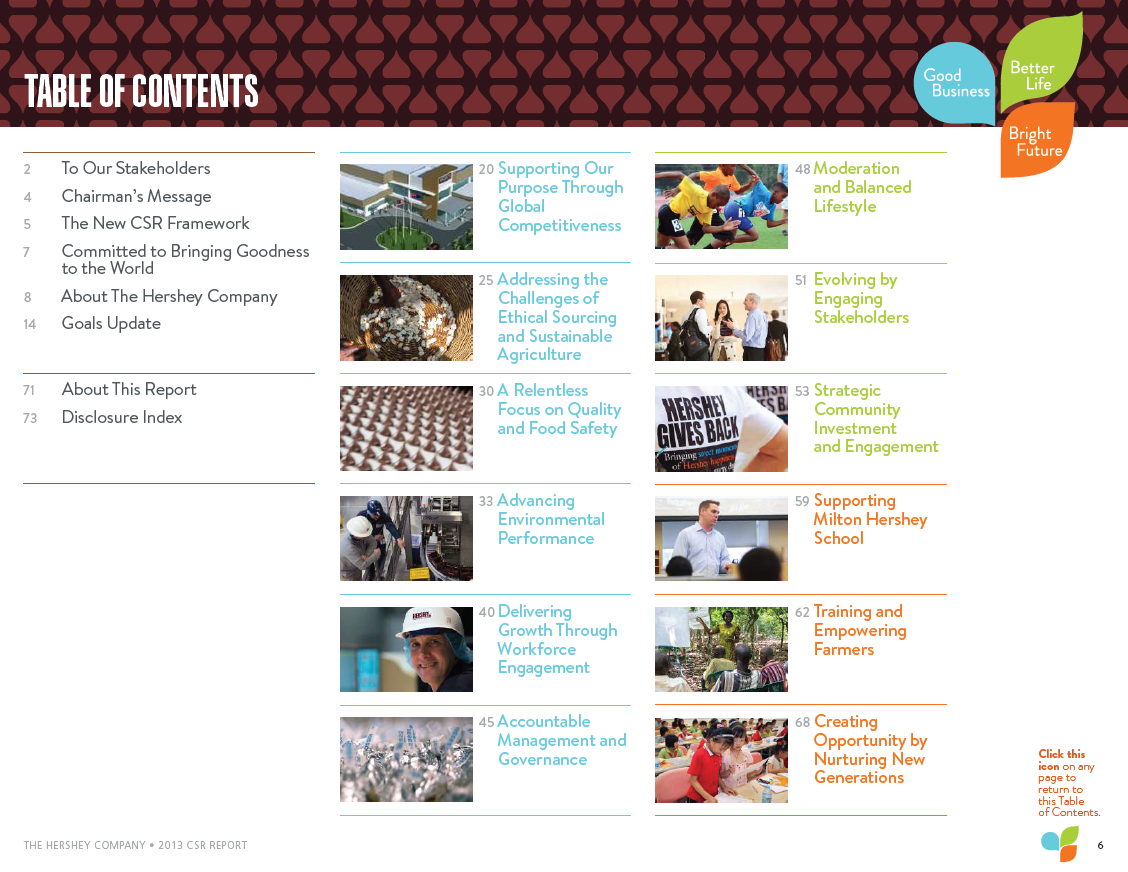
And here is another example from The Hershey Company 2013 CSR Report.


Hershey's has defined the priority issues and they are all dealt with well in the company's CSR report. It's great that out of a total of 25 issues, Hershey has selected ten that represent the most important impacts. However, what makes food safety so much less important than ethical sourcing? Why is child labor so much more important than GHG emissions? Why is ethics more important than governance? And if philanthropy is so low on the matrix, both for stakeholders and for the company, then what's it even doing on the matrix? Isn't that just a waste of energy, deciding where to put the philanthropy dot? And if the currency is dots, is philanthropy the only dot that is loooooooow priority? I could think of a whole load of additional issues that might have come up in a materiality discussion that are not on this matrix. The point is, selection of the top ten prioirities is great. Using these materiality priorities to define strategy is fantastic, and structuring your reporting around these material priorities is brilliant. Hershey does this fairly well.


But taking that to the point of plotting dots on a useless matrix is what I don't understand. Especially if no-one explains why these dots are where they are.

The GRI G4 guidelines does not require the presentation of material Aspects in a matrix. The reporting disclosure is:
The G4 guidance for determining what is material makes reference to defining thresholds for materiality and defining and documenting how the thresholds have been defined. The guidance also offers a matrix for presentation of material issues. But this is guidance... it's not a G4 requirement. In general, the companies that present materiality matrices define why issues are material but they do not make reference to the relative material priority of each dot on the matrix. So why bother with a matrix. Why not simply do what is asked: give a list.

Materiality and its importance were recently addressed by think-tank advisory firm SustainAbility


SustainAbility published an excellent paper on transparency and its use as a driver for improved performance. SustainAbility says: "Most companies are not gaining the value commensurate with the resources spent on reporting." This is a proposition that I wholly agree with, for many reasons. (Haha - you can see that from my red text). SustainAbility's response to this is to use materiality to drive the rest. 


The SustainAbility paper provides two examples of materiality presented in reports: PG&E and Fibria. 

The PG&E Sustainability Report for 2013 presents a materiality matrix in a pretty familiar way - using dots. (SustainAbility helped PG&E create this matrix.) It has an element not usually found in materiality matrices: the addition of arrows showing the interrelation of issues. The online presentation of the matrix is interactive - when you click on an issue, it turns blue and a number of little orange dots show up connecting things to the blue dot, as in the version shown below. No connection between Public Safety and Employee Engagement, for example. Seems rather odd to me. However, SustainAbility writes in their report that highlighting interconnectivity between issues "provided insight into how PG&E might approach issues in a more integrated way." Intuitively, that sounds sensible to me. Although, if I were to be truly provocative, I would say that pretty much everything is connected to pretty much everything.   


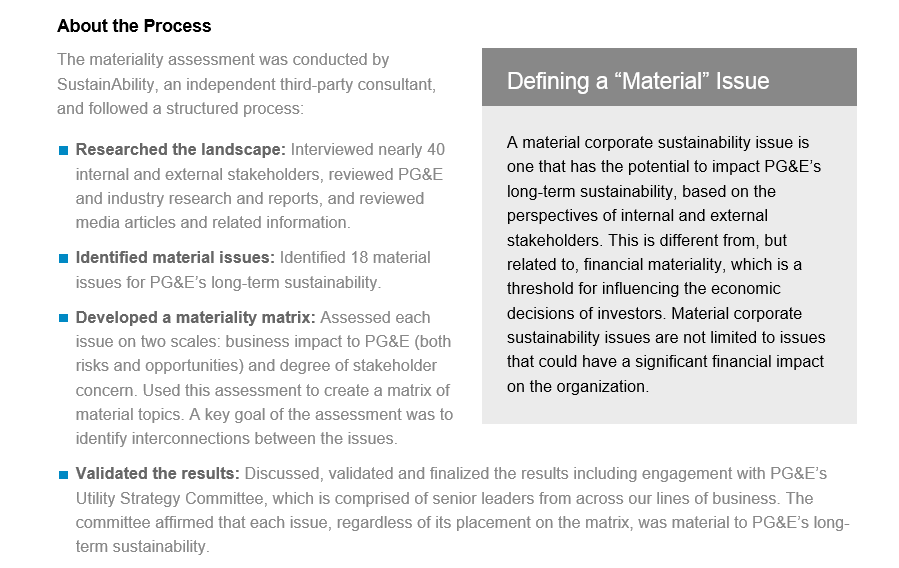
In the PG&E matrix, however, we again we have a nicely arranged set of dots. It is not clear, based on the description of the process, what criteria were used to actually decide where each dot should be carefully placed. On what basis do you assess the scale of business impact? Is this an opinion based assessment or a fact-based analysis? Interestingly, PG&E states that: "PG&E’s materiality assessment identified 18 issues. Every issue is material to PG&E’s long-term sustainability, regardless of its placement on the matrix." Sounds to me that there is no need for a matrix. The real value of the process was the engagement benefit. See this quote from the Corporate Sustainability Director.


The Fibria 2013 Sustainability Report, on the other hand, uses the list method. Isn't this super-clear? Ten key issues, all equally important, all top priority. Businesses are complex things. It's OK to have more than one top priority. 


For those of you who like a little more detail and to know where things fit, Fibria provides an infographic: 

However, the plain, no-dots list of material issues, and its use in defining strategy and reporting is.... for me.. the way to go. I like the list. I don't like the meaningless matrix.

In addition to the list of top priorities, for completeness, companies may also select to indicate other topics that are on the radar, but not considered to be most material. This could be another (not too long) list. All attempts at creating flurries of dots is simply a waste of energy.

So here's to a great 2015 and clear, focused, material reporting.
Down with the matrix.
Up with the list. 


elaine cohen, CSR consultant, Sustainability Reporter, HR Professional, Ice Cream Addict. Author of Understanding G4: the Concise guide to Next Generation Sustainability Reporting  AND  Sustainability Reporting for SMEs: Competitive Advantage Through Transparency AND CSR for HR: A necessary partnership for advancing responsible business practices . Contact me via Twitter (@elainecohen)  or via my business website www.b-yond.biz   (Beyond Business Ltd, an inspired CSR consulting and Sustainability Reporting firm).  Need help writing YOUR Top Ten Report in 2015? Contact Elaine: info@b-yond.biz   
Related Posts with Thumbnails