The inaugural Asia Sustainability Reporting Summit, organized by CSRWorks International, in Singapore earlier this month, which I was honored to chair, was one of the most successful events on the reporting calendar that I have personally attended, a view supported by everyone else that was there. The caliber of the speakers, the (largely corporate) audience from all over the region and beyond, the engagement of delegates during all the conference sessions, the fun and informal style and the overall organization and attention to detail were all superb, making this Summit a model to be replicated. And it will be, every year, I am sure.
 |
| Photo courtesy of CSRWorks |
One of the highlights of the conference, for me, was learning about the leading practices of the Stock Exchange of Thailand (SET). It was a pleasure to listen to Mrs. Kesara Manchusree, President of SET, and Guest of Honor at the Summit, who I came to realize is a powerhouse in the Thai market and has driven major advances in sustainable practice and disclosure. SET joined the Sustainable Stock Exchange Initiative in 2014, the first Asian Stock Exchange to do so.
 |
| Mrs. Kesars Manchusree. Photo courtesy of CSRWorks |
Mrs Manchusree said: "ESG disclosure continues to be an integral part of sustainable practice as companies move from ambition to action. Our ambition for the Stock Exchange of Thailand is to make the capital market work for everyone.....The Exchange started on its journey in 2002, with the issue of guidelines to listed companies. We followed OECD principles and established a voluntary basis for disclosure, creating an environment for companies with a set of guidelines, training and talking with the organizations and explaining the benefits. Along the way, we moved to CSR practice in 2008, and issued CSR Reporting guidelines in 2012. However during the past two years, I moved from a CSR approach to sustainability guidelines, strengthening sustainability as a key mechanism to help listed companies prepare for long term value. 85% of listed companies have participated in the training sessions of SET. We have to prove to our listed companies that sustainability will benefit for them for a longer period."
Ms. Manchusree talked about forward-thinking Thai companies that are sector leaders in the Dow Jones Sustainability Index. This is not by chance. In order to drum up support for DJSI inclusion, Ms. Manchusree described inviting all the CEO's of the leading companies in Thailand to "sit in the same room". "We wanted them to know that this is important for them and to point out who has already got in, and you haven't got in! Once the CEO's knew and took on this mission, we were sure that we would get more companies listed on DJSI and later we would invite their teams to learn more. Every year we decide to do more and have more companies listed in DJSI - institutional investors use DJSI as a benchmark. But we realized that not all companies could achieve inclusion in the global DJSI list, which is why we created a domestic list for Thai companies of any size who have published an ESG report - we have 51 companies on this list."
 |
| From Mrs. Manchusree's presentation |
These kinds of initiatives have delivered strong reputational and economic outcomes for Thailand with high rankings in different indices such as the Asean Sustainable Cities Scorecard, a billion dollars a year in IPOs and a high level of market liquidity. Thailand has the highest number of companies with DJSI inclusion among Asean countries.
Not only this, SET has published its own Sustainability Reports regularly since 2012, the latest one covering 2016, written in accordance with GRI G4 Core option.

The report is structured around material impacts which are clearly stated and also aligned with the Sustainable Development Goals.
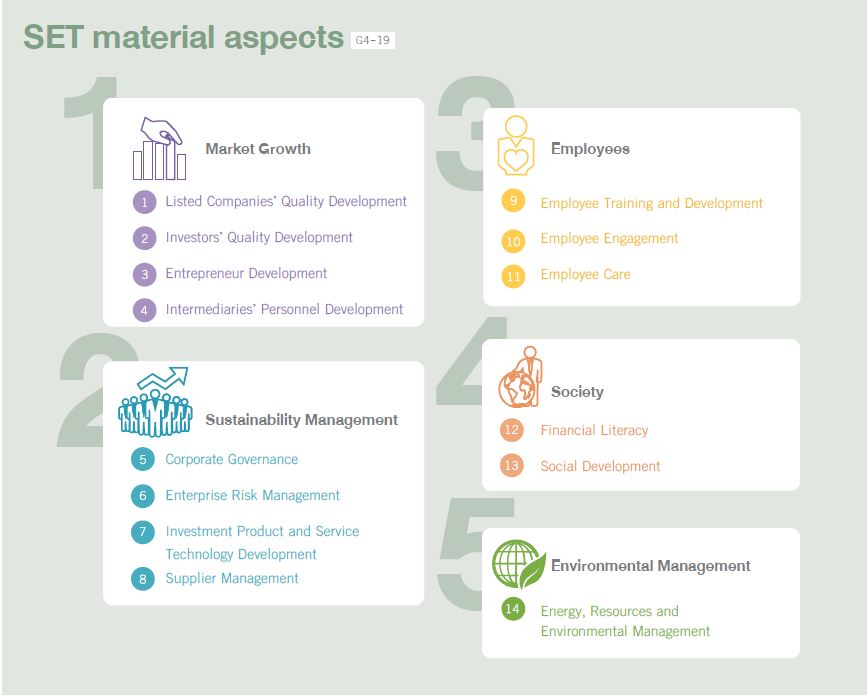

The report is fascinating as it gives an overview of the Thai culture which embraces the "Sufficiency Economy Philosophy of His Majesty King Bhumibol Adulyadej which consists of 3 key components: moderation, reason and self-immunity, based on knowledge and ethics.", providing an environment in which business can advance sustainability in line with the leading values of the country as well as sustainability principles.
This report, as did Mrs. Manchusree, clearly emphasizes the significant role that SET has played in educating, encouraging and supporting businesses along a sustainability journey. This enlightened, proactive approach has earned SET significant respect from other markets in the region, and, in the recently published 2017 Ranking of World Stock Exchanges, SET ranks in the Top Ten Stock Exchanges for sustainability disclosure (out of 55 ranked), having improved its ranking every year since 2013 when SET was ranked at number 40.

Mrs. Manchusree gave examples of two impressive Thai companies that have achieved strong DJSI positions.
Thai Oil pcl is a supersector DJSI leader heading the global oil and gas sector for four consecutive years in DJSI. According to DJSI, Thai Oil is largely recognized as one of the most modern oil refinery plants in Asia Pacific Region. Thai Oil leadership has also been very proactive in helping advise and instruct other Thai companies and demonstrating the benefits of sustainable practice. You can see Thai Oil's latest Sustainability Report here:


It's a beautifully designed report, written using GRI G4 guidelines, structured around material sustainability impacts. Four pages in this report are dedicated to sustainability awards and recognition. Just think how proud the 1,400 employees of this company must be!
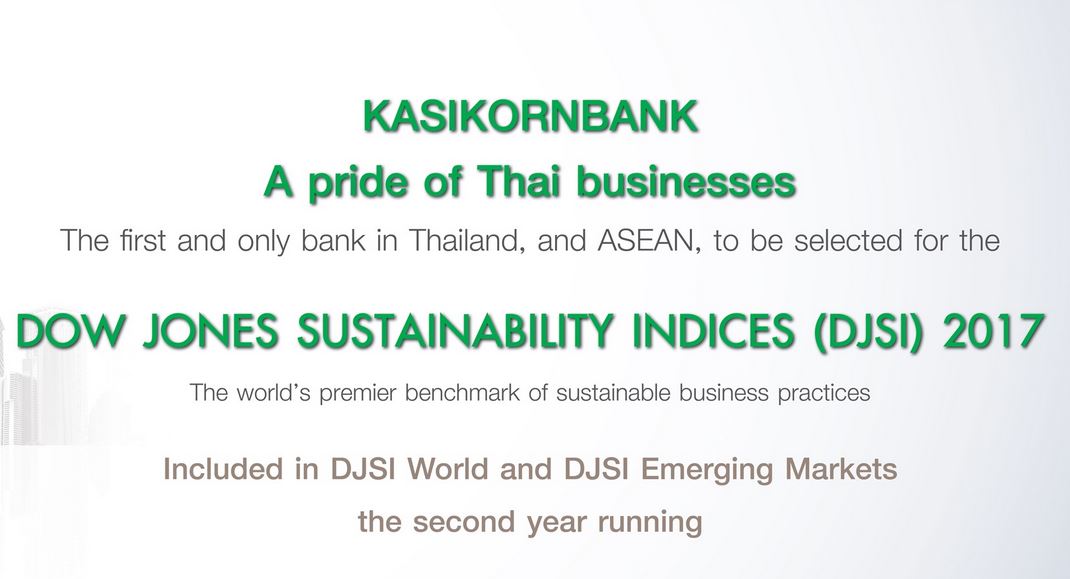
The second example quoted was that of Kasikorn Bank, another leading Thai company that sets an example for all the rest. Describing itself as the Bank of Sustainability, Kasikorn Bank "aims to harmoniously
combine technology and human resources
to sustainably create world-class-quality
financial services, so as to achieve
optimal benefits for all stakeholders." You can see their latest Sustainability Report here.


Ms. Manuschree left us with an important thought.
"The sustainability strategy will only be successful when the top management is committed. Even though embedding sustainability into the company is important, it is the role of the top leader in the company to create an environment conducive to sustainability. Visionary leaders see the opportunity to change the world for the better."
In summary, I found SET to be a shining light for Stock Exchanges around the world, which, individually and collectively have such potential to foster and environment in which sustainable markets and sustainable economies can flourish. I have often believed that sustainability is driven by business opportunity - for SMEs, this is the opportunity to access supply chains of larger companies through demonstrating and disclosing sustainable practice, and for larger (public) companies, it's through the possibility to access capital markets. Stock Exchanges are pivotal to driving a such disclosure and as we know, disclosure is a catalyst for performance improvement. The leadership of Mrs. Kesara Manuschree was, for me, quite energizing.
And that's just ONE of the highlights of #ReportingMania at the Asia Sustainability Reporting Summit. Watch this space for more.
elaine cohen, CSR Consultant, Sustainability Reporter, former HR Professional, Trust Across America 2017 Lifetime Achievement Award honoree, Ice Cream Addict, Author of three totally groundbreaking books on sustainability (see About Me page). Contact me via Twitter (@elainecohen) or via my business website www.b-yond.biz (Beyond Business Ltd, an inspired CSR consulting and Sustainability Reporting firm). Need help writing your first / next Sustainability Report? Contact elaine: info@b-yond.biz
Elaine will be chairing the edie Conference on Smarter Sustainability Reporting in London on 27th February 2018
In summary, I found SET to be a shining light for Stock Exchanges around the world, which, individually and collectively have such potential to foster and environment in which sustainable markets and sustainable economies can flourish. I have often believed that sustainability is driven by business opportunity - for SMEs, this is the opportunity to access supply chains of larger companies through demonstrating and disclosing sustainable practice, and for larger (public) companies, it's through the possibility to access capital markets. Stock Exchanges are pivotal to driving a such disclosure and as we know, disclosure is a catalyst for performance improvement. The leadership of Mrs. Kesara Manuschree was, for me, quite energizing.
And that's just ONE of the highlights of #ReportingMania at the Asia Sustainability Reporting Summit. Watch this space for more.
elaine cohen, CSR Consultant, Sustainability Reporter, former HR Professional, Trust Across America 2017 Lifetime Achievement Award honoree, Ice Cream Addict, Author of three totally groundbreaking books on sustainability (see About Me page). Contact me via Twitter (@elainecohen) or via my business website www.b-yond.biz (Beyond Business Ltd, an inspired CSR consulting and Sustainability Reporting firm). Need help writing your first / next Sustainability Report? Contact elaine: info@b-yond.biz
Elaine will be chairing the edie Conference on Smarter Sustainability Reporting in London on 27th February 2018







 Posts
Posts

