Showing posts with label SDG. Show all posts

Thursday, December 7, 2017

Is your report long and boring?

One of the numerous tests I use when I am reading and reviewing sustainability reports is how far into the report I can get before it becomes tedious, boring or generally rather meaningless. Some reports are so full of verbiage before they tell you anything substantive that it rather turns you off and makes the rest of the report hard to digest. This is the problem with looooong reports. No-one has the patience these days to read long waffly explanations of every thought process about every bowel movement of the reporting team. 

Reports today need to be concise: they need to state clearly and quickly the most material impacts of the business and efficiently update us on what has changed over the past year. Companies that maintain an online "policy bank" -  a list of policies and positions on core aspects of sustainability -  save themselves time and space in the annual sustainability report. They also gain reader attention, as we don't exhaust our patience on long diatribes and lose energy before we get to the main course. Let's face it, when you go out for a meal, if the first course is massive, you don't have room to eat the main course, let alone dessert. It's the same way sustainability reports. Your material content is your main course. A light starter provides context and background, and a healthy dessert provides the GRI content index and other references. The main course, your materiality process, topics and performance, is where companies should focus their reporting efforts. You can offer a menu of snacks - sustainability stories, anecdotes and case studies - on your website.

Here's an example of a report I came across while doing some research on the consumer goods sector. Ontex Group is a Belgian-based company listed on Euronext Brussels, employing more than 11,000 people and enjoying sales of almost Euro 2 billion. Ontex is a supplier of disposable personal hygiene products including diapers and pants, pads, tampons and panty liners in more than 110 countries. The Ontex 2016 Sustainability Report is a credible report that focuses on its defined most material impacts of the business.


It's a GRI Standards core report, crafted around SDG priorities, and does its stuff in 44 pages (including 5 pages of GRI Content Index) in an attractive, pleasant and clean design. Ontex provides contextual background on trends that have influenced the selection of material impacts and sustainability strategy.


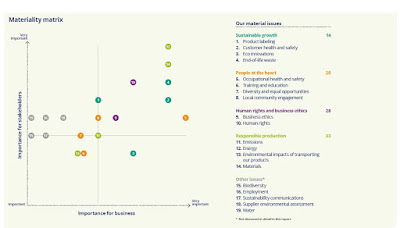
And presents a materiality matrix

While aligning the report with Sustainable Development Goals


And on the Ontex website, the company discloses specific strategy and policy documents to complement and complete the sustainability picture.


But beware: Concise does not mean skeletal. 

Reports that are 2-page infographics are not reports. Four-page summaries are not reports. If they are not infographics of a concise report, or summaries of a longer report, they are not useful in lieu of a sustainability report. While it is possible to reference a host of other documents where disclosures may be located (and the GRI framework allows this), in practice, the beauty of a sustainability report is that key information is on one place and we don't have to go searching for all the individual elements separately. We want the essence of everything that's material without having to trawl the web, download multiple other documents and search forever for references that all too often are not there anyway. So, up to around 45 pages, for me, is concise enough to deliver a complete story with enough detail and context for me to understand the company's impacts and accountability. If I want supplementary information for interest or deeper understanding of quantitative data, I am happy to get this online, via a policy bank or other downloadable appendix.

I know that many people will consider even 40 pages too long....and there are many reports that are much shorter than that and do a good job. While the quality of reporting should not really be measured in terms of the number of pages, my rule of thumb for something that fits in the space between feeling stuffed and still feeling hungry - sort of nicely satiated - is around 40 pages.

Here's another nice example: Ramboll's 2016 Corporate Repsonsibility Report.


Ramboll is an engineering, design and consultancy company founded in Denmark in 1945. Ramboll employs 13,000 people across the world. This is a 40-page GRI G4 almost-core report that packs a ton of information in a well-structured concise framework, pleasingly designed and easy to read, with no distracting glossies and frills. The GRI Content Index and key KPI tables take up 4 pages.

One of the positive things about this report is that the material impacts are right there up front on page 5, immediately after the CEO statement, making it very clear what we are going to learn about Ramboll in the remaining pages. I like reports that state materiality up front - not only does this help clarify the report context, it also drives credibility. If it's one of the first things a company reports, it must be one of the first things a company thinks. And that's what materiality means. It should never be an afterthought or a summary of what you are doing. Materiality is a guide to what you should be doing.


The remainder of the report is split into two main sections, a format that I particularly favor. The first section is called "Shaping sustainable societies" and it addresses what are broadly the indirect impacts of the company's business - through the projects it advances and the role it takes in shaping the sector and public policy. The second section covers direct impacts, called "Demonstrating our progress", and includes sections on employer of choice, environment, safety and integrity - linking these also to UN Global Compact and SDG priorities.


Ramboll also uses its website to supplement information with policy statements and commitments - here's an example from one of the sections:


While this report could be even more reporting-year focused, with fewer perennial policy statements that could be policy-banked on the website, this report offers comprehensive coverage of material impacts in a concise way.

So, if your report is long, it is almost certainly also boring (at least in parts). It's totally worth reconsidering how you can deploy other ways of getting your content out there and delivering on your transparency obligations without crowding your report with content that causes us to doze off instead of inspiring us to buy in.  Incentivize yourselves. For every page you save, treat yourself a scoop of salted caramel ice cream.

(NB: I have previously written about Liberty Global's last Corporate Responsibility Report - a masterpiece in concise, precision reporting).


elaine cohen, CSR Consultant, Sustainability Reporter, former HR Professional, Trust Across America 2017 Lifetime Achievement Award honoree, Ice Cream Addict, Author of three totally groundbreaking books on sustainability (see About Me page). Contact me via Twitter (@elainecohen) or via my business website www.b-yond.biz (Beyond Business Ltd, an inspired CSR consulting and Sustainability Reporting firm). Need help writing your first / next Sustainability Report? Contact elaine: info@b-yond.biz 

Elaine will be chairing  the edie Conference on Smarter Sustainability Reporting  in London on 27th February 2018

Monday, October 16, 2017

In the hot seat at GRI with Tim Mohin

After nine months at the helm of GRI, Tim Mohin is still, yes, still, enjoying his job and making waves in sustainability circles. An eternal optimist endowed with just about enough realism and an unshakeable vision of a future of sustainable development powered by corporate accountability and transparency, Tim has a lot to say. GRI is also 20 years old young, and though Tim Mohin has been leading it for a much shorter time, his experience as a practitioner and sustainability leader gives him the long perspective. 

What prompted me to pound Tim with a barrage of tough questions was an interview with Bob Eccles published in Forbes a couple of months back.  Tim is quoted as saying: "There is a narrative that has been running for a while now that portrays sustainability reporting organizations as in conflict with each other. The reality is that nothing could be further from the truth. I believe there is an increasing amount of harmonization in this space, whether it be GRI, or the UN Global Compact, SASB or the IIRC. Not only do we have longstanding partnerships with those organizations and others, but we are in fact all just after the same thing, which is sustainable development." 

I beg to differ. I do not see harmonization between any of these organizations and there are new frameworks and reporting approaches popping up all the time, whether in relation to specific sectors, regulation, stock exchange listings or other independent initiatives. Investment analysts use their own proprietary methodologies that are not based wholly on one framework or another. Longstanding partnerships with organizations in this space may look nice on paper, but in practice, they have yielded very little in terms of simplifying the way companies report. I am sure it sounds nice to talk of harmonization and partnership, but the reality is that it is not yet yielding tangible benefits. The proliferation of Linkage Documents that enable some sort of correlation between GRI Standards and other frameworks further clutters the landscape. 


One case in point is GRI's close collaboration with the UN Global Compact. Both organizations have been in dialogue forever and have signed more MOUs than Nobel has given out prizes. And yet, signatories to the UN Global Compact are still required to prepare a Communication on Progress in line with UNGC requirements at Advanced, Active or Learner level. In fact, the UNGC is very proud of its flagship reporting framework - as noted on its website. 


There is a 31 page document making the connection between GRI G4 Guidelines and the UNCG COP(s). This states clearly that reporters using GRI must still include content relating to UNGC core elements, even if those have not been deemed material for the organization and therefore not required by GRI Standards. Frankly, just reading this linkage document made me crave for paracetamol-flavored ice cream. If there were a true spirit of harmonization, I would expect the UNGC to declare the demise of the COP and require all large company signatories to deliver GRI-based in accordance reports and all SMEs to deliver reports covering a subset of GRI indicators. The perpetuation of different frameworks compounded by the need to understand the link between them is about as useful as an iPhone at a mindfulness retreat. There are many examples where unnecessary duplication of requirements adds nothing to sustainable development. It adds only bureaucracy, budget and salaries for people charged with promoting different frameworks. 

I asked Tim to explain his thinking about the positive extent of harmonization. 

"I am coming from twenty years of practitioner experience. I can say that a fractured landscape has created confusion and burden for corporations and we have to pay attention to that. We have to look at how to dig a layer deeper and appreciate that there are different tools for different uses. It is not a reason for companies to become confused. There is real harmonization work going on. When I say harmonization, I am talking about when standard-setters are asking the same question in annoyingly different ways. Right now, we have an aspiration to work with SASB to align such questions. There are over two thousand different disclosure standards out there. Currently we are in Phase One, mapping the overlap and looking at where we can align and simplify. This is work we are trying to get funded. I am certainly seeing a change in collaborative spirit at SASB. When I first got this job, I went on a listening tour. When I got to SASB, it felt like we were competitors. I took the opportunity to appeal to a shared aspiration which is our end-goal to improve how information is used to advance sustainable development. That's the reason I took this job."

And the new thinking on the Sustainable Development Goals? 

"My view is that work in industry sectors and work on the Sustainable Development Goals can merge together. When you look at a sector and what's material for that sector, and then overlay the SDGs, you can see there is a good degree of correlation. I am very keen to merge those streams of work."   

What about the work GRI is undertaking to advance reporting by SMEs? 

"I took a trip through Asia this summer and one of the things I noted was the explosion in stock market listing requirements. Many of the listed companies in that region are SMEs, and they are starting to come to us for help. This is a major driver of the expansion of SME reporting. We have been working with one of our major funders in a program to drive sustainability reporting through the supply chain. When large companies use their buying power, you can bring a lot of SMEs into the fold, so it's a program to bring buyer and supplier together. First, they define the material issues they really want from the SME. A digital tool has been developed to help them use the GRI Standards so that it is more simple, straightforward and requires fewer resources. We are conducting training in developing countries (Colombia, Ghana, Indonesia, Peru, South Africa and Vietnam) where we have funding and there are more to come. The pilot program has a two-year time-frame before we can roll it out globally. We are excited about this and it clearly shows the difference that GRI brings - we are trying to affect the entire global economy by harnessing the forces of capitalism in the service of sustainable development." 

How would you summarize your thinking after nine months at GRI?

"I have never been happier. This is certainly one of the highlights of my career. It's a fantastic cause and a fantastic organization. My only frustration is that there are so many ideas and possibilities, more than we can act upon at any given time. I have had to prioritize and manage expectations and focus but it's working out quite well. Running a not-for-profit is like running a business - we now have nearly 100 people around the world." 

And the focus is? 

"We have four key areas that we are prioritizing at present and we have reorganized our structure to meet the needs. (1) improving the quality of sustainability reporting (2) providing preliminary reporting guidance on sustainability topics that are new to the corporate reporting field (3) increasing reporting among small and medium-sized enterprises (4) promoting harmonization in the corporate reporting landscape. We are actively working in all these areas."

Do think there is still an issue connecting reporting practice to actual sustainable development?

"There is more work to do in this area. We have gotten some funding recently to work with the investor community to define what is investor grade reporting and how GRI can make that happen. It's a big hill we have to climb."

And the next GRI Global Conference?

"Ah yes, we'll be making an announcement on that soon. Watch this space!"


So, lots of things bubbling at GRI, including the tarmac on the Road to Harmonization. Tim Mohin is very consistent and clear in his purpose and intentions - to advance sustainable development and improve the value of reporting as a tool to help us all do that. In the meantime, defragging and optimizing the reporting framework hard drives continues to be somewhat of an elusive goal.

And if all that is not enough for you, you can check out the recent GRI Podcast with Tim Mohin and hear him talk about GRI's 20th anniversary and other things reporting - including more on the subject of harmonization. 


elaine cohen, CSR Consultant, Sustainability Reporter, former HR Professional, Trust Across America 2017 Lifetime Achievement Award honoree, Ice Cream Addict, Author of three totally groundbreaking books on sustainability (see About Me page). Contact me via Twitter (@elainecohen) or via my business website www.b-yond.biz (Beyond Business Ltd, an inspired CSR consulting and Sustainability Reporting firm). Need help writing your first / next Sustainability Report? Contact elaine: info@b-yond.biz 

Elaine will be chairing  the edie Conference on Smarter Sustainability Reporting  in London on 27th February 2018

Monday, December 21, 2015

Santa's 2015 SDG Report

With only four more shopping days to Christmas, the time is here once again to preview Santa's Sustainability Report. Reporting is a long Santa tradition. Check out Santa's prior reports:

Santa's 1750th Sustainability Report 2014
Santa's First G4 Comprehensive Sustainability Report 2013
Santa's First Integrated Financial and CSR Report 2012 
Santa's 1,747th 2011 Annual CSR Report 
Santa's 1,746th 2010 Annual CSR Report 
Santa's 1,745th 2009 Annual CSR Report 


Santa Claus Inc. 2015 SDG Report 
Leadership Message

Dear Stakeholders,

In a year when climate change has been on the agenda more often than leaked emails from Hillary Clinton, I have to wonder what all the fuss is about. My old friend Heraclitus, whose works I studied as a child, said "Everything changes and nothing stands still". He was so right. The only constant in our world is change. So, now that the climate is changing, why try to stop it? The leaders of the free world came together earlier this month to join forces to stop climate change. We at Santa Claus Inc. take a different approach. We embrace this change and look for opportunity in adversity. For example, the more people that stop stopping climate change, the more coal fires there will be. The more coal fires there are, the more chimneys we will have. The more chimneys we have, the more work we will be able to do, sliding down the chimneys to deliver Christmas gifts and cheer to the world's children. I implore the leaders of the world, for the sake of our children, let the climate be. Change something else. 

2015 has been another great year for Santa Claus Inc. Our revenues were up, our operating profit was up, our working capital was down and our spirits were high. (Non-spirits were placed on the lower shelves). We once again brightened up the world with LED lighting on our sleighs, made children happy with gifts bought in bulk from a Taiwanese toymaker with very few human rights abuses and supply chain irregularities, and engaged our employee elves and reindeer through enlightened human resources policies including embryo-freezing, 14 day paid parental leave for anyone who knows anyone who became a parent and a new policy to enable employees to contribute to their community by working as much unpaid overtime as they want. We couldn't have hoped for a better year. And to top it all, a special new customer was born in May 2015 - Princess Charlotte, daughter of William and Kate, the Duke and Duchess of Cambridge. Amner Hall, their residence, has several chimneys so delivering our gifts for both Royal Kids will be a doddle. The problem is that we are not sure if the 1.5 mile no-fly zone over their house applies to me, my sleigh and my reindeer. If you hear reports of a decline in reindeer population and/or I do not publish a Sustainability Report next year, you will know we were shot out of the sky. 

Business Development
In 2015, following years of doing well what we do best, we decided to diversify in order to enhance our contribution to happiness in the world and make more profit by doing things that we do not do best. Our first attempt at diversification was to balance our workload throughout the year, and not just at Christmas time, to provide our elves and reindeer with meaningful activity instead of them just lazing around waiting for the continuation of season 12 of Grey's Anatomy. We started a joint venture with a leading global drug company to increase accessibility to life-saving drugs for children in emerging economies. The plan was to have our elves and reindeer make all-year-round direct-to-home discounted deliveries of benzodiazepine to help families address panic disorder, general anxiety disorder and insomnia in children between the ages of 2 to 49. The program started well and we were able to provide tranquility to many households. However, when several elves started to have convulsive epileptic seizures we knew something was wrong. Investigation revealed a benzo black market resulting from elves skimming benzos from each delivery and selling them to Cuban drug cartels. The cartel chiefs threatened the elves if they did not increase drug deliveries to meet their growing demand. As a result, the elves were so agitated that they started ingesting the very benzodiazepine they had earmarked to sell. Following a review of this new business approach, we realized our risk management program had failed to identify that elf stress, theft, drug abuse and drug trafficking could be possible outcomes of this new business initiative. We have therefore decided to cancel our risk management program and go with our intuition. In this case, with hindsight, it was not such a disaster as, while it lasted, we made more profit from this initiative than we have done in the past thousand years and the Santa Claus Inc. Santa Retirement Fund is now well padded. In future, we will deliver only placebos so that if the elves are tempted, they will only think they are having seizures. 

Board on Board
In 2015, we made a concerted effort to onboard the Board of Directors of Santa Claus Inc. following new guidance published by the UN Global Compact. "The Global Compact Board Program is the first of its kind to align and support Boards of Directors to effectively oversee and drive a strategic approach to corporate sustainability....." This year, we decided that our Board must play a more active role in supporting our efforts to improve society and the planet. In addition to making personal contributions to the Santa Claus Inc. Santa Retirement Fund, each Board member has personally committed not to fall asleep in discussions about our sustainability program. Moreover, each Board member will engage in stakeholder dialogue. Fortunately, this is something they can do during their afternoon nap as most are prone to talking in their sleep. In fact, if you can catch what they are saying in between snores and grunts, it's actually more intelligent than what they say when they are awake. We feel sure that our valued stakeholders will not know the difference.  

Sleigh Emissions
Following the scandal regarding auto-maker Volkswagen who was found to have been systematically cheating regulators about vehicle emission levels through the use of an electronic device that falsifies emissions test readings, we decided to ensure we are not exposed to such a risk. Aside from a small number of electric sleighs, all our sleighs are run by reindeer power whose emissions levels are, well, restricted to natural bodily functions that involuntarily cause greenhouse gas emissions into the environment. We performed a check by an independent third party to ensure that no electronic devices are implanted in any of our reindeer to interfere in any way with the recording of reindeer emissions. The check involved an internal examination using ultrasound and rear-end visual inspections for all reindeer over the age of six months. While we did not find any emission-related devices, we were amazed at what we did find in our reindeer. In addition to old coins, chewed toy parts, several undigested hamburgers from McDonald's from the 1980s, millions of cigarette butts, an array of candy wrappers and chocolate bar foils, and quite a few old socks, we managed to salvage thousands of iPhone parts, laptop keyboards, earphones, flash drives and cables. As a result, we have created a new for-profit initiative to retrieve reindeer stomach contents and repurpose them for sale. In our first year, we generated a very significant supplemental revenue, most of which was diverted to the Santa Claus Inc. Santa Retirement Fund while the remainder went to fund a new recreational facility for in-service reindeer in the hope that they will swallow even more valuables in their spare time.

Sustainable Development Goals
In 2015, we undertook an intensive mapping analysis to identify where the activities of Santa Claus Inc. contribute to the 2030 Agenda and the global Sustainable Development Goals. This report therefore forms our first report against the SDGs and we expect to continue our reporting in line with the SDG framework. Enough of G4 and CDP and everything else. We are converting totally to SDG reporting. By doing this, we express our support for this UN-led initiative and hope to gain a reputational point or two that will help reduce our cost of capital so that the Santa Claus Inc. Santa Retirement Fund will enjoy an improved return over time. The problem was, that in reviewing the SDGs, we didn't actually find anything that we could align with. 


All the SDGs are about things we do not have a direct impact on and therefore we recommend an 18th goal. We will call this goal: 18: Make Santa Happy


We believe that the world will benefit immeasurably through ensuring Santa is happy. When Santa is happy, good cheer is spread and kids around the world smile and are more motivated to do well at school and help their parents with household chores. The world becomes a more harmonious place and society is enriched. With a happy Santa, you know that you can sleep easy at night as crime and violence will reduce and there will be more food to enable everyone at the bottom of the pyramid to live in comfort. The elderly will be cared for and poverty will remain a word in a dictionary, bearing no resemblance to any real-world situation. In other words, making Santa happy is the key to achieving all the other Sustainable Development Goals.  Here are the targets we recommend: 

  • By 2030, eradicate extreme poverty for all people everywhere, currently measured as people living on less than $1.25 a day, and ensure that people who now have all this extra income will make regular donations to the Santa Claus Inc. Santa Retirement Fund
  • Implement nationally appropriate Santa protection systems and measures including security, cyber-security, and free health care for Santa, elves and reindeer everywhere 
  • By 2030, ensure that all men and women, in particular the poor and the vulnerable, have equal rights to gifts from Santa 
  • Ensure significant mobilization of resources from a variety of sources, including through enhanced development cooperation, in order to provide adequate and predictable means for Santa to source gifts and toys for the world's children at significantly discounted prices and with elevated commissions for the Santa Claus Inc. Santa Retirement Fund
  • Create sound policy frameworks at the national, regional and international levels, based on pro-poor and gender-sensitive development strategies, to support accelerated investment in the Santa Claus Inc. Santa Retirement Fund.
Not only this, along with many other global corporations, we have made a pledge to achieve a science-based target. The target is to reduce our carbon emissions by 40% per total elves and reindeer employed by 2030 using 1843 as a baseline. In order to achieve this, we will gradually eliminate baked beans and green cabbage from our reindeer diet and demand that elves keep their iPhones on low-power mode at all times.

Elf Healf and Safety
Every year we intensify our efforts to ensure our elves and reindeer remain safe on the job. We don't care about them off the job. In 2015, we held several training activities to enhance the awareness of safety hazards. One of the most significant risks for elves is sliding down chimneys where fires are still burning. This has resulted in so many bottomless elves over the past hundred years that their lack of behinds almost looks like a genetic mutation. In fact, three elf babies were born without bottoms last year which saves on diapers but gives rise to concerns about how elves will manage to sit on our sleighs as we travel the world delivering gifts and good cheer. We are now ergonomically redesigning all our sleighs to enable standing-only. This is not so bad as it means we can cram 23% more elves onto each sleigh, which means we travel fewer overall kilometers which reduces the resource burden on our planet. For those elves that lost their bottom in 2015, we commissioned bebionic to create a unique multi-articulating, pearlescent design prosthetic bottom made of  post-consumer recycled stainless steel covered with multi-layered variable hardness material lined with fabric mesh. The bottoms look and feel so real that beneficiary elves can lead a perfectly normal life and sit and s*it wherever and whenever they want. They are so happy with their bottoms that, on World Toilet Day, they volunteered to take part in the global #wecantwait efforts by performing true-life demonstrations of toilet-use in refugee camps in Ethiopia. 

Supporting the Sharing Economy
In an attempt to modernize our services, improve global wellbeing and generate new revenue streams, Santa Inc. has finally joined the sharing economy. As you may know, the sharing economy is a new business model based upon peer-to-peer-based sharing of access to goods and services (coordinated through community-based online services). Alongside Uber, AirBnB, Zipcar, Bookmooch and ParkAtMyHouse.com, we have decided to make Santa a sharing Santa. Sign up online at SharingSanta.com to make use of anything that we have and pay for it. For example, book taxi rides by sleigh to any global destination, hire an elf to clean your house or babysit your kids, or borrow one of Santa's red suits to supplement your party wardrobe. We also offer, at a modest rate of $4,000 per night, a place to sleep - Santa's bed in his Lapland home. Of course, Santa sleeps in the bed 364 nights per year, so you will have to share it. If you need earplugs to silence Santa's snores there is a small extra charge. If you need a noseplug for various involuntary odors that Santa emits, there is a small extra charge for that too. If you'd like to be woken up by a live elf alarm system, we can make our elves available in all shapes and sizes, also for a small extra charge. So far, in 2015, the sharing economy has generated more than $1 million in revenue for Santa Inc. Actually, this is not so much from the sharing we offer for use of Santa facilities, but more from the sharing of other's facilities with us. We decided that the many households we reach around the world through our toy deliveries should have the opportunity to share their economy with Santa too. During each visit, we help ourselves to cash we find in wallets, handbags and kitchen cookie jars. This has proven to be a major success as on more than 84% of visits, our beneficiaries have shared more than $100 with Santa. We think this sharing economy is a fantastic idea and kindly request that households make it slightly easier for us to find the cash they wish to share by leaving it on the mantlepiece in an envelope marked Sharing with Santa. 

New Mentoring Program for Elves
In response to last year's employee survey, where elves expressed a desire to receive guidance relating to personal growth and development, we hired several mentors to help elves grow. Of course, by nature, elves are short. Helping them grow requires several innovative techniques and ongoing coaching. In order to provide relevant role models, we hired top players from the Chicago Bulls, the Los Angeles Lakers and the Seattle Supersonics. Each player was paired with an elf and charged with teaching him how to overcome his height-challenged physique related issues during a period of six months of intensive mentoring. During this period, elves learned how to spring-jump, walk on stilts, use electronic arm extensions, hover 15 centimeters above ground using kinetic energy, and extend their neck muscles using yoga techniques. Regrettably our elves are still short. Therefore, in a final attempt to meet the personal growth needs of our very important elf stakeholders, we purchased a set of distortion mirrors that reflect you back in triple height. All our elves now think that they are three times taller than they actually are and are completely satisfied. The only problem is that they all applied to join the Bulls, Lakers and Supersonics and couldn't understand why they were rejected.  

Combatting Santa Counterfiets
As we report each year, we maintain our ongoing battle to delegitimize Santa branded products that are not approved and licensed by Santa Inc. Although we failed to have the Talking Naughty Farting Santa Doll we reported last year removed from the market, we did succeed in receiving royalties of 50% on each sale. We are now working on the same thing with another product that came to our attention this year, the Chantilly Lane Rip Von Kringle - Singing Farting Santa.  As all these Santa functions in doll form appear to delight our customers all around the world, we adopted the "if you can't beat them" philosophy and created our own Santa doll. We call it the Talking Naughty Farting Singing Dancing Twirling Belching Jogging Screaming Humming Skipping Spitting Punching and Praying Santa. Check it out now on Amazon.com to get your delivery just in time for Christmas. We have also adopted a similar collaborative approach with app developers. For example, while the Personalized Phone Call from Santa app may not feature the real me, we have come to believe that this kind of application can support our mission and help spread the Santa message. Unfortunately, this app is free, so our 50% royalties amount to 50% of nothing. Therefore, we successfully negotiated to become the sole and exclusive provider of in-app purchases where all profits go to, yes, you guessed it, the Santa Claus Inc. Santa Retirement Fund. So far we have developed several in-app purchases: a slurpy kiss from Santa ($50), a Santa fart (using the Talking Naughty Farting Santa Doll) ($100) and a Santa indecent proposal ($500). As you can imagine, the last app is the most popular, although several customers asked for a refund when they discovered that the indecent proposal was a copy of the 1993 move starring Robert Redford and Demi Moore which can be rented from Amazon.com at $3.99. We are now considering more sustainable options.  

Feedback on this report
We will be happy to receive your feedback on this report, as long as it's positive.


In the meantime....

 We Wish You and Everyone in the World 
a Happy Holiday Season and a 
Happy New Year


elaine cohen, CSR consultant, Sustainability Reporter, HR Professional, Ice Cream Addict. Author of Understanding G4: the Concise Guide to Next Generation Sustainability Reporting  AND  Sustainability Reporting for SMEs: Competitive Advantage Through Transparency AND CSR for HR: A necessary partnership for advancing responsible business practices . Contact me via Twitter (@elainecohen)  or via my business website www.b-yond.biz   (Beyond Business Ltd, an inspired CSR consulting and Sustainability Reporting firm).  Need help writing your first / next Sustainability Report? Contact elaine: info@b-yond.biz  

Friday, May 2, 2014

What would you say to the UN?

If you had the attention of the UN General Assembly in a debate about "Elements for a Monitoring and Accountability Framework for the Post-2015 Development Agenda", what would you tell them? I suppose it depends on who you are, where you come from and what you see.

If you have been one of the leaders of the most dominant business accountability organizations for the last ten years and have had a top position in the Dutch government, in charge of human rights, climate change, and scientific research, and had several international leadership positions, such as chair of an OECD Working Group, OECD President of donor governments to the Sahel, and Vice Chair of the Oversight Committee of the Consultative Group on International Agricultural Research (hosted at the World Bank, with UNPD, FAO, IFAD and 60 governments) and climate change director during COP 6, when agreement was reached on the Kyoto protocol under the UN Climate Change Convention, what would you say?

If you are also a board member of WWF Netherlands, the second largest national WWF network with almost 1 million contributing members, and of  the International Institute of Environment and Development, a global leader in sustainable development, and of CORDAID, a large international development organization with almost a thousand partner organizations in 36 countries, combining emergency aid and structural poverty eradication, and of the SEED Initiative, a global partnership for action on sustainable development and the green economy, and of  Women in Europe for a Common Future (WECF), an international network of over 100 women’s, environmental and health organizations implementing projects in 40 countries and advocating globally for a healthy environment for all, assuming you found the time to take a trip to New York, what exactly would you tell the UN General Assembly, headed by Ban Ki Moon and including delegates from 193 countries?

If you are a dynamic, thoughtful leader with a vision for a better world where business plays a positive role, how would you formulate your advice to the UN delegates?

This person did that yesterday, May 1, 2014, in the General Assembly. Yes, of course, I am talking about Teresa Fogelberg, Deputy Chief Executive of the Global Reporting Initiative. And this is what she said: 

"
A successful post-2015 Development Agenda will require a robust, inclusive and transparent monitoring and accountability framework. Accountability extends beyond government, and applies to all stakeholders being held accountable for their role in implementing a universal development agenda. And that is what I will do today: address business accountability.

There is a unique momentum bringing together two global currents, two movements: 1) the business and stakeholder movement behind the growing integration of sustainability considerations in business and 2) the growing accountability practice developed in the field of Sustainability Reporting over the past years, with the overall inter-governmental monitoring of Sustainable Development Goals (SDGs).

The reality is that the private sector is diverse. Fortunately the number of companies that appreciate the importance of their social and environmental performance is growing. But this realization is still far from universal. The UN Global Compact, the World Business Council for Sustainable Development and the Global Reporting Initiative are the central global players advancing this practice. We have joined forces in a new Alliance to establish a strong link between this growing practice among business and their stakeholders and the SDGs. We call our alliance the Post-2015 Business Engagement Architecture. We felt proud when UN Secretary-General Ban Ki-moon launched it in September 2013.

The plan is to develop private sector guidance that will help companies enhance their sustainability management and reporting with a view to global sustainable development goals and targets. The Alliance partners will work together to add a chapter to GRI’s global standard to make the connection to the forthcoming SDGs. This would provide an important element; a crucial piece of the jigsaw in crafting the Monitoring and Accountability Framework for the Post-2015 Development Agenda. It would mean that the wheel would not have to be re-invented, and that thousands of companies would bring their commitment and experience to the post-2015 implementation arena.

So what is the current global business accountability mechanism, used today as standard practice by thousands of companies from all continents? The topic of private sector accountability has appeared prominently on the agenda for over two decades now. The drivers have been a lack of public trust and a more restrictive operative license for companies. Opportunities for establishing a green economy and new markets have also arisen. There is no accountability without transparency – so sustainability reporting has become a key accountability tool for many companies and their stakeholders.

This is how the Global Reporting Initiative (GRI) was born. It started as a multi-stakeholder movement by companies, civil society, labour unions, the World Bank and various foundations.The UN Environment Programme (UNEP) welcomed GRI as a collaborating center and facilitated its establishment as an independent international organisation, based in the Netherlands (and now with satellite offices on all continents). GRI established key partnerships through Memorandums of Understanding with inter-governmental organisations like UN Global Compact (UNGC), the OECD and UNCTAD, where GRI actively contributes to the intergovernmental Working Group on International Standards on Accounting and Reporting (ISAR). Over the years, investors and stock exchanges have increasingly become engaged in business accountability and sustainability reporting or disclosure, as they call it. One important initiative launched in Rio in 2012 is the Sustainable Stock Exchanges Initiative, hosted by UNEP/FI, UNGC and UNCTAD.

Governments first referred to environmental reporting at the United Nations Conference on Environment and Development in 1992. In Agenda 21 of the Conference, they agreed that business and industry should be ‘encouraged to adopt and report on their environmental records, as well as on the use of energy and natural resources’. Building on this, the World Summit on Sustainable Development also underlined the importance of reporting by noting the need to enhance corporate environmental and social responsibility and accountability, including through actions such as ‘public reporting on environmental and social issues’.

In 2002, at the UN World Summit on Sustainable Development in Johannesburg, GRI launched the first mature version of the GRI Guidelines. These had been created as a de facto standard through a formal multi-stakeholder due process, with all stakeholder constituencies and geographic regions represented. GRI was referenced in the World Summit’s Plan of Implementation. Paragraph 18 of the Report reads as follows:

Enhance corporate environmental and social responsibility and accountability. This would include actions at all levels to: (a) Encourage industry to improve social and environmental performance through voluntary initiatives, including environmental management systems, codes of conduct, certification and public reporting on environmental and social issues, taking into account such initiatives as the International Organization for Standardization standards and Global Reporting Initiative guidelines on sustainability reporting, bearing in mind principle 11 of the Rio Declaration on Environment and Development; (b) Encourage dialogue between enterprises and the communities in which they operate and other stakeholders; (c) Encourage financial institutions to incorporate sustainable development considerations into their decision-making processes; (d) Develop workplace-based partnerships and programmes, including training and education programmes. 

The GRI Guidelines consist of accountability principles and standard disclosures or indicators in the environmental, social, and economic and governance spheres. Examples of standard disclosure fields are employment, gender equality, human rights, climate change, biodiversity, pollution, water use, corruption, as well as payments to governments and local communities. All of these disclosures are based on key sustainable development-related UN Conventions (for example, the Universal Declaration of Human Rights, the three Rio Conventions, many ILO conventions, and CEDAW). In addition, the GRI guidelines provide a reporting language for three of the most important international normative frameworks: the UNGC ten principles, the OECD Guiding Principles for MNEs and the UN Guiding principles for Business and Human Rights.

In May 2013, GRI launched the fourth generation of the most widely used comprehensive sustainability reporting framework in the world, its Sustainability Reporting Guidelines - G4. The launch marked the culmination of two years’ extensive stakeholder consultation and dialogue with a diverse constituency of hundreds of experts across the world. G4 places the concept of materiality at the heart of sustainability reporting. This means encouraging organizations to report only on issues that are material to their organization, on the basis of a dialogue with their stakeholders. This in turn will result in sustainability reports that are more strategic, more focused, more credible, and easier for stakeholders to navigate. Such reports will center on the issues critical for achieving the organization’s main goals, and managing its economic, environmental and social impacts. An organization might monitor many sustainability indicators, but it should report only on the most material ones.

The result is stunning. Today, 5,800 companies from around the world measure their sustainability performance, and can be held accountable through their public reporting. The majority of these (3,600) are officially registered GRI reporters. However, 5,800 companies is just a small part of the 80,000 or so existing large companies. The single largest factor in the acceleration of business accountability is government policy. Governments use different policies to advance sustainability reporting, ranging from incentives such as transparency awards (for example in the Netherlands), credit and investment facilities, and voluntary guidelines, to regulation and mandatory reporting. As the “Carrots and Sticks” research by UNEP, GRI and Stellenbosch University has shown, there has been a steep increase in reporting policy. The latest data - collected in 45 countries - indicate that there are 180 regulations, of which over 70% are mandatory. Research by the Harvard Business School has revealed that mandatory corporate sustainability reporting increases the social responsibility of businesses.

In the last month alone, there have been three key examples of government policy and regulation in this area:

The EU Directive on disclosure of non-financial and diversity information by certain large undertakings and groups which was adopted last month by the European Parliament introduces measures that will strengthen the transparency and accountability of about 6,000 companies in the European Union. Public interest enterprises with more than 500 employees will soon have to report on environmental, social anti-corruption, bribery and human rights-related matters on a ‘report or explain’ basis. The statement will have to include a description of the policies, outcomes and the risks related to those matters. There will be no strict requirement on the reporting framework, however, – companies are expected to rely on one of the internationally recognized frameworks (GRI amongst them). The EU regulation is inspired by Danish national reporting legislation. The Danish Government has held an annual review of effectiveness and impact of this regulation, performed by the Copenhagen Business School in collaboration with the Danish Business Authority. The results are quite encouraging. More information is available on the business performance on sustainability and human rights; and the motivation by business is high.

The State-owned Assets Supervision and Administration Commission of the State Council in China is currently working on an updated document called the Suggestions on State Owned Enterprises’ Fulfilment of Social Responsibilities, the first iteration of which was issued in 2008. They have invited a team of experts to review the first draft and provide feedback. The Head of the GRI Focal Point China was included in the consultation process.

India has legislated company expenditures on Corporate Social Responsibility, as of April 1 of this year. The Companies Act 2013 mandates that companies—including foreign firms—with a minimum net worth of $500 million and net profit of at least $5 million spend two percent of their profit on CSR. An estimated 8,000 companies are affected. All these regulations will have a multiplier effect on business accountability.

The Group of Friends of Paragraph 47 is a government-led initiative that was born in June 2012 following acknowledgement of the importance of corporate sustainability reporting in Paragraph 47 of the Outcome Document of the 2012 United Nations Conference on Sustainable Development (Rio+20) – ‘The Future We Want’. The Group, which was initially formed by countries who were pioneers in the practice of sustainability reporting such as Brazil, Denmark, France and South Africa, now has ten government representatives. UNEP and GRI support the group in a Secretariat capacity and provide technical support and guidance in concert with others.

As I explained above, the Alliance partners will work together to add a chapter to the GRI’s global standard to make the connection to the forthcoming Sustainable Development Goals (SDGs). This adapted Sustainability Reporting Framework will provide business, stakeholders AND governments with a tool to assess and to create dialogue about their contribution to the SDG’s. Governments can use the disclosure and reporting by companies at an aggregate level, to review the performance of the companies in their countries. But they can also use it to get information about foreign companies investing in their countries. And civil society and consumer or research organisations can use the data to benchmark business performance per sector, per region.

Preparation work is now fully underway. We cooperate with the Sustainable Development Solutions Network (SDSN), which maps and develops performance indicators, targeted at government and national levels. Performance indicators for business demand a specific methodology. This addition to the global standard would include new elements, depending on the goals that are agreed. One example could be more explicit or detailed disclosure on the financial contribution by companies to the post-2015 means of implementation. That would help governments, auditors general and other stakeholders, to monitor and review business contributions in their own countries. There is also cooperation with the UN Statistics Division: here, the ambition is to facilitate the capture of the private sector’s contribution to sustainable development in the macro-economic indicators being developed to measure progress on SDGs. Sustainability reporting can help with data publicly disclosed by companies.

In conclusion: the private sector is a huge force in a post-2015 development agenda. It is extremely important that companies around the world measure, monitor and report publicly on their contribution to the SDGs – both in terms of their financial contribution to the means of implementation, as well as on the impact of their core business. Let’s use today’s business accountability framework in the field of sustainability reporting: and let’s transform this into a post-2015 Business Accountability Framework. GRI, as a member of the Business Architecture Alliance, and its many partners, is ready to help make it happen.
"

That's what Teresa Fogelberg said, and it was well said.

In a world where not enough companies are engaged in advancing sustainable development,  and those that are have a lot more to do, despite progress made so far, Teresa's call to action to make sustainability reporting more central to business, more relevant, more transparent where it counts, and more aligned with the needs of our shared future, is exactly what the UN General Assembly needed to hear. I just hope they listened.


elaine cohen, CSR consultant, winning (CRRA'12) Sustainability Reporter, HR Professional, Ice Cream Addict. Author of Understanding G4: the Concise guide to Next Generation Sustainability Reporting  AND  Sustainability Reporting for SMEs: Competitive Advantage Through Transparency AND CSR for HR: A necessary partnership for advancing responsible business practices . Contact me at www.twitter.com/elainecohen   or via my business website www.b-yond.biz   (Beyond Business Ltd, an inspired CSR consulting and Sustainability Reporting firm)
Related Posts with Thumbnails